Bottled lightning
Seeing solar from the inside
Other news
All the oil in the world
Seeing solar from the inside
Other news
All the oil in the world
Last edited:
Suniva to Build 4.5 GW Solar Cell Plant in South Carolina
![]()
Suniva to Build 4.5 GW Solar Cell Plant in South Carolina | OilPrice.com
Suniva is expanding U.S. solar cell manufacturing with a new South Carolina facility set to open in 2027.oilprice.com
Regards,
The California power company bears those responsibilities, not just the government. beenI’m
Never in a positive way. California shuts off the electricity to millions of residential customers every time the wind blows and the typical Californian now suffers without air conditioning during peak hours because of “smart meter” billing. I can’t think of a state with a worse track record in managing energy, green otherwise.
Those are called Rainbow Projects, because they seem to recede as you try to approach them, so you never reach that fabled pot of gold at the end - very apt for Ireland, but it's really a global phenomenon...It's Ireland, every Capital program is always 15+++ years from coming online, just keep shifting the timeline.
What makes them an attractive "investment" for the principles opening these companies is heavy government subsidies. What they do is set up a manufacturing site using mostly government funding. They give themselves big salaries and produce some solar panels which aren't that hard to manufacture. Sure, the company is losing money except for the subsidies propping it up.So many failed American solar cell manufacturers. Suniva itself went bankrupt in 2017, taken over by a private equity. Hilariously, investors were dumb enough to buy into the IPO of an unrelated, similarly named Sunnova IPO in 2019…which went bankrupt last year. Basically, solar cells are low profit margin, undifferentiated commodity products. It doesn’t really matter who makes them or where they’re made.
![]()
Sunnova Went Bankrupt—What Does It Mean For Other Major Solar Players?
Sunnova Energy, a leading U.S. solar installer and lease provider, said it filed for Chapter 11 bankruptcy protection on Sunday, just a week after one of its subsidiaries took the same action.www.energysage.com
Storage is unnecessary with conventional electrical generation. That means unless storage costs approach zero they are too much to be paying for what is an unnecessary system addition to use intermittent generation sources like wind and solar.The Race for Long-Term Energy Storage Is Heating Up
![]()
The Race for Long-Term Energy Storage Is Heating Up | OilPrice.com
A new and exciting technology shows promising results in solving the challenge of long-duration, grid-scale energy storage critical for a fully renewable energy future.oilprice.com
Regards,
Storage is unnecessary with conventional electrical generation. That means unless storage costs approach zero they are too much to be paying for what is an unnecessary system addition to use intermittent generation sources like wind and solar.
I'm not. The systems are unreliable, and ungodly expensive in end cost. They will easily double to triple the cost of electricity in any nation that makes heavy use of them.I'm all for the solar & wind electric generation, as well as for the storage systems. Far better to rely on Chinese parts of the renewable system, than to hope that the lunatic does not decide to attack another oil-rich country.
The problem is the cost of setting them up is such that it's cheaper to go with conventional generation like natural gas over the lifetime of the plant. Storage is never going to be cost effective, and that's another huge problem.Really, you have to pay for oil, gas, coal whatever with "conventional electrical generation", and let's not forget the massive ongoing operational cost.
Once renewables are setup your production and operational cost is miniscule
Also, the best part is storage gets cheaper everyday unlike fossil fuels.
Regards,
Sun and wind are free. Today, money is cheap.I'm not. The systems are unreliable, and ungodly expensive in end cost. They will easily double to triple the cost of electricity in any nation that makes heavy use of them.
The further we're away from the imported hydrocarbons, the better.The problem is the cost of setting them up is such that it's cheaper to go with conventional generation like natural gas over the lifetime of the plant. Storage is never going to be cost effective, and that's another huge problem.
If you don't take environmental damage into account - yes, initially.The problem is the cost of setting them up is such that it's cheaper to go with conventional generation like natural gas over the lifetime of the plant.
The problem is the cost of setting them up is such that it's cheaper to go with conventional generation like natural gas over the lifetime of the plant. Storage is never going to be cost effective, and that's another huge problem.
about.bnef.com
So? Money is money. It is never "cheap."Sun and wind are free. Today, money is cheap.
Imported gas and other hydrocarbons are expensive, and too much susceptible to the whim of a person in charge in Moscow, Washington DC, or the paragons of democracy and stability that litter the Middle East. Europe, Japan, China, India and many countries are much better off with buying cow, than with buying milk.
The further we're away from the imported hydrocarbons, the better.
Doesn't matter. It's still too expensive.![]()
New Record Lows for Battery Prices | BloombergNEF
Lithium-ion battery prices dropped again in 2025, with average prices coming down 8% to $108 per kilowatt-hour, according to BloombergNEF’s annual price survey.about.bnef.com
"The average pack price for stationary storage systems dropped to $70/kWh, 45% lower than in 2024. This is the sharpest drop across all segments and makes stationary storage the lowest-priced segment for the first time."
We have a clear trend of battery storage dropping in price consistently as massive battery production comes online all around the world(especially China). Sodium ion tech will help stationary storage drop even furthur as weight is not a important factor in stationary storage.
Fun fact : Closed loops PSPs also exist for Long term grid storage and they're also experiencing a boom.
We can do this all day long.So? Money is money. It is never "cheap."
The problem with solar and wind is they are intermittent generation sources. That means you have to have something available when they aren't producing. That in turn, means duplication of generation sources.
Every nation--EVERY NATION--that has heavily invested in wind and solar has seen the cost of electricity double to triple or more. They have also seen grid stability plummet. It doesn't help if you buy a cow that only gives a day's worth of milk one time a week...
China is betting heavily on hydroelectric with some incredible dam projects.We can do this all day long.
The bottom line for a government of any European country ( bar Norway and Russia), as well as the EU, Japan, China, India and other countries that have no easy access to the hydrocarbons, is to step-up the generation of energy by solar and wind, as well as to increase the storage capacity. The more success they have in these regards, the better the people are off, and the less the damage is done by the people that think that they can leverage their oilfields in order to enforce their will abroad.
It is okay if you disagree.
Nuclear power will be the answer. Some Europeen countries (Netherlands, Belgium, Sweden and to a certain degree Italy and Danemark) have stopped their nuclear cancelation program and now want to build new reactors, others are working on their first nuclear reactors (Poland) or expand their nuclear capacity (France, Hungary, Slowakei, Tchichia, Romania).We can do this all day long.
The bottom line for a government of any European country ( bar Norway and Russia), as well as the EU, Japan, China, India and other countries that have no easy access to the hydrocarbons, is to step-up the generation of energy by solar and wind, as well as to increase the storage capacity. The more success they have in these regards, the better the people are off, and the less the damage is done by the people that think that they can leverage their oilfields in order to enforce their will abroad.
It is okay if you disagree.
Wind energy is very short lived, usually they need to be replaced after 25 years.and for offshore applications even this seams unrealistic (in Germany a hughe offshore windfarm was scrapped after just 14 Years). So even in case that you are right, it is now the time to prepare for a better solution.In the Netherlands, if the decision is made to build them, nuclear reactors will not be operational this decade, nor the next. Maybe the decade after that. Construction of solar and wind parks is ongoing. The energy grid needs upgrading whichever decision is made.
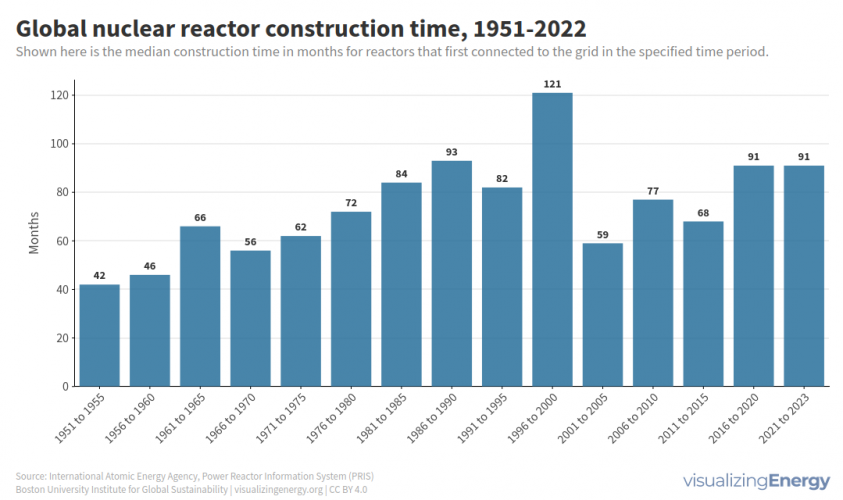
Construction of nuclear power plants takes a long time. Partly because of planning and approval, partly because they are complex beasts.So even in case that you are right
Admittedly from ten years ago, but my browsing power plant construction news over the years has not made me more optimistic about construction times:... Firstly, their inertia complicates the adaptation of the production to 2 General introduction the consumption. Secondly, the period of time between the wish of the construction of a nuclear power plant and its commissioning is often more than 10 years [29] which is long considering the urgency of the situation. The renewable energy production systems are quicker to install and should thus be used simultaneously to meet the challenges of the greenhouse gas reduction. ...
One of the key considerations for an organization seeking to construct and operate a nuclear facility is timely procurement of items which are critical for all nuclear systems. Well-planned activities towards construction and commissioning of a nuclear power plant (NPP) take typically up to 11-12 years. The average construction time of a unit is 7 years. The actual duration of a construction will depend on the complexity of the design and experience with a given technology.
[...]
However, around 75 percent of nuclear reactors under construction worldwide are facing delays [3]. Eight reactors have been under construction for more than 20 years. The construction time of the last 37 reactors started up in 9 countries since 2004 ranged from 3.8 to 36.3 years
I grew up on the Dutch coast, I regularly visit the old place and the wind park construction business there is showing no signs of slowing down. Twenty years or so ago I moved east some 100 km, to witness the closing down and partial demolishing of the local plant of TKF.it is now the time to prepare for a better solution.
Solar fuelAgain, this war is putting renewables front and centre which is one positive.
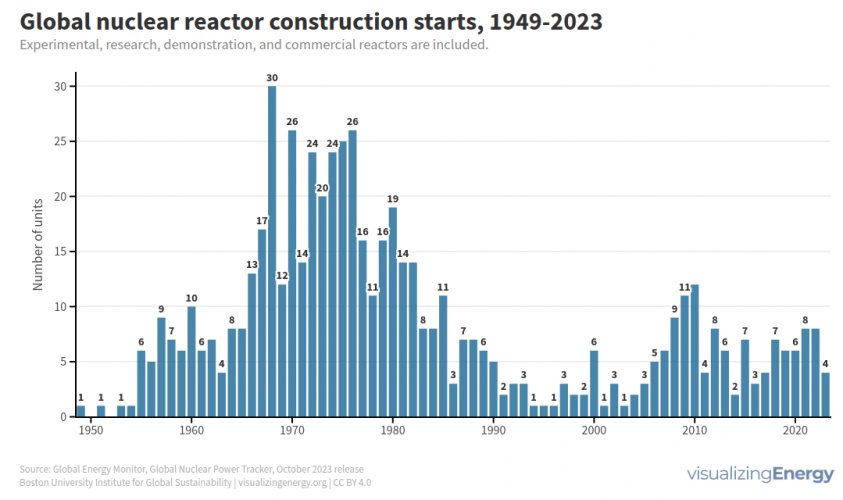
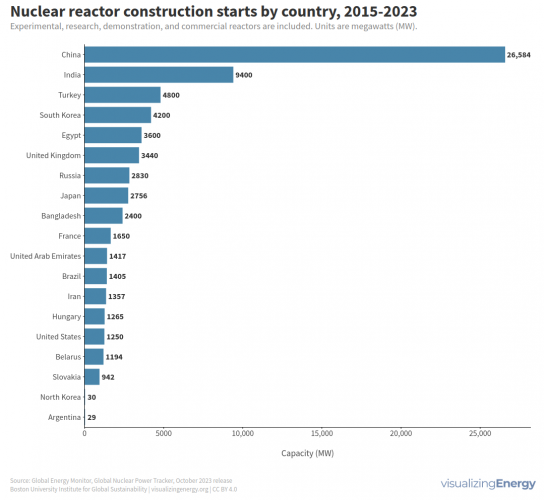
That's far more about politics than it is about sound engineering or economics. A big problem with nuclear power is that for the vast majority of people they've been indoctrinated to believe all things nuclear are evil and bad.2023 nuclear powerplant construction time data from Boston University.
It looks like a plateau has been reached.Global nuclear reactor construction starts and duration, 1949-2023
The construction of new nuclear power plants reflects changing electricity demand and technology competitiveness. Despite industry and government support, nuclear power faces challenges such as cost-competitiveness and safety concerns, leading to extended construction times. While some advocate...visualizingenergy.org