- Joined
- 11 February 2010
- Messages
- 1,719
- Reaction score
- 3,180

Tbh that makes way more sense as Stanflex, rather than old truck-mounted.This one appears to use R-77-1.

Impossible, it's a large footprint system. More so because it can't be dropped off like NASAMS, it's more or less MICA-VL/CAMM set. Imagine, idk, two fire units, 1-2 radar vehicles(1 if dedicated multifunctional, more likely 2 off-the-shelf ones, search&fire control), maybe a separate command unit. It isn't survivable anywhere where it can be engaged by drones.Probably a substitute for its' dwindling supplies of SA-11 Gadfly, SA-17 Grizzly and SA-27 Gollum SAM systems (Ukraine has been very busy destroying them mostly with drones since 2022).
which currently appears to be low on missiles and being butchered by Ukrainian loitering munitions...
A simple answer is that it allows the use of thousands of missiles that have already used their life under the wing, which are either not usable anymore, or would waste manufacturers' time, which can be spent making new ones. Pool is free, but result absolutely have the performance to hit any high-performance cruise missile.

Well, well, well....
Russia joints the FrankemSAM club....
There has been speculation for around a year now that Russia's reserves, and indeed production, of SAM's might not be as big as some people were assuming....recent reports of Pantsir systems in Crimea having no missiles (although the huge expansion of the Pantsir fleet is partly the cause of that...but why build more launchers if you cannot provide them with ammo...) to Strela 10 having new missiles being put into production for a very limited system, regular sightings of Buk without its full complement of missiles etc etc.
Putting R-77 to use would use a comparatively underutilised resource and provide some support to the very much under pressure Buk force, which currently appears to be low on missiles and being butchered by Ukrainian loitering munitions...
https://militarnyi.com/uk/news/v-rosiyi-pomityly-zrk-z-raketamy-r-77-1/
It's hard to call a weapon obsolete when it's a weapon in hi-lo pair with R-37M(which outranges any deployed western weapon). As a medium-range supplement, it's perfectly competitive and more (it doesn't live on updated 1980s vanilla seekers at least).I suppose the primary reason for R-77 being employed as SAM is simply that it's irrelevant in its AAM role, as Russian air combat happens at more extreme ranges (in large part to avoid long range SAM threats). It has also become obsolete in face of Meteor and Aim-120C/D.
AASMs can fly maybe a couple of dozen kilometers from a low altitude toss, minus manpad range. This would leave the truck in an absolutely unsurvivable position.R-77 has lock on after launch capability. Its employment as SAM (if far enough forward, which is very doubtful)could counter the very low level Hammer PGM bomb tossing by the Ukrainians IF there is an airborne radar (Su-3x, MiG-31?) detecting them. It's again highly doubtful whether the Russians have developed the cooperative engagement capability for that, though.
R-77 has lock on after launch capability. Its employment as SAM (if far enough forward, which is very doubtful)could counter the very low level Hammer PGM bomb tossing by the Ukrainians IF there is an airborne radar (Su-3x, MiG-31?) detecting them. It's again highly doubtful whether the Russians have developed the cooperative engagement capability for that, though.
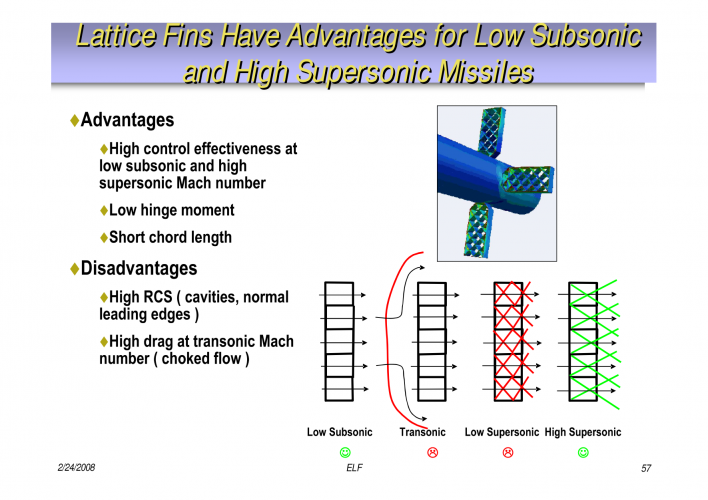
the grid fins used in the early versions of the R77 cause very high drag, and therefore these makeshift SAM systems will have terrible aerodynamic performance at low altitudes where air is signficantly denser then fighter patrol altitudes, and consequently a short range.
R-37M does not outrange AIM-174 and it's questionable whether it outranges Meteor or AIM-260.It's hard to call a weapon obsolete when it's a weapon in hi-lo pair with R-37M(which outranges any deployed western weapon). As a medium-range supplement, it's perfectly competitive and more (it doesn't live on updated 1980s vanilla seekers at least).
AIM-174A - point taken, I forgot about it; though it hardly seriously affects Russia and comes on a single American naval, effectively subsonic fighter.R-37M does not outrange AIM-174 and it's questionable whether it outranges Meteor or AIM-260.
I think that the actual answer, since the very dawn of flight, is engaging unexpectedly at shorter ranges(=stealth is the way). Long-range throwing, unless completely unexpected by the opponent(intel failure), is bound to be not overly effective against an aware opponent.Medium range appears to merely be a contact breaker, suitable to threaten a pursuer in order to shake it off. It takes a huge no escape zone to actually score kills against aware enemies who get timely warning (by ground radar, AEW or own sensors) of incoming MRAAMs.
AIM-174A - point taken,
AIM-260 - not operational, and honestly unlikely to be truly longer-ranged.
It's ultimately a medium-sized weapon. It will, on a philosophical level, define "normalcy", rather than long range weapons. Yes, this normalcy will be longer ranged than early LRAAMs(R-33s and AIM-54s), that's the way it is.That is a premature assessment to make.
It makes complete sense to me to configure such a simple and cost effective SAM system in time of war - giving mobility to a key targeted platform of any adversary, whilst utilising a missile already in one's inventory or in production. Of course one needs to be realistic and appreciate such an improvised SAM systems limitations, when compared to a tailored designed SAM systems. I wouldn't use such a system on a battlefield. But for defending rear echelons, yes.
All of Russia has around 900 active fighter aircraft. The US Navy has around 450 AIM-174 capable Super Hornets (airframes that are suitable to use AIM174 with modifications, not talking about the numbers of all F18s or currently AIM-174 fielding test squadron hornets). That “single naval, effectively subsonic fighter” is equivalent to half of the entire Russian fighter fleet. The F-18 Super Hornet is not a plane to be underestimated, either in quantity or quality.AIM-174A - point taken, I forgot about it; though it hardly seriously affects Russia and comes on a single American naval, effectively subsonic fighter.
Saying that it’s not operational and probably not longer ranged is a bit of a stretch. The whole reason it exists is to counter stuff like the PL-15, so it would be pretty strange if it didn’t at least match or exceed that in reach. Also, the US track record with things like the AIM-120 AMRAAM shows a steady trend of improving both range and guidance at the same time. The lack of public specs is just normal for newer systems, not evidence that it underperforms. Also it is way closer to mass serial production (not producing a few and then using them for photo ops, talking about big numbers) then the new variants of Russian long range missiles.AIM-260 - not operational, and honestly unlikely to be truly longer-ranged.
Calling the MBDA Meteor gimmicky is absurd considering that objectively it is currently one of the best beyond visual range air to air missile in the world. The ramjet isn’t there just to push the max range number higher on paper, it’s there to keep the missile energetic much later into the engagement. The advantage is that they keep enough energy to stay dangerous for longer, which limits the target’s options over time. That translates into a bigger no escape zone, which in practice matters more than raw range. A missile that still has speed and maneuverability in the endgame is simply harder to defeat, so it’s not really a gimmick but a different optimization.Meteor - no specific data, but Meteor is not considered terribly outstanding in dumb range even within its own class. It's ultimately a gimmicky MRAAM with very high Isp, not LRAAM.
Max range numbers of these classic rocket powered ballistic trajectory air to air missiles depend heavily on ideal launch conditions, which you rarely get in a real fight. Once you factor in maneuvering targets, electronic warfare, additional control surface drag caused by guidence algorithm inefficiencies and imperfect targeting data, the practical engagement ranges shrink a lot.In practice, VKS substantially outranges its western opposition for almost ~10 years, and the newly deployed picture is grimmer than the wide one (R-77M, R-97 are part of the picture as well).