US FF(X) Program

You are correct, but they also replaced the FFG-7s in role as Friedman points out.

Where does he point this out, exactly? I scanned through the relevant bits of US Destroyers, and he only mentions that both the FFG-7s and DD-963s were slated to retire around the same time.

SC-21 actually pitched a mix of ships, but the budget at the time prevented both from happening, along with some very unrealistic costing on DD-21. Around 2000, I wrote a draft paper proposing an FF-21 to complement DD-21, but with the crazy low price being claimed for the destroyer, it was hard to propose a frigate with a straight face. And working for the PEO at the time, challenging the budget projections for the DD-21 was not career enhancing for a young analyst.

In hindsight, the frigates would have been a better deal in many ways. One yard building DDGs (new or old design) at a low rate and another one or two building new FFGs would have been so much more flexible.
 
Where does he point this out, exactly? I scanned through the relevant bits of US Destroyers, and he only mentions that both the FFG-7s and DD-963s were slated to retire around the same time.
Page 448 specifically in relation to the conception of DD-21: "Plans called for building 32 ships to replace retiring Perry and Spruance-class ships."
Around 2000, I wrote a draft paper proposing an FF-21 to complement DD-21, but with the crazy low price being claimed for the destroyer, it was hard to propose a frigate with a straight face.
I am extremely interested in this. Do you still have it? Do you have anything more regarding similar projects?
The relevant costings to which you refer are also coincidentally on page 448 iirc
And working for the PEO at the time, challenging the budget projections for the DD-21 was not career enhancing for a young analyst.
Certainly wasn't aided by the contemporary DoN opinion that older vessels should be moved into escort duties while newer vessels took frontline roles.
In hindsight, the frigates would have been a better deal in many ways.
Now getting very off topic but I tend to agree. Particularly a VGAS or 5in ERGM equipped frigate, not dissimilar to the '98 Springstyle Frigate, would seemingly fulfill the USMC's NGFS requirements at lower cost and with greater versatility for the Navy at large than DDG-1000.
Oh well, hindsight is 20/20 after all
 
At the rate things are going, it may well be time to go back to the future:
sea-vulcan-25-02-jpg.807916

(h/t Rattlesnek)
 
Page 448 specifically in relation to the conception of DD-21: "Plans called for building 32 ships to replace retiring Perry and Spruance-class ships."

I am extremely interested in this. Do you still have it? Do you have anything more regarding similar projects?
The relevant costings to which you refer are also coincidentally on page 448 iirc

Ah, I see. Yeah, I think this is honestly not really accurate.

What really happened was that DD-21 was planned to directly replace the DD-963s, and the Navy simply abandoned the ocean escort/deep-water ASW role almost completely.

I don't have a copy of that paper and it would have been work product for my employer at the time anyway. (And they no longer exist.)

Certainly wasn't aided by the contemporary DoN opinion that older vessels should be moved into escort duties while newer vessels took frontline roles.

Right, so rather than having DD-21s replacing FFG-7s, the plan was for DD-963s to replace the FFGs. But of course the budget and especially manpower constraints around 2000 meant that retaining the older hulls for the low mix was not feasible.

Of course, what all this means in the 2020s is complicated. FFG(X) was not exactly an FFG-7 analog and was definitely positioned more as a mid-mix ship than a low-mix one like the old FFGs. You could definitely have made a case for a somewhat lower mix FFG, but FF(X) isn't it.
 
Greedo was responding to me.
I said FF(X) would have more capability than OHPs did when decommissioned
No, your exact words were "Sure, but in reality even without putting anything fancy on the aft platform it’s a replacement for the OHPs." Nothing about their state when they were decomm'd. The Peace Dividend just gave the Navy the justification for stripping out the Mk13 launcher instead of upgrading them with VLS like the Aussies did. Not that these ships had much tread left by the early oughts though.

But in their prime? The OHPs were a good ship, with good sensors and armaments appropriate to their role. The FF(X) is no such beast.
 
First of all FFG-7 did not have ASROC, it's sonar was incapable of utilizing the system. Secondly what gives you the impression FF(X) is an OHP successor?
You're right, for some reason I thought the MK13 carried ASROC as well as the Standard and Harpoon. Thanks for the correction. I was also responding to JPJ about the role of the FF(X) in relation to the OHP.
 
No, your exact words were "Sure, but in reality even without putting anything fancy on the aft platform it’s a replacement for the OHPs." Nothing about their state when they were decomm'd. The Peace Dividend just gave the Navy the justification for stripping out the Mk13 launcher instead of upgrading them with VLS like the Aussies did. Not that these ships had much tread left by the early oughts though.

But in their prime? The OHPs were a good ship, with good sensors and armaments appropriate to their role. The FF(X) is no such beast.
I don’t think the ‘peace dividend’ had much to do with it. I think the number of burkes planned had more to do with, than a ‘peace dividend’ because you don’t build a navy based on what is needed during peace time.

You keep saying what FF(X) is or isn’t when there hasn’t even been an actual initial design released beyond ‘based off of NSC’
 
Last edited:
This might be even more controversial than basing the FF(x) off of the NSC, but what about the heritage class? Not a ‘proven’ hull form, but it’s not a radical new or experimental design, but it has an active construction line.

Yes smaller so it would be harder to fit high end systems on it, but we could easily have 2 variants an ASW and ASuW variants.
ASW, remove the side RHIB mounts, place SVTT there, add a containerized towed array on the aft platform.
ASuW, remove the center RHIB, add ASMs, and add ASMs on the aft platform.

Possibly a third AAW variant build VLS for ESSM on the aft platform.

Three variants on the same hull, operating together.
This would be more of a corvette.

However the heritages are currently being built and current costs are under $660m
 
Of course, what all this means in the 2020s is complicated. FFG(X) was not exactly an FFG-7 analog and was definitely positioned more as a mid-mix ship than a low-mix one like the old FFGs. You could definitely have made a case for a somewhat lower mix FFG, but FF(X) isn't it.
The only major increase in capability of FFGX over the FFG7s was adding Aegis. Technically FFGX was even down some missiles compared to FFG7, 32 versus 40.
 
The only major increase in capability of FFGX over the FFG7s was adding Aegis. Technically FFGX was even down some missiles compared to FFG7, 32 versus 40.
I’d argue FFG(X) would like have a lot more than 40 missiles standard loadout.
Assuming 4 VLS are filled with ESSM you have more than 40 missiles in VLS. 45 if I’m not wrong, plus 16 NSM.
Even if you have big missiles in each cell, that’s 32 missiles, +16 NSM for a total of 48 missiles.
 
I don’t think the ‘peace dividend’ had much to do with it.

You keep saying what FF(X) is or isn’t when there hasn’t even been an actual initial design released beyond ‘based off of NSC’

That's not true.

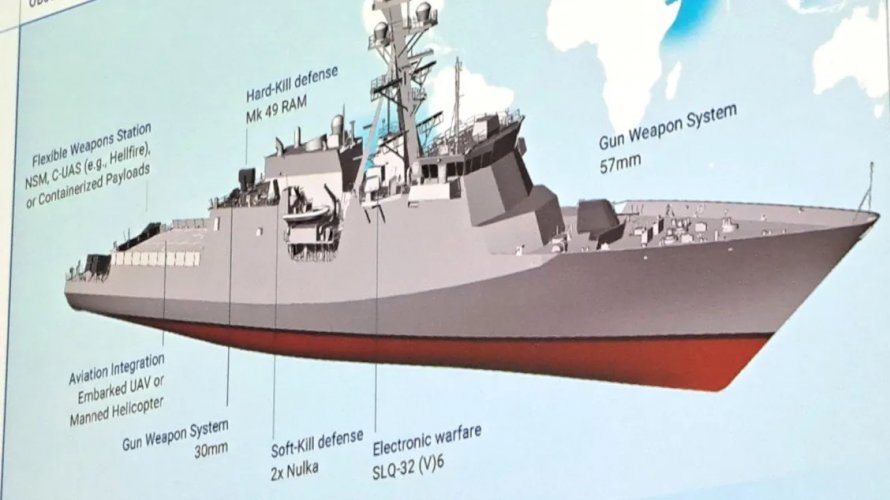
We have a very clear portrayal of the Flight I FF(X).

1775516819682.jpeg

 
That's not true.

We have a very clear portrayal of the Flight I FF(X).

View attachment 808221

lol it’s a concept, there is no actual design decided on, and definitely doesn’t touch on the FII design that hasn’t even begun to be discussed in any serious manner.

I literally know some one advising on the program as a liaison officer to Congress.
 
lol it’s a concept, there is no actual design decided on, and definitely doesn’t touch on the FII design that hasn’t even begun to be discussed in any serious manner.

I literally know some one advising on the program as a liaison officer to Congress.

It is really cool watching it get mired in the foot dragging.

At least when it finally crawls into the production stages it shouldn't get overly fat like FFG(X).
 
What really happened was that DD-21 was planned to directly replace the DD-963s, and the Navy simply abandoned the ocean escort/deep-water ASW role almost completely.
I don’t think Friedman was talking about DD-21 in the ocean escort role. I understood it to refer to the AAW capabilities DD-21 would bring to a CSG. I believe it is on an earlier page where the requirements for a system below Aegis were discussed
The only major increase in capability of FFGX over the FFG7s was adding Aegis. Technically FFGX was even down some missiles compared to FFG7, 32 versus 40.
This is so hugely inaccurate it beggars belief. For one the powerplant is significantly more advanced, allowing for the integration of DEWs. It also has greater C3 infrastructure to work as a UxV teaming node. I even believe the radar system is more sensitive than legacy PESA radar systems in a smaller package. The undersea warfare suite combining both a towed array and VDS is do more sensitive than legacy systems, before we account for the lower noise of FFG(X) itself. FFG-7s were also incredibly skint on space for growth, both in displacement and volume. Final nail in the coffin: they don’t even fill the same roles

Yeah, raw cell counts are indeed lower, but this is a poor argument when the US navy overall is trending towards lower cell counts anyway, utilising offboard systems (for example cells on LUSVs)
At least when it finally crawls into the production stages it shouldn't get overly fat like FFG(X).
It has lower SLA margins than FFG(X) and more changes to make if you want to reach anything resembling FFG(X) combat capability. Again, apples to oranges comparison
 
It is really cool watching it get mired in the foot dragging.

At least when it finally crawls into the production stages it shouldn't get overly fat like FFG(X).
Mired in foot dragging? The new program was announced like mid December.
How fast did you expect this to go?
 
The only major increase in capability of FFGX over the FFG7s was adding Aegis. Technically FFGX was even down some missiles compared to FFG7, 32 versus 40.

AEGIS/SPY-6 is a huge step up from the grand total of two channels of fire on the FFG-7.

Missile counts on the FFG-62 are 32 cells of VLS plus 16 NSM, so minimum of 48 missiles (plus more if any of those 32 are ESSM quadpacks).
 
ESSM is never probably going into FF(X). It's a great solution in most ways except cost. There is this romantic myth that ESSM are cheap missiles, but that is far from the truth. ESSM is not a huge savings over Standard SM-2. When ESSM came about it was an era where the USN was trying to get rid of any remnants of Tartar program and its successor, Standard SM-1. In hindsight, it really should have probably been adapted to new roles rather than abandoned.

I was excited about the ESSM Block 1 until I read about their inability to mass ripple-fire missiles like I was expecting it to work. Apparently the command link has some major limitations. FFG-7 with its SARH and limitations of the illuminators isn't much less capable within its limitations. ESSM wasn't really pitted against SM-1, but rather at Sea Sparrow users. Granted the ESSM has advantages that the Sea Sparrow will never have, but it was not as big of operational advantage as it sounded until they hit Block 2. Sea Sparrow was relatively cheap, so it wasn't a gold-plated solution. A navalized NASAMS in my opinion would be a better fit for an FF(X) when it comes to both cost and installation.

The Hellfire is probably what will ultimately protect FF(X) against aircraft. And they will get Sea RAM for anti-missile. Maybe they could also figure out Miniature Hit-to-Kill (MHTK) using a Multi-Mission Launcher (MML) derivative for USN anti-drone use. MML is a 3x5 tube launcher that fits on medium trucks, so not a huge system. Unit cost per MHTK is pretty affordable, nearly 1/3 the price of a Stinger, and would have gotten cheaper with orders. MHTK was designed with focus primarily on knocking down incoming artillery shells and rockets. Its cost made far more sense to use MHTK against drones than most other SAMs and was light enough it could have been adapted for use on aerial drones to take down enemy drones. Instead of replacing any CIWS they could offer it as an addon or replacement to existing Typhon/Mark 38 or Mini Typhon/Mark 49 mounts.
 
You keep saying what FF(X) is or isn’t when there hasn’t even been an actual initial design released beyond ‘based off of NSC’
I've made three posts concerning the FF(X), and all I said was that "The OHPs were a good ship, with good sensors and armaments appropriate to their role. The FF(X) is no such beast." Since as currently described, they are really just vaporware everyone is projecting/hoping will be something wonderful. History has shown that's not going to be the case.
 
Yeah, raw cell counts are indeed lower, but this is a poor argument when the US navy overall is trending towards lower cell counts anyway, utilising offboard systems (for example cells on LUSVs)
Do you really have faith that the USN will actually deploy USVs in substantial numbers (with filled magazines) in any reasonable time? We heard the same talk about UCAS and that was essentially ignored after 2015.
 
Do you really have faith that the USN will actually deploy USVs in substantial numbers (with filled magazines) in any reasonable time?
This is the basis of NAVSEA's future fleet architecture and this impacts the construction and design of current and future vessels. It is entirely possible that this fails due to political meddling (see the DDG-1000 debacle) but as it stands we need to contextualize decisions within the scope of today, not 1975
 
The Hellfire is probably what will ultimately protect FF(X) against aircraft.

Hellfire is not an anti-aircraft solution. It's CUAS and counter-small boats.

RAM Block 2 is the closest thing FF(X) will have to anti-aircraft capability. With IR all-the-way homing and HAS, it's no longer limited to just emitting missile threats, but it is really only suitable for slow aircraft or jets doing reckless things like trying to dumb bomb a ship at sea.
 
First of all FFG-7 did not have ASROC, it's sonar was incapable of utilizing the system. Secondly what gives you the impression FF(X) is an OHP successor?
One would have assumed that, because they're calling it a frigate, it would have similar roles and capabilities as previous US frigates like the OHP and Knox classes.
 
I was excited about the ESSM Block 1 until I read about their inability to mass ripple-fire missiles like I was expecting it to work.
Current production is the active radar homing Block 2, criticising Block 2 for a Block 1 limitation doesn't really work.

A navalized NASAMS in my opinion would be a better fit for an FF(X) when it comes to both cost and installation.
NASAMS 3 uses either AIM 120, AIM-9X, or AMRAAM ER, which is ESSM with the AIM-120 guidance section. So compared to ESSM Block 2, you either get shorter-ranged missiles, or a new ESSM variant with only an X band datalink, rather than the dual S and X band datalink of ESSM Block 2, plus the problem of finding somewhere to point the efflux from a non-VLS launcher. So you're adding a new missile to the logistics load for no gain and several new problems.

The Hellfire is probably what will ultimately protect FF(X) against aircraft.
ESSM: Mach 4 to 50km
CAMM: Mach 3 to 25km
RAM Blk 2: Mach 2.8 to 16km
Stinger: Mach 2.5 to 8km
Starstreak: Mach 3-4 to 7km
Martlet/LMM: Mach 1.5 to 8km
Hellfire: Mach 1.3 to 8km
AGR-20F Falco: Mach 2 to 11km (air-launched, it'll be less ship-launched)

Hellfire as a SAM is about the worst option possible. It's out-performed by MANPADS. If RAM is aboard, it's going to be chosen over Hellfire every time versus an aircraft threat. It's only versus low performance drones that Hellfire is worth considering as the cheaper option. (I do wonder if Hellfire is also ceiling limited in comparison to the various MANPADS and SAMs - yes, you can drop it off a drone at 50,000ft, but how high can it go going up, not down).

Maybe they could also figure out Miniature Hit-to-Kill (MHTK) using a Multi-Mission Launcher (MML) derivative for USN anti-drone use.
MML and MHTK are both several years dead, though MML sort of lives on as the re-engineered Enduring Shield launcher, which only uses AIM-9X in a 6x3 configuration.
 
They are all similar in performance due to more or less same range/performance requirements, hence, ~8 km for ground launch and ~11 km air launched. The difference is altitude while helicopter speed is rather neglegible. The size difference is in their kinematics, the Martlet/LMM for example is better than AGR-20F/APKWS in every respect on paper but practicaly negligible.

(I do wonder if Hellfire is also ceiling limited in comparison to the various MANPADS and SAMs - yes, you can drop it off a drone at 50,000ft, but how high can it go going up, not down).
nominal 1700 ft (altitude difference) up to 2300 ft for extreme
The important thing is terminal speed that will determine and limit the intercept to targets with a certain max. speed (roughly 66% or so).
It won't be able to intercept missiles or rockets if altitude comes into play.
 
One would have assumed that, because they're calling it a frigate, it would have similar roles and capabilities as previous US frigates like the OHP and Knox classes.
But the OHP and a Knox classes in and of themselves filled separate roles, particularly during the later years of their lives
but people are going to demand you use it to fill FFG-sized holes if you don't actually have any real FFGs.
I'll let that pearl of wisdom speak for itself, not sure why USN operations should, or indeed would, be dictated by "people" who think a slightly modified USCG cutter should be engaging in the same missions as an FFG-7

This isn't to say I love FF(X) but the idea that fleet architecture shouldn't evolve is beyond me
 
But the OHP and a Knox classes in and of themselves filled separate roles, particularly during the later years of their lives

I'll let that pearl of wisdom speak for itself, not sure why USN operations should, or indeed would, be dictated by "people" who think a slightly modified USCG cutter should be engaging in the same missions as an FFG-7

This isn't to say I love FF(X) but the idea that fleet architecture shouldn't evolve is beyond me
Did the roles suddenly go away? Clearly most other navies think they still exist.
 
Did the roles suddenly go away? Clearly most other navies think they still exist.
Yes and no, and in some ways they never existed. Recall the Ocean Escort fleet, and even the Spruances were built on the idea that the Soviet Navy would try to cut off Atlantic supply lines which we now realize was not a serious (or attainable) goal. Ultimately the USN has quite successfully filled the air warfare role in the post 1991 world via masses of Burkes but has failed to fill the ASW role due to the outcome of DDG-1000 and the currently abortive acquisition of FFG(X). Notably the composition of the PLAN forces different focuses on the USN than they had during the Cold War, and when we combine this with advances in technology I do not consider the OHP to be the best point of comparison for a modern USN frigate.
 
Notably the composition of the PLAN forces different focuses on the USN than they had during the Cold War, and when we combine this with advances in technology I do not consider the OHP to be the best point of comparison for a modern USN frigate.
What do you think the USN needs in a frigate?
 
What do you think the USN needs in a frigate?
The identified FFG(X) CONOPS first and foremost, a solid contribution to SAGs and an ASW vessel to protect CSGs. This should be accomplished via integration of UxVs and, with the rapidly expanding list of future technologies the Navy is rapidly fielding, it needs stored power and good generative capacity. In this way they can slot into the networked fleet the Navy is working towards and not get constrained by a restrictive design. Third order missions would be maintaining SLOCs and in some cases perhaps convoy escort, although I hesitate to describe it as such because of the historical connotations.
 
nominal 1700 ft (altitude difference) up to 2300 ft for extreme
The important thing is terminal speed that will determine and limit the intercept to targets with a certain max. speed (roughly 66% or so).
It won't be able to intercept missiles or rockets if altitude comes into play.
Holy crap, I expected it to be bad, but not anywhere near that bad.
 
not sure why USN operations should, or indeed would, be dictated by "people" who think a slightly modified USCG cutter should be engaging in the same missions as an FFG-7
It's called the chain of command, and is what happens when you let ex-infantry majors, finance execs, or ex-Gurkha lieutenants* for that matter run a navy without the professionals calling them on their decisions.

(Which is not to say I disagree with having a civilian at the head of the chain of command, but when you appoint people to these positions they either have to be competent in their sphere of responsibility, or willing to be educated by those who are competent).

* see John Nott and the 1981 Defence White Paper, though to be fair to the Admiralty they did call him on it, they just didn't manage to stop him.
 
Third order missions would be maintaining SLOCs and in some cases perhaps convoy escort, although I hesitate to describe it as such because of the historical connotations.

Yeah, I think convoy escort per se is probably a dead letter, but SLOC control is a good way to talk about it. Ships that can operate inside a denied SLOC (like Bab al-Mandab) and provide close protection to ships transiting the area, under cover of high-end air/missile defense ships handling the AShBM threat.

LCS actually showed some ability to do that during the prior Houthi attacks there, but a ship with more robust multi-domain capabilities would seem like a better solution.
 
Yeah, I think convoy escort per se is probably a dead letter, but SLOC control is a good way to talk about it. Ships that can operate inside a denied SLOC (like Bab al-Mandab) and provide close protection to ships transiting the area, under cover of high-end air/missile defense ships handling the AShBM threat.

LCS actually showed some ability to do that during the prior Houthi attacks there, but a ship with more robust multi-domain capabilities would seem like a better solution.
SO. . .

A pair of SeaHawks
16/32 cell VLS w. ESSM / ASROC
57mm or 76mm
RAM launcher
Several Mk 38 gun mounts
8 NSM cells

Propulsion ?
Speed ?
Displacement?
 
Yeah, I think convoy escort per se is probably a dead letter, but SLOC control is a good way to talk about it. Ships that can operate inside a denied SLOC (like Bab al-Mandab) and provide close protection to ships transiting the area, under cover of high-end air/missile defense ships handling the AShBM threat.

LCS actually showed some ability to do that during the prior Houthi attacks there, but a ship with more robust multi-domain capabilities would seem like a better solution.
MMSC should have been the choice from the get go. Should have been the choice for FF(X) but shitty politics and ignorance got in the way.
 
MMSC should have been the choice from the get go. Should have been the choice for FF(X) but shitty politics and ignorance got in the way.
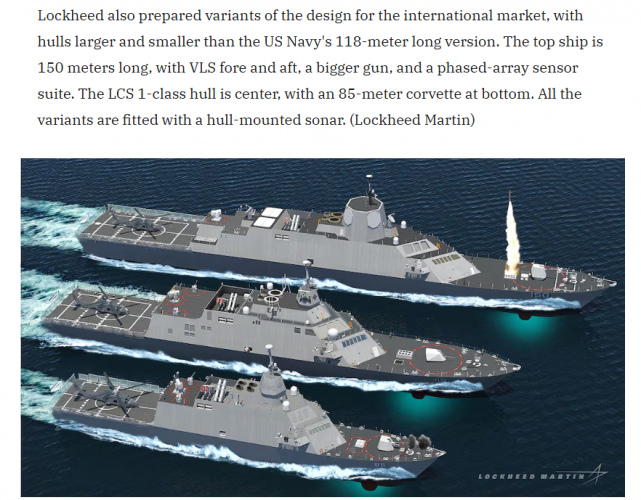
Does Lockmart's Multi-Mission Surface Combatant (MMSC) even come in a steel version?
 

Similar threads

Back
Top Bottom