Scott Kenny
ACCESS: USAP
- Joined
- 15 May 2023
- Messages
- 19,517
- Reaction score
- 27,965
Not really. I don't believe that Ukraine has any MCM USVs active right now.That would be Ukraine's cue to offer its' combat-proven USVs to the US.

Not really. I don't believe that Ukraine has any MCM USVs active right now.That would be Ukraine's cue to offer its' combat-proven USVs to the US.


Hundreds of millions of cameras have been installed above shops, in homes and on street corners across the world, many connected to the internet and poorly secured. Recent advances in artificial intelligence have enabled militaries and intelligence agencies to sift through vast amounts of surveillance footage and identify targets.
On Feb. 28, Israel vividly demonstrated the potential of such systems to be hacked and used against adversaries when Israel tracked down Iranian leader Ayatollah Ali Khamenei with the help of Tehran’s own street cameras - despite repeated warnings that Iran’s surveillance systems had been compromised, according to interviews and an Associated Press review of leaked data, public statements and news reports.

Iran has 'legal right' to control Strait of Hormuz, official tells state media, as Israel kills navy chief
Iran says it has 'legal right' to control Strait of Hormuz in response to US peace plan - state mediapublished at 14:27
14:27
Ghoncheh Habibiazad
Senior reporter, BBC Persian
While we wait to hear from the US president, Iran’s Islamic Revolutionary Guard Corps-affiliated Tasnim News Agency says Tehran has responded to the US’s reported 15-point peace plan and is now awaiting a response.
Citing an "informed official", Tasnim reports that Iran's conditions are:
- "Acts of aggression and assassination by the enemy must cease"
- "Objective conditions must be established to ensure that war will not recur"
- "Compensation and war reparations must be guaranteed and clearly determined"
- "An end to hostilities must be implemented on all fronts and for all resistance groups involved in the conflict across the region”, referring to Iran's allies and proxies in the region
The official is also reported to have told Tasnim that Iran’s exercise of sovereignty over the Strait of Hormuz is the country's "natural and legal right".


Iran has bombed U.S. bases across the Middle East in retaliation for the U.S.-Israeli war, forcing many American troops to relocate to hotels and office spaces throughout the region, according to military personnel and American officials.
So now much of the land-based military is, in essence, fighting the war while working remotely, with the exception of fighter pilots and crews operating and maintaining warplanes and conducting strikes.
Iran’s Islamic Revolutionary Guards Corps has urged people to report these new locations as it hunts for the dispersed troops. U.S. military officials say that threat is not stopping the Pentagon from carrying out the war against Iran, which is in its fourth week.
There were close to 40,000 U.S. troops in the region when the war started, and Central Command has dispersed thousands of them, some to as far away as Europe, American military officials said. But many have remained in the Middle East, although not on their original bases, military officials said.
“Yes, we have the ability to set up expedient operation centers, but you’re absolutely going to lose capability,” said Master Sgt. Wes J. Bryant, a retired Special Operations targeting specialist in the U.S. Air Force.
Many of the 13 military bases in the region used by American troops are all but uninhabitable, with the ones in Kuwait.
https://archive.ph/E8LkFIranian officials have even accused the U.S. military of using civilians as human shields by putting American troops in hotels.
“We are forced to identify and target the Americans,” the intelligence arm of the Islamic Revolutionary Guards Corps said in a message to people in the region, according to Tasnim News Agency. “Therefore, it is better not to shelter them in hotels and to stay away from their locations.”
New angle, seems like a (very) near miss.Claim of an F-18 shot down. Footage seem to show the F-18 was definitely hit.
View: https://x.com/noctu_mind/status/2036856818391982279
https://www.timesofisrael.com/liveb...invasion-convinced-iran-will-then-capitulate/An official from one of the countries mediating between the US and Iran tells The Times of Israel that US President Donald Trump appears to be leaning toward ordering a major US ground operation against Iran, with Washington convinced Tehran will buckle under such military pressure.


Successful Trophy intercepts.It occurs that things on the front with Lebanon are going as bad, if not worse, than with the front with Iran:
(Images at link)Iranian air strikes have forced American soldiers to evacuate several bases in the Middle East.
Troops are now working from nearby hotels and office spaces, which could endanger both themselves and civilians.
Iran has struck 104 American and regional bases, according to a rough analysis of geolocated strikes by Fabian Hinz, an open-source analyst.
American satellite firms have delayed the release of imagery by at least 14 days, making it hard to assess the damage.
But The New York Times reported that many of the 13 American bases across Kuwait, Bahrain, Qatar, Saudi Arabia and the United Arab Emirates had become close to uninhabitable as a result of persistent strikes.
Of all the bases, Ali Al Salem in Kuwait has suffered most hits – a total of 23 – according to Mr Hinz. Camp Arifjan and Camp Buehring follow, with 17 and six geolocated strikes respectively.
Satellite imagery from these three bases shows damage to hangars, communications infrastructure, satellite equipment, fuel stores, and – following a strike on Ali Al Salem on Wednesday – a large warehouse.
Iran has hit bases in the UAE 17 times, Bahrain 16 times, Iraq seven times, Qatar six times, Saudi Arabia six times and Jordan twice, according to Mr Hinz’s “conservative” assessment.
A study by the Centre for Strategic and International Studies estimated that attacks in the first days of the war caused at least $800m (£600m) of damage, with hits on an American Thaad (Terminal high altitude area defence) radar in Jordan and other infrastructure elsewhere in the region.
In Saudi Arabia, at the Prince Sultan Air Base, satellite imagery shows a hangar with a pitched roof reduced to rubble.
In Qatar, at Al Udeid Air Base – the largest American base in the Middle East – imagery shows the destruction of multiple antennae and satellite arrays.
In the UAE, at Al Dhafra Air Base, a large hole has been ploughed through a building apparently used to house troops, with a large blast radius of dust.
Iranian sources claimed the attack was carried out by a Khorramshahr-4 missile, the most advanced in Iran’s arsenal.
On Monday, Centcom (Central Command), which is responsible for American forces in the Middle East, put out an urgent call for contractors to deliver transportable hardened bunkers to Jordan.
The Islamic Revolutionary Guards Corps (IRGC) has targeted radar and air defence facilities in an attempt to “blind” Washington.
ran has struck four sites hosting components for the American-made Thaad system, which tracks and intercepts incoming missiles, Mr Hinz said.
An early-warning radar in Qatar and other radar installations across the region were also hit. That may have made it harder to intercept Iranian missiles.
Although the number of Iran’s launches has fallen sharply, more are penetrating US and Israeli air defences – which face acute shortages of interceptor missiles, according to a study published on Wednesday by the Royal United Services Institute think tank.
Kuwait is the country in the region that has been hit most, with 50 confirmed impacts, according to Mr Hinz.
That may reflect its proximity to Iran, but it also has less advanced air defence systems than countries such as the UAE and Qatar.
A drone strike on Port Shuaiba in Kuwait on March 1 killed six American soldiers.
The US has struck 10,000 regime targets in its air campaign, according to an update on Wednesday by Adml Brad Cooper, the commander of Centcom.
“We have damaged or destroyed over two-thirds of Iran’s missile, drone and naval production facilities and shipyards,” he said.
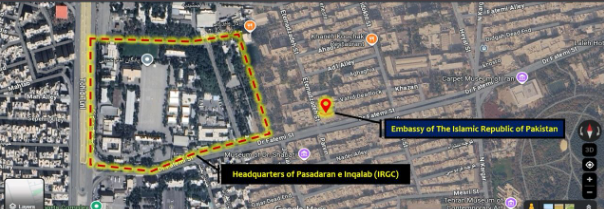
Please use words like "allegedly" or "reportedly" for news items of dubious origin. This specifically was debunked. The Pakistani embassy was not struck, but was in proximity to it.Israel bombed the Pakistani embassy and residence of the ambassador in Iran

On March 27 local time, the Islamic Revolutionary Guard Corps of Iran issued a statement saying that the Strait of Hormuz is currently closed, and any attempt to pass through the strait will be severely attacked. The statement also said that any vessels traveling to or from 'ports of allies and supporters of the US-Israel hostile forces,' regardless of their destination or route, are prohibited from passing. On the 26th, Iran's Tasnim News Agency quoted an Iranian military source as saying that if the United States wants to forcibly open the Strait of Hormuz through military action, Iran is prepared and will continue to blockade the strait. Iran has mobilized more than one million combat personnel, ready for ground combat with the United States.