Addendum.
This article nominally relates to the Type 31, which is in production, but the philosophy is relevant overall.
https://www.navylookout.com/the-dev...solution-for-the-royal-navys-type-31-frigate/
The Type 31 frigate has been designed from the outset to minimise crew numbers. This is part of the overall philosophy of driving down both upfront and through-life costs for the programme. Although based on a parent design, Type 31 differs very significantly and meets a completely new set of naval standards. The programme also presented an opportunity to take advantage of the latest technologies and implement them from the outset. For example, Type 31 makes the first use of the Unattended Machinery Space (UMS) notation in an RN Frigate.
One can expect this to be applied for the Type 83. Indeed, one proposal for the 83 upstream in this thread that looks like a baby Zumwalt is extremely focussed on this goal (excessively in my opinion, but fortunately the Type 91 makes that unnecessary).
A chunk of the article looks at crew stress and its mitigation, interfaces, remote monitoring etc., but let's look at design:
A good part of the cost and complexity of good warship design and construction is devoted to mitigating the effects of blast, shock, fires and floods and having resilient systems that will continue to function even if parts of the system are destroyed. Recoverability is the ability to promptly react to damage, restoring the ship so it can remain in action or counter follow-on attacks. This resilience can only really be achieved by features and fixed systems incorporated during the ship’s construction, rather than retrofitted once the vessel is in service.
The ship is fitted with centralised digital incident boards, fed from a camera network with motion detection, fire, flood and equipment monitoring sensors. This reduces the workload required for damage search and system fault diagnosis.
In legacy frigates, many repetitive tasks have to be carried out manually, often with poorly designed user interfaces. The TACTICOS CMS fitted to Type 31 automatically manages routine picture compilation and tracking functions allowing the operators to concentrate on unexpected or anomalous events. Additionally, some of the advanced capabilities of the NS110 primary radar, enable superior detection of small drones and low-RCS missiles at considerably increased ranges, using automation to alert the operator. This solution reduces fatigue during long watches and avoids unnecessary distractions for the picture compiler.
The number of marine engineer watchkeepers is reduced by the use of uncrewed machinery spaces.
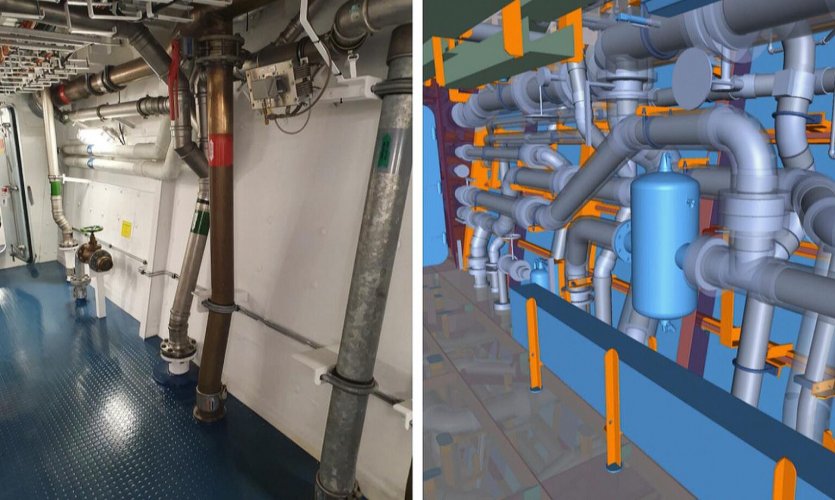
In terms of how it all looks, this is emblematic:
(Left) passageway in an Iver Huitfeldt class frigate. (right) The equivalent location in a Type 31 shown in the CAD model. This demonstrates how the Type 31’s higher survivability and recoverability standards adds complexity. The duplication of systems achieves this without an increase in the number of personnel needed to carry out battle damage repair.
View attachment 806175
It looks to me that in practice, this will mean that you don't have to fix as much at sea because there's resilience (redundancy) designed in, but you'll have a lot more to fix in port, but in turn, that can be outsourced to civilian contractors.
Is that a good idea really? I don't know, but I imagine that someone in Whitehall looking at a spreadsheet would think so.