Status
Not open for further replies.
Camm MR is already practically a different missile, at that point call it something else. Also making a new missile would still involve intergrating it into MK41
CAMM is a successful brand, why sacrifice that brand name recognition? cf Standard, or Sidewinder.

Integration of Aster* into Mk 41 would have advantages beyond the simple ability to put Aster into planned Mk 41 cells on RN warships. It opens up the possibility of moving away from Sylver without necessarily moving away from Aster, increasing flexibility in future designs. It might also open up future potential sales for Aster among navies already committed to Mk 41, which is good for MBDA, and also for the RN by potentially reducing future prices.

* Or Aquila, or anything else
 
But how many strike missiles will we want? Remember our total procurement of Tomahawk to date, for use by Astute, is probably just over 200, with somewhere around half probably used. IIRC we've only ordered 24+39 upgrades to Block V to date.

There was a request for information for VL ASW weapons a couple of years back, but that may be for the unmanned ASW sloops.
The sloops wont have VLS, theyre sensor platforms. And if we dont order more than 100 Stratus Lo after all this time then i dont know what were doing.
 
The sloops wont have VLS, theyre sensor platforms. And if we dont order more than 100 Stratus Lo after all this time then i dont know what were doing.
I think he was referring to the larger vessels, the BAE Trimaran LUSV
 
That sentence is part of the sole-source justification (as opposed to running a competition). It just means that no company other than MBDA is able to reasonably do the work outlined in the solicitation.
And just to clarify this for those who don't realise the contractual nuances, justifying sole source is pretty much a legal requirement to be able to use it. Without that justification you're risking a rival company seeking a judicial review of the contract.
Pre-Brexit it would have been a breach of EU law (EU Directive 2009/81/EC) to have a sole source procurement without adequate justification. I'm not certain if it's currently illegal under UK law, but if not it would almost certainly be a breach of government contracting regs.
 
  • Like
Reactions: zen
The sloops wont have VLS, theyre sensor platforms.
The sensor platforms are Phase 1/Atlantic Net, the Type 92 ASW sloop is under Phase 2/Bastion Atlantic.
 
It might also open up future potential sales for Aster among navies already committed to Mk 41, which is good for MBDA, and also for the RN by potentially reducing future prices.
This could be a real game changer for many European navies.

If I was the Netherlands, Finland, Denmark, Norway etc (or any Navy buying new frigates with ESSM but no SM-2/SM-6) I’d be lining up for Aster 30 + MK-41 as a high end complement to quad-packed ESSM or CAAM.

Even the Germans should be looking at it IMHO. They could certainly put their money to better use for the future F-127 frigates than throwing billions of $ at the US to buy into the full AEGIS / SPY-6 / SM-2/SM-6 ecosystem.
 
I would point out the existing Fremms especially between the French and Italian ones do not share alot in common, certainly not their propulsion systems for example, nor could they agree on a same radar setup.

Stuffing our next AAW ship into the T26 is a fools errand, apart from the highly expensive ASW elements which would drive up the cost of such a ship its also too small and too underpower as it stands to fill the AAW role needed in future.
If anything T31AAW makes more sense
 
Another fallback option....or maybe something more is licensed PAC-3MSE production and use across FADS and GBAD. Which had been proposed as an alternative naval SAM.
Benefits there of cross platform compatibility and deeper stocks of missiles.

It's time for MBDA and Aster to prove their worth for the future.
Which means convincing ministers.

But I do think some be on the money on other potential Aster users wanting Mk41 integration. Denmark's future Ivar Huitfeldt replacement being an example here. If UK can tie them into Type 31 variants (OMT has ideas of it's own but I suspect their still involved). Then it recapitalises North Sea states compatible fleets around a common logistics standards.
Pressure then on the Dutch and Germans. Especially if it swings Sweden.

The option of Japanese systems is intriguing. Especially after this recent, positive meeting between PMs.
 
Navy Lookout reports that funding chaos is likely to force a delay to the Type 83.

https://www.navylookout.com/defence-funding-chaos-puts-royal-navy-future-fleet-programmes-at-risk/
FADS is supposed to replace the six Type 45 destroyers between 2035-38, although this timeline has never been very credible.

Having plenty of hull life left in them and benefiting from a rolling programme of upgrades means retaining the Type 45s slightly longer into the early 2040s would not be a disaster.

The article doesn't mention the Type 91 and similar systems but presumably these could arrive sooner and Type 45s upgraded to deal with them? It would at least gain valuable experience in anticipation of the Type 83 entering service.

It also mentions that the schedule for the MRSS is slipping. Considering immediate needs, I think that MRSS is a more urgent requirement. Well, putting them first is less bad.
 
Letting the shipyards go idle would be terrible. It would be a lot better to give them a contract for SOMETHING to prevent the massive layoffs and loss of workers when HMGovernment finally deigns to give them another contract.

What the yards build is a separate discussion.

But letting them go idle needs to be avoided even at the cost of building things that are less than a necessity. Case in point, the USS Jimmy Carter, built from the keel up as a special operations boat instead of converting a ship like had been done before with USS Parche.

If Type 83 can be delayed a little because the Type 45s are still going strong, then that means MRSS or more Type26/31s need to be built.
 
So because of personnel, retention and recruitment issues, lean crewed vessels might solve this conundrum.
The use of greater automation and AI or networking could help.

But the interceptor missile cost and magazine depth is likely playing on the Admirals minds.
Plus there is a whole supply chain to reevaluate in the light of certain political developments.
 
So because of personnel, retention and recruitment issues, lean crewed vessels might solve this conundrum.
The use of greater automation and AI or networking could help.
That's certainly a major design requirement in the upcoming generation of vessels.
 
If Type 83 can be delayed a little because the Type 45s are still going strong, then that means MRSS or more Type26/31s need to be built.

As Mies van der Rohe didn't say, more is more. I don't think any extra ships would be a waste - the only problem would be crewing them (see above).

So far only 'up to six' MRSSs are planned and according to the article, and BAE Systems has 13 Type 26 frigates on its order book, with few other alternative suppliers for the construction and systems integration of highly complex surface combatants. There's been annoyance in some quarters when it was announced that Norway would be buying Type 26s and that would mean the RN losing a couple of production slots. Type 26 production may well have to be extended anyway.

Modern naval operations are mutinational and the UK has strong defence ties (industrially and politically) with Norway and Sweden and it has been noted that the Norwegian Type 26(s) won't be a net loss of force - but it won't be a net gain either unless the build number is increased - which it looks like it should be:

https://ukdefencejournal.org.uk/experts-warn-atlantic-bastion-needs-more-ships-to-track-subs/
I'd really like to know more about progress on the unmanned vessels that are a part of the FADS apart from the Type 83. This dispersal of capabilities also means dispersal of costs across time - fingers crossed.

There's this on the Types 92 and 93 for Atlantic Bastion:

https://ukdefencejournal.org.uk/uk-signals-progress-on-drone-sub-hunting-fleet-for-atlantic/
There appears to be no fundamental reason why a Type 91 can't operate with an upgraded Type 45, so if the 83s are delayed, these needn't be.

https://www.navylookout.com/bae-systems-large-uncrewed-warship-proposal/
Sorry to go a little off the topic of the Type 83, but the RN's plans for future ships are highly integrated and interdependent.
 
Last edited:
This just in:

https://www.telegraph.co.uk/business/2026/03/18/australia-in-talks-with-uk-over-robot-warships/
Paywalled, but if you hit reload and then stop quickly enough...

Essentially, as part of AUKUS (or AUK...), Australia could collaborate with the UK on its 90-series vessels, as it's own vision involves a hybrid crewed/uncrewed navy and it has emerged as a leader in unmanned systems.

Britain and Australia have held talks about developing robot warships as part of plans for a “hybrid” navy of crewed and uncrewed vessels.

Pat Conroy, the Australian defence industry minister, said Canberra was open to potential joint purchases of futuristic “missile barges” following discussions with UK officials.

“Pillar two” of the Aukus deal, which commits Australia, the UK and the US to unprecedented levels of military technology sharing, includes provisions for so-called advanced capabilities such as drones.

Asked if he thought Britain and Australia could collaborate on uncrewed warships, he replied: “We’ve got a build-plan for 20 crewed combatants and then we’ve identified six large, optionally crewed surface vessels, or missile barges.
 
That's certainly a major design requirement in the upcoming generation of vessels.
Addendum.

This article nominally relates to the Type 31, which is in production, but the philosophy is relevant overall.

https://www.navylookout.com/the-dev...solution-for-the-royal-navys-type-31-frigate/
The Type 31 frigate has been designed from the outset to minimise crew numbers. This is part of the overall philosophy of driving down both upfront and through-life costs for the programme. Although based on a parent design, Type 31 differs very significantly and meets a completely new set of naval standards. The programme also presented an opportunity to take advantage of the latest technologies and implement them from the outset. For example, Type 31 makes the first use of the Unattended Machinery Space (UMS) notation in an RN Frigate.

One can expect this to be applied for the Type 83. Indeed, one proposal for the 83 upstream in this thread that looks like a baby Zumwalt is extremely focussed on this goal (excessively in my opinion, but fortunately the Type 91 makes that unnecessary).

A chunk of the article looks at crew stress and its mitigation, interfaces, remote monitoring etc., but let's look at design:

A good part of the cost and complexity of good warship design and construction is devoted to mitigating the effects of blast, shock, fires and floods and having resilient systems that will continue to function even if parts of the system are destroyed. Recoverability is the ability to promptly react to damage, restoring the ship so it can remain in action or counter follow-on attacks. This resilience can only really be achieved by features and fixed systems incorporated during the ship’s construction, rather than retrofitted once the vessel is in service.

The ship is fitted with centralised digital incident boards, fed from a camera network with motion detection, fire, flood and equipment monitoring sensors. This reduces the workload required for damage search and system fault diagnosis.

In legacy frigates, many repetitive tasks have to be carried out manually, often with poorly designed user interfaces. The TACTICOS CMS fitted to Type 31 automatically manages routine picture compilation and tracking functions allowing the operators to concentrate on unexpected or anomalous events. Additionally, some of the advanced capabilities of the NS110 primary radar, enable superior detection of small drones and low-RCS missiles at considerably increased ranges, using automation to alert the operator. This solution reduces fatigue during long watches and avoids unnecessary distractions for the picture compiler.

The number of marine engineer watchkeepers is reduced by the use of uncrewed machinery spaces.


In terms of how it all looks, this is emblematic:

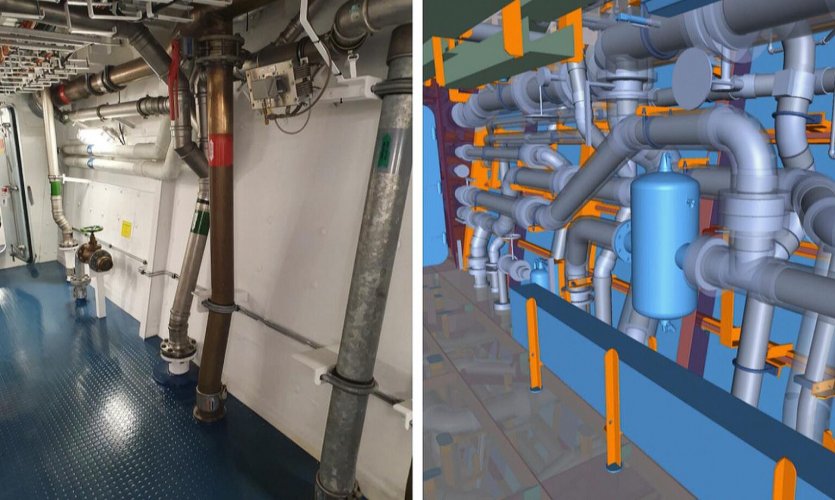
(Left) passageway in an Iver Huitfeldt class frigate. (right) The equivalent location in a Type 31 shown in the CAD model. This demonstrates how the Type 31’s higher survivability and recoverability standards adds complexity. The duplication of systems achieves this without an increase in the number of personnel needed to carry out battle damage repair.

Type-31-internal-equipment-fit-1536x920.jpg

It looks to me that in practice, this will mean that you don't have to fix as much at sea because there's resilience (redundancy) designed in, but you'll have a lot more to fix in port, but in turn, that can be outsourced to civilian contractors.

Is that a good idea really? I don't know, but I imagine that someone in Whitehall looking at a spreadsheet would think so.

 
Last edited:
Addendum.

This article nominally relates to the Type 31, which is in production, but the philosophy is relevant overall.

https://www.navylookout.com/the-dev...solution-for-the-royal-navys-type-31-frigate/
The Type 31 frigate has been designed from the outset to minimise crew numbers. This is part of the overall philosophy of driving down both upfront and through-life costs for the programme. Although based on a parent design, Type 31 differs very significantly and meets a completely new set of naval standards. The programme also presented an opportunity to take advantage of the latest technologies and implement them from the outset. For example, Type 31 makes the first use of the Unattended Machinery Space (UMS) notation in an RN Frigate.

One can expect this to be applied for the Type 83. Indeed, one proposal for the 83 upstream in this thread that looks like a baby Zumwalt is extremely focussed on this goal (excessively in my opinion, but fortunately the Type 91 makes that unnecessary).

A chunk of the article looks at crew stress and its mitigation, interfaces, remote monitoring etc., but let's look at design:

A good part of the cost and complexity of good warship design and construction is devoted to mitigating the effects of blast, shock, fires and floods and having resilient systems that will continue to function even if parts of the system are destroyed. Recoverability is the ability to promptly react to damage, restoring the ship so it can remain in action or counter follow-on attacks. This resilience can only really be achieved by features and fixed systems incorporated during the ship’s construction, rather than retrofitted once the vessel is in service.

The ship is fitted with centralised digital incident boards, fed from a camera network with motion detection, fire, flood and equipment monitoring sensors. This reduces the workload required for damage search and system fault diagnosis.

In legacy frigates, many repetitive tasks have to be carried out manually, often with poorly designed user interfaces. The TACTICOS CMS fitted to Type 31 automatically manages routine picture compilation and tracking functions allowing the operators to concentrate on unexpected or anomalous events. Additionally, some of the advanced capabilities of the NS110 primary radar, enable superior detection of small drones and low-RCS missiles at considerably increased ranges, using automation to alert the operator. This solution reduces fatigue during long watches and avoids unnecessary distractions for the picture compiler.

The number of marine engineer watchkeepers is reduced by the use of uncrewed machinery spaces.


In terms of how it all looks, this is emblematic:

(Left) passageway in an Iver Huitfeldt class frigate. (right) The equivalent location in a Type 31 shown in the CAD model. This demonstrates how the Type 31’s higher survivability and recoverability standards adds complexity. The duplication of systems achieves this without an increase in the number of personnel needed to carry out battle damage repair.

View attachment 806175

It looks to me that in practice, this will mean that you don't have to fix as much at sea because there's resilience (redundancy) designed in, but you'll have a lot more to fix in port, but in turn, that can be outsourced to civilian contractors.

Is that a good idea really? I don't know, but I imagine that someone in Whitehall looking at a spreadsheet would think so.

What puzzles me is the Japanese Mogami class kitted out to a much higher standard e.g. 5" main gun, AShMs, 16 VLS cells, LWTs, VDS, mine laying equip. etc is said to crewed by 90 whereas talk of lean manning of 100 plus for Type 31 which is only a minimal reduction from the Iver Huitfeldt class, a fully fitted out SM-2 frigate, with a crew of 117 - 121 plus its air detachmemt compared to the minimaly fitted out Type 31 with what appears to be hyped up claims of lean manning, though true if compared to the old Type 23 era frigates whoose design dates back ~50 years.

The images you showed of the passageway at first glance show more complication/expense for little reduction if any in manning, the final manning figure of the limited kitted out Type 31 is unkown as yet, will be of interest when revealed after trials.
 
Personally I appreciate easy to access pipework and dread so called space efficient or high density designs that tend to put things in need of repair in places the human body doesn't like to go.
 
Personally I appreciate easy to access pipework and dread so called space efficient or high density designs that tend to put things in need of repair in places the human body doesn't like to go.
That's why we have Human Factors and specifically Human Engineering.
 
  • Haha
Reactions: zen
Personally I appreciate easy to access pipework and dread so called space efficient or high density designs that tend to put things in need of repair in places the human body doesn't like to go.
A problem with the B-58 Hustler and the RN's Vanguards, I've heard.
 
That's why we have Human Factors and specifically Human Engineering.
My joints disagree with the computer model in manners most vehement.
Unlike the designers model, humans be not octopuses with night vision eyes on the ends of their superhumanly strong tentacles.
 
Anyway, current indications be FADS Type 83 or 86 or whatever number they want to ascribe it, is likely to get pushed right to defer spending.
Arguably the Australians interest in autonomous or semi-manned vessels implies a shift of focus onto Type 91.
Which may line up with Norwegian and Dutch thinking.
But that is only going to work if we fund networking across vessels.
 
My joints disagree with the computer model in manners most vehement.
Unlike the designers model, humans be not octopuses with night vision eyes on the ends of their superhumanly strong tentacles.
The system on the left is less survivable and less maintainable, so would not be acceptable. The 'Type 31 is just a modified IVAR HUITFELD' situation is comparable to the 'CONSTELLATION is just a modified FREMM' one in a number of respects.

The acceptance process for the modelled design involves compartment walkthroughs with the acceptance authority and often the operators and maintainers. I have actually run such meetings (for a different platform), and anything which is only maintainable by an octopus with night vision will not be approved without exceptional justification.
 
The system on the left is less survivable and less maintainable, so would not be acceptable. The 'Type 31 is just a modified IVAR HUITFELD' situation is comparable to the 'CONSTELLATION is just a modified FREMM' one in a number of respects.

The acceptance process for the modelled design involves compartment walkthroughs with the acceptance authority and often the operators and maintainers. I have actually run such meetings (for a different platform), and anything which is only maintainable by an octopus with night vision will not be approved without exceptional justification.
And there be literally generations of maintainers and practical experience that has led up to this. May their ghosts rest easy.

But sadly some people keep wanting to skip this process.
 
My joints disagree with the computer model in manners most vehement.
Unlike the designers model, humans be not octopuses with night vision eyes on the ends of their superhumanly strong tentacles.
I'm a systems engineer and had the good fortune to see a really good HF/HE team in action. They start with tables to see if the design complies with the spec. Ironically, this is the best transverse engineering I have participated in, and there is barely an engineer in sight. HF are predominantly PhD and Masters Psychologists, working with designers, techos, technical sailors and other operators, and critically maintainers and trades from navy, maintenance yards and building yards.

If there is a clash, they escalate to digital manikins in the model. At this point, queries are made as to how important access is, i.e. is it safety critical, accessed at sea, only along-side or only during a maintenance availability, maybe it has never been accessed and nobody even knows why it is there.

The next stage is a physical mock-up and real squishy people of various shapes and sizes see if they can access it, it is surprising how much more flexible a human body is than a digital manikin.

After that, it is determined if it can be mitigated, i.e. a tool designed to access it, or a different widget fitted that doesn't need to be accessed, failing that, redesign to ensure access.
 
The system on the left is less survivable and less maintainable, so would not be acceptable. The 'Type 31 is just a modified IVAR HUITFELD' situation is comparable to the 'CONSTELLATION is just a modified FREMM' one in a number of respects.

The acceptance process for the modelled design involves compartment walkthroughs with the acceptance authority and often the operators and maintainers. I have actually run such meetings (for a different platform), and anything which is only maintainable by an octopus with night vision will not be approved without exceptional justification.
Agreed.

The USN and RN both have painful experiences in ships getting hit and crew killed, and I can't help but notice Norway has selected the full-blown Type 26 to replace the F310s, even Denmark is looking at the Type 31 to replace the design that the Type 31 evolved from.

Having worked on a number of different platforms and walked through blocks under construction of different classes, there are very real differences under the skin between a warship designed to survive and one designed to be cheap and look good.
 
I got funny feeling Type 83 will be cancelled and T4x (Type 26 X no Stealth - AAW version 64-96 cells) with T91 use as arsenal ship escort with Type 26 + Type 4x (Type 91 act support ships Missiles barge 96-128 cell for T4x and T26)

yet I would prefer see:
the Type 83 as AA + ASW Destoryer (96-128 cell) with Type 91 support (12x will ideal will be 4x T83 each Carrier - (4x QoE and 4x PoW) and 4x will back up at defend uk or other mission or rotate, Stand by or repair/upgrade the fleet, yet i think will be ok if they reduce to 8x if keep type 45 upgrade (6x) or T4X (8x) - preferred 12x T83 as full strenght as the cold war)

Reason: free Type 26 to focus north Altantic defence with Type 91 (and Type 92, type 93) Support Type 26 to defence or attack. only issues is radar and weapon AAW level might not that best level as Type 45, (maybe use other nation AAW destoryer to protect Type 26)

so also i think important keep Type 45 with an upgrade again with CAMM-MR DP and Aster-30 Block 2 SP, CAMM-ER QP (or get build T4x to replace T45 with less Crew as AI and automech, new technology so can transfer crew to other ship) and plus keep 12x T83 for Carrier protection fleet)

so pair Type 45/T4x more focus to protect Type 26 north Altantic mission.

or delay Type 83 and cut to 6x (replace Type 45) < which i don't want see this 8x is better option.

Edit: to better and clear English and explain (Sorry)
 
Last edited:
I got funny feeling Type 83 will be cancelled and T4x (Type 26 X no Stealth - AAW version) with T91 use as arsenal ship escort with Type 26 + Type 4x + Type 91 (act support ships Missiles barge 96-128 cell for T4x and T26)

yet would prefer Type 83 as AA + ASW Destoryer with Type 91 support (12x will idea 4x each Carrier - 2 of them and 4x will back up at defend uk or other mission or rotate, or can reduce to 8x)

Reason: free Type 26 to focus north Altantic defence with Type 91 (and Type 92, type 93) Support Type 26 to defence or attack. only issues is radar so also i think important keep Type 45 with an upgrade again with CAMM-MR DP and Aster-30 Block 2 SP, CAMM-ER QP (or get build T4x to replace T45 and maybe need T83 reduce to 8x) to protect Type 26 north Altantic mission.

or delay Type 83 and cut to 6x (replace Type 45) which really need 8-12x (Best option is full 12x to back cold war level)
I don't think it'll be cancelled, I think they'll just push it back so that construction begins in the late 2030s, rather than having the ships enter service in the late 2030s as currently planned.

The Type 45 then gets LIFEX for an extra decade of service.

It's already going to essentially be a modified Type 26, with a size increase and a chunky radar. I doubt it'll carry a sonar setup, though.
 
Just to expand, the final Type 26 frigates are then slowed to prevent a gap in shipbuilding, whilst Babcock get either more frigates, Swedish frigates, or something to replace the B1 Rivers.

Who knows with MRSS? Ideally, there are two large amphibs built in Northern Ireland, then four smaller vessels built by whoever needs the work.

Meanwhile, Kongsberg or Ulstein build new MCMV and motherships. Barrow builds the 12 new SSNs.
 
Just to expand, the final Type 26 frigates are then slowed to prevent a gap in shipbuilding, whilst Babcock get either more frigates, Swedish frigates, or something to replace the B1 Rivers.

Who knows with MRSS? Ideally, there are two large amphibs built in Northern Ireland, then four smaller vessels built by whoever needs the work.

Meanwhile, Kongsberg or Ulstein build new MCMV and motherships. Barrow builds the 12 new SSNs.
Even under the current 13-ship timeline at a 12-month cycle the last T26 will come out of build between 2038 and 2040. That's the earliest T83 could be built and with a new, larger ship class there might be a year or two's delay to get the first in class in service in '43-44. That's plenty late enough for T45's upgrades to serve out their lives.
Agree with the 2+4 MRSS plan and MCMV.
 
What universe is Starmer living in?
It's the same story they've all been reporting over the past week - essentially, some bright spark over at the Times realised they could pretty much write whatever they wanted, attribute it to a 'anonymous military official', and then publish it.

Hypothesising over budget cuts is just another symptom of the intrinsic, self-defeating boredom that exists in most British amateur defence commentary. Maybe FADS will be delayed, maybe it won't. But don't get baited by right-wing news media.

Additionally, delaying FADS to enter service in the 2040s, rather than the absurd 2035 schedule, would probably be a good idea. The Type 45s have three decades of hull life, ignoring the multiple years they've spent in port, and a LIFEX, whilst costly, could give another decade again.
 
Normally the hyperbole is to exaggerate the cuts, so when the real plan hits it doesn’t seem so bad.
I agree, but I think the response to this articles goes well beyond what is warranted.

On a similar note, Gabriele Molinelli was claiming on Twitter the other days that the UK ought to drop out of GCAP pre-emptively.

View: https://x.com/Gabriel64869839/status/2035847715662233992

I think a similar thing is happening across the board.
 
https://www.navylookout.com/first-sea-lord-expands-on-hybrid-navy-vision-in-landmark-fisher-lecture/

The RN is also pursuing a LUSV demonstrator as part of the Future Air Dominance System (FADS) programme. The project will trial a vessel of more than 24 metres, operated in consort with a crewed RN platform, with a contract expected by September 2026 and operational trials planned for 2027. Phase 1 will demonstrate autonomous operations and regulatory compliance; Phase 2 will integrate additional capabilities into the vessel.

First trials of the unmanned components of the FADS are scheduled for 2027, then. Much earlier than I expected.

Some questions I can think of now are:

- Which ships will these be trialled alongside? There'll only be at very best a couple of T26, T31 and T23 each hanging around at that point, and the two new classes will be undergoing their own trials. T45 would make the most sense, IMO.

Ideally, of course, the RN gets this concept working smoothly with T45, before bringing it onto T83.

Phase 2 sounds like it'll be the start of integrating actual combat systems. Perhaps radars, or, if the rumours are true and T83 isn't expected to carry a sonar, they'll trial a TAS again.

I think weapons systems will wait a bit longer.
 
Status
Not open for further replies.

Similar threads

Back
Top Bottom