Mark 1 from Estonia:


The Estonian indigenous missile specifically designed to destroy drones is the Mark 1, developed by the Estonian startup Frankenburg Technologies. It is designed as a cost-effective solution to neutralize low-flying, long-range drones such as the Shahed-131 and Shahed-136.
Medium +2

Key Features of the Mark 1 Missile:
  • Dimensions: It is very compact, roughly 60 to 65 cm (roughly 2 feet) in length.
  • Guidance & Operation: The missile uses AI for autonomous terminal guidance and operates on a "fire and forget" principle. It is resistant to electronic warfare.
  • Range & Performance: It can reach altitudes of up to 2 kilometers (approx. 1.25 miles).
  • Cost: The projected cost is around $50,000–$70,000 per unit, which is significantly cheaper than conventional air defense missiles like the Patriot, making it an "affordable mass" solution.
  • Testing & Production: The missile is set to be tested in Ukraine in 2026. Production facilities are being established in two NATO countries, with plans to produce hundreds of missiles per day.


Frankenburg Technologies' team includes engineers who previously worked on the European IRIS-T and Spear III missile programs.

Additionally, in January 2026, British engineering firm Babcock partnered with Frankenburg Technologies to develop a naval launch system for this, described as a "micro-missile".


View: https://www.youtube.com/watch?v=yM-xwrjUGQs
 
https://www.atlanticcouncil.org/dis...ukraine-make-europe-stronger-and-more-secure/
https://seenews.com/news/romania-to-host-facility-for-joint-drone-production-with-ukraine-1291354
"The joint project is set to receive up to 200 million euro ($229.3 million) in funding through the European Union's Security Action for Europe (SAFE) programme, according to a joint statement signed by the two presidents on Thursday during Zelenskyy's visit in Romania.

"The Ukrainian Party will enable, in accordance with all applicable export control laws and regulations, the sharing of relevant technologies, mutually protected intellectual property and data necessary for the establishment of defence production facilities for defence systems and capabilities in Romania for the benefit of the security of Ukraine, Romania, the Black Sea region and the European continent," the joint statement reads. Romania, for its part, will support and promote the establishment of Ukrainian defence and security companies on its territory, including through joint ventures, partnerships, co-production arrangements and other investment formats between Ukrainian and Romanian entities."
 
Belgium testing APKWS equivalent...
SA laser isn't ideal for air-to-air work. If you have time to engage drones individually (~30sec flight time at 10km) and this guidance can time-share a laser, you can engage the drones more quickly with SAL than with an IIR system unable to claim targets for each missile.
 
SA laser isn't ideal for air-to-air work. If you have time to engage drones individually (~30sec flight time at 10km) and this guidance can time-share a laser, you can engage the drones more quickly with SAL than with an IIR system unable to claim targets for each missile.

You could use the SA laser to designate each target for the missile's IIR seeker to lock onto.
 
This is an interesting development.

the Ukrainian's have been swatting Orlan, Zala, Supercam, Merlin VR etc down at quite a rate with the FPV interceptors...and I suspect the faster interceptors, like Sting, have made the situation for Russian ISR drones even worse. The cost alone of lost ISR drones must be starggering.

Using Molniya makes sense as its cheaper and easier to produce...but the optics are where the real cost is....Molniya typically flies lower. If they rely on cheaper optics to keep costs down its going to result in less ISR value than the higher lying likes of Orlan. It's ability to stay in the air for long is also dramatically less...

View: https://x.com/dim0kq/status/2033694060918325371
 
Looks like the best way to kill drones may be to drill the operators through the face from space.

Pentagon’s Megawatt Laser Demo To Highlight Recent Tech Breakthroughs​

https://aviationweek.com/defense/mi...aser-demo-highlight-recent-tech-breakthroughs
nLight megawatt demonstration scheduled for this year

Demonstrate a 1-megawatt-class laser made by nLight, which is capable of shooting down ballistic and hypersonic missiles.
https://www.nlight.net/directed-energy
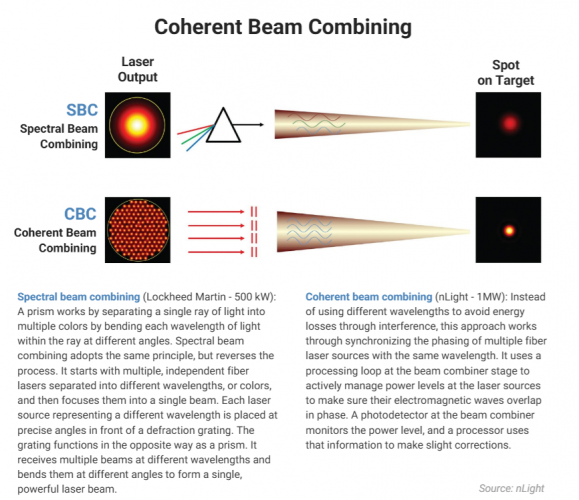
Under the High Energy Laser Scaling Initiative (HELSI), nLIGHT is advancing its coherent beam combined (CBC) architecture to deliver a megawatt-class laser over the next two years.

In addition to scaling to 1 MW this laser will develop advanced adaptive optics for atmospheric correction.

Looking at the size of the spot on target (half radius, quarter area), the nLight 1MW laser could be 8x more effective than the 500kW LM laser.
1773756475538.png
 
Last edited:
SA laser isn't ideal for air-to-air work. If you have time to engage drones individually (~30sec flight time at 10km) and this guidance can time-share a laser, you can engage the drones more quickly with SAL than with an IIR system unable to claim targets for each missile.
Wonder what’s stopping countries from modifying MALE drones for air to air roles using laser guided rockets. They have good loitering time and have enough speed to deal with the average Shaheed types. Cost per sortie is also a lot lower than manned jets.
 
Wonder what’s stopping countries from modifying MALE drones for air to air roles using laser guided rockets. They have good loitering time and have enough speed to deal with the average Shaheed types. Cost per sortie is also a lot lower than manned jets.
Slant range from a MALE drone at altitude to a Shahed on the deck. A 10km range APKWS on a drone at 8km altitude can only hit a target 6km distant from the drone.
 
This is an interesting development.

and I suspect the faster interceptors, like Sting, have made the situation for Russian ISR drones even worse. The cost alone of lost ISR drones must be starggering...Molniya typically flies lower. If they rely on cheaper optics to keep costs down its going to result in less ISR value than the higher lying likes of Orlan...
I think gun (or some other projectile thrower) equipped interceptors will happen, and unmanned recharge (and potentially rearm) docking stations enable persistent high interceptor density.
 
I think gun (or some other projectile thrower) equipped interceptors will happen, and unmanned recharge (and potentially rearm) docking stations enable persistent high interceptor density.

Already happening, there have been a few Molniya downed by net throwing interceptors recently...
 

Sting and their Russian counterpart, the Yolka, appear to be relatively efficient when it comes to intercepting small to medium drones.

I also saw reports discussing the use of laser on optic-fiber with varying degrees of success (though we have seen a few instances, in Ukraine, where fiber-optic drones had been disabled through the use of pair of scissors to cut the optic-fiber).


However "dealing with drones" is a multi-faceted issue that does not limit itself to drones.

The war in Ukraine will probably be the corner stone for any future drone-warfare doctrine and literature. From their use on the battlefield and their numerous iterations on the frontline, to naval drones, to the conduct of large-scale and extensively planed operations such as Spider-Web. And we are yet to have seen all of the possible iterations.
I suppose this could, more or less accurately, be compared as a metaphorical Pandora's box.

Each drone comes with its issues and limitations which can be worked with more or less easily.
Notably, naval drones might be the easiest to deal with due to how limited they are in term of movement (evolving on one dimension field) and visibility on the operator's end (waves, weather, etc...).
They are also, and obviously, limited by their own nature: they need water. I know, that comes as a surprise nobody saw coming, but naval drones will be used in an environment "fundamentally wet".
Size and speed, however are the main elements playing in their favor and nothing can be done to deal with these characteristics.

UAVs have transcended these limitations since they have been seen being deployed from, at this point, every possible location:
-launched by hand.
-launched by catapults.
-launched from trucks.
-launched from surface units.
-launched from the air.
-launched from other drones (ground, air, surface).


What drones and their users have going for them is how easy and cheap these can be produced in large quantities.
Production wise this is an invaluable advantage.


Developing a countermeasure system should, sensibly, keep in mind the cost factor of the drone. The most expensive part of these drones being: human ingenuity.

EW has a lot of limits (frequency, reach, strength, etc...) and can be bypassed (optic fiber).

Drones-hunting drones (aka "war on brothers"/"drone on drone violence), also has its limits but has also proved to be rather efficient to a "generously conservative extent". Net launchers, "jousting stick", explosive-impact, buckshot carrier, etc...

Missiles might be the weakest solution. Though, yes, they do manage to shoot down drones, the ratio of drones shot down per missiles launched is, imho, not satisfactory enough (but that's just my opinion); and the cost and the interceptor far outweighs the cost of a drone. Yes, the ultimate cost is the one of the object being targeted by the drone.

Volume by fire. Treating drones as clay pigeons, saturating their general position with small projectiles/shrapnel. Ukraine has shown us the use of shotguns and fragmented munitions are used with relative efficiency when dealing with FPVs, twin/quad machine guns mounted on trucks and, relatively recently, truck-mounted YakB 12.7 gatling-gun.

Aside from EW, most countermeasures require the individual conducting anti-drone tasks to have, to some extent, a visual on the drone.
 
Last edited:
Normally I'd never link to anything from the Daily mail...but their Crossfire team have been doing excellent documentaries over the last few years in Ukraine and this is another one. they've embedded with Kraken in Sumy and observe anti-drone warfare.

View: https://www.youtube.com/watch?v=yOF2AFh_sGE
 
I've seen somewhere the idea of interceptor drone "using" a net (shot) before but not with guns.
I've some doubts about this being practical. Human reaction time and range of the shot matters for it to be successful.
If the range is short can people aim accurately fast enough before it hits them?
 
Up to 10W riffle mounted solid state laser:

Powered by high-density lithium-ion batteries kept in a modular vest (or integrated into the rifle stock), the laser's key advantage is that it operates in a multi-wavelength spectrum, incorporating green, blue, and infrared (IR) bands at a power range between one and 10 Watts.

The blue is particularly important because lasers in that part of the spectrum are absorbed easier by many materials, including metals and plastics, compared to infrared lasers, making them more effective even at low power levels.

The upshot is that the Lyocon laser can dazzle or destroy the sensors on a hostile drone at a range of up to 500 m (1,640 ft), blinding the attacker or even crashing it.

https://newatlas.com/military/nuburu-infantry-drone-laser-weapon/
 
Last edited:
I've seen somewhere the idea of interceptor drone "using" a net (shot) before but not with guns.
I've some doubts about this being practical. Human reaction time and range of the shot matters for it to be successful.
If the range is short can people aim accurately fast enough before it hits them?

Interceptor drones with nets have been in use for years....

Quadcopters have been using them to down drones for 2.5yrs plus....and fixed wing drones, primarily Russian Molniya have been downed with interceptor net throwers...

Net throwers were also amongst the first anti-quadcopter devices on the market, particularly for civilian applications where kinetic means or EW were not possible (at civilian airports).

The idea behind these Russian GL launched nets is that they throw a 4 metre wide net out so don't require a huge degree of accuracy. They're primarily designed to operate as a last resort, when the FPV is on its terminal approach...i.e. flying directly at you...downing it some distance away might still mean it detonates and you're injured....but its a damn sight better than a direct hit....
 
And heres part of the future of dedicated anti-drone missiles
You can see just how small the micro-turbojet is.

I'm not sure it is...a hobbyist RC turbine is still £5k at a minimum, probably more... they need to be carefully looked after as well...

If you need higher speed than a prop and EDF is better and cheaper, any higher speed than that and I think rockets still have the advantage. The only way the jet interceptors make sense if they really have significantly more range, speed and loiter capability...plus the ability to be re-used...
 
History teaches us that Nazi bombs did not stop falling on London until German industry was destroyed and Allied soldiers occupied the launch bases located in northern France and Holland. The British "defenses" were of no use, neither the radar, nor the Spitfire.
 
Those defences worked quite well against the Buzz-bomb, you are confusing the V1 with the V2.
The Heinkels passed, the Dorniers flew past high and medium altitudes, the Junkers passed, the Bf 109s, Bf 110s and Fw 190 fighter bombers passed, the V-1s passed and the V-2s passed over the British defenses. No matter how strong the defenses are, one bomber or one robot always makes it through, except for the ones that are destroyed on the assembly line.
 
You're missing the point of what I was saying, the vast majority of the V-1s were shot down before they reached their targets as for the Dorniers, Heinkels* and Junkers I assume you're referring to the Battle of Britain. A significantly number of them didn't get through to their targets and the numbers that did declined over time also this was several years before the proximity-fuse was introduced.

Edit:

*Autocorrect turned Heinkel into Heinekens.​
 
Last edited:
You're missing the point of what I was saying, the vast majority of the V-1s were shot down before they reached their targets as for the Dorniers, Heinekens and Junkers I assume you're referring to the Battle of Britain. A significantly number of them didn't get through to their targets and the numbers that did declined over time also this was several years before the proximity-fuse was introduced.​
We are both right, there are no discrepancies.

In the early 1940s it was acceptable for some bombers to make it through, causing civilian casualties rather than causing destruction at radar stations, Sector 11 airfields, Merlin engine production or Spitfire fighters.

But in 1945 it was already unacceptable for a single plane to pass because that could mean a new Hiroshima.

And that reasoning is as valid today as it was then.

Only by the destruction of enemy industry, its oil and its ability to generate electricity will be able to stop bombers and suicide drones.

That, or the conviction of enemy leaders (and their successors for several generations) that it is not profitable to stick arrows in the butt of a mammoth.
 

Attachments

  • 1013.jpg
    1013.jpg
    920.3 KB · Views: 7
  • 1014.jpg
    1014.jpg
    26.1 KB · Views: 7
Sorry about the length. It appeared on my facebook feed and the linked site says "Under construction," so finding the full article won't be easy if you're off social media. "Under construction" means that it has zero reputation too.

SEA HOG

The Military Channel

https://themilitarychannelusa.com/

In a move that has stunned both defense analysts and Air Force budget planners, the A-10 Thunderbolt II, affectionately known as the "Warthog," is currently undergoing a radical tactical rebirth. As of March 23, 2026, the venerable tank-killer has been spotted in the Persian Gulf executing a mission it was never originally designed for: acting as a high-endurance "Sea-Hog" to protect the Navy’s most vulnerable surface assets.

While the U.S. Air Force has spent years trying to retire the airframe, the U.S. Marine Corps (USMC) and Navy commanders in the Middle East are finding that the A-10’s "low and slow" DNA makes it the perfect bodyguard for littoral operations, particularly against the swarming drone and fast-attack boat threats of the 2026 regional escalation.

The current conflict, dubbed Operation Epic Fury, has served as a live-fire laboratory for the "Sea-Hog" concept. As U.S. and partner forces move to dismantle the Iranian regime’s security apparatus, the A-10 has moved from the desert to the coastline.

Littoral Guardian: On February 2, 2026, A-10s were officially integrated into training exercises with the littoral combat ship USS Santa Barbara in the Arabian Gulf. Their mission? To provide a persistent "shield" against the small-boat swarms and one-way attack drones that threaten these relatively light warships.

Hunting Fast-Attack Craft: On March 19, 2026, Chairman of the Joint Chiefs Gen. Dan Caine confirmed that A-10s are "hunting and killing fast-attack watercraft in the Strait of Hormuz." Their 30mm GAU-8 cannons, designed to pierce Soviet tank armor, are proving devastatingly effective against fiberglass and steel-hulled speedboats.

Economic Attrition: Using an F-35 or F-22 to intercept a $20,000 Shahed drone is a losing financial battle. The A-10, armed with APKWS laser-guided rockets and its cannon, offers a "cost-per-kill" that allows the U.S. to sustain a long-term defense without depleting its high-end missile stocks.

The Marine Corps' interest in the A-10 stems from its Force Design 2030 initiative, which prioritizes "Expeditionary Advanced Base Operations" (EABO) and littoral maneuver.

Loiter and Look: Stealth jets are designed for "speed and strike." Marines on the ground need "loiter and look." The A-10 can stay over a target area for hours, providing a constant eye and an immediate "BRRRRTT" of support that faster jets cannot maintain without constant aerial refueling.

Austere Operations: The A-10 was built to fly from rough, damaged runways and straight sections of roadway. This aligns perfectly with the Marine Corps' need to operate from small, remote islands or "austere" littoral bases where a traditional runway might not exist.

Battlefield Durability: In a contested littoral environment where MANPADS (shoulder-fired missiles) are common, the A-10’s "titanium bathtub" armor and redundant flight systems mean it can take a hit and keep fighting, something the Marines prioritize for Close Air Support (CAS).

Despite the Air Force's "Hawg Out" ceremony at Hill Air Force Base in February 2026, which was supposed to mark the end of depot-level maintenance Congress has stepped in to save the fleet yet again.

The 103-Ship Floor: The 2026 National Defense Authorization Act (NDAA) explicitly prohibits the Air Force from dropping the A-10 inventory below 103 aircraft through September 30, 2026.

The "Wake-Up Call": Lawmakers have pointed to the A-10's success in Operation Epic Fury as a "wake-up call." They argue that until a viable, low-cost replacement for the CAS and counter-drone missions exists, retiring the Warthog would create an "unacceptable capability gap."

Transition Delays: The Air Force is now required to brief Congress by March 31, 2026, on its long-term plan (2027–2029) for the remaining fleet, with many in the Marine Corps lobbying to have the remaining airframes transferred to a joint-service or reserve-focused maritime support role.

The A-10C Thunderbolt II has emerged as a surprisingly dominant asset in the 2026 littoral battlespace, outclassing fifth-generation fighters in the unique "low-and-slow" requirements of Operation Epic Fury. Unlike the F-35, which is optimized for high-altitude stealth but limited by short loiter windows, the "Warthog" can remain on station for over four hours, providing persistent overwatch against fast-attack swarms in the Strait of Hormuz.

Its ability to operate under 1,000-foot ceilings allows pilots to visually identify and shred small, agile surface craft that are often difficult for high-speed sensors to track. Furthermore, the A-10’s legendary 1,200-pound titanium "bathtub" and redundant flight systems provide a level of survivability against small-arms and anti-aircraft fire that "thin-skinned" multirole jets cannot match. Combined with an operating cost of approximately $22,000 per flight hour, the lowest in the tactical inventory, the A-10 remains the most cost-effective and lethal tool for securing contested coastal waters.

"The A-10 was built to kill tanks in the Fulda Gap," one Marine officer noted. "But it turns out the best tool for killing a swarm of drones in a strait is a rugged, loitering relic with a giant gun."

 

Similar threads

Back
Top Bottom