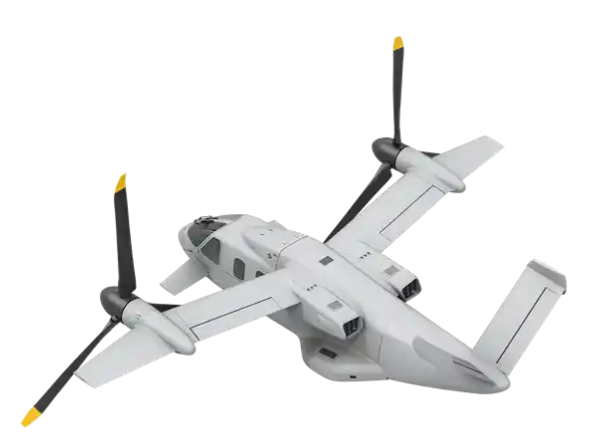
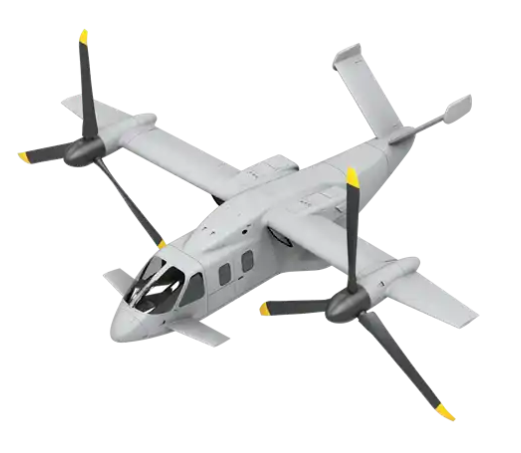
People shouldn't get upset over commercial renderings. After all Boeing showed more smoke than jet and the forum loves it. I'm certain Airbus will knock it out of the park, although I'm still sceptical about the compound version.
 
Removable wings?
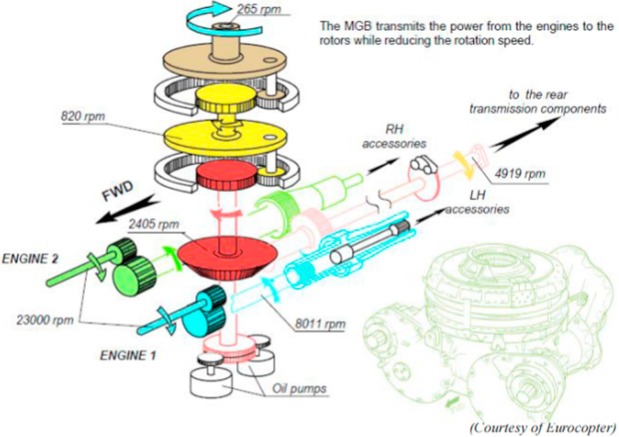
Four (?) gearboxes and lots of high speed shafts(?). I guess if anyone can pull it off, it would be Airbus.
However, I suspect both Leonardo and Sikorsky are thinking their options are more in play now.
 
Removable wings?
Four (?) gearboxes and lots of high speed shafts(?). I guess if anyone can pull it off, it would be Airbus.
However, I suspect both Leonardo and Sikorsky are thinking their options are more in play now.
I'm thinking the prop shafts would be coming off the tail rotor output drive.
 
A possibility might be that on this military version as opposed to the civilian version its an electric transmission from the engine to lateral motors. But another idea would be to take it from the standard engine accessory feeds. That would mean only minor differences between a compound and a non compound version. Isnt that what they already do on the Racer.

(Illustrative generic helicopter transmission images)

Racer

racer-pad-cropped-001.jpg


Racer gearbox arrangement

https://www.researchgate.net/figure/Schematic-of-the-RACER-transmission-system_fig1_333827990
Standard helicopter gearbox

1-s2.0-S0003682X17306552-gr1.jpg


Standard helicopter gearbox

Zoerkler%20Helicopter%20MGB%20%C2%A9Zoerkler%20Gears%20GmbH%20-%20Co%20KG.jpg


dreamstime_m_144689179.jpg
 
Last edited:
Electrically powered fans would likely make the transition from compound to conventional an easier proposition.
 
I see Scott Kenny, so no full electric propulsion for helicopters just yet, but perhaps within the next ten years or so there should be more technological advances in that field between now and then I would think.
 
I see Scott Kenny, so no full electric propulsion for helicopters just yet, but perhaps within the next ten years or so there should be more technological advances in that field between now and then I would think.
It requires highly efficient motors and generators to be developed.
 
We are probably looking at these technologies right now Scott Kenny.
 
It requires highly efficient motors and generators to be developed.
Transmissions aren't 100% efficient, losing 1 to 2 % efficiency in each mesh, so probably about 95% efficient. The question is whether the loss in efficiency is outweighed by other improvements, like weightsaving. Even though helicopters are more weight critical than fixed-wing aircraft, design choices that increase weight, like cast vs built-up gearbox housings are made to improve other factors (built-up g/b housings are much more expensive).

One potential advantage of an electric helicopter could be reduced vulnerability to AA weapons. Another could be using batteries to improve safety in autorotation. A third could be improved reliability. When I was in the industry, in the 1980s, a counterintuitive datum was transmission failure rates in twins were greater than the sum of engine plus transmission failures in twins.

In any case, I don't see electric transmission replacing gearboxes soon, unless there is a massive amounts of government money spent. Commercial helicopter sales are too small to justify such long term R&D
 
Way out of my expertise but does scaling become a factor? Prop rotors ( and tail rotors) being smaller than main rotors might they be less challenging?
With all of the electric propulsion work going on with eVTOL I would think some of it applicable.
 
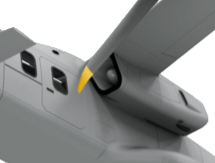
The engine's air intake is directly behind the cabin door... Can this concept be taken seriously?
They seem to have done a decent job at trying to maximise the wetted area and drag of their concept...

From looking at the pictures, is it actually a "tilt-wing" with the outer wing panels and nacelles beyond the flap rotating together?
 
The prop tips also.
In the future, a good way to rapidly spot any Italian special forces'

*the ones with a large scar on their left cheek.
 
The engine placement does seem suboptimal as is. Of course the concept is very early in design phase I would think. There are ways to mitigate the concern of the inlet so close to doors, like bypass inlet filters/doors and a main inlet cover (similar to that seen on Mig-29).
The wing 'extension ' is very reminicent of the Karem's tilt rotor concepts and the Bell V-247. I very much would expect them to tilt with the rotor pylon to reduce downwash effect. In that case we now have a "tiltrotorwing" aircraft as it is both a tilt rotor and tilt wing aircraft.
 
Last edited:
Way out of my expertise but does scaling become a factor? Prop rotors ( and tail rotors) being smaller than main rotors might they be less challenging?
With all of the electric propulsion work going on with eVTOL I would think some of it applicable.
Yes, and not what you think.
Just like with flywheel the more mass (drive train) the more efficient it is. With e-motors once they lose electric power they will stop instantly (partly due to hall effect/generator mode). While wit traditional setup autorotation will save the day.

The engine's air intake is directly behind the cabin door... Can this concept be taken seriously?
View attachment 804535
At least the door block people from completly sucked in and it's behind the rotors, too.
The only other option would be dorsal intakes but this would suck some air away from the wings leading to some loss of lift.
It's a compromise for the sake of keeping the transmission system "simple".
 

Leonardo Takes Next Steps In Tiltrotor Development​

Unfortunately the article is behind the AW&ST paywall at the moment. However the article informs us that at the wind tunnel level of exploration Leonardo has realized some good drag reduction on their NGCTR on both the airframe and the prop-rotor blades. Of course once you start putting the 'bits & bobs' all over the outside the drag will return.
 

Leonardo Takes Next Steps In Tiltrotor Development​

Unfortunately the article is behind the AW&ST paywall at the moment. However the article informs us that at the wind tunnel level of exploration Leonardo has realized some good drag reduction on their NGCTR on both the airframe and the prop-rotor blades. Of course once you start putting the 'bits & bobs' all over the outside the drag will return.
Sounds like Leonardo needed to fill the news void with some positive PR and something promising for the future.

In the meantime, still no AW609 certification. And flight testing of I-NGTH (the NGCTR prototype) is barely moving forward, having achieved only 2 short 15 minute hops in 6 months. Nothing yet on FlightRadar which means they haven't turned on their ADS-B, which likely means they haven't left the runway perimeter, no forward flight, no translations from vertical mode etc.
 
In the meantime, still no AW609 certification.
Well, yeah. Every time Leonardo gets close, EASA adds "just one more thing" they need to do before the AW609 can be certified.

It's honestly at the point where I would be suing EASA because they're blatantly never going to actually approve it.


And flight testing of I-NGTH (the NGCTR prototype) is barely moving forward, having achieved only 2 short 15 minute hops in 6 months. Nothing yet on FlightRadar which means they haven't turned on their ADS-B, which likely means they haven't left the runway perimeter, no forward flight, no translations from vertical mode etc.
Still gotta prove out their vertical flight regime.
 
Interesting, AIrbus Helicopters pushing Canada into collaborating on the NGRC

https://aviationa2z.com/index.php/2...collaboration-on-new-nato-helicopter-project/.

Interesting as Canada and France been having closer military ties in over a decade

https://www.canada.ca/en/news/archive/2014/06/canadian-army-hones-amphibious-skills-french-navy.html

and the RCAF CH-146 Griffins embarked on amphibious warship ia first, also with SkyAlyne rotary wing training with Airbus Helicopters CT-135 Juno as a first for the Canadians.

cheers
 
Interesting, AIrbus Helicopters pushing Canada into collaborating on the NGRC

https://aviationa2z.com/index.php/2...collaboration-on-new-nato-helicopter-project/.

Interesting as Canada and France been having closer military ties in over a decade

https://www.canada.ca/en/news/archive/2014/06/canadian-army-hones-amphibious-skills-french-navy.html

and the RCAF CH-146 Griffins embarked on amphibious warship ia first, also with SkyAlyne rotary wing training with Airbus Helicopters CT-135 Juno as a first for the Canadians.

cheers
Not surprising really given the current political spat going on. As the political winds change (as they always do) I think Canada will find itself in a enviable position to haggle over aircraft with both Airbus and Bell having presence there.
 
Not surprising really given the current political spat going on. As the political winds change (as they always do) I think Canada will find itself in a enviable position to haggle over aircraft with both Airbus and Bell having presence there.
I think Canada will push for a tiltrotor for their needs, so Bell better hurry up with a folding wing for a naval MV-75...
 
Interesting, AIrbus Helicopters pushing Canada into collaborating on the NGRC

https://aviationa2z.com/index.php/2...collaboration-on-new-nato-helicopter-project/.
From the link:
[Airbus Helicopters chief executive Matthieu Louvot] pointed to the NH Industries partnership, which includes Airbus, Leonardo, and GKN/Fokker, as proof that multinational collaboration can successfully deliver complex defense aircraft.
That´s the kind a statement nobody would want to see from Airbus for now. Being bold doesn't always save the day...
 
NSPA_NATO "minutes ago" issued the NGRC Request for Proposals (RFP) to Airbus Helicopters, Leonardo Helicopters, Lockheed Martin–Sikorsky, and Boeing Defense. No further details at this time, except responses due by September 2027 to identify a single preferred solution by the end of December 2027. The partner countries will then deliberate and make their own political decisions before selecting one or more designs for production, ahead of entry into service in 2035.

Airbus Helicopters likely to respond with two concepts, one based on its RACER and the other a conventional helicopter.

Leonardo Helicopters leveraging its AW609 and other tiltrotor technologies.

Lockheed Martin–Sikorsky has adapted the X2 technologies, and has also concepted a large conventional helicopter.

Boeing has not yet disclosed any concept, with the NSPA programme head previously noting, "The concept studies were there to help the nations and the contracting authority to build the initial set of requirements. [From the RFP] it will be a new competition, so it is a new starting line and [Boeing] will get the same information as the other vendors before starting the bidding phase." (illustrating with a Little Bird, because I like them – no other reason!).

Janes story to come...

View: https://x.com/GarethJennings3/status/2083147847235522965
 
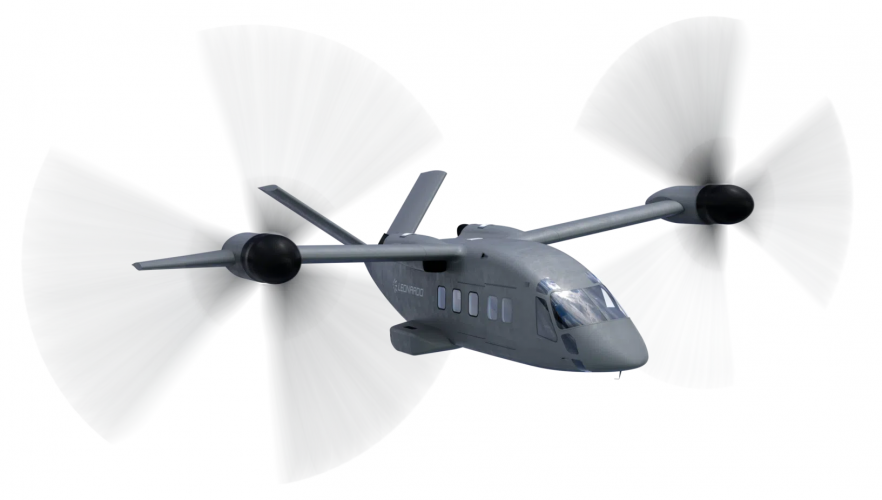
While flipping through a magazine I noted an advert for an upcoming European Rotorcraft Forum. Prominently displayed as part of the advert (with no associated information) was this tilt rotor aircraft seen in the attached picture. Since it says Leonardo on the side, I am thinking this is either a newer rendition of their NGTR effort, or a previous design. What is striking to me is that it has proprotors and wing very reminiscent of the Karem TR efforts, which is who I though had come up with the design before noting the Leonardo logo. Anyway thought I would share.
Anyone have any more information?
Here's another view of the same Leonardo tilt-rotor concept from a paper presented at VFS 2026.
https://www.nlr.org/newsroom/artikel/nlr-contributes-to-helicopter-of-the-future/

The paper evaluates handling qualities, shipboard landing limits, and tactical benefits of high speed flight:
  • Level 1 handling qualities achieved in all respects
  • 17t landing weight used for the shipboard studies (possibly the same as the maximum take-off weight)
  • High-speed reduces the threat of small arms fire and FPV drones. By implication it does not help against SAMs? (Both MANPADS and radar guided SAM threats were also evaluated)

P.S. On a tangent, has anyone heard anything new about Leonardo's NGCTR demonstrator? One would have expected an update at the recent European Rotorcraft Forum (Airbus presented 3 papers on Racer flight testing), but the last news from March 2026 was that NGCTR had only completed 2 short hovering tests in December 2025 and February 2026 (PR labelled them "flights" which is a bit of a stretch).

So... no test flights in 6 months? No forward flight? No attempt at tilting the rotors into their forward position for high speed flight?
 

Attachments

  • NGRC Next-Gen Military Rotorcraft Concept Design Assessment Paper VFS2026.pdf
    3 MB · Views: 11
  • Leonardo NGRC concept2.png
    Leonardo NGRC concept2.png
    579.1 KB · Views: 27
Last edited:
Here's another view of the same Leonardo tilt-rotor concept from a paper presented at VFS 2026.
https://www.nlr.org/newsroom/artikel/nlr-contributes-to-helicopter-of-the-future/

The paper evaluates handling qualities, shipboard landing limits, and tactical benefits of high speed flight:
  • Level 1 handling qualities achieved in all respects
  • 17t landing weight used for the shipboard studies (possibly the same as the maximum take-off weight)
  • High-speed reduces the threat of small arms fire and FPV drones. By implication it does not help against SAMs? (Both MANPADS and radar guided SAM threats were also evaluated)

P.S. On a tangent, has anyone heard anything new about Leonardo's NGCTR demonstrator? One would have expected an update at the recent European Rotorcraft Forum (Airbus presented 3 papers on Racer flight testing), but the last news from March 2026 was that NGCTR had only completed 2 short hovering tests in December 2025 and February 2026 (PR labelled them "flights" which is a bit of a stretch).

So... no test flights in 6 months? No forward flight? No attempt at tilting the rotors into their forward position for high speed flight?
I suspect that since the dynamic components are all "new" they may be spending more time on the test stand. I was surprised that they even decided to do the "air under the tires" videos.
 
I suspect that since the dynamic components are all "new" they may be spending more time on the test stand. I was surprised that they even decided to do the "air under the tires" videos.
Something's clearly happened as it's going slower than Leonardo planned...

NGCTR ground runs started in August 2024 and at the time Leonardo stated first flight would follow shortly (before end of 2024) followed by 200 hours of flight tests. In the end it took them over a full year for that first hover test (December 2025), and now they've accumulated less than 30 minutes of hover time in 9 months.
 
Unless I am remembering wrong the wing, and all the dynamics are new. Very possible that there are gremlins they have to deal with.
Or they are going to punt and go with MV-75A with Bell.
 

Similar threads

Back
Top Bottom