
You are using an out of date browser. It may not display this or other websites correctly.
You should upgrade or use an alternative browser.
You should upgrade or use an alternative browser.
41 States Sue Meta Over the Social Media Giant’s Impact on Kids
- Thread starter edwest4
- Start date

Somewhat related to this:
View: https://www.youtube.com/watch?v=DB2bhXCd34U
The author's book related to this:
https://www.amazon.com.au/Anxious-G...demic-ebook/dp/B0CGWS3JQ6?ref_=ast_author_mpb

The author's book related to this:
https://www.amazon.com.au/Anxious-G...demic-ebook/dp/B0CGWS3JQ6?ref_=ast_author_mpb
SlothmanAllen
ACCESS: Confidential
- Joined
- 3 January 2025
- Messages
- 80
- Reaction score
- 192
I honestly think its time to do away with social media. Just outright get rid of it. I don't think it actually contributes anything to society and its value is greatly overrated.

scautomoton
ACCESS: Secret
- Joined
- 19 January 2024
- Messages
- 315
- Reaction score
- 788
Here's the thing, its not just the impact on children thats a worry, but on everyone. I cancelled Facebook about 8 years ago now, and also stopped using LinkedIn (since it had become like FB) about a year ago, and I haven't looked back.
Now employers demand access to your social media—there’s your problem
That should be illegal.
Scott Kenny
ACCESS: USAP
- Joined
- 15 May 2023
- Messages
- 19,533
- Reaction score
- 27,980
It is, in the US.That should be illegal.
Doesn't stop people from asking.
Doesn't stop people from asking.
Well then the law needs to be enforced with these employers prosecuted.
Scott Kenny
ACCESS: USAP
- Joined
- 15 May 2023
- Messages
- 19,533
- Reaction score
- 27,980
It works better when the various Social Media companies inflict contractual penalties for it.Well then the law needs to be enforced with these employers prosecuted.

Halcyon66
ACCESS: Top Secret
- Joined
- 9 July 2022
- Messages
- 1,523
- Reaction score
- 3,262
Meta fined $567m in largest child safety ruling against social media giant
https://www.bbc.com/news/articles/cd7lz3wr2rlo
It is a good day.
https://www.bbc.com/news/articles/cd7lz3wr2rlo
It is a good day.
scautomoton
ACCESS: Secret
- Joined
- 19 January 2024
- Messages
- 315
- Reaction score
- 788
The problem is this is a drop in the ocean for them.
spikedpsycho
ACCESS: Secret
- Joined
- 14 March 2026
- Messages
- 336
- Reaction score
- 471
The issue having age limit check on social media has some merit. But question how intend enforce it unless everyone submits identification to internet tech companies essentially allowing them track you permanently
Halcyon66
ACCESS: Top Secret
- Joined
- 9 July 2022
- Messages
- 1,523
- Reaction score
- 3,262
Meta Faces Up to $1.4 Trillion Reckoning as Youth-Addiction Trial Opens in Oakland
https://www.kqed.org/news/12094595/...ing-as-youth-addiction-trial-opens-in-oakland
https://www.reuters.com/video/watch/idRW498712082026RP1/
Meta close today 1.47 trillion.
This is awesome.
Regards,
https://www.kqed.org/news/12094595/...ing-as-youth-addiction-trial-opens-in-oakland
https://www.reuters.com/video/watch/idRW498712082026RP1/
The problem is this is a drop in the ocean for them.
Meta close today 1.47 trillion.
This is awesome.
Regards,

SuperShark
ACCESS: Confidential
- Joined
- 28 July 2019
- Messages
- 109
- Reaction score
- 157
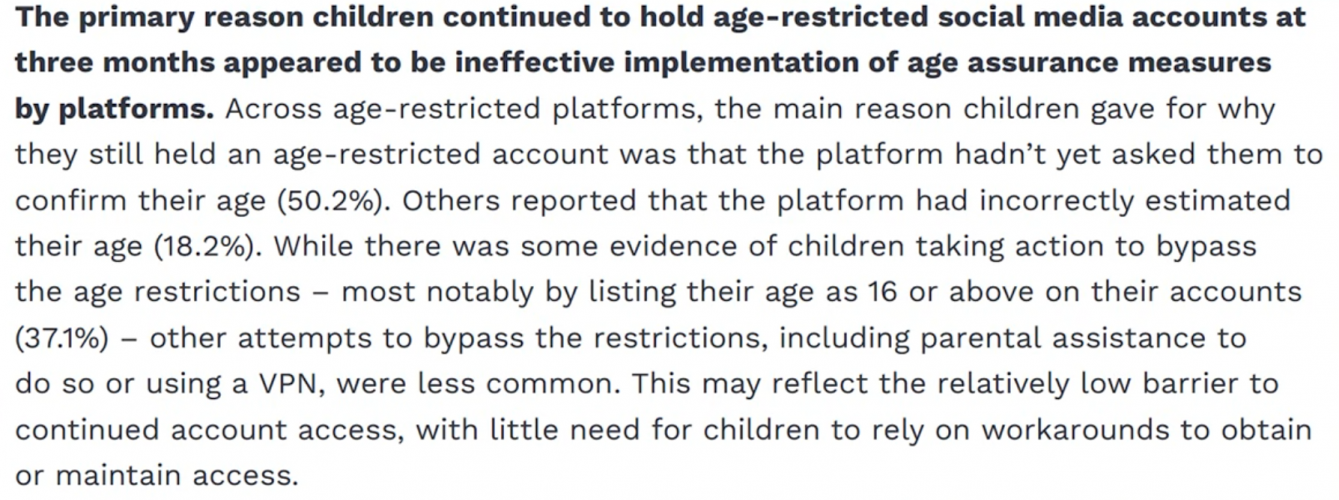
The Australian government did this, it didn't work and there never seemed to be a plan for enforcement - almost as though keeping children off social media was a secondary concern.The issue having age limit check on social media has some merit. But question how intend enforce it unless everyone submits identification to internet tech companies essentially allowing them track you permanently
"""Algorithms""" were used to determine if you were of-age based on your digital footprint for most people.
Luckily now that police have the power to Cellebrite anybody's mobile phone without a warrant or cause, individuals can be easily audited and all children will finally be safe!
And your proof for it supposedly not working???The Australian government did this, it didn't work and there never seemed to be a plan for enforcement - almost as though keeping children off social media was a secondary concern.
"""Algorithms""" were used to determine if you were of-age based on your digital footprint for most people.
Luckily now that police have the power to Cellebrite anybody's mobile phone without a warrant or cause, individuals can be easily audited and all children will finally be safe!
I view actions to ban the use of social media by children the same as bans on the use of alcohol and smoking by the same children. I would like to think that all agree that letting children smoke or drink is not smart - the same goes with social media. And while no-one claims that bans on the alcohol etc is perfect, it is still a step in the right direction and if parents are responsible, it will go a long way to stopping it and protecting health of the minors. Are the bans perfect? No. But is it better than doing nothing. Most definitely!!

dannydale
ACCESS: Top Secret
- Joined
- 13 May 2007
- Messages
- 1,014
- Reaction score
- 1,633
Literally my face when.Meta Faces Up to $1.4 Trillion Reckoning as Youth-Addiction Trial Opens in Oakland
https://www.kqed.org/news/12094595/...ing-as-youth-addiction-trial-opens-in-oakland
https://www.reuters.com/video/watch/idRW498712082026RP1/
Meta close today 1.47 trillion.
This is awesome.
Regards,

I'm not sure what that means?
SuperShark
ACCESS: Confidential
- Joined
- 28 July 2019
- Messages
- 109
- Reaction score
- 157
I am making a point of digital surveillance, keeping children off social media is probably the most important action society can take right now.And your proof for it supposedly not working???
I view actions to ban the use of social media by children the same as bans on the use of alcohol and smoking by the same children. I would like to think that all agree that letting children smoke or drink is not smart - the same goes with social media. And while no-one claims that bans on the alcohol etc is perfect, it is still a step in the right direction and if parents are responsible, it will go a long way to stopping it and protecting health of the minors. Are the bans perfect? No. But is it better than doing nothing. Most definitely!!
I see how far social media has come just since I was in high school catching the start of everyone having smartphones and it is disgusting, being able to compare yourself to every person on the planet in the palm of your hand is leading to dark days.
Attachments
Last edited:
dannydale
ACCESS: Top Secret
- Joined
- 13 May 2007
- Messages
- 1,014
- Reaction score
- 1,633
https://en.wikipedia.org/wiki/Sickos Basically schadenfreude at Meta's legal liabilities.I'm not sure what that means?
In my understanding, the sad reality is that privacy is now fail-deadly, especially with the evolving technological enviroment.I am making a point of digital surveillance, keeping children off social media is probably the most important action society can take right now.
I see how far social media has come just since I was in high school catching the start of everyone having smartphones and it is disgusting, being able to compare yourself to every person on the planet in the palm of your hand is leading to dark days.
Like, oh, the equipment-and-expertise price tag of biotech is decreasing at a rate similar to how the capabilities of integrated chips rose...
... or how having a completely and utterly unregulated media environment is basically telling everyone else, 'I've made my population extremely vulnerable to memetic warfare! Turn my population into puppets!'.
I recommend you read this recent blog post by Nick Couldry, Professor of Media, Communications and Social Theory in the Department of Media and Communications at the London School of Economics. He makes the point, at length, that social media bans for children only enable social media companies (broligarchs) to continue business models and practices that are harmful to as all.
Invasive age and identity verification actually benefits a further ingrainment of a surveillance state and economy on a level and scale yet unseen. In the end a band-aid age ban will only serve to further disadvantage the majority and fail in its stated purpose because age bans are not radical enough. The moral panic about children belies the overall immaturity of us all in having allowed this wholesale commodification of every aspect of ourselves, our societies and our politics. Court cases such as these may go some way in addressing the issue but can't go the whole nine yards.
https://blogs.lse.ac.uk/medialse/20...ill-fail-because-they-are-not-radical-enough/
Furthermore children and youth are not oblivious to the risks. Many are more astute about the situation than most (adults, let alone politicians) and (rightly) blame those who allowed this to happen in the first place and angry at being objectified en masse. I'm going to quote a letter from one youth to Guardian from this summer in full.
https://www.theguardian.com/uk-news/2026/jun/18/social-media-ban-saving-kids-or-punishing-them
The OECD is gathering a lot of information on the effects of social media on children and lately also the efforts to install age bans. Well worth reading as they provide context and an excellent overview of the dynamics going forward. They report that, for instance, those children and youth who spend a "moderate" amount of time on social media (two to three hours) fare better in school than those who are not on social media at all or those who spend more time there. Not that this is pure causation, there are complex socioeconomic dynamics and such behind this. There are no universal rules that apply. OECD has also noted that three quarters of youth use social media excessively during leisure, a recognized risk behavior.
What is happening now though is that social media (and "smart" devices in education) are being banned wholesale with the expectation that the vacuum will sort of inevitably filled with something more positive. Research doesn't support the idea that learning results will improve or bullying diminish simply by removing these factors. It's appealing to think there's a simple fix of course, resorting to some immediate thing we can do or proclaim but social media as it's constituted now will have a long tail of effects we can't be oblivious to however we stumble forward. Adults will need to change their social media habits concurrently also - and clearly indicate doing so.
OECD on social media restrictions for children:
https://www.oecd.org/en/blogs/2026/...-why-they-are-rising-and-what-comes-next.html
A rather grim OECD read on childhood in our digital age:'
https://www.oecd.org/en/publication.../how-children-use-digital-media_a8d3a6d0.html
There are also sizeable groups among children and youth for whom digital communication enables modes of being and support not available in their immediate physical surroundings. Growing up I probably would've been among some of those groups and had a somewhat easier time of it. Therefore I'm quite sensitive to arguments that the arbitrary nature of a blanket ban (instead of disallowing business practices that are universally harmful) can amount to an almost violent, stochastic, dehumanizing experience. It's very easy to overlook true human diversity.
Invasive age and identity verification actually benefits a further ingrainment of a surveillance state and economy on a level and scale yet unseen. In the end a band-aid age ban will only serve to further disadvantage the majority and fail in its stated purpose because age bans are not radical enough. The moral panic about children belies the overall immaturity of us all in having allowed this wholesale commodification of every aspect of ourselves, our societies and our politics. Court cases such as these may go some way in addressing the issue but can't go the whole nine yards.
https://blogs.lse.ac.uk/medialse/20...ill-fail-because-they-are-not-radical-enough/
Furthermore children and youth are not oblivious to the risks. Many are more astute about the situation than most (adults, let alone politicians) and (rightly) blame those who allowed this to happen in the first place and angry at being objectified en masse. I'm going to quote a letter from one youth to Guardian from this summer in full.
Clara O'Grady said:It’s always been my dream to exist in a world that uses snail mail, fanzines and social clubs, but this ban on social media for under-16s is not setting the foundations for a screen-free utopia. Instead, it’s scolding teens for living in the online world we were born into.
I don’t disagree with the principle. Yes, parents of the nation, phones are bad. However, social media is not an isolated section of our lives that can easily be removed. Its heavy usage is a habit born out of a lack of anything else to do, and something that has cemented together the cracks in our lives with many positives: revision resources, tutorials for hobbies and fandoms to engage with.
Not once have I heard anyone – lawmakers or parents – consider what will fill those cracks when they are crudely hollowed out. Why don’t they speak to us? I exist as part of a lost generation in the eyes of the government. Sixteen now, and too late to be saved. Why don’t they ask how social media has affected us and make laws tailored to the real world rather than indulging in some political-saviour complex?
We’re being treated like one huge monolith, all obsessed with vaping and phones, and strange cryptic memes that parents will never be able to understand. Modern is scary to parents, but they forget that one they were modern too.
I want social media to just go away too. But in this attempt to “save the children”, many adults seem to have begun acting rather childishly themselves.
Clara O’Grady
York
https://www.theguardian.com/uk-news/2026/jun/18/social-media-ban-saving-kids-or-punishing-them
The OECD is gathering a lot of information on the effects of social media on children and lately also the efforts to install age bans. Well worth reading as they provide context and an excellent overview of the dynamics going forward. They report that, for instance, those children and youth who spend a "moderate" amount of time on social media (two to three hours) fare better in school than those who are not on social media at all or those who spend more time there. Not that this is pure causation, there are complex socioeconomic dynamics and such behind this. There are no universal rules that apply. OECD has also noted that three quarters of youth use social media excessively during leisure, a recognized risk behavior.
What is happening now though is that social media (and "smart" devices in education) are being banned wholesale with the expectation that the vacuum will sort of inevitably filled with something more positive. Research doesn't support the idea that learning results will improve or bullying diminish simply by removing these factors. It's appealing to think there's a simple fix of course, resorting to some immediate thing we can do or proclaim but social media as it's constituted now will have a long tail of effects we can't be oblivious to however we stumble forward. Adults will need to change their social media habits concurrently also - and clearly indicate doing so.
OECD on social media restrictions for children:
https://www.oecd.org/en/blogs/2026/...-why-they-are-rising-and-what-comes-next.html
A rather grim OECD read on childhood in our digital age:'
https://www.oecd.org/en/publication.../how-children-use-digital-media_a8d3a6d0.html
There are also sizeable groups among children and youth for whom digital communication enables modes of being and support not available in their immediate physical surroundings. Growing up I probably would've been among some of those groups and had a somewhat easier time of it. Therefore I'm quite sensitive to arguments that the arbitrary nature of a blanket ban (instead of disallowing business practices that are universally harmful) can amount to an almost violent, stochastic, dehumanizing experience. It's very easy to overlook true human diversity.
Halcyon66
ACCESS: Top Secret
- Joined
- 9 July 2022
- Messages
- 1,523
- Reaction score
- 3,262
France's top court blocks social media ban for under-15s
https://www.reuters.com/world/franc...a-ban-curtails-freedom-expression-2026-08-14/
Regards,
https://www.reuters.com/world/franc...a-ban-curtails-freedom-expression-2026-08-14/
Regards,
The reality is less pro-freedom than you assume, I'm afraid. The sad reality is that we need a surveillance state, and yesterday. Look up the Vulnerable World Hypothesis and Electronic Communities: World Village or Cyber Balkans, and then look at the world today.I recommend you read this recent blog post by Nick Couldry, Professor of Media, Communications and Social Theory in the Department of Media and Communications at the London School of Economics. He makes the point, at length, that social media bans for children only enable social media companies (broligarchs) to continue business models and practices that are harmful to as all.
Invasive age and identity verification actually benefits a further ingrainment of a surveillance state and economy on a level and scale yet unseen. In the end a band-aid age ban will only serve to further disadvantage the majority and fail in its stated purpose because age bans are not radical enough. The moral panic about children belies the overall immaturity of us all in having allowed this wholesale commodification of every aspect of ourselves, our societies and our politics. Court cases such as these may go some way in addressing the issue but can't go the whole nine yards.
https://blogs.lse.ac.uk/medialse/20...ill-fail-because-they-are-not-radical-enough/
Furthermore children and youth are not oblivious to the risks. Many are more astute about the situation than most (adults, let alone politicians) and (rightly) blame those who allowed this to happen in the first place and angry at being objectified en masse. I'm going to quote a letter from one youth to Guardian from this summer in full.
https://www.theguardian.com/uk-news/2026/jun/18/social-media-ban-saving-kids-or-punishing-them
The OECD is gathering a lot of information on the effects of social media on children and lately also the efforts to install age bans. Well worth reading as they provide context and an excellent overview of the dynamics going forward. They report that, for instance, those children and youth who spend a "moderate" amount of time on social media (two to three hours) fare better in school than those who are not on social media at all or those who spend more time there. Not that this is pure causation, there are complex socioeconomic dynamics and such behind this. There are no universal rules that apply. OECD has also noted that three quarters of youth use social media excessively during leisure, a recognized risk behavior.
What is happening now though is that social media (and "smart" devices in education) are being banned wholesale with the expectation that the vacuum will sort of inevitably filled with something more positive. Research doesn't support the idea that learning results will improve or bullying diminish simply by removing these factors. It's appealing to think there's a simple fix of course, resorting to some immediate thing we can do or proclaim but social media as it's constituted now will have a long tail of effects we can't be oblivious to however we stumble forward. Adults will need to change their social media habits concurrently also - and clearly indicate doing so.
OECD on social media restrictions for children:
https://www.oecd.org/en/blogs/2026/...-why-they-are-rising-and-what-comes-next.html
A rather grim OECD read on childhood in our digital age:'
https://www.oecd.org/en/publication.../how-children-use-digital-media_a8d3a6d0.html
There are also sizeable groups among children and youth for whom digital communication enables modes of being and support not available in their immediate physical surroundings. Growing up I probably would've been among some of those groups and had a somewhat easier time of it. Therefore I'm quite sensitive to arguments that the arbitrary nature of a blanket ban (instead of disallowing business practices that are universally harmful) can amount to an almost violent, stochastic, dehumanizing experience. It's very easy to overlook true human diversity.
If you're not blinded by the idea of 'the freer the freedoms, the freer the people', then you'll see that we're sliding into the worst-case scenario for both.

shin_getter
ACCESS: Top Secret
- Joined
- 1 June 2019
- Messages
- 1,490
- Reaction score
- 2,191
The entire discussion is so web 2.0, when its GPT 1.0.
The future of electronic social interaction is deeply (AI) agent mediated. It makes no sense to humanly look at social media sites/apps when agents can crawl it, extract useful information while filtering out unwanted noise while constructing a interaction layer to fit the user's use case, while having machine operable information useful to the user. Of course, as agents proliferate the SNR ratio goes to zero, and the entire thing become worthless.
The thing to actually teach the children is teaching how to use video generation models, which is intended as the counterexample to social media "reality." I am sure kids all know how to use models to generate homework, just help them to also generate personas online as well.
Things are moving fast, and it is not even 4 years into gpt era yet. More things will change before a childhood is over. Regulation is the "it is not even wrong" thing when the tempo is that of irrelevance except for collateral damage.
The future of electronic social interaction is deeply (AI) agent mediated. It makes no sense to humanly look at social media sites/apps when agents can crawl it, extract useful information while filtering out unwanted noise while constructing a interaction layer to fit the user's use case, while having machine operable information useful to the user. Of course, as agents proliferate the SNR ratio goes to zero, and the entire thing become worthless.
The thing to actually teach the children is teaching how to use video generation models, which is intended as the counterexample to social media "reality." I am sure kids all know how to use models to generate homework, just help them to also generate personas online as well.
Things are moving fast, and it is not even 4 years into gpt era yet. More things will change before a childhood is over. Regulation is the "it is not even wrong" thing when the tempo is that of irrelevance except for collateral damage.
The reality is less pro-freedom than you assume, I'm afraid. The sad reality is that we need a surveillance state, and yesterday. Look up the Vulnerable World Hypothesis and Electronic Communities: World Village or Cyber Balkans, and then look at the world today.
If you're not blinded by the idea of 'the freer the freedoms, the freer the people', then you'll see that we're sliding into the worst-case scenario for both
Somewhat unsure as to what freedom scale you're evaluating that collection of resources on the subject I posted on. It's been a while since I've read anything of Bostrom's; don't know if he's fading from view somewhat. I don't think Couldry's argument was laissez faire, nor was O'Grady's introspection.
The most recent treatise on the subject I've paid attention to is Timothy Snyder's "On Freedom" (or rather, him discussing it since I haven't read the book). He holds up childhood (societies' different approaches to it) as the foundational example that freedom "from" (negative freedom) is insufficient for a person to (grow to) have true sovereignty; that requires nurturing and security on various scales (positive freedom, freedom "to", enablement). He often states that the use of "smart" devices is not allowed for students on his courses (history). He seems very aware of the negative impacts of digital platforms (the individual loneliness of screens is perhaps the ultimate balkanization), saying that they restrict freedom (personal and collective) by reducing us to our most predictable selves. He's aligned with Haidt, I think, mentioned before in this conversation by @GTX .
In that framework, I guess, I'm arguing that by imposing blanket bans we're stereotypically concerned with children's freedom "from" (also, perhaps, adults' freedom from responsibility as the ban "solves" it), not so much freedom "to" and the imbalance might not be ideal. But your message was age agnostic, so somewhat hard to bring around to the subject.

GreenBullet
International rules-based hors d'oeuvre
- Joined
- 2 September 2015
- Messages
- 70
- Reaction score
- 129
I understand your argument. If everybody has a "kill everyone" button (or analog, like being able to produce novel bioweapons at home), some nutjob is going to push it. I think in practice it's likely to be a little more nuanced than that, but the hazard is real.The reality is less pro-freedom than you assume, I'm afraid. The sad reality is that we need a surveillance state, and yesterday. Look up the Vulnerable World Hypothesis and Electronic Communities: World Village or Cyber Balkans, and then look at the world today.
If you're not blinded by the idea of 'the freer the freedoms, the freer the people', then you'll see that we're sliding into the worst-case scenario for both.
However, I'd rather be dead than live in a surveillance state. There are worse things than death. That is one of them. Never, ever, ever. I will not live in the kind of world Solzhenitsyn did. And that is the endstate of every government given that kind of power.
Good reason to have a multiplanetary society though. Hopefully we can pull it off. Until then, we have the Second Amendment.
shin_getter
ACCESS: Top Secret
- Joined
- 1 June 2019
- Messages
- 1,490
- Reaction score
- 2,191
With new technologies and very complex interactions but limited systematic risk, blanket bans are not the best solution. Instead different scale and type of (social) responses needs to be explored to best extract out value and minimize risk.The reality is less pro-freedom than you assume, I'm afraid. The sad reality is that we need a surveillance state, and yesterday. Look up the Vulnerable World Hypothesis and Electronic Communities: World Village or Cyber Balkans, and then look at the world today.
When there is support of blanket bans, there is support for smaller scale bans in schools, from parents, targetting specific platforms and so on. After a while the differential treatment would generate a data rich picture that enables much more precise and targeted interventions.
This takes time though, and sometimes serious pain if the printing press taught us anything.
History has constantly told us that men must be governed. It also tells us that technology determines everything, but people hate to acknowledge that little fact.I understand your argument. If everybody has a "kill everyone" button (or analog, like being able to produce novel bioweapons at home), some nutjob is going to push it. I think in practice it's likely to be a little more nuanced than that, but the hazard is real.
The problem is that it's either kill privacy and have a surveillance state or live in a world where the best-case scenario is, well, mass murder as a law enforcement tool. The moral calculus in this situation is kind of binary in that regard.However, I'd rather be dead than live in a surveillance state. There are worse things than death. That is one of them. Never, ever, ever. I will not live in the kind of world Solzhenitsyn did. And that is the endstate of every government given that kind of power.
The Second Amendment died on the fields of Passendale at the latest... and the 30 Years (i.e., before the amendment was even dreamt of) at the earliest. Technology guaranteed that.Good reason to have a multiplanetary society though. Hopefully we can pull it off. Until then, we have the Second Amendment.
It's less a straightforward freedom scale and more a realization between trying to understand history and realizing that the human condition isn't what those who are considered 'political philosophy optimists' proudly yell from the rooftops.Somewhat unsure as to what freedom scale you're evaluating that collection of resources on the subject I posted on. It's been a while since I've read anything of Bostrom's; don't know if he's fading from view somewhat. I don't think Couldry's argument was laissez faire, nor was O'Grady's introspection.
The thing with me is that the blanket bans aren't the right thing for the situation. The right solution requires things like killing privacy, which is something people here and elsewhere won't acknowledge as a solution in any shape or form.With new technologies and very complex interactions but limited systematic risk, blanket bans are not the best solution. Instead different scale and type of (social) responses needs to be explored to best extract out value and minimize risk.
When there is support of blanket bans, there is support for smaller scale bans in schools, from parents, targetting specific platforms and so on. After a while the differential treatment would generate a data rich picture that enables much more precise and targeted interventions.
This takes time though, and sometimes serious pain if the printing press taught us anything.
Privacy is part of the problem, just like assuming that unlimited speech and information are a solution to things like conspiracy theories and information/memetic warfare (and... the sad reality is that unlimited speech and information make conspiracy theories and information/memetic warfare worse).
Last edited:
Halcyon66
ACCESS: Top Secret
- Joined
- 9 July 2022
- Messages
- 1,523
- Reaction score
- 3,262
Meta faces ‘astronomical’ consequences as legal fight reaches critical moment in California
https://www.cnbc.com/2026/08/17/met...-federal-trial-astronomical-consequences.html
One can only hope......................
Regards,
https://www.cnbc.com/2026/08/17/met...-federal-trial-astronomical-consequences.html
One can only hope......................
Regards,
Scott Kenny
ACCESS: USAP
- Joined
- 15 May 2023
- Messages
- 19,533
- Reaction score
- 27,980
Just by following the New Mex example and applying it to Cali's population, that would be about 20bn in penalties. 12bn in the abatement fund, and another 7.5bn in penalties.Meta faces ‘astronomical’ consequences as legal fight reaches critical moment in California
https://www.cnbc.com/2026/08/17/met...-federal-trial-astronomical-consequences.html
One can only hope......................
Regards,
Similar threads
-

-
2026 Israeli–United States strikes on Iran and elsewhere in region - News and Discussion
- Started by NMaude
- Replies: 1K
-
 New York Again Embraces Nuclear Power With Plans to Build New Plant (The New York Times)
- Started by Grey Havoc
- Replies: 2
-

-