
You are using an out of date browser. It may not display this or other websites correctly.
You should upgrade or use an alternative browser.
You should upgrade or use an alternative browser.
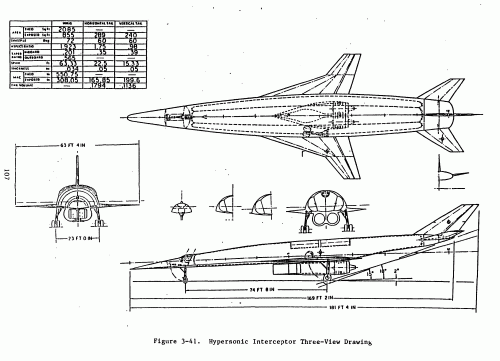
Boeing Model 1074-0006 Hypersonic Interceptor
- Thread starter Tuomasn
- Start date

- Joined
- 25 June 2009
- Messages
- 15,517
- Reaction score
- 9,300
shockonlip
ACCESS: Top Secret
- Joined
- 29 January 2008
- Messages
- 606
- Reaction score
- 78
The fuselage designs of these remind me more of McDonnell hypersonic designs.
So maybe when you say Boeing, you really mean the current owner of McDonnell.
So maybe when you say Boeing, you really mean the current owner of McDonnell.
- Joined
- 25 June 2009
- Messages
- 15,517
- Reaction score
- 9,300
shockonlip said:The fuselage designs of these remind me more of McDonnell hypersonic designs.
So maybe when you say Boeing, you really mean the current owner of McDonnell.
I think Meteorit can confirm, but the 1074-*** series of designs predate the McDonnell Douglas merger by a couple of decades at least, so, no, it IS Boeing all the way.
shockonlip
ACCESS: Top Secret
- Joined
- 29 January 2008
- Messages
- 606
- Reaction score
- 78
Stargazer2006 said:shockonlip said:The fuselage designs of these remind me more of McDonnell hypersonic designs.
So maybe when you say Boeing, you really mean the current owner of McDonnell.
I think Meteorit can confirm, but the 1074-*** series of designs predate the McDonnell Douglas merger by a couple of decades at least, so, no, it IS Boeing all the way.
Not the 1074 designs, which look VERY Boeing, but Meteorit's original post and the color frames posted
below it (the delta winged vehice), before you posted the Boeing 1074 design. Those designs look very
much to me, like McDonnell designs, Stargazer.
Also, for Meteorit, since he seems very interested,
from the AIAA paper that flateric
posted that showed the picture. Not a lot of info, but
in case he was wondering what the paper said abut it.
The paper title again was:
AERONAUTICAT. TECHNOLOGY 2000: A PROJECTION OF ADVANCED VEHICLE CONCEPTS
Authors:
Cecil C. Rosen III,
Office of Aeronautics and Space Technology,
NASA,
Washington, D.C.
Robert 3. Burger,
Aeronautics and Space Engineering Board,
National Research Council,
Washington, D.C.
Armand Sigalle,
New Product Development,
Boeing Commercial Airplane Company,
Seattle, Washington
pg. 9 bottom
Hypersonic Aircraft.
Hypersonic aircraft, both manned and unmanned,
operating in the sensible atmosphere, will be
able to function at speeds up to Mach numbers
of 12. For such vehicles, new propulsion technologies,
control techniques, and fuel handling (cryogenics)
capabilities will be required. Figure 11 presents
essential and enhancing and supporting technologies
for this class of aircraft.
The hypersonic aircraft illustrations (interceptor,
missiles, and a transport) Figures 12
through IS, reflect potential military and civil
vehicle ConceptS. These aircraft would make use
of multicycle propulsion systems for high total
flight envelope efficiency and new materials and
structures to allow high heat loads and low weight
for both airframe and engine. Cruise Mach numbers
of 6 to 8 would he realized with ranges of hundreds
of miles for the interceptors to thousands of miles
for the other aircraft. The propulsion concepts
include airturbo ramjetlrockets and hydrogen erpansion
cyrojets for the lower hypersonic speeds. For
very high speeds, supersonic combustion ramjets, or
"scramjets," would be utilized.
Integration of the airframe and propulsion
system are important for low total vehicle drag
and proper conditioning of the intake air for
propulsion system operation as well as for the
handling of the hot exhaust gases.
- Joined
- 25 June 2009
- Messages
- 15,517
- Reaction score
- 9,300
shockonlip said:Not the 1074 designs, which look VERY Boeing, but Meteorit's original post and the color frames posted
below it (the delta winged vehice), before you posted the Boeing 1074 design. Those designs look very
much to me, like McDonnell designs, Stargazer.
The first picture in this page in *another* Model 1074 design, hence the "-xxx" in the title of this topic. I believe that the CG images are merely an interpretation of that other 1074.
shockonlip
ACCESS: Top Secret
- Joined
- 29 January 2008
- Messages
- 606
- Reaction score
- 78
Stargazer2006 said:shockonlip said:Not the 1074 designs, which look VERY Boeing, but Meteorit's original post and the color frames posted
below it (the delta winged vehice), before you posted the Boeing 1074 design. Those designs look very
much to me, like McDonnell designs, Stargazer.
The first picture in this page in *another* Model 1074 design, hence the "-xxx" in the title of this topic. I believe that the CG images are merely an interpretation of that other 1074.
But do you see the resemblance of that first aircraft, and the CG interpretations, to past McDonnell hypersonic designs?
Hmmm?


- Joined
- 6 August 2007
- Messages
- 4,376
- Reaction score
- 9,181
shockonlip said:But do you see the resemblance of that first aircraft, and the CG interpretations, to past McDonnell hypersonic designs?
Hmmm?
Like:
http://www.secretprojects.co.uk/forum/index.php/topic,2867.msg91691.html#msg91691
http://www.secretprojects.co.uk/forum/index.php/topic,2867.msg30271.html#msg30271
shockonlip
ACCESS: Top Secret
- Joined
- 29 January 2008
- Messages
- 606
- Reaction score
- 78
quellish said:shockonlip said:But do you see the resemblance of that first aircraft, and the CG interpretations, to past McDonnell hypersonic designs?
Hmmm?
Like:
http://www.secretprojects.co.uk/forum/index.php/topic,2867.msg91691.html#msg91691
http://www.secretprojects.co.uk/forum/index.php/topic,2867.msg30271.html#msg30271
Indeed!

Tuomasn
ACCESS: Secret
- Joined
- 5 January 2006
- Messages
- 482
- Reaction score
- 424
shockonlip said:Also, for Meteorit, since he seems very interested,
from the AIAA paper that flateric
posted that showed the picture. Not a lot of info, but
in case he was wondering what the paper said abut it.
The paper title again was:
AERONAUTICAT. TECHNOLOGY 2000: A PROJECTION OF ADVANCED VEHICLE CONCEPTS
Shockonlip, actually I have that paper.
Last edited:
shockonlip
ACCESS: Top Secret
- Joined
- 29 January 2008
- Messages
- 606
- Reaction score
- 78
Meteorit said:shockonlip said:Also, for Meteorit, since he seems very interested,
from the AIAA paper that flateric
posted that showed the picture. Not a lot of info, but
in case he was wondering what the paper said abut it.
The paper title again was:
AERONAUTICAT. TECHNOLOGY 2000: A PROJECTION OF ADVANCED VEHICLE CONCEPTS
Shockonlip, actually I have that paper.
And yes, the 1074 variant in the paper resembles McDonnell designs, but is a Boeing one.
Now, does anyone have ideas regarding the "nozzles" in the back (in the original 1984 artist impression)?
>And yes, the 1074 variant in the paper resembles McDonnell designs, but is a Boeing one.
So I don't see how you know that this is a Boeing design. So where does this "1074" business come from?
Only one of the three authors is from Boeing. And the Boeing guy is a commercial airplane guy.
For example, I do not see in the 1984 paper we previously discussed any reference of "1074".
>Now, does anyone have ideas regarding the "nozzles" in the back (in the original 1984 artist impression)?
I can see you have probably a good guess, namely "nozzles".
Wanna take a guess at what kind of nozzles?
Notice, it is hard to see, but probably there is a larger ramp, expansion surface on the underside
in the rear, and an inlet ramp.
I would expect right now that this image is just being used as a concept vehicle to illustrate a point
about the future. But I'm willing to take it further. So let me know about this "1074"
business, and maybe I can do something.
- Joined
- 6 August 2007
- Messages
- 4,376
- Reaction score
- 9,181
Meteorit said:Shockonlip, actually I have that paper.
And yes, the 1074 variant in the paper resembles McDonnell designs, but is a Boeing one.
Now, does anyone have ideas regarding the "nozzles" in the back (in the original 1984 artist impression)?
The 1984.jpg vehicle is quite clearly the McDD design mentioned in the McDD thread. I do not see how there is confusion here.
On the McDD design, those two nozzles are XLR-129s. Quite clearly that is the case in 1984.jpg, as you can see the two position nozzle that is so characteristic of the XLR-129.

- Joined
- 1 April 2006
- Messages
- 12,028
- Reaction score
- 13,977
Just note that Boeing's co-author of paper is from their commercial aircraft department, so he would be responsible for 'civil' part of writings on future trends, while NASA guys would use illustrations from every contractor, including McDonnell. Hope that solves the mystery.
shockonlip
ACCESS: Top Secret
- Joined
- 29 January 2008
- Messages
- 606
- Reaction score
- 78
>Okay, nobody seems to be reading the links I am posting (Angry). Let's go through this one by one:
I think we are. I am getting the impression you are not listening to us.
But I am all for modelling hypersonic shapes, and I wish you well, and have fun,
most of all!
Since you are so excited about this one concept design, I would suggest
trying to contact the Boeing author and asking him directly. Be sure
to tell him you were quite taken with some of his example designs.
If you would like, I would be willing to do it. But you tell me.
I would report back to everyone here.
I guess the answer to my question about where this 1074 business comes from,
is that it comes from Stargazer's 1074-0006 3-view gif.
Now THAT looks like a Boeing design! Very different but cool!
I actually like all these different Boeing high speed designs.
I recently bought a AIAA paper out of Boeing that discussed
turbine bypass engines. There was a very cool Boeing high speed
design in that paper as well, that they studied a turbine bypass
cycle with. We ought to collect all these cool Boeing designs.
I'd contribute.
I can see what you are trying to do here in modelling this design.
When I looked at that 1984 design, I did not see a engine module with
a vertical splitter (let's call it that instead of a vertical ramp inlet).
In front of what you call the vertical splitter, I saw a white area that
I thought was the underside of the nose of the vehicle. In other words,
the fuselage was a fatter fuselage. And the dark areas to the back
I thought showed an inclined ramp inlet. Look at it a bit and you may
be able to see what I saw. I see what you mean by the vertical splitter
maybe being there. You may be right.
But in my opinion, I suspect this is just an example design that the
authors used to illustrate one possible configuration. I would suspect,
that if this were a real Boeing design, they would have highlighted it
more like in the other Boeing high speed vehicle papers I have read.
Let me know if you want me to pursue this more.
Regards, and have fun with it!
I think we are. I am getting the impression you are not listening to us.
But I am all for modelling hypersonic shapes, and I wish you well, and have fun,
most of all!
Since you are so excited about this one concept design, I would suggest
trying to contact the Boeing author and asking him directly. Be sure
to tell him you were quite taken with some of his example designs.
If you would like, I would be willing to do it. But you tell me.
I would report back to everyone here.
I guess the answer to my question about where this 1074 business comes from,
is that it comes from Stargazer's 1074-0006 3-view gif.
Now THAT looks like a Boeing design! Very different but cool!
I actually like all these different Boeing high speed designs.
I recently bought a AIAA paper out of Boeing that discussed
turbine bypass engines. There was a very cool Boeing high speed
design in that paper as well, that they studied a turbine bypass
cycle with. We ought to collect all these cool Boeing designs.
I'd contribute.
I can see what you are trying to do here in modelling this design.
When I looked at that 1984 design, I did not see a engine module with
a vertical splitter (let's call it that instead of a vertical ramp inlet).
In front of what you call the vertical splitter, I saw a white area that
I thought was the underside of the nose of the vehicle. In other words,
the fuselage was a fatter fuselage. And the dark areas to the back
I thought showed an inclined ramp inlet. Look at it a bit and you may
be able to see what I saw. I see what you mean by the vertical splitter
maybe being there. You may be right.
But in my opinion, I suspect this is just an example design that the
authors used to illustrate one possible configuration. I would suspect,
that if this were a real Boeing design, they would have highlighted it
more like in the other Boeing high speed vehicle papers I have read.
Let me know if you want me to pursue this more.
Regards, and have fun with it!
Tuomasn
ACCESS: Secret
- Joined
- 5 January 2006
- Messages
- 482
- Reaction score
- 424
I guess the answer to my question about where this 1074 business comes from,
is that it comes from Stargazer's 1074-0006 3-view gif.
It comes from
AD-A259 291 PROPULSION/WEAPON SYSTEM INTERACTION MODEL
Colin Widdison
The Boeing Company
July 1992
But in my opinion, I suspect this is just an example design that the
authors used to illustrate one possible configuration. I would suspect,
that if this were a real Boeing design, they would have highlighted it
more like in the other Boeing high speed vehicle papers I have read.
Yes, however, several other illustrations in the paper are real Boeing designs, such as the Model 733 variant supersonic transport, the Model 733-606 "advanced fighter aircraft" and the Model 1046 long-haul airlifter.
Last edited:
shockonlip
ACCESS: Top Secret
- Joined
- 29 January 2008
- Messages
- 606
- Reaction score
- 78
The Boeing author of that 1988 paper is no longer available.
Armand Sigalla
Chief, Technology Preliminary Design
Boeing Commercial Aircraft Company
Retired from Boeing in 1993, after 35 years with them,
and passed away in 2008 at age 80.
Armand Sigalla
Chief, Technology Preliminary Design
Boeing Commercial Aircraft Company
Retired from Boeing in 1993, after 35 years with them,
and passed away in 2008 at age 80.


Steve Pace
Aviation History Writer
- Joined
- 6 January 2013
- Messages
- 2,266
- Reaction score
- 262
Hey, hey! Not cool!!Meteorit said:Stargazer2006 said:Also you removed the Soviet red star!!
Which apperared in one image! Please wake up!
- Joined
- 25 June 2009
- Messages
- 15,517
- Reaction score
- 9,300
Meteorit said:Stargazer2006 said:Also you removed the Soviet red star!!
Which apperared in one image! Please wake up!
What are trying to tell me here??

airrocket
Dreams To Reality
By mounting the inlets on side chines under fuse one would loose compression lift generated by an standard 2D underbody inlet utilizing the entire forward section on the vehicle planform as an inlet(s) compression ramp. The lift loss would be considerable at hyper velocities. That inlet orientation appears to me to be more of M3/M4 supersonic design. Looks way cool just not sure that would be inlet of choice for hyper flight.

OM
ACCESS: Top Secret
Stargazer2006 said:Meteorit said:Stargazer2006 said:Also you removed the Soviet red star!!
Which apperared in one image! Please wake up!
What are trying to tell me here??
...OOH! OOH! Mis-ter Cot-TER! Mis-ter Cot-TER! Lemme answer this one! Lemme answer this one!
- Joined
- 25 June 2009
- Messages
- 15,517
- Reaction score
- 9,300
Oh... I see.1°) I didn't realize the CG artwork was also yours.
2°) I hadn't previously noticed the sentence in the first post that said the "red star" was a joke.
3°) Not knowing this was yours, I assumed the one with the red star was an artist's concept found on some site, done by someone who believed the project to be Russian.
4°) In Reply #20, you said "I made some modifications to the model". I assumed you reworked pics done by somebody else and simply remarked that you had erased the red star, which I thought was a good thing considering it was a Boeing, not Russian project.
5°) As you assumed I was being cheeky, you answered in a way that I found sarcastic. However there was no malice on my part.
Sorry for all the confusion.

- Joined
- 3 June 2011
- Messages
- 20,033
- Reaction score
- 17,243
Meteorit said:Stargazer2006 said:Sorry folks. I still didn't get it, and I have the unpleasant feeling I'm kept out of this discussion.
Excessive explaining rarely makes things better. But perhaps in this case you should explain what you meant with your post? Because I certainly couldn't interpret it in any positive way from my point of view. As I stated in my first post the "Russian" image was meant as a joke on what to do when you have a (potentially) inaccurate model of a real (or actually designed) airplane - turn it into a What-if.
And I have absolutely no idea what "OM" is meaning.
Horshack. Welcome Back Kotter.
Tuomasn
ACCESS: Secret
- Joined
- 5 January 2006
- Messages
- 482
- Reaction score
- 424
Stargazer2006 said:
<snip>
Sorry for all the confusion.
Okay, I didn't expect that much confusion. Issue settled

bagera3005
ACCESS: Confidential
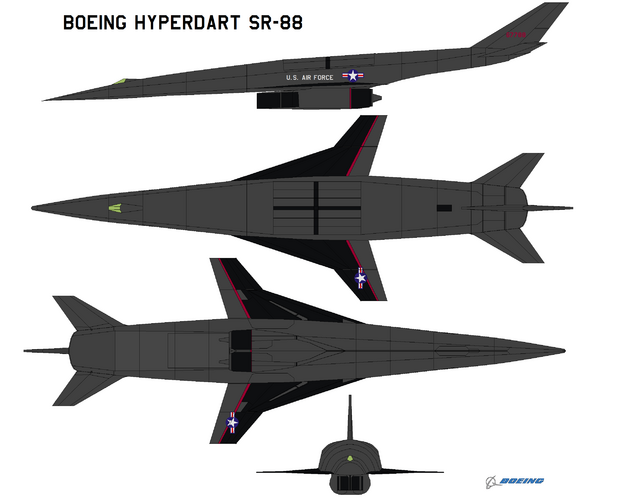
Meteorit said:It comes from
AD-A259 291 PROPULSION/WEAPON SYSTEM INTERACTION MODEL
Colin Widdison
The Boeing Company
July 1992
http://www.dtic.mil/cgi-bin/GetTRDoc?Location=U2&doc=GetTRDoc.pdf&AD=ADA259291
Necro-threading a bit but I noticed something when going through this paper again,
Page 113, Section 3.7.4 "Propulsion" for the Model 1074-006 design is given,
"Uninstalled engine performance was computed using the General Electric tandem turboramjet hyperjet, GE16/F40 study Bi.
The engine is a low bypass ratio, hydrogen fueled augmented turboramjet having a max augmented thrust of 57,718 lb sea level
static. The engine cycle characteristics are bypass ratio (BPR) = 1.5, overall pressure ratio (OPR) = 25, turbine inlet
temperature (TIT) = STOICHIOMETRIC."
Though the engines illustrated are clearly based on the Mardquart Mach-4+ SERJ engines, and the listed speed (Mach 6.0) fits the proposed performance of that engine with LH2 fuel rather than a turboramjet engine since the "engine" in question only occupies the rear third of the "engine" bay. I can't find anything online anywhere about the cited engine the "General Electric Tandem Turboramjet Hyperjet, GE16/F40 study Bi" which further muddles the waters.
Any comments on that?
Randy

- Joined
- 2 May 2007
- Messages
- 557
- Reaction score
- 2,322
Mach 6 Reconnaissance Model 1074-0012

from A Method of Sizing Multi-Cycle Engines for Hypersonic Aircraft
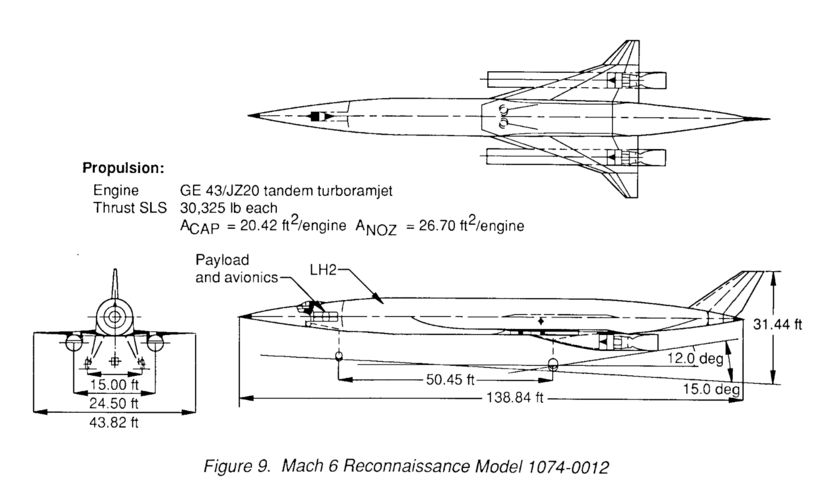
from A Method of Sizing Multi-Cycle Engines for Hypersonic Aircraft
Last edited:
Tuomasn
ACCESS: Secret
- Joined
- 5 January 2006
- Messages
- 482
- Reaction score
- 424
For the record the design that started this thread is not Boeing but a variant of the McDonnell Mach 6 Interceptor. My apologies, I was confused over ten years ago I would suggest starting a new thread in the projects section for the Model 1074-0012 image @Dew just posted (Also CiTrus90 has made an actual 1074-0006 render)
I would suggest starting a new thread in the projects section for the Model 1074-0012 image @Dew just posted (Also CiTrus90 has made an actual 1074-0006 render)
Last edited:

GreenBullet
International rules-based hors d'oeuvre
- Joined
- 2 September 2015
- Messages
- 52
- Reaction score
- 94

- Joined
- 22 January 2006
- Messages
- 4,393
- Reaction score
- 2,674
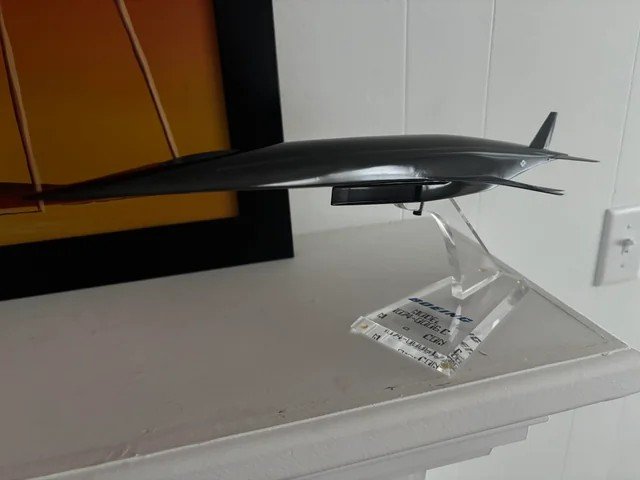
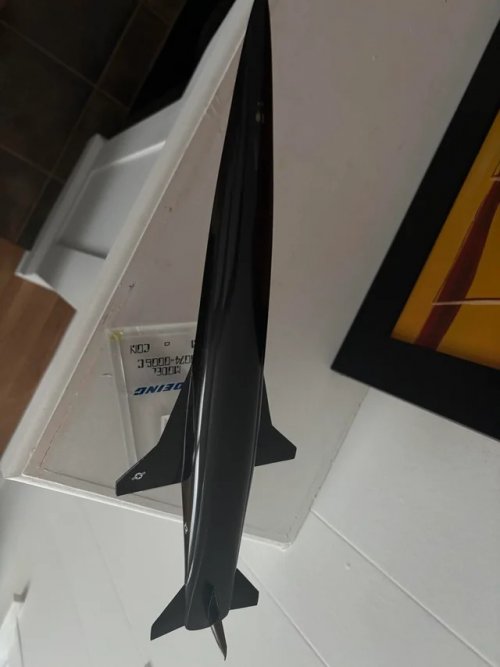
The image has been deleted by the Reddit moderators.
Did you downloaded it when it was still available to post it here?

- Joined
- 27 December 2005
- Messages
- 18,721
- Reaction score
- 33,132
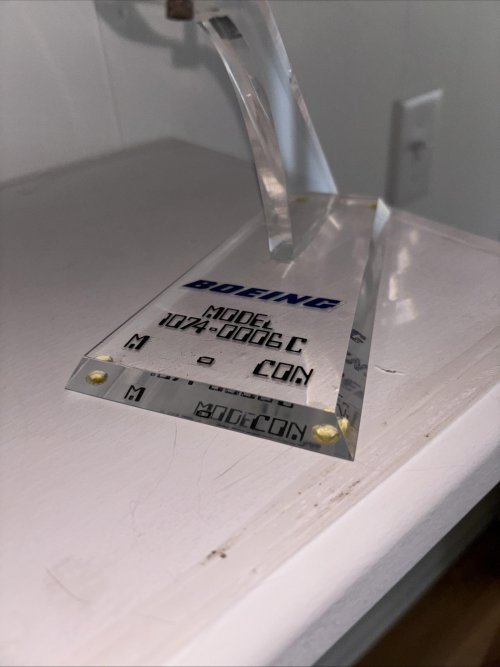
Google image search cache got me these.
Stand lettering is a bit... unusual shall we say.
Stand lettering is a bit... unusual shall we say.
Attachments

- Joined
- 19 February 2007
- Messages
- 1,601
- Reaction score
- 3,285
Huh. Typeface looks a MICR E-13B derivative such as Amelia or Westminster. Physically, it looks like rub-on wax transfer like Letra-set. Somebody was was going for "very futuristic". Gut feel - mid to late-70s?
- Joined
- 27 December 2005
- Messages
- 18,721
- Reaction score
- 33,132
Not an expert, but all the lettering except the Boeing logo looks like Letraset applied by the owner. How sure are we its a genuine model?
GreenBullet
International rules-based hors d'oeuvre
- Joined
- 2 September 2015
- Messages
- 52
- Reaction score
- 94
How sure are we its a genuine model?
I am not, but it's an incredibly obscure thing for a third party to be putting out notional models for. Although never say never when it comes to airplane nerds.
Similar threads
-

-

-

-
 Early/mid 80s Boeing 1074-006 Hypersonic Interceptor
- Started by overscan (PaulMM)
- Replies: 2
-