Do UUVs and USVs make subchasers viable again?

johnpjones1775

ACCESS: Top Secret
Joined
27 May 2023
Messages
1,373
Reaction score
767
The sub chaser, a long forgotten and disused class of combat vessel was once a cheap means of protecting coastal/littoral regions from sub attack.

It can be argued the ASW module was an attempt to turn the LCS into a modern sub chaser, but that part of the program failed.

So could the use of UUVs or USVs with their own sonars be the answer?

Think of the MK VI boat as an example.
Instead of launching a RHIB off the ramp in back you launch a UUV. This drone has its own sonar, and potentially even its own warhead, but the sonar feeds back to the boat, which is armed with a mk38 mod4 and a single SVTT, and maybe sonobuoys.

Shore based ASWA helicopters or birds from a central base vessel like an ESB can then be vectored to continue to pursue any hostile subs detected, if it’s deemed unreasonable for the boat to close and engage.
 
These could also be combined with a concept I came up with a while ago I called the MFD, or mobile FAC dock.

Basically an LPD, but instead of ship to shore connectors in the well deck you carry FAC.

In this case you’d carry subchasers, and rotate them out as the crews need a rest or the boats need refueling.

6 subchasers carried means you ideally operate 3 at a time escorting a convoy, but can cut down to 2 at a time if boats go down for some reason.
 
Not a small USV, I don't think.

Sensors need too large a hull, whether pulling a towed array and VDS or getting a hull sonar far enough away from the engines.

I'm suspecting we're talking a 3000-4000 ton minimum size to be able to haul the towed sonars.
 
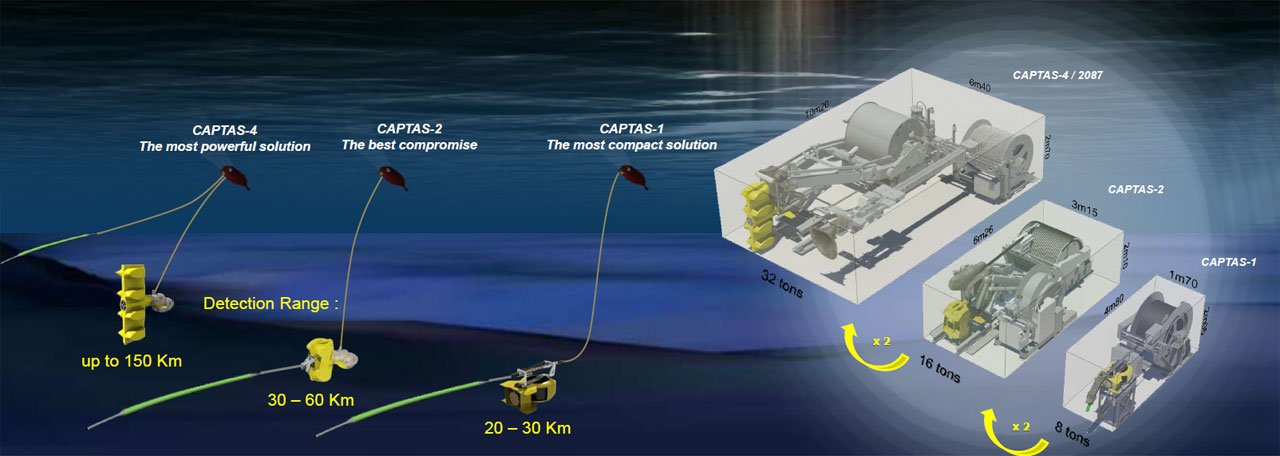
USV doesn't need to be that big. A CAPTAS-1 isn't that big either (<1 m). The main size of the system is the cable winding component.
The USV needs to accomodate 20 - 40 ft ISO containers, hence, by that requirement alone it's more than sufficient large and powerful enough for towing. At ~196 ft gives around 2000 t.
As for chasing, yes and no. Once a contact has been detected smaller UAV drones willl be launched to drop sonar buoy. This should be a lot faster than callling in a manned helicopter. If confirmed then an ASW helicopter coud be send out for the hunt. If there's enough USV around then a number of them could be send out to close the range and bring in their larger torpedo magazine (than helicopter).
Ofc if ASROC and the like is available then that woulld lessen the need for a close tail chase.
We'll probably see depth charge equiped UAV drones soon.
CAPTAS-1-2-4.jpg
 
Not a small USV, I don't think.

Sensors need too large a hull, whether pulling a towed array and VDS or getting a hull sonar far enough away from the engines.

I'm suspecting we're talking a 3000-4000 ton minimum size to be able to haul the towed sonars.
Proven on vessels under 500 tons, granted that doesn’t necessarily mean it will work on something as small as a MK VI but it’s a starting point and the first thing that came up when I googled ‘small towed sonar array’

https://www.l3harris.com/sites/defa...odel_980-active-low-frequency-towed-sonar.pdf

And the navy is currently working on smaller sonar arrays for smaller vessels already.


https://www.sbir.gov/awards/31337
 
Last edited:
Proven on vessels under 500 tons, granted that doesn’t necessarily mean it will work on something as small as a MK VI but it’s a starting point and the first thing that came up when I googled ‘small towed sonar array’
Yeah, the UK has already demonstrated the capability to stream a thinline from Oceanus12:

https://www.navylookout.com/royal-navy-evaluates-first-usv-to-deploy-a-thin-line-towed-array-sonar/
Not necessarily a "small" USV but not inordinately large, either. Obviously your array length is limited by the size of the reel you can fit on the thing, but your bigger issues are generally going to be mechanical reliability. Streaming and retrieving a towed array is one of those evolutions where the simplest thing can go wrong and the entire evolution is cooked.

Personally I believe that USVs towing thinlines around will probably be a big part of future ASW. Boats today are being launched with fewer and fewer acoustic vulnerabilities and many of the other solutions are becoming unviable.
 
Yeah, the UK has already demonstrated the capability to stream a thinline from Oceanus12:

https://www.navylookout.com/royal-navy-evaluates-first-usv-to-deploy-a-thin-line-towed-array-sonar/
Not necessarily a "small" USV but not inordinately large, either. Obviously your array length is limited by the size of the reel you can fit on the thing, but your bigger issues are generally going to be mechanical reliability. Streaming and retrieving a towed array is one of those evolutions where the simplest thing can go wrong and the entire evolution is cooked.

Personally I believe that USVs towing thinlines around will probably be a big part of future ASW. Boats today are being launched with fewer and fewer acoustic vulnerabilities and many of the other solutions are becoming unviable.
Considering I was thinking of something like a MK VI boat a 12m boat is pretty small.
 
The sub chaser, a long forgotten and disused class of combat vessel was once a cheap means of protecting coastal/littoral regions from sub attack.

Think of the MK VI boat as an example.
Mk VI: 72t, 45kts, 750nm @ 25kts
PC 461 Class: 450t, 20kts, 3000nm @ 12 kts
Fairmile D: 104t, 29kts, 2000nm @11 kts.

So while the Mk VI is speedy, in comparison to historic subchasers it's far smaller and far shorter ranged - it doesn't even have the range of a WWII MGB. It also has limited Sea State handling, operational up to 8 ft waves, 20 kt winds, but going where the sea wants at 12 ft waves. An escort that can't go where its escortees go has a problem.

Sea State handling is perhaps a question we're not really seeing being asked of a lot of USVs. But it's essential for a lot of places, even in coastal waters.
 
Mk VI: 72t, 45kts, 750nm @ 25kts
PC 461 Class: 450t, 20kts, 3000nm @ 12 kts
Fairmile D: 104t, 29kts, 2000nm @11 kts.

So while the Mk VI is speedy, in comparison to historic subchasers it's far smaller and far shorter ranged - it doesn't even have the range of a WWII MGB. It also has limited Sea State handling, operational up to 8 ft waves, 20 kt winds, but going where the sea wants at 12 ft waves. An escort that can't go where its escortees go has a problem.

Sea State handling is perhaps a question we're not really seeing being asked of a lot of USVs. But it's essential for a lot of places, even in coastal waters.
Tonnage isn’t quite as important as length. Fairmile is a torpedo boat, and as such some of the tonnage includes torpedo tubes.
For example the SC-497 was closer in length to the Fairmile, but is roughly right in between the Fairmile and MK VI in terms of tonnage.
The SC-1 class however was only 1 ton heavier than a MK VI boat, though still about 25 feet longer.

Fairmile d is a little over 100’ and the MK VI is about 85’, but again it was an example.

Range is relatively irrelevant since it would be carried by the MFD, and refueled by the MFD.(whoops mentioned the MFD in a separate topic. Think something between an ESB and an LPD.)

Carry 6, and you can do a port/starboard rotation of 3, or rotation of 3 pairs.

Could be a crew of each group or one crew that cycles through boats.
 
Last edited:
Tonnage isn’t quite as important as length.
For speed, perhaps. But try sticking 25 tonnes of systems in a boat with a load capacity of 20ts. Or fuel, for that matter.

Fairmile is a torpedo boat, and as such some of the tonnage includes torpedo tubes.
For example the SC-497 was closer in length to the Fairmile, but is roughly right in between the Fairmile and MK VI in terms of tonnage.
The SC-1 class however was only 1 ton heavier than a MK VI boat, though still about 25 feet longer.
Yes, combatants do often include weapons tonnage.

If the 110ft subchasers were completely satisfactory, why did the US build 341 450t PC 461s? Minimal displacement means minimal capabilities, and I don't think a 75t craft has the capabilities needed.

Range is relatively irrelevant since it would be carried by the MFD, and refueled by the MFD.(whoops mentioned the MFD in a separate topic. Think something between an ESB and an LPD.)
Which gives your entire escort force a single point of failure.

Carry 6, and you can do a port/starboard rotation of 3, or rotation of 3 pairs.

Could be a crew of each group or one crew that cycles through boats.
Not sure why you brought up manning in response to me? Though that's going to be an issue, especially if you expect the crew to also recover and refuel USVs/UUVs. How much rest do you expect them to get in a small, fast craft doing UUV/USV recovery ops at all hours? Small craft have historically been small endurance because that's all the crew can support.

And you didn't address Sea State.
 
Range is relatively irrelevant since it would be carried by the MFD, and refueled by the MFD.(whoops mentioned the MFD in a separate topic. Think something between an ESB and an LPD.)

On paper a mothership-chaser combination sound nice but I've to side with the sea state argument.
How are you going to dock it in a storm? If it can't be done then it has to be abandoned once it runs out of fuel and the convoy fleet moves on.
I think the complications of both moterhsip design (which makes it less efficient) and deploy/recovery process isn't worth it today.
It might be more convenient to design a new class of "two-stage" torpedo or so. The first stage could be designed to be recoverable, hence, get some cost back.
 
It might be more convenient to design a new class of "two-stage" torpedo or so. The first stage could be designed to be recoverable, hence, get some cost back.
That's called an airdropped LWT.

=======================


As for chasing, yes and no. Once a contact has been detected smaller UAV drones willl be launched to drop sonar buoy. This should be a lot faster than callling in a manned helicopter. If confirmed then an ASW helicopter coud be send out for the hunt. If there's enough USV around then a number of them could be send out to close the range and bring in their larger torpedo magazine (than helicopter).
Ofc if ASROC and the like is available then that woulld lessen the need for a close tail chase.
We'll probably see depth charge equiped UAV drones soon.
My mental model is USVs hauling the towed array, with a VTOL UAV doing the killing.

Basically an unmanned FF/FFG, including the onboard helo.


USV doesn't need to be that big. A CAPTAS-1 isn't that big either (<1 m). The main size of the system is the cable winding component.
The USV needs to accomodate 20 - 40 ft ISO containers, hence, by that requirement alone it's more than sufficient large and powerful enough for towing. At ~196 ft gives around 2000 t.
Combined mess:
A CAPTAS-1 isn't enough range to stop a sub with SLCMs, the main threat model for attacking ships. Or to stop torpedoes.

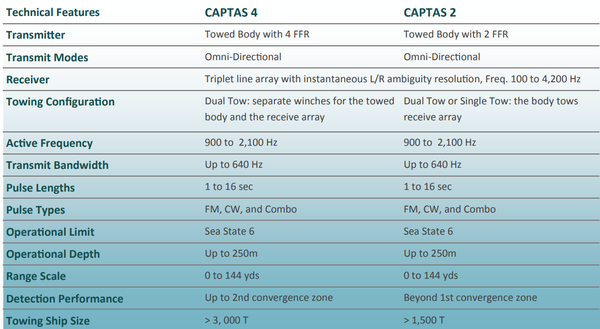
And frankly, even a CAPTAS-2 may not be enough range to stop a Mk48 (open source 55km range).

So now we're up to needing CAPTAS-4.
 
My mental model is USVs hauling the towed array, with a VTOL UAV doing the killing.

Basically an unmanned FF/FFG, including the onboard helo.
Well, I did say from the beginning UAV/ASW-helicopter are part of the system. The two-tage torpedo is just an alternative to the old chaser role.
A CAPTAS-1 isn't enough range to stop a sub with SLCMs, the main threat model for attacking ships. Or to stop torpedoes.

And frankly, even a CAPTAS-2 may not be enough range to stop a Mk48 (open source 55km range).

So now we're up to needing CAPTAS-4.

Only if the USV are the target. The protected ships inside are further away and as I said the distance allows better warning and defense planning. The USV being both sensor net and defense line there are not only more options for actions but also more opportunities to return fire and intercept fire.
 
For speed, perhaps. But try sticking 25 tonnes of systems in a boat with a load capacity of 20ts. Or fuel, for that matter.


Yes, combatants do often include weapons tonnage.

If the 110ft subchasers were completely satisfactory, why did the US build 341 450t PC 461s? Minimal displacement means minimal capabilities, and I don't think a 75t craft has the capabilities needed.


Which gives your entire escort force a single point of failure.


Not sure why you brought up manning in response to me? Though that's going to be an issue, especially if you expect the crew to also recover and refuel USVs/UUVs. How much rest do you expect them to get in a small, fast craft doing UUV/USV recovery ops at all hours? Small craft have historically been small endurance because that's all the crew can support.

And you didn't address Sea State.
It’s not an escort force. It’s a patrol force.

Why did we have DDs and CLs? Or CLs and CAs?

The larger sub chaser’s capabilities as sub chasers increased marginally with increased size. The larger sub chasers were given more capability for AAW and ASuW in WWII.

My point about tonnage and weapons, being that weight added by anti-shipping torpedo tubes, doesn’t effect the boat’s suitability as a sub chaser.

Throw an SVTT on a MK VI and its tonnage increases, but that has no bearing on if it can operate a towed sonar array.

Sea state will limit operations, but it limits operations eventually for any ship. I imagine sea state plays a big detriment for towed arrays no matter how large the host platform
 
Last edited:
Sea state will limit operations, but it limits operations eventually for any ship. I imagine sea state plays a big detriment for towed arrays no matter how large the host platform
No. That's the thing subs aren't necessarilly affected by sea state.
According, to the ads the towed sonar operate to a depth of 250 m.
v2-1278da94651ab239daabc35952c08033_b.png
Marine research says ordinary storms don't disturb sediments (sand) below 40m and deeper than 100 m is effected by suspended sediment flow. The Navy faq #21 states:
In extremely violent storms like hurricanes and cyclones, wave motion can reach 400 feet or more below the surface. Though not as violent as on the surface, these large waves can cause a submarine to take 5 to 10 degree rolls.
400 ft ~122m
the sonars are fine.
 
Only if the USV are the target. The protected ships inside are further away and as I said the distance allows better warning and defense planning. The USV being both sensor net and defense line there are not only more options for actions but also more opportunities to return fire and intercept fire.
Right, but you'd be talking about those sub-chaser USVs needing to be more than 30km from the protected ships to give you enough standoff from Mk48s, assuming CAPTAS-1. Hull down over the horizon or farther out.

And that's still not enough standoff if we're talking AShMs as the primary threat.


My point about tonnage and weapons, being that weight added by anti-shipping torpedo tubes, doesn’t effect the boat’s suitability as a sub chaser.

Throw an SVTT on a MK VI and its tonnage increases, but that has no bearing on if it can operate a towed sonar array.
You do need a certain minimum size to effectively tow an array.


Sea state will limit operations, but it limits operations eventually for any ship. I imagine sea state plays a big detriment for towed arrays no matter how large the host platform
There's a reason that the USN went with SWATH catamarans for their SURTASS ships.
 
No. That's the thing subs aren't necessarilly affected by sea state.
According, to the ads the towed sonar operate to a depth of 250 m.
View attachment 799004
Marine research says ordinary storms don't disturb sediments (sand) below 40m and deeper than 100 m is effected by suspended sediment flow. The Navy faq #21 states:

400 ft ~122m
the sonars are fine.
Ok what do submarines have to do with surface vessels?

You don’t think waves jerking the cable towing the array around won’t have an effect on how well it works?
 
Last edited:
Right, but you'd be talking about those sub-chaser USVs needing to be more than 30km from the protected ships to give you enough standoff from Mk48s, assuming CAPTAS-1. Hull down over the horizon or farther out.

And that's still not enough standoff if we're talking AShMs as the primary threat.


You do need a certain minimum size to effectively tow an array.


There's a reason that the USN went with SWATH catamarans for their SURTASS ships.
I never said you didn’t? I just pointed out tonnage is not the metric to use to determine that. A 100ft boat will have different tonnage depending on what it’s made of .
A steel ship will be heavier than one made from aluminum or wood or carbon fiber.
 
Right, but you'd be talking about those sub-chaser USVs needing to be more than 30km from the protected ships to give you enough standoff from Mk48s, assuming CAPTAS-1. Hull down over the horizon or farther out.

And that's still not enough standoff if we're talking AShMs as the primary threat.
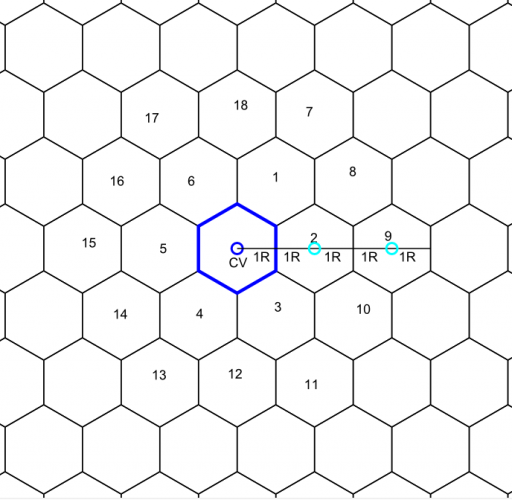
Let's take a single protected ship as an example for easy imagination and using a hexagonal map. A hexagon representing the sensor range.

Now, your argument of 30km range is only valid if the protected ship has no sonar itself at all. Then the USV would be placed at each corner of the hexagon.

If the protected ship does have the same 30km sonar range then all USV would be the cells around the center cell hexagon and the distance between USV and protected ship would be 60 km. But the total range of the net would be 90 km.
With 60km it would be 180 km; with 150 km it would be 450km.
With a fleet the range would be much further:
So a fleet of 19 protected ships or 3 ships in a radius line would have a range of 300-750 km (to the center) with 18 USV.

Also I did say :
As for chasing, yes and no. Once a contact has been detected smaller UAV drones willl be launched to drop sonar buoy. This should be a lot faster than callling in a manned helicopter. If confirmed then an ASW helicopter coud be send out for the hunt. If there's enough USV around then a number of them could be send out to close the range and bring in their larger torpedo magazine (than helicopter).

Ok what do submarines have to do with surface vessels?
Not being effected the same as surface ships in a storm?
You don’t think waves jerking the cable towing the array around won’t have an effect on how well it works?
See the ads it says works up to sea state 6.
The key issue you should be asking is that noise from wave might make it all pointless. But then I'm sure the navy has figured out that ages ago how to deal with it.
 
Let's take a single protected ship as an example for easy imagination and using a hexagonal map. A hexagon representing the sensor range.

Now, your argument of 30km range is only valid if the protected ship has no sonar itself at all. Then the USV would be placed at each corner of the hexagon.

If the protected ship does have the same 30km sonar range then all USV would be the cells around the center cell hexagon and the distance between USV and protected ship would be 60 km. But the total range of the net would be 90 km.
With 60km it would be 180 km; with 150 km it would be 450km.
With a fleet the range would be much further:
So a fleet of 19 protected ships or 3 ships in a radius line would have a range of 300-750 km (to the center) with 18 USV.
Uhm...

You'd need a whole lot more than 18x USVs.

Convoy in center, 6x USVs in the inner ring. Middle ring needs 12x USVs (vertex plus one halfway down each face), outer ring needs 18x USVs (vertex plus 2 on each face). 36 total USVs to cover the entire area.


Not being effected the same as surface ships in a storm?

See the ads it says works up to sea state 6.
The key issue you should be asking is that noise from wave might make it all pointless. But then I'm sure the navy has figured out that ages ago how to deal with it.
Sea State 6 is only 20ft waves.

And I've seen that in the Pacific on a clear day, no clouds horizon to horizon.

Nevermind whatever monstrosity sucked us up from 160ft. Those were waves over 65ft tall.
 
You'd need a whole lot more than 18x USVs.

Convoy in center, 6x USVs in the inner ring. Middle ring needs 12x USVs (vertex plus one halfway down each face), outer ring needs 18x USVs (vertex plus 2 on each face). 36 total USVs to cover the entire area.
It all depends how you want to place and use the protected ship.
If you don't want to use them then sure you need more. In this case all protected ship are at center and range denpends on how many "rings" of USV you want 2 rings is what I said 150(CAPTAS-1)-300(CAPTAS-2)-750(CAPTAS-4) km and 6+12 USV.
If all ships take part in the net structure then two outer layer of USV will suffice. Well, I suppose it's always at least 2 layers added.
hexagonal-sensor-net.png
1R being one sensor radius. range is not diameter
 

Similar threads

Back
Top Bottom