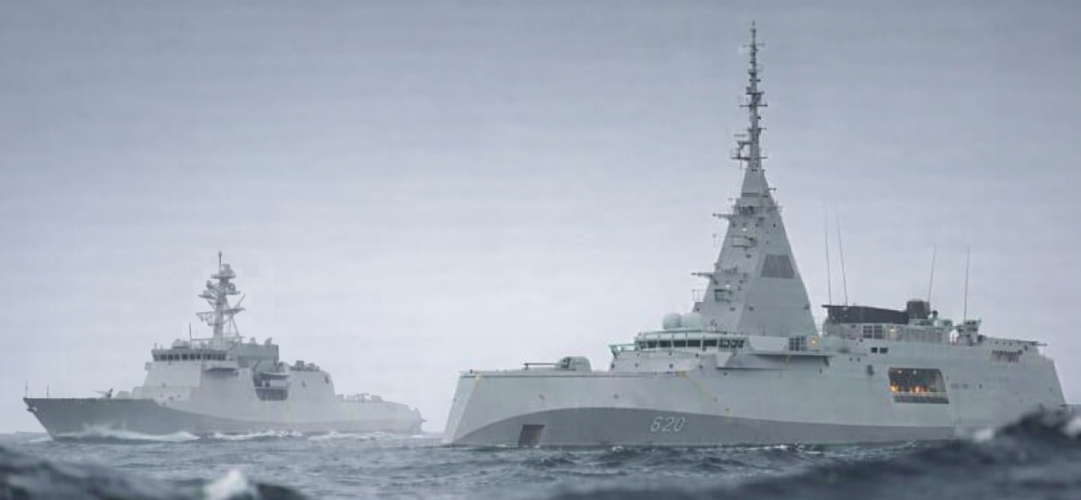
US FF(X) Program - DISCUSSION

Per the link, the Independence class has a 3,500 nm range at 14 knots, but only approximately 1,000 nm at full load Sprint Speed. https://www.surfpac.navy.mil/Ships/By-Class/Littoral-Combat-Ship-Class-LCS/
The 4,300 nm range in wikipedia articles are from here: https://www.al.com/live/2010/04/in_high-stakes_lcs_competition.html Published in 2010.

Legend class has options for all sorts of heavy armaments that they produced for the Saudis. But it went sky high in price when they tried to make it comparable to an Arleigh-Burke imitation. Even the Saudis wouldn't accept that price.
The range listed in your link is labeled the freedom variant which matches up with what the freedom’s wiki says…
I don’t see any range listed in your link for the independence class.

Edit
This and your link might have just been copy/paste jobs but I find it weird I can’t find any official sources that list the independence’s range

https://www.surflant.usff.navy.mil/...at-Ships/Littoral-Combat-Ship-Class-LCS-Info/
Both links, when information between the two variants is identical lists the information on both sides, so the lack of range information under the Indy’s side shouldn’t be interpreted as being the same as a result.
 
Last edited:
Taiwan seems to be working on a 2500 ton class light frigate.
other than being not proven designs wonder why not just use those. Pictures show a VLS deck behind the gun, ASMs, and a flight deck with hangar.
Same reason the US doesn't buy the Israeli Sa'ar (whatever) series.

No space for long deployments.
 
Awhile back some one also mentioned chasing subs down with sonar, so an escort needed speed to get back into position with the convoy.

Based on my conversation with my friend who is currently working as a liaison with some congressman who involved with some committee or other, one of the goals for the batch0 legends will be to utilize a UUV with its own sonar, so the UUV would be what chased down the sub while a helo got into position to drop sonobuoys and a torpedo.

This seems like the future of small cheap combatants. One or two drones with their own sonar to keep the ship itself smaller and cheaper not having its own sonar installed.
 
Awhile back some one also mentioned chasing subs down with sonar, so an escort needed speed to get back into position with the convoy.

Based on my conversation with my friend who is currently working as a liaison with some congressman who involved with some committee or other, one of the goals for the batch0 legends will be to utilize a UUV with its own sonar, so the UUV would be what chased down the sub while a helo got into position to drop sonobuoys and a torpedo.

This seems like the future of small cheap combatants. One or two drones with their own sonar to keep the ship itself smaller and cheaper not having its own sonar installed.
That is always going to be a challenge, talking to a submerged UUV (or manned sub).

Floating wire radio antenna would probably be best.
 
Based on my conversation with my friend who is currently working as a liaison with some congressman who involved with some committee or other, one of the goals for the batch0 legends will be to utilize a UUV with its own sonar, so the UUV would be what chased down the sub while a helo got into position to drop sonobuoys and a torpedo.

This seems like the future of small cheap combatants.
Great, let's spend billions based on an unproven Powerpoint concept.

Wait, where have I heard that one before? Oh yes, that's how the USN got into this mess in the first place.
 
Great, let's spend billions based on an unproven Powerpoint concept.

Wait, where have I heard that one before? Oh yes, that's how the USN got into this mess in the first place.

We are at a technology inflection point.

While I understand your position, we also don't want to be the guys that hung onto horses when others embraced tanks.
 
Great, let's spend billions based on an unproven Powerpoint concept.

Wait, where have I heard that one before? Oh yes, that's how the USN got into this mess in the first place.
Sea drones are extremely proven, particularly using sonar.
Much of mine hunting/sweeping is being conducted by UUV already. So you’d just be expanding the underwater detection capabilities of UUVs. The only real question is can you fit a sonar powerful enough into a UUV that can be operated from this ship for the idea to be viable.
Torpedoes that have their own seekers are basically just a suicide drone in the same vein as I’m describing. The only additional capability being suggested here is the ability to communicate what the torpedo is hearing back to the ship.
 
Last edited:
Sea drones are extremely proven, particularly using sonar.
Much of mine hunting/sweeping is being conducted by UUV already. So you’d just be expanding the underwater detection capabilities of UUVs. The only real question is can you fit a sonar powerful enough into a UUV that can be operated from this ship for the idea to be viable.
Do you mean UUV (underwater) or USV (surface)?

UUVs are a terrible idea for ASW patrols as they don't have the speed & endurance to cover a large area. They also can't keep up with surface ships so that rules out escort missions.

Small USVs on the other hand can work but still only for goalkeeping a port or chokepoint. For open ocean work you need a big powerful towed sonar to give you large area coverage and reach the 2nd convergence zone... like Captas 4 (20-25 tonnes). Plus you need a platform with good seakeeping and endurance/range for 1-2 week patrols (and ideally 4+ weeks)... so basically you're talking a full size USV, likely based on a commercial oil & gas platform.

At that point you might as well just install VDS sonar on your frigates & destroyers, since they have everything else that's needed, including ASW helos, expeditionary capability, robust self-defense etc. Though I wouldn't be averse to fitting USCG cutters or smaller USVs with a small sonar for ASW patrols off the US seaboard...
 
Do you mean UUV (underwater) or USV (surface)?

UUVs are a terrible idea for ASW patrols as they don't have the speed & endurance to cover a large area. They also can't keep up with surface ships so that rules out escort missions.

Small USVs on the other hand can work but still only for goalkeeping a port or chokepoint. For open ocean work you need a big powerful towed sonar to give you large area coverage and reach the 2nd convergence zone... like Captas 4 (20-25 tonnes). Plus you need a platform with good seakeeping and endurance/range for 1-2 week patrols (and ideally 4+ weeks)... so basically you're talking a full size USV, likely based on a commercial oil & gas platform.

At that point you might as well just install VDS sonar on your frigates & destroyers, since they have everything else that's needed, including ASW helos, expeditionary capability, robust self-defense etc. Though I wouldn't be averse to fitting USCG cutters or smaller USVs with a small sonar for ASW patrols off the US seaboard...
Both. Either could be used.
 
Last edited by a moderator:
Both. Either could be used.

OK, please explain how will a UUV carry out ASW patrols.

What's the CONOPS? How long could it operate and at what speeds? What's the sonar power and coverage going to be like? e.g. If it's pinging a dead slow speed (2-3 knots) and broadcasting its presence to every SSK or SSN out there, won't the opposition subs just make a beeline to avoid it? And if it does make contact, how does it avoid losing contact against a much faster sub, especially if it has to come up to periscope depth to send out a contact report? Etc
 
Last edited:
As numerous as they should be they should be forming a sensor net around the ship/fleet at some distance, preferable sufficiently far so ships can roam freely inside. This is ofc for being on station not cruising toward area of operation.
They do not need to do the chasing since USV woud be faster anyway.
Besides ships, subs and USV alike can have towed sonar.

Sonar has been cheap and available to the civilian sector for decades (fishing boats, science etc.) and apparently these "small" devices are sufficient for 7 km range and 11 km depth and can do imaging.
https://jorgenamundsen.com/series-sonar-technical-specifications-and-capabilities/It's endurance and sensitivity that's a bigger problem.

Surface ships are noisy anyway, so it's not like a sub can't find them easily. The sized network will keep them at a much longer distance than otherwise. This gives more time to plan defenses and intercepts.
Fast submarines make noise, too. None of them will do so. They will try to find holes to get closer.
 
OK, please explain how will a UUV carry out ASW patrols.

What's the CONOPS? How long could it operate and at what speeds? What's the sonar power and coverage going to be like? e.g. If it's pinging a dead slow speed (2-3 knots) and broadcasting its presence to every SSK or SSN out there, won't the opposition subs just make a beeline to avoid it? And if it does make contact, how does it avoid losing contact against a much faster sub, especially if it has to come up to periscope depth to send out a contact report? Etc
Make the UUV fast. Somehow torpedoes are expected to catch up to submarines.

And as I’ve said, vector helicopter to begin dropping sonobouys and a torpedo on the contact.
Not that hard.

As some one else said, a floating wire antenna.
 
Make the UUV fast. Somehow torpedoes are expected to catch up to submarines.

They do it by having relatively short endurances. You can't make a non-nuclear torpedo that runs at 20 knots for a week, and more than you can make a non-nuclear sub that does the same.
 
Make the UUV fast. Somehow torpedoes are expected to catch up to submarines.
And torpedoes have limited radius of action, using exotic fuels. Are the vaunted rigorous USN safety standards that deep-sixed FFG(X) really likely to allow onboard stowage of Otto Fuel on FF(X) for UUV refuelling when it's toxic and requires respirators for handling?
 
They do it by having relatively short endurances. You can't make a non-nuclear torpedo that runs at 20 knots for a week, and more than you can make a non-nuclear sub that does the same.
Doesn’t need to run at 20 knots for a week
 
Try 10 knots for 1 week. Even that a UUV won’t be able to do.
 
And torpedoes have limited radius of action, using exotic fuels. Are the vaunted rigorous USN safety standards that deep-sixed FFG(X) really likely to allow onboard stowage of Otto Fuel on FF(X) for UUV refuelling when it's toxic and requires respirators for handling?
Like I said if UUV isn’t feasible USV.
 

"Of particular note is the emphasis on modularity regarding payloads and potential strike options, with the aft deck designed to slot in a number of intended missions depending on the type of task designated to the frigate."

Minimal sensors, minimal weaponry, reliant on modularity for whatever task is allocated. LCS rides again.
 
As numerous as they should be they should be forming a sensor net around the ship/fleet at some distance, preferable sufficiently far so ships can roam freely inside. This is ofc for being on station not cruising toward area of operation.
They do not need to do the chasing since USV woud be faster anyway.
Besides ships, subs and USV alike can have towed sonar.

Sonar has been cheap and available to the civilian sector for decades (fishing boats, science etc.) and apparently these "small" devices are sufficient for 7 km range and 11 km depth and can do imaging.
https://jorgenamundsen.com/series-sonar-technical-specifications-and-capabilities/It's endurance and sensitivity that's a bigger problem.

Surface ships are noisy anyway, so it's not like a sub can't find them easily. The sized network will keep them at a much longer distance than otherwise. This gives more time to plan defenses and intercepts.
Fast submarines make noise, too. None of them will do so. They will try to find holes to get closer.
Have you seen the size of CAPTAS? It's huge you won't have USV that can carry that plus a reasonable range without being huge themselves. CAPTAS is also the current western gold standard for a towed array, I am extremely skeptical that commercial sonar can detect subs without being constantly active. At that point you're broadcasting your position to every sub in the region, greatly simplifying one of the difficulties of subs finding ships.

Not to mention the costs of putting even CAPTAS reduced on a bunch of ships.

"Of particular note is the emphasis on modularity regarding payloads and potential strike options, with the aft deck designed to slot in a number of intended missions depending on the type of task designated to the frigate."

Minimal sensors, minimal weaponry, reliant on modularity for whatever task is allocated. LCS rides again.
The only thing it has going for it is range. But at the expense of cost, timeline, and crewing numbers over LCS.
 
Try 10 knots for 1 week. Even that a UUV won’t be able to do.
Doesn’t need to do that
"Of particular note is the emphasis on modularity regarding payloads and potential strike options, with the aft deck designed to slot in a number of intended missions depending on the type of task designated to the frigate."

Minimal sensors, minimal weaponry, reliant on modularity for whatever task is allocated. LCS rides again.

Have you seen the size of CAPTAS? It's huge you won't have USV that can carry that plus a reasonable range without being huge themselves. CAPTAS is also the current western gold standard for a towed array, I am extremely skeptical that commercial sonar can detect subs without being constantly active. At that point you're broadcasting your position to every sub in the region, greatly simplifying one of the difficulties of subs finding ships.

Not to mention the costs of putting even CAPTAS reduced on a bunch of ships.


The only thing it has going for it is range. But at the expense of cost, timeline, and crewing numbers over LCS.
This is anecdotal but I’ve seen lots of posts from fishermen saying their fish finders have detected either whales or submarines based on the size of the returns. No clue how deep these returns were, anecdotal as I said.
 
And torpedoes have limited radius of action, using exotic fuels. Are the vaunted rigorous USN safety standards that deep-sixed FFG(X) really likely to allow onboard stowage of Otto Fuel on FF(X) for UUV refuelling when it's toxic and requires respirators for handling?

Yes, because Mk 54 torps are already OTTO fueled.
 
Yes, because Mk 54 torps are already OTTO fueled.
Agreed, but that's contained within the Mk 54, you're not hoisting it on deck, opening it up and refuelling it from onboard tanks for extra range, as I presume will be required for any FF(X) deployed UUV.
 
This is anecdotal but I’ve seen lots of posts from fishermen saying their fish finders have detected either whales or submarines based on the size of the returns. No clue how deep these returns were, anecdotal as I said.
At what range? If you're pinging you're going to get reflections off anything nearby, that's the basics of acoustics. How sensitive your sonar is will define the range at which you can usefully detect a sub. A fishfinder pinging into the water immediately below you isn't a militarily useful search sensor. 1) you're broadcasting where you are, and 2) its useful range is suicidally low. A military search sonar needs a usefully large detection range while functioning completely passively. Civilian sonar will probably struggle even against narcosubs, never mind SSKs,
 
At what range? If you're pinging you're going to get reflections off anything nearby, that's the basics of acoustics. How sensitive your sonar is will define the range at which you can usefully detect a sub. A fishfinder pinging into the water immediately below you isn't a militarily useful search sensor. 1) you're broadcasting where you are, and 2) its useful range is suicidally low. A military search sonar needs a usefully large detection range while functioning completely passively. Civilian sonar will probably struggle even against narcosubs, never mind SSKs,
Like i said, no clue. Just random forum posts online. Not much detail.
 
The new “plan” entails building 50-65 FF(X), which could take 20+ years. Then factor in a 30-40 service life and you could have an FF(X) fighting a war in 2075-2090. Good luck to their crews.

Considering the design is already 20+ years old and was obsolete even when it first came out, what could possibly go wrong? The pic below says it all…

FFX vs FDI.png
 
The new “plan” entails building 50-65 FF(X), which could take 20+ years. Then factor in a 30-40 service life and you could have an FF(X) fighting a war in 2075-2090. Good luck to their crews.

Considering the design is already 20+ years old and was obsolete even when it first came out, what could possibly go wrong? The pic below says it all…

View attachment 798748
The burke design is pushing 40 years old, and expected to fight wars for another decade or two. Design age is relatively meaningless.

If it can still mount a useful sensor and useful weapons doesn’t matter much if the design is 2 years old, 20 years old, or 200 years old
 
Awhile back some one also mentioned chasing subs down with sonar, so an escort needed speed to get back into position with the convoy.

Based on my conversation with my friend who is currently working as a liaison with some congressman who involved with some committee or other, one of the goals for the batch0 legends will be to utilize a UUV with its own sonar, so the UUV would be what chased down the sub while a helo got into position to drop sonobuoys and a torpedo.

This seems like the future of small cheap combatants. One or two drones with their own sonar to keep the ship itself smaller and cheaper not having its own sonar installed.
UUVs large enough to "chase down" a sub are rather large and need a large host vessel which can take them aboard. Even if it could use a ramp, which it very much cannot, the basic Orca is more than twice the size of an NSC's RHIB and gets bigger when you add an actual payload.

And, again, how does the crew know a sub's around and that it's time to launch their UUV? ESP? Tarot cards? One of the ships in their convoy blowing up?
 
View: https://x.com/nomadpossum/status/2011736173295861877

AI Overview
The image shows an FDI (Frégate de Défense et d'Intervention) frigate, a class of multi-purpose warships designed by the Naval Group. The ship in the photo appears to be the HS Kimon (F601), the first of the FDI HN class for the Hellenic Navy, identified by the hull number '620' visible on the bow.

Key specifications:

Speed Maximum: 27 knots (50 km/h; 31 mph)
Range 5,000 nmi (9,300 km; 5,800 mi) at 15 knots (28 km/h; 17 mph)
Endurance 45 days
Complement 125 (+28 passengers)
Displacement 4,460 t (4,390 long tons)
Length 122 m (400 ft 3 in)
Beam 17.7 m (58 ft 1 in)
Propulsion Combined diesel and diesel (CODAD) arrangement
Total output: 32,000 kW (43,000 shp)
Armament
1 × Oto Melara 76 mm Super Rapid gun (in stealth cupola)
2 × Nexter Narwhal 20B 20 mm RWS
8 × Exocet MM-40 Block 3c anti-ship missiles
2 × Sylver A50 8-cell VLS for 16 Aster 15 or 30 surface-to-air missiles (first three French FDIs from build); 4 x 8 (32 Aster 15/30) on last two French FDIs from service entry[3] or retrofit to other vessels of the class in the 2030s
2 × 2 Sadral Mistral Simbad-RC point-defence SAM (either fit from build or retrofit)
2 × twin torpedo tubes for MU90 Impact torpedoes
Cost
€2.1 billion (2017) (equivalent to €2.3 billion in 2022)[1] for 5 units
€3.5 billion (2017) (equivalent to €3.9 billion in 2022)[1] including development costs

The idea that guided missile frigates will be under $2.5 billion seems illogical at this point.
Not really. Not if you accept an American frigate doesn’t need to be nearly as capable as a destroyer.
Most of the cost of a surface combatant outside of the steel for the ship itself and labor, is the radar.
If you have 4 phased arest radar, you’re going to be spending like $300m or more on radar.

Edit
Can’t find costs for seafire radar panels but assuming a very conservative estimate of $60m each that’s $240m just in the radar.

Those ships also have kingklip mk2 HMS, which is estimated to be around $100m
As well as CAPTAS which is around another $69m
So just on radar and sonar they’re spending $400m at bare minimum.

A frigate can easily get by with just the CAPTAS sonar and a radar like EASR which as noted below cost $61m and have a ship with sonar and radar package for about half the cost of the belharra radar cost.
 
Last edited:
Small USVs on the other hand can work but still only for goalkeeping a port or chokepoint. For open ocean work you need a big powerful towed sonar to give you large area coverage and reach the 2nd convergence zone... like Captas 4 (20-25 tonnes). Plus you need a platform with good seakeeping and endurance/range for 1-2 week patrols (and ideally 4+ weeks)... so basically you're talking a full size USV, likely based on a commercial oil & gas platform.

At that point you might as well just install VDS sonar on your frigates & destroyers, since they have everything else that's needed, including ASW helos, expeditionary capability, robust self-defense etc. Though I wouldn't be averse to fitting USCG cutters or smaller USVs with a small sonar for ASW patrols off the US seaboard...
I suspect that a large USV (~2500 tons or more) is going to be the norm for ASW.

Something big enough to tow at least one towed array, two would be better, and two tails plus a bow/hull sonar the optimal. It's got a lily pad for ASW UAVs plus some VLS (~32 cells). Maybe even an AEW UAV to give warning of sea-skimming missiles, though I expect the manned ship to handle that.
 
Most of the cost of a surface combatant outside of the steel for the ship itself and labor, is the radar.
If you have 4 phased arest radar, you’re going to be spending like $300m or more on radar.
So far off. EASR costs $61M.

Right there on page 277 of the Navy's ship construction budget.
https://www.secnav.navy.mil/fmc/fmb/Documents/26pres/SCN_Book.pdf
P.S. Incidentally, the basic construction cost of an FFG-62 is only $650M. That's the platform cost - everything else is weapons and sensors. So going to a cheapo FF(X) hull isn't where the Navy is going to save money, it's by castrating the ship's military capability.
 
The Turks have a frigate they got for $500m with a 4D AESA radar.
So no, a frigate doesn’t need to be anywhere near $2b
 
The Turks have a frigate they got for $500m with a 4D AESA radar.
So no, a frigate doesn’t need to be anywhere near $2b
For now it's hard to tell how applicable these prices are to US. FFX will tell us.
054A is stupid cheap (and it does have 4x X- arrays, which are rather unlikely to be just illuminators), because series and efficient industry matter.
 
So far off. EASR costs $61M.

Right there on page 277 of the Navy's ship construction budget.
https://www.secnav.navy.mil/fmc/fmb/Documents/26pres/SCN_Book.pdf
P.S. Incidentally, the basic construction cost of an FFG-62 is only $650M. That's the platform cost - everything else is weapons and sensors. So going to a cheapo FF(X) hull isn't where the Navy is going to save money, it's by castrating the ship's military capability.
I meant the full sized panels. When I checked a year or two ago, a burke’s SPY-6 arrays were around $100m per array.

https://www.naval-technology.com/ne...en-more-an-spy-6v-radars-at-nearly-100m-each/
Considering a day or two ago people were here saying rotating radar weren’t good enough for high end air defense I didn’t think I needed to specify.

The belharra given as an example above, has four large fixed arrays presumably comparable to AN/SPY-6 panels, which is the point I was trying to make. Even if each panel is only $60m (which I really doubt) that’s still $240m in radar per ship.
 
Last edited:
For now it's hard to tell how applicable these prices are to US. FFX will tell us.
054A is stupid cheap (and it does have 4x X- arrays, which are rather unlikely to be just illuminators), because series and efficient industry matter.
I know things tend to cost more here, but I doubt it would end up being any where near 4x the cost.

But it would still need to have US systems since the navy would need to start whole new A and C schools to support foreign systems. Which I guess could increase cost of the ships significantly if factored in.
 
Last edited:
But it would still need to have US systems since the navy would need to start whole new A and C schools to support foreign systems. Which I guess could increase cost of the ships significantly if factored in.
That's exactly the issue.

With everything but LCS using SPY6, there's only two radar schools in the Navy. Well, probably 3 total. 1 basic intro school, and then LCS and SPY6 specialty schools.

(And I expect that the LCS will eventually get SPY6)
 
That's exactly the issue.

With everything but LCS using SPY6, there's only two radar schools in the Navy. Well, probably 3 total. 1 basic intro school, and then LCS and SPY6 specialty schools.

(And I expect that the LCS will eventually get SPY6)
LCS radar are being upgraded to TRS-4D radar on the freedoms at least
 
The burke design is pushing 40 years old, and expected to fight wars for another decade or two. Design age is relatively meaningless.

If it can still mount a useful sensor and useful weapons doesn’t matter much if the design is 2 years old, 20 years old, or 200 years old
Expect it was cutting edge when it was launched, not already obsolete. Additionally it was comissioned right before there was a 10-15 year pause in novel naval advancements.
For escort duty it will take 2-3 frigates to escort a convoy so they’ll be in the same place anyway.

Even at $900m per hull 3 frigates would be $2.7b and since we can all agree the FFX is going to cost more than $900m it would likely be awash.
But the convoy would still need at least one frigate for AAW.

But like i said the ship im envisioning would be very light on sensors and weapons itself.
It would not literally be a San Antonio.

As I said something ideally more like a fast ESB.
The difference is the frigates can do something else other than ASW and they can do ASW much better than the USV mothership. As, as stated above you'll likely need something ~2kt to be useful at which point your USV mothership is more of a tender than anything else.

So far off. EASR costs $61M.

Right there on page 277 of the Navy's ship construction budget.
https://www.secnav.navy.mil/fmc/fmb/Documents/26pres/SCN_Book.pdf
P.S. Incidentally, the basic construction cost of an FFG-62 is only $650M. That's the platform cost - everything else is weapons and sensors. So going to a cheapo FF(X) hull isn't where the Navy is going to save money, it's by castrating the ship's military capability.
I wonder how that scales with radar size, as in how much of it is the panels vs ancillary equipment. As if it scales with panel size, AB flight 3's will have a $330M radar, which is pretty close to the number mentioned earlier.

The NSC cost 1 billion inflation adjusted to build. So I imagine FF(X) will be at least 1.2 B with currently worsened ship building industry and some grift from Phelan's business friends is sprinkled in before accounting for any additional equipment.
The Turks have a frigate they got for $500m with a 4D AESA radar.
So no, a frigate doesn’t need to be anywhere near $2b
But you're advocating for something that will likley be 1.2B+ and not have anything equipped. For the best example of a good cheap frigate look at the Super Mogami class at 600M. Additionally Australia is already buying it, so we might as well too and build training + parts commonality.
 
Last edited:

Similar threads

Back
Top Bottom