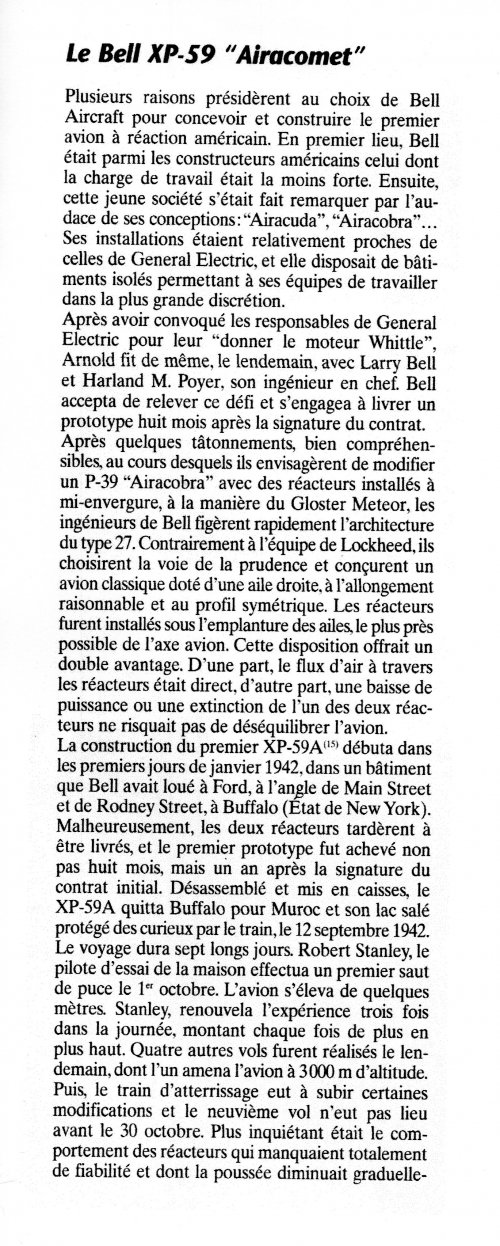
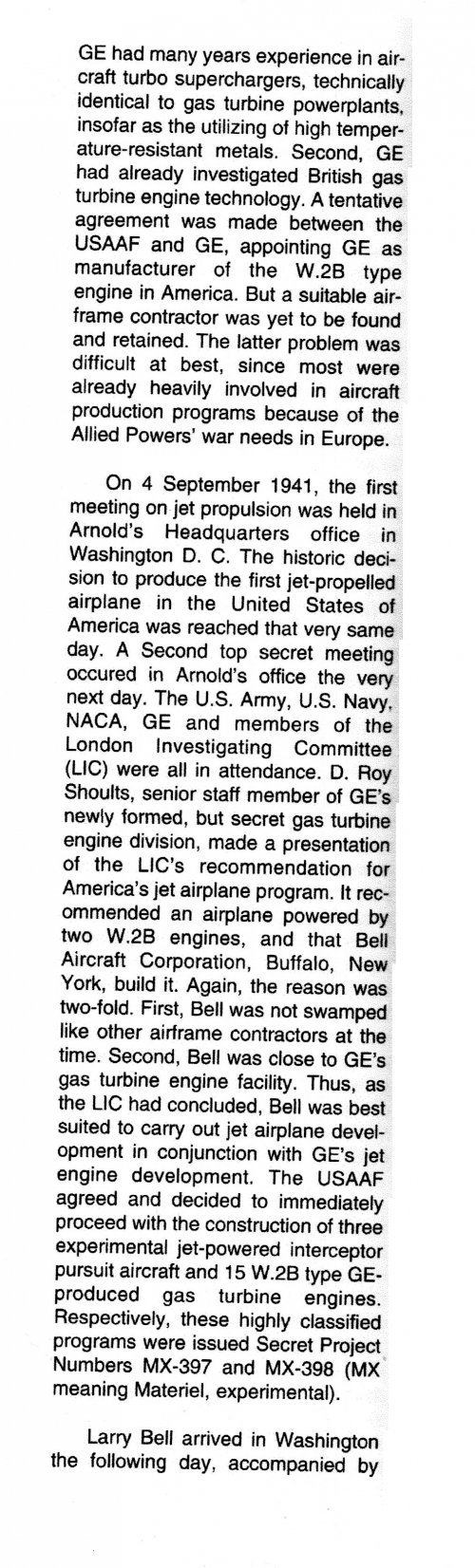
On September 4, 1941, General Henry H. Arnold made the decision to commission General Electric to build the British turbojet Rover W.2B under license with the secret project denomination MX-397.
In the September 5 meeting that occurred in Arnold’s Headquarters office, Dr. Roy Shoults, senior staff member of G.E. gas turbine division, recommended an experimental airplane powered by two G.E. I-16 engines (the American version of W.2B) each rated at 748 kgp, because any single turbojet offering sufficient thrust to provide the required fighter performance, with the secret project denomination MX-398.
He also recommended as a possible manufacturer the Bell Aircraft Corporation facilities at Buffalo-New York.
Larry Bell and the Airacobra designer Harland M. Poyer arrived in Washington on December 6 and after a briefing with General Arnold, they agreed to participate in the MX-398 project.
On September 30, 1941, USAAF issued a letter contract for three prototypes.
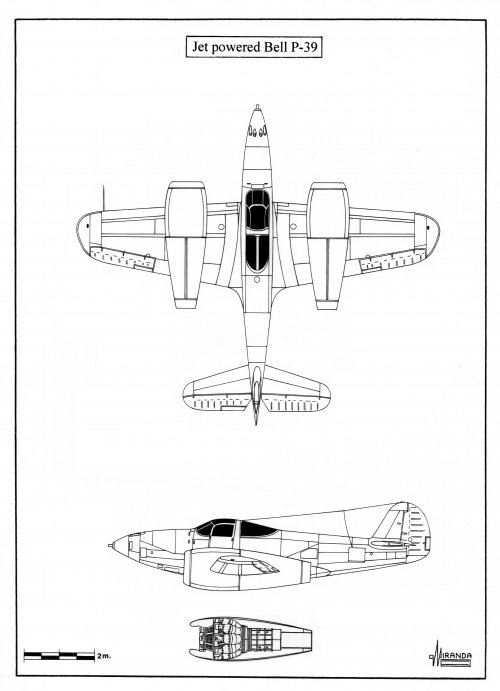
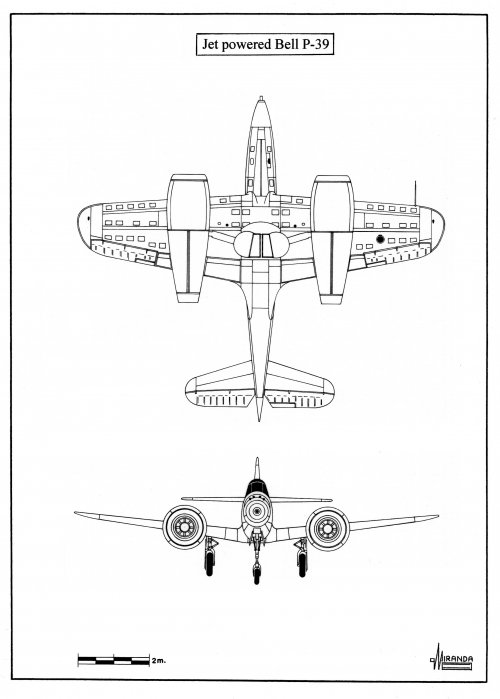
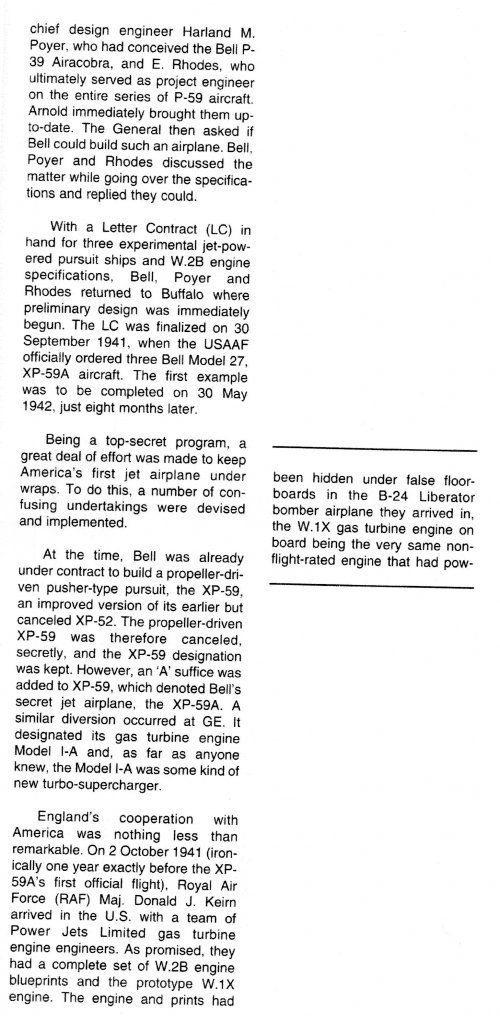
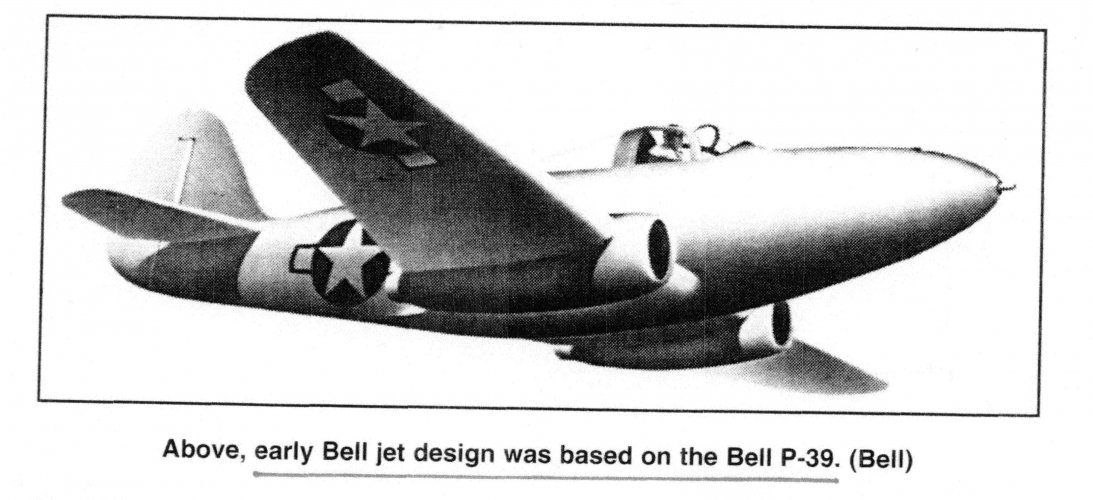
Preliminary design began, Poyer proposed a version of the P-39 standard fighter with two Meteor style wing mounted turbojets and one fuel tank replacing the Allison piston engine.
This first configuration had to be discarded in October, when Bell engineers received the first confidential data on the dimensions and fuel consumption rate of the I-16.
It was necessary to go back to the drawing board, under the leadership of Ed Rhodes, to design the larger aircraft with greater fuel capacity.
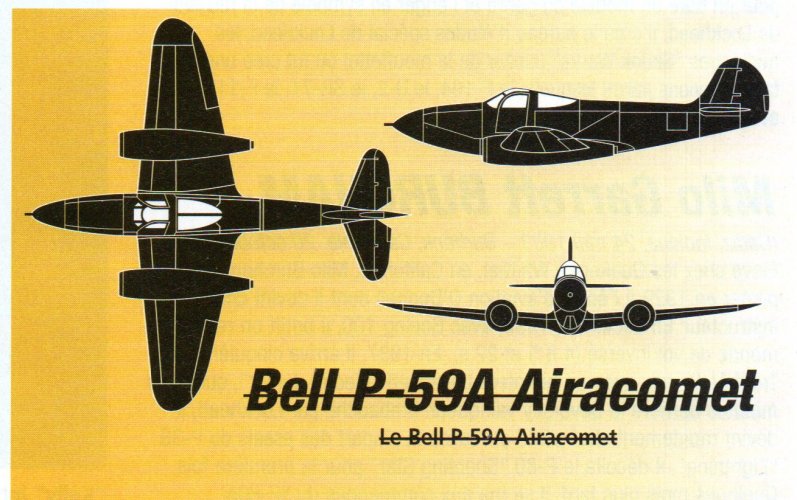
The prototype was designated Bell XP-59A to differentiate it from the piston fighter project XP-59.
In the September 5 meeting that occurred in Arnold’s Headquarters office, Dr. Roy Shoults, senior staff member of G.E. gas turbine division, recommended an experimental airplane powered by two G.E. I-16 engines (the American version of W.2B) each rated at 748 kgp, because any single turbojet offering sufficient thrust to provide the required fighter performance, with the secret project denomination MX-398.
He also recommended as a possible manufacturer the Bell Aircraft Corporation facilities at Buffalo-New York.
Larry Bell and the Airacobra designer Harland M. Poyer arrived in Washington on December 6 and after a briefing with General Arnold, they agreed to participate in the MX-398 project.
On September 30, 1941, USAAF issued a letter contract for three prototypes.
Preliminary design began, Poyer proposed a version of the P-39 standard fighter with two Meteor style wing mounted turbojets and one fuel tank replacing the Allison piston engine.
This first configuration had to be discarded in October, when Bell engineers received the first confidential data on the dimensions and fuel consumption rate of the I-16.
It was necessary to go back to the drawing board, under the leadership of Ed Rhodes, to design the larger aircraft with greater fuel capacity.
The prototype was designated Bell XP-59A to differentiate it from the piston fighter project XP-59.