
No Terrier, no Tartar, no Standard

Sorry to necro this thread, but I missed this snippet the first time. I was completely unaware of this evolutionary pathway - does anyone have additional detailed info?
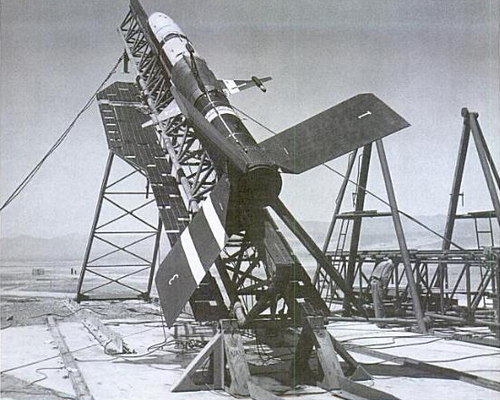
The AAM-N-5 "Meteor" was early post-war attempt from USN to develope ait-to-air guided missile. It was a liquid-fiel powered Mach 2 missile with semi-active radar seeker of interferometer type (like the one that Talos missile used):

1765990901768.png

The missile was build & tested, but by early 1950s, USN started to lose interest in the whole concept. The liquid-fuel rocket motor was massively disliked by sailors from the very beginning, and the interferometer seeker required MASSIVE radar power to operate (since there aren't any reflector, there is no way to focus the reflected energy on the receiver, and thus the return signal must be very powerful). The development shifted toward more promising Sparrow-I (the beam-riding one), which was liquid-fueled and could work with typical fighter radars.

The "Meteor" wasn't outright canned, thought - unlike many early guided weapon programs, made obsolete by technological development - because Royal Navy got interested in it. The British wanted to use it as short-range surface-to-air missile for warships self-defense. Essentially those efforts also got nowhere, since original radar system was not designed for low-altitude interceptions and suffered too much from water reflection (and USN decided not to proceed with X-band seeker for already-obsolete missile).
 
* "Zeus" shell would clearly reach the limit of its development; no modernization would make it capable of competing with supersonic aircraft and anti-ship missiles....

Neither of those systems would actually fit well on small (destroyer-size) ships - albeit it is possible that single-barrel 8-inch RF mount would be developed to provide destroyers with "Zeus" capability.
Zeus was a 4" diameter projectile in side a sabot. It was designed so that it could potentially be fired from 6" and 5" barrels, albeit at lower velocities. It would improve throughout the '50s until transistors hit the scene, at which point guided projectiles would improve rapidly until you wind up with something like DART decades earlier. These would cover point defense, with larger ones with higher velocities perhaps effective for local area defense.

The US, UK, and Sweden all had 6" guns the same time Zeus was in development with fire rate ranging from 12-20 rpm per barrel. The US Mark 42 5" originally had a fire rate of 40 rpm (it was derated later), with proposals for a mark 65 at 48rpm and the Mark 66 dual barrel mount at 96. The Swede's also had the TAK120 120mm gun with a fire rate of 80rpm.

Modern naval gunfire would look entirely different if the Zeus "tech tree" had been developed.

* "Talos" would still have its rate-of-fire and complexity limitation, which would preclude it from being used as self-defense and short-range defense weapon.
Talos would be the long range system, but it's really just too big to be long term viable.
If you eliminate Terrier and Tartar goes with it, I think what happens is that you get Sea Sparrow a lot sooner; possibly even a version with a small booster.

Tartar evolved very quickly to outperform the original winged, beam-riding Terrier. There is no reason why Sea Sparrow, under evolutionary pressure, could not evolve to cover Tartar's original requirement.
It might be a pathway forward for Sparrow II, since you could enlarge it to put a larger terminal guidance radar on it.
If what you're looking for is a missile the size of Tartar, for the space to fit a heavier or possibly nuclear warhead, perhaps a navalized HAWK or a navalized, surface-launched variant of AIM-47 are your go-to candidates.
The obvious candidate is the AAM-N-10 Eagle. It's pretty close to Terrier in size, and even making allowance for reduced range for surface launch it could easily have a longer range that Tartar as is. About all you'd have to do is reduce the booster diameter and lengthen it to make up for the lost volume so that it would have the same diameter the full length of the two stage missile for rail launch and you'd be set.

And if Eagle goes forward, that's more of an incentive to continue Missileer, so you could be looking a mid to late 60s naval air defense system with Missileer covering the outer air-battle, a RIM-Eagle for medium range intercepts, and various caliber guns with guided projectiles handling short and point-blank ranges.
 
Last edited:
So, let's imagine that "Terrier" was never born. How it would affect the history of US Navy SAM?

I suppose, in 1950s, in lieu of lack of alternatives, the USN would adopt SAM-N-8 "Zeus" fin-stabilized gun-launched guided shell as main air defense system. While it was obviously less capable than "proper" guided missile, it still have advantages in much higher fire rate & reliance on proven gun technologies. The long-range air defense would be solely covered by "Talos", which would be the ubiquitous SAM of USN by late 1950s. I suppose, that significantly large number of WW2-era gun cruisers would be refitted into "Talos" & "Zeus" carriers (presumably, with "Talos" SAM system on rear, and 1-2 autoloading 8-inch RF turrets on bow)

But what would become of it by 1959-1960?

* "Zeus" shell would clearly reach the limit of its development; no modernization would make it capable of competing with supersonic aircraft and anti-ship missiles.

* "Talos" would still have its rate-of-fire and complexity limitation, which would preclude it from being used as self-defense and short-range defense weapon.

* Neither of those systems would actually fit well on small (destroyer-size) ships - albeit it is possible that single-barrel 8-inch RF mount would be developed to provide destroyers with "Zeus" capability.

So, what would be next?
Major Caliber Lightweight Gun would be developed ~15 years sooner, and deployed.

Zeus shells should be able to be fired from 5" or 6" guns as well, at lesser performance. Same size dart, different sabots:
Zeus was a 4" diameter projectile in side a sabot. It was designed so that it could potentially be fired from 6" and 5" barrels, albeit at lower velocities. It would improve throughout the '50s until transistors hit the scene, at which point guided projectiles would improve rapidly until you wind up with something like DART decades earlier. These would cover point defense, with larger ones with higher velocities perhaps effective for local area defense.

The US, UK, and Sweden all had 6" guns the same time Zeus was in development with fire rate ranging from 12-20 rpm per barrel. The US Mark 42 5" originally had a fire rate of 40 rpm (it was derated later), with proposals for a mark 65 at 48rpm and the Mark 66 dual barrel mount at 96. The Swede's also had the TAK120 120mm gun with a fire rate of 80rpm.

Modern naval gunfire would look entirely different if the Zeus "tech tree" had been developed.
Yeah, we'd be seeing DART and Vulcano in the 1970s, as "normal" shells. And unguided shells would be minimally used.


Talos would be the long range system, but it's really just too big to be long term viable.
I suspect that the 2nd generation Talos would be Sea Dart sized:
Seadart always struck me as owing more to Talos than Terrier/Tartar. It looks like a reduced size Talos.
The US would have evolved a smaller version of Talos to go on their destroyers.
Agreed, I could see a reduced-sized Talos could very well replace the Standards.


The obvious candidate is the AAM-N-10 Eagle. It's pretty close to Terrier in size, and even making allowance for reduced range for surface launch it could easily have a longer range that Tartar as is. About all you'd have to do is reduce the booster diameter and lengthen it to make up for the lost volume so that it would have the same diameter the full length of the two stage missile for rail launch and you'd be set.
Agreed here.

And if Eagle goes forward, that's more of an incentive to continue Missileer, so you could be looking a mid to late 60s naval air defense system with Missileer covering the outer air-battle, a RIM-Eagle for medium range intercepts, and various caliber guns with guided projectiles handling short and point-blank ranges.
No, I still think that the Missileer is a dead end. Because it cannot deal with any escorting fighters. Which is why F-111B happened. And then developed into F-14 once the lessons of Vietnam happen.
 
Zeus was a 4" diameter projectile in side a sabot. It was designed so that it could potentially be fired from 6" and 5" barrels, albeit at lower velocities. It would improve throughout the '50s until transistors hit the scene, at which point guided projectiles would improve rapidly until you wind up with something like DART decades earlier. These would cover point defense, with larger ones with higher velocities perhaps effective for local area defense.
It won't. The whole concept is far too limited.
 
No, I still think that the Missileer is a dead end. Because it cannot deal with any escorting fighters. Which is why F-111B happened. And then developed into F-14 once the lessons of Vietnam happen.
That's assuming the escorts have the range to reach the Missileers. If they do, the F-111 can only run away faster, and the F-14s have a third the loiter time and will be out of fuel if they have to use afterburner that far from the carrier. Besides, I'll trade a missileer squadron for a bomber regiment anyday.
It won't. The whole concept is far too limited.
Care to elaborate?
 
Care to elaborate?
The Zeus shell used a deflection charge method. I.e. inside the shell was a solid rocket engine, with nozzle aimed at right angle to shell axis. The charge could be ignited by command frok the ship to deflect the shell trajectory in the direction to where nozzle was aimed at this moment. The shell slowly rotated in flight (relatively slowly), and its precise position was constantly tracked by shipborne radar, using vertical antenna polarization to detect moments when shell transponder antenna was in the same plane as shil antenna (spike in signal from shell) and calculate shell rotation speed (time between two spikes).

The deflection charge was activated by signal from the ship, when the angle between shell theoretical trajectory - assumed from gun position - and target bearing exceeded a set value. Then ship fire control computer calculated the direction, in which shell should be deflected, waited for the shell nozzle to be pointed in requred direction (by counting down fractions of shell rotation cycle), and sent activation signal to the charge ignition circuit.

I.e. the Zeus shell was able to make just one course correction in the general direction of the target. It improved accuracy, all right - but it have literally no space for further improvement. Adding, for example, the second deflection charge, would cut into burster weight to the point of shell becoming a slug.
 
Last edited:
Agreed, I could see a reduced-sized Talos could very well replace the Standards.
Except in the long term, ramjets are a dead end because they can't be developed into exoatmospheric killers the way a rocket-driven missile can, and because their engines react very badly to being asked to take sharp corners while still under power.
 
Except in the long term, ramjets are a dead end because they can't be developed into exoatmospheric killers the way a rocket-driven missile can, and because their engines react very badly to being asked to take sharp corners while still under power.
The first is not exactly what is required from average SAM, and the second seems to be questionable. There were a lot of ramjet-powered SAM's, and I didn't recall exactly them having presistent maneuvering problems. Really sharp maneuvers usually required only on terminal stage - where the loss of engine thrust isn't of greater importance, because missile have enough kinetic energy anyway. And ramjet missiles have the advantage of engine burning all the way to target, i.e. always having their full kinetic energy supply for terminal maneuvers.
 
Except in the long term, ramjets are a dead end because they can't be developed into exoatmospheric killers the way a rocket-driven missile can, and because their engines react very badly to being asked to take sharp corners while still under power.
SM3 isn't a typical use case (they make up maybe 1 in 7 missiles in the loadout). And the boosters for a ramjet missile will still require development of solid rockets. As will the development of ballistic missiles.

But I do think it will result in the development of something like Meteor in place of Sparrow. Or the GDW AIM-152 long range AAM in place of AIM47/54
 
The Zeus shell used a deflection charge method. I.e. inside the shell was a solid rocket engine, with nozzle aimed at right angle to shell axis. The charge could be ignited by command frok the ship to deflect the shell trajectory in the direction to where nozzle was aimed at this moment. The shell slowly rotated in flight (relatively slowly), and its precise position was constantly tracked by shipborne radar, using vertical antenna polarization to detect moments when shell transponder antenna was in the same plane as shil antenna (spike in signal from shell) and calculate shell rotation speed (time between two spikes).

The deflection charge was activated by signal from the ship, when the angle between shell theoretical trajectory - assumed from gun position - and target bearing exceeded a set value. Then ship fire control computer calculated the direction, in which shell should be deflected, waited for the shell nozzle to be pointed in requred direction (by counting down fractions of shell rotation cycle), and sent activation signal to the charge ignition circuit.

I.e. the Zeus shell was able to make just one course correction in the general direction of the target. It improved accuracy, all right - but it have literally no space for further improvement. Adding, for example, the second deflection charge, would cut into burster weight to the point of shell becoming a slug.
So we go to aerodynamic controls in the 2nd generation, like Excalibur and DART/Vulcano.

Not a big deal.
 
So we go to aerodynamic controls in the 2nd generation, like Excalibur and DART/Vulcano.

Not a big deal.
Extremely big deal. It would require an order of magnitude more complex electronic and mechanical equipment - to create guided shell with aerodynamic controls. In 1950s it would likely be impossible; the required vacuum tube electronic would be just too bulky and servomechanics not precise enough.
 
Extremely big deal. It would require an order of magnitude more complex electronic and mechanical equipment - to create guided shell with aerodynamic controls. In 1950s it would likely be impossible; the required vacuum tube electronic would be just too bulky and servomechanics not precise enough.
Who said that generation would happen with tube electronics?

This is definitely a 1960s or 70s development, like Copperhead laser-guided 155mm shells.
 
Erm, Zeus did not use semi-active homing. Zeus used command guidance with radar tracking.
But Copperhead used SA homing.

Though we can argue about the best type of guidance for gun-launched projectiles. I'm sure you have reasons for each guidance type?
 
It is well-known, that RIM-2 "Terrier" surface-to-air missile - forebear of the whole "Standard" missile family - was a bit... accidental product. It was developed as byproduct of "Bumblebee" research program, that created long-range RIM-8 "Talos" missile. To better understand the problematic of controlled supersonic flight, Applied Physics Lab of the John Hopkins University developed several test vehicles; one of which was supersonic solid-fuel STV (Supersonic Test Vehicle) for beam-riding guidance system. It proven itself exceptionally well, and when it became apparent, that "Bumblebee" program is more complex than originally expected, Navy decided to develop a simpler missile on the base of STV. And so RIM-2 "Terrier" was born.

But what if it wasn't?

There were a lot of possible divergence points, that could kill the "Terrier" before it was even born. Engineers of Applied Physics Lab may decide that solid-fuel rocket is not powerful enough, and develop STV with liquid-fuel engine. STV itself might just be designed over-complicated and not reliable enough. Or, Navy high ranks could just have a bad day, and dismiss the whole idea of "interim" missile as impractical - only diverting resources from "Bumblebee" project.

So, let's imagine that "Terrier" was never born. How it would affect the history of US Navy SAM?

I suppose, in 1950s, in lieu of lack of alternatives, the USN would adopt SAM-N-8 "Zeus" fin-stabilized gun-launched guided shell as main air defense system. While it was obviously less capable than "proper" guided missile, it still have advantages in much higher fire rate & reliance on proven gun technologies. The long-range air defense would be solely covered by "Talos", which would be the ubiquitous SAM of USN by late 1950s. I suppose, that significantly large number of WW2-era gun cruisers would be refitted into "Talos" & "Zeus" carriers (presumably, with "Talos" SAM system on rear, and 1-2 autoloading 8-inch RF turrets on bow)

But what would become of it by 1959-1960?

* "Zeus" shell would clearly reach the limit of its development; no modernization would make it capable of competing with supersonic aircraft and anti-ship missiles.

* "Talos" would still have its rate-of-fire and complexity limitation, which would preclude it from being used as self-defense and short-range defense weapon.

* Neither of those systems would actually fit well on small (destroyer-size) ships - albeit it is possible that single-barrel 8-inch RF mount would be developed to provide destroyers with "Zeus" capability.

So, what would be next?
This is unlikely. Terrier was born out of Project Bumblebee as the STV, as you note. This was an integral part of that program to develop the flight controls and basic missile guidance system for what became Talos. The Terrier that followed simply did away with the booster stage of the missile for all intents. If not Terrier, then some other similar variant for the STV program would have had to be developed. No STV program, no Bumblebee, no Talos.

The concept was to give ships a layered defense with Talos being the long-range SAM, Terrier, the intermediate range one, and Tartar a short-range (10 NM-ish) version that could also fit on destroyers and other smaller ships.
 
But Copperhead used SA homing.

Though we can argue about the best type of guidance for gun-launched projectiles. I'm sure you have reasons for each guidance type?
I'm afraid, I don't follow. How exactly the facts that Copperhead used laser SA connected with the fact that Zeus used command guidance?
 
I'm afraid, I don't follow. How exactly the facts that Copperhead used laser SA connected with the fact that Zeus used command guidance?
A fin-maneuvered guided shell used SA guidance.

Make it a SARH guided shell and fin-maneuvered shell.

Not much left of the original Zeus concept but the subcaliber dart, though.
 
This is unlikely. Terrier was born out of Project Bumblebee as the STV, as you note. This was an integral part of that program to develop the flight controls and basic missile guidance system for what became Talos. The Terrier that followed simply did away with the booster stage of the missile for all intents. If not Terrier, then some other similar variant for the STV program would have had to be developed. No STV program, no Bumblebee, no Talos.
Simple; you already quoted it:
There were a lot of possible divergence points, that could kill the "Terrier" before it was even born. Engineers of Applied Physics Lab may decide that solid-fuel rocket is not powerful enough, and develop STV with liquid-fuel engine. STV itself might just be designed over-complicated and not reliable enough. Or, Navy high ranks could just have a bad day, and dismiss the whole idea of "interim" missile as impractical - only diverting resources from "Bumblebee" project.
For example, APL might decide that liquid-fuel rocket engine would be better for test vehicle (and Navy would highly unlikely adopt the liquid-fuel missile!). Or the chosen design might not be reliable enough to be of any non-experimental use (imagine that half of STV failed due to rocket motor failures - hardly something that Navy would even consider worthy of non-experimental use!). Or, as I pointed out - Navy could just dismiss the idea of "internum" missile as impractical, that would only divert resources from "Bumblebee".
 
Not much left of the original Zeus concept but the subcaliber dart, though.
That's the whole problem. Not to mention, that radar-homing shell would be much bigger headache than laser-homing one. The shell diameter seriously limit the size of antenna you could fit on it; and the extreme loads would force to use highly inefficient antenna designs. Essentially, it would likely be impossible on vacuum-tube tech, and on transistor tech... why even bother with guided AA shell, when the missiles already proven themselves to be a solution?
 
Simple; you already quoted it:

For example, APL might decide that liquid-fuel rocket engine would be better for test vehicle (and Navy would highly unlikely adopt the liquid-fuel missile!). Or the chosen design might not be reliable enough to be of any non-experimental use (imagine that half of STV failed due to rocket motor failures - hardly something that Navy would even consider worthy of non-experimental use!). Or, as I pointed out - Navy could just dismiss the idea of "internum" missile as impractical, that would only divert resources from "Bumblebee".
Highly unlikely. The USN was very much against using liquid fuel rocket engines aboard ship and even hesitant to use any fuel with the Talos that was highly flammable. Aside from that, fuels like the Thiokol series sulphonated rubbers were superior to many liquid fuels and far easier to use. The US Army went that direction too. They switched Nike Hercules to solid fuel after having major issues with an initial liquid fuel design.

Even the British, with fewer solid fuels available at the time, were reluctant to use liquid fuel rocket engines in SAMs. As soon as it wasn't This or nothing for them, they made the same move to solid fuels the US had.

One thing that Talos proved problematic with was its sheer size. It could only be deployed on a larger ship. Not just the missiles, but the guidance system, radars, and even the ship's search radars all were bigger and heavier.

Now, an alternative to Terrier would have been a solid fuel, supersonic, version of Lark. One was proposed but not proceeded with due to the success of Terrier. Lark was already a proven system, even if it was pretty marginal as a SAM. Its big drawback was it was subsonic. It had already been proven to be capable of intercepts and shootdowns, and it was available.
 
Highly unlikely. The USN was very much against using liquid fuel rocket engines aboard ship and even hesitant to use any fuel with the Talos that was highly flammable. Aside from that, fuels like the Thiokol series sulphonated rubbers were superior to many liquid fuels and far easier to use. The US Army went that direction too. They switched Nike Hercules to solid fuel after having major issues with an initial liquid fuel design.
Exactly what I'm saying. So if STV for Talos would be liquid-powered - which is perfectly possible, since it's merely a test vehicle, launched from ground launcher! - it would block any possibility of making a combat-capable missile out of it.

Now, an alternative to Terrier would have been a solid fuel, supersonic, version of Lark.
This would require basically building a totally new missile. A solid-fueled version of AAM-N-5 Meteor would be more possible - at least it's supersonic from the beginning.
 
Last edited:
Exactly what I'm saying. So if STV for Talos would be liquid-powered - which is perfectly possible, since it's merely a test vehicle, launched from ground launcher! - it would block any possibility of making a combat-capable missile out of it.

They wouldn't have done it that way. STV, like CTV before them, were cheap and expendable missiles for development of the control systems on missiles. That meant using solid fuel. Liquid fuel engines were far more expensive to build and operate due to their greater complexity. Range on these missiles wasn't a big issue. What was being looked for was a cheap, expendable, missile for testing.

The British used the same model in their test missiles. Make them cheap, expendable, and reliable.
This would require basically building a totally new missile. A solid-fueled version of AAM-N-5 Meteor would be more possible - at least it's supersonic from the beginning.
Not at all. The Lark would have only needed new wings to make it supersonic. The bigger issue would be the Meteor would have required extensive modifications to guidance whereas Lark was already using what amounted to earlier versions of the Terrier guidance system successfully. This included an active radar terminal homing system on one version that had already been proven to work in live fire trials against a drone.
 
They wouldn't have done it that way. STV, like CTV before them, were cheap and expendable missiles for development of the control systems on missiles. That meant using solid fuel. Liquid fuel engines were far more expensive to build and operate due to their greater complexity. Range on these missiles wasn't a big issue. What was being looked for was a cheap, expendable, missile for testing.
Range wasn't - but stable thrust was. The 1940s solid rockets weren't exactly very stable. That's why many experimental devices actually used liquid fuel engines - their burning was much more stable and not prone to wild variations.

This included an active radar terminal homing system on one version that had already been proven to work in live fire trials against a drone.
With all respect, but active radar homing for anti-air missiles in early 1950s was a dead end for everyone who tried it. To put it simply, the vacuum tube electronic wasn't smart enough to make any use of it. It have great troubles with target discrimination, could be fooled by simplest decoys, and most importantly, it was slow. For semi-active homing missiles it wasn't a big problem, since the target was discriminated and tracked by big powerful shipborne radar, backed by both human operators and capable shipborne computers. For active homing missiles it was enormous problem, since missile was supposed to be smart & fast-reacting enough by itself, relying only on its own feeble tube brain. Not a good idea.

So no, "just putting new wings" on Lark wouldn't work. Making it supersonic would require completely rebuilding the whole guidance system, because active seeker would just not be able to aquire target with engagement time shortened drastically.
 
With all respect, but active radar homing for anti-air missiles in early 1950s was a dead end for everyone who tried it. To put it simply, the vacuum tube electronic wasn't smart enough to make any use of it. It have great troubles with target discrimination, could be fooled by simplest decoys, and most importantly, it was slow. For semi-active homing missiles it wasn't a big problem, since the target was discriminated and tracked by big powerful shipborne radar, backed by both human operators and capable shipborne computers. For active homing missiles it was enormous problem, since missile was supposed to be smart & fast-reacting enough by itself, relying only on its own feeble tube brain. Not a good idea.
And painfully short effective range for an 8" diameter missile body.

~5nmi/8km in clear skies, much less in clouds or rain.
 
And painfully short effective range for an 8" diameter missile body.

~5nmi/8km in clear skies, much less in clouds or rain.
Yep. With early 1950s electronic, making such seeker-equipped missile supersonic would likely render seeker useless - it won't have time to aquire the target.
 
And painfully short effective range for an 8" diameter missile body.

~5nmi/8km in clear skies, much less in clouds or rain.
According to NRL's "Lark-Wasp research program" (1947), the range of "Wasp" active seeker was about 2-3 miles, and it was of a polyrod antenna type, with scanning achieved by fast lobe switching. So it PROBABLY could track fast enough (without the need to mechanically steer the antenna), but the power & discrimination capability would be beyond abysmal. Against group targets it would be powerless, chaff discrimination would be zero, and any remote jamming would made it useless.

So no, supersonic Lark is out of question.
 
Not at all. The Lark would have only needed new wings to make it supersonic.
It's much, MUCH more complicated than that. Different flight dynamics above Mach 1 demand a completely different control system, since everything had to be programmed in hardware back then, and your guidance has to be able to relay the correct instructions to the control surfaces for making the appropriate turns. It really will need what amounts to a totally new missile.

This was difficult stuff.
Bumblebee was first up and running in 1944, but it was over a decade before anything it turned out was even remotely fit to go into service.
 
And painfully short effective range for an 8" diameter missile body.

~5nmi/8km in clear skies, much less in clouds or rain.

That explains why the Navy dropped it by 1956, only for Avro Canada with the Arrow, stepping right into that minefield. CF-105 airframe and engines were working like a charm and under delays and budget; what killed the program was the shift to Sparrow II from early 1956 to September 1958.
Before and after that date the Arrow was to have the F-106 radar and missiles (MA-1 & AIM-4). Whatever their flaws (with perfect hindsight) they had two massive advantages: they had been proven and paid through the F-106 program ... and as such, they were part of NORAD network of interceptors. Basically: they made the Arrow integrated into NORAD, somewhat like the BOMARC that replaced it, also the CF-101s.

But that off topic here.
 
Last edited:
That explains why the Navy dropped it by 1956, only for Avro Canada with the Arrow, stepping right into that minefield. CF-105 airframe and engines were working like a charm and under delays and budget; what killed the program was the shift to Sparrow II from early 1956 to September 1958.
Essentially yes. In 1950s, the only way to have active seeker on anti-air missile was to use something like Bomarc - a huge pilotless interceptor, with large antenna, excessive power, and (most importantly!) direct link to powerful computers, which calculated interception and make sence out of seeker data.
 
active radar homing for anti-air missiles in early 1950s was a dead end for everyone who tried it.
Thinking about it : besides the Arrow, also applies to Red Dean / Red Hebe, and the TWJ then F155T to carry them. The missiles were enormous and draggy and heavy, and they dragged F155T along them on the slippery slope. Internal carriage would need an enormous weapon bay around the missile and an enormous F155T around the bay. Carrying them externally was hardly better, the F155T needed to be a brute force monster to overcome the drag of a pair of missiles. Case in point: the Vickers and Saro F155T entries.
 
Range wasn't - but stable thrust was. The 1940s solid rockets weren't exactly very stable. That's why many experimental devices actually used liquid fuel engines - their burning was much more stable and not prone to wild variations.

Actually, that is backwards. Getting stable thrust out of liquid fuel engines was a major PITA. The mixture had to be exact and sprayed evenly into the combustion chamber. The whole process was complex and expensive. For example, on the BOMARC, the initial combustion chamber on the early liquid fuel rocket booster version caused a resonance (vibration) in the fuel as it burned leading to the engine detonating seconds after ignition.

For small rockets, liquid fuel was highly impractical. The small size meant that feeding the fuel into the combustion chamber had to rely on some simple system that wasn't going to be able to regulate it accurately like using compressed gas to push the fuel out of the tanks. Tanks would be problematic since the feed location was rarely optimal if the missile had to maneuver at all. This was a major fail of Taifun for example.

On the other hand, fuels like GALCIT 61 and the Thiokol series pushed the thrust to weight ratio of solid fuels into near equality with some liquid fuels. The work done by Alleganey Ballistics Labs on the cross-section design gave those fuels much better and consistent burn rates, again resulting in higher, constant thrust.

Liquid fuels were the go-to in the 30's and 40's because the only widely available solid fuels were nitrocellulose double base propellants like cordite and diglycol. Outside the US, these remained the solid fuel into the early 50's.

What was the biggest problem with early solid fuels was burn times. Nitrocellulose had a high burn rate resulting in a short burn time. This was fine for use in boosters where just a few seconds of thrust was required. Later fuels, like the two I mentioned solved this problem by using variants found to burn slower and longer. This issue was the reason liquid fuel was usually chosen where you needed thrust for longer periods of time.
With all respect, but active radar homing for anti-air missiles in early 1950s was a dead end for everyone who tried it. To put it simply, the vacuum tube electronic wasn't smart enough to make any use of it. It have great troubles with target discrimination, could be fooled by simplest decoys, and most importantly, it was slow. For semi-active homing missiles it wasn't a big problem, since the target was discriminated and tracked by big powerful shipborne radar, backed by both human operators and capable shipborne computers. For active homing missiles it was enormous problem, since missile was supposed to be smart & fast-reacting enough by itself, relying only on its own feeble tube brain. Not a good idea.

Lark had tested two different guidance systems, and both worked. However, the active radar one proved more expensive and complex and was dropped for that reason. In testing, both guided missiles to shoot downs repeatedly.

In the terminal active radar system, codenamed Wasp Lark used beam riding with an SPQ-2 radar on the ship to get to the vicinity of the target. At about 10 NM from the target, the missile's APN 23 conical scan, pulse doppler, radar took over and guided the missile to an intercept. The design included anti-jam features but given that the target had less than a minute to detect and jam the incoming missile, these were almost overkill.

During beam riding, the ship's fire controls would send course corrections piggybacked on the radar signal and the missile had a transponder to increase accuracy of tracking.

Given that this system resulted in the first ever shoot down of a live target by a SAM in history says that it worked well enough.
 
It's much, MUCH more complicated than that. Different flight dynamics above Mach 1 demand a completely different control system, since everything had to be programmed in hardware back then, and your guidance has to be able to relay the correct instructions to the control surfaces for making the appropriate turns. It really will need what amounts to a totally new missile.

This was difficult stuff. Bumblebee was first up and running in 1944, but it was over a decade before anything it turned out was even remotely fit to go into service.
Thus why the CTV (subsonic) then STV series were produced. These were relatively cheap test missiles for development of flight controls and aerodynamic surfaces missiles in the Bumblebee program.

By comparison, Douglas building Nike took an approach of designing a missile that could fly supersonic from the outset and then refined the wing and control surfaces during testing to optimize them.
 
In the terminal active radar system, codenamed Wasp Lark used beam riding with an SPQ-2 radar on the ship to get to the vicinity of the target. At about 10 NM from the target, the missile's APN 23 conical scan, pulse doppler, radar took over and guided the missile to an intercept. The design included anti-jam features but given that the target had less than a minute to detect and jam the incoming missile, these were almost overkill.
You know, I noticed some strange thing in "Lark" data. Early documents - from 1940s period - did not mention active guidance for "Lark" at all. They describe "Lark" as pure beam-rider, while "Skylark" is described as command guidance & semi-active homing. And the AN/APN-23 designation looks just plainly wrong for such device. APN was reserved for airborne navigation radars. The missile seekers were listed as DPN. There are DPN-7 semi-active seeker for "Skylark", for example:

https://www.designation-systems.net/usmilav/jetds/an-d.html

So AN/APN-23 designation is clearly some kind of error.

Was "Lark" actually equipped with any kind of seeker device? I actually started to doubt it now. For example, there are no mention of any seeker for "Lark" in "Lark-Wasp guided missile seminar" (July 1947) data. The "Wasp" is described only as beam-riding guidance system, no mention of any kind of homing capability.

P.S. US Navy radar systems survey (1949) also metion nothing about any kind of AN/APN-23 active seeker. While AN/DPN-7 is mentioned clearly and in direct connection to "Skylark" program.
 
Last edited:
Erm, it was "Skylark", i.e. version of missile with command midcourse - semi-active terminal guidance.
Wasp.

SAM-N-4 (Lark) became the first surface-to-air missile in history to make a successful interception of an airborne target, an F6F-5K drone, using the Wasp control system on 13 Jan 1950. The drone was intercepted at 7000 ft, 11 miles from the launch position.
 
SAM-N-4 (Lark) became the first surface-to-air missile in history to make a successful interception of an airborne target, an F6F-5K drone, using the Wasp control system on 13 Jan 1950. The drone was intercepted at 7000 ft, 11 miles from the launch position.
Wasp control system is a purely beam-riding guidance.
 
Essentially yes. In 1950s, the only way to have active seeker on anti-air missile was to use something like Bomarc - a huge pilotless interceptor, with large antenna, excessive power, and (most importantly!) direct link to powerful computers, which calculated interception and make sence out of seeker data.
Not that big. You could pack an ARH seeker into a 1500lb missile like the AAM-N-9 Eagle.
 
Back
Top Bottom