Interwar USN built to or near treaty limits

Delve deeper into the industry and you find that many of the yards closed, although known by one name were often part of larger shipbuilding groups.

Looking at Beardmore, which is the one you seem interested in, you need to look at Vickers.

Back at the turn of the 20th century Vickers was a big armaments and shipbuilding company based at Barrow.

At the same time Armstrongs had the same business interests on the Tyne with their principal yard at Elswick. As ships grew larger they built a new modern naval yard at High Walker on the Tyne in the first decade. As a result of a bad business deal Armstrongs were forced into a shot gun merger with Vickers in 1928. At the same time Vickers had acquired a 60% share in Beardmore which it then dumped in the late 1920s.

Just how many loss making modern yards does one commercial company (Vickers-Armstong) need before it starts making cuts?

Harland & Wolff was another. As well as having its own yard on the Clyde it owned the following on the Clyde:-
A&J Inglis
D&W Henderson (acquired in 1916, stopped shipbuilding in 1935 under the NSS and activities then restricted to ship repair)
Caird & Co, Greenock (acquired 1916)
Archibald McMillan & Co, Dumbarton (acquired 1916, modernised and closed under NSS in 1932)

The first two were located on the opposite bank of the river from the main H&W Clyde yard.

The H&W history can be found here.
https://www.theyard.info/index.asp
The book "The Battleship Builders" has charts inside the covers showing how all the main companies evolved and merged over time.

So most of it came down to simple economics. Industry overcapacity in the midst of a worldwide depression with no prospective purchasers (who wants a loss making yard?). This was before the time that Govt would step in to nationalise failing businesses.
 
I'm not really interested in the companies as much as the infrastructure, as it appears that one reason Britain started to lose its shipbuilding lead postwar was (surviving) yards were small but ships were getting bigger. I just wonder how the bigger infrastructure might survive through these Locust Years to serve well in WW2 and beyond. I have a vague notion that in the US a similar or analogous situation occurred somewhat, where infrastructure and process developed during the War was lost as soon as the War ended.
 
Without Govt intervention, which is not going to happen in that era, it is left to market forces to decide who sinks or swims. So you can't divorce the infrastructure from the companies.

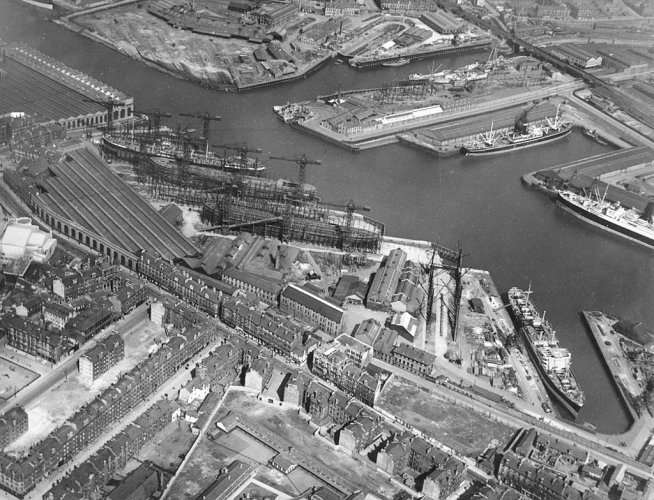
But one fundamental problem facing the British shipbuilding industry as ships got bigger, was geography and the location of the yards themselves. The Tyne, Clyde and the Barrow yards were on relatively narrow waterways. Only the Mersey offered a broad waterway. Just look at how the various slipways had to be angled to the waterway itself. The next problem was how little depth there was to many of the yards, most then being closely hemmed in to landward by housing for the workers.

At Fairfield in WW1 the largest slipway had to be realigned to a shallower angle to the river before the Admiral class Rodney, later cancelled, was laid down. In WW2 it would again have had to have been realigned again, and worshops relocated, before a Malta class carrier could be laid down. In 2004 when the yard was owned by BAe Systems, the launch of Mounts Bay went wrong and the ship collided with the opposite bank suffering some damage. The legacy of that can still be seen in the layout of the BAe facilities at Govan (formerly Fairfield) & Scotstoun (formerly Yarrow). See Google maps.

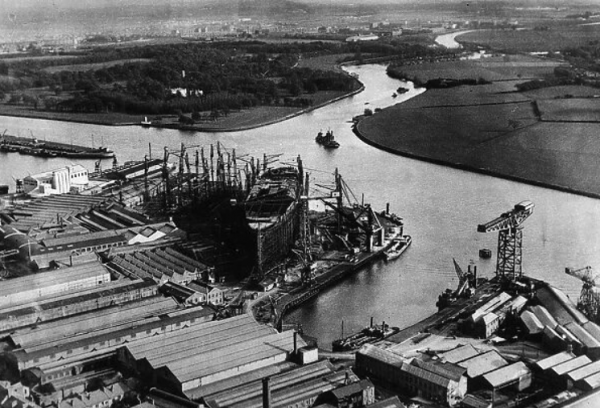
This was the H&W Clyde yard with the Inglis and Henderson yards either side of the mouth of the River Kelvin emerging from the north bank.
1764892195001.jpeg

The site at Clydebank chosen by John Brown was deliberately chosen because it was opposite the mouth of the River Cart that flowed into the Clyde. That gave extra space to launch towards that extra piece of water. The town then grew up around the yard. This is the yard in 1934. The large ship on the slip is the RMS Queen Mary.

1764891740430.png


Armstrong had to move away from the Elswick yard to High Walker because of bridge restrictions in the centre of Newcastle.

There are plenty of photos around on the Tynebuilt website highlighting the problem.
https://tynebuiltships.co.uk/Riverviews.htmlhttps://tynebuiltships.co.uk/Shipbuilders.html
 
What appears strange to me is that in the face of a lack of orders and economic downturn it wasn't the most 'backward looking' yards that were closed, rather it was big, modern and theoretically efficient yards that were closed. I'm no expert on shipbuilding, but it appears to me that a good trajectory for the industry would be the older, smaller, less efficient yards should close during downturns. I'm getting the vibe that interwar shipbuilding is a bit akin to the postwar aviation industry where rationalisation was pushed by the government.
Agreed, that's what it feels like.
 
Thanks @EwenS , I've only just started down this rabbit hole, the room the Mersey has over the Clyde and Tyne is blindingly obvious on Google maps.

My question is that some shipyards would be more suitable for the work in the 50s onwards, with bigger facilities, more launching room and fewer other obstacles. Were these the early ones to close, or did they survive for longer? I know Cammel Laird was building SSNs in the 60s at least.
 
Thanks @EwenS , I've only just started down this rabbit hole, the room the Mersey has over the Clyde and Tyne is blindingly obvious on Google maps.

My question is that some shipyards would be more suitable for the work in the 50s onwards, with bigger facilities, more launching room and fewer other obstacles. Were these the early ones to close, or did they survive for longer? I know Cammel Laird was building SSNs in the 60s at least.
The major run down of the industry on the Clyde took place from the mid-1960s.

It might be worth your while reading the Geddes Report of 1966.
https://en.wikipedia.org/wiki/Geddes_Committee
Also about "The Fairfield Experiment" and the saga of Upper Clyde Shipbuilders in the period 1968-71 that amalgamated 5 yards including Fairfield & John Brown.

John Brown famously built the QE2 1965-68. The yard then passed through various hands. UCS until 1972 (completing its last ship in 1972) then Marathon and a French company building oil rigs for the booming North Sea oil industry and on to other companies. The site was finally cleared from 2002. I was down there a few weeks ago. All that remains of the old shipyard is the fitting out wet dock with the huge Titan crane used to lift boilers / engines / guns / turrets into ships under construction and now a museum. New construction is gradually taking over.

Fairfield at Govan & Yarrow at Scotstoun still exist under the BAe Systems banner, building and fitting out respectively, Type 26 frigates for the RN and in the future Norway. They have just built a huge new construction shed, filling in the old Fairfield wet dock used for fitting out. But the vessels are no longer "launched" but moved onto a barge and taken down river to be gently lowered into the water in Loch Long. The last warship to be launched there in traditional fashion down the slip was the last Type 45 destroyer, HMS Duncan, in 2010.

There is also a Ferguson yard down at Greenock that has acquired an unenviable reputation for massive cost overruns and delays building two ferries.

By the way there was, either on this thread or another, the start of discussions about the use of welding, or the lack thereof in Britain in the 1930s & 1940s. I have a number of comments about that.
1. In the USA only one yard built Liberty ships that were all welded. The other eight (?) yards used welding and riveting to varying degrees to suit their skiĺl base and working practices. The same thing happened with merchant shipbuilding in Britain & Canada.

2. The history of welding ships goes back into the late 1800s. The first all welded ship in the world was the SS Fullagar built by Cammell Laird, on the Mersey, and completed in 1920/21. The use of welding in British shipyards slowly increased in the 1930s. A good part of the hull of the carrier Ark Royal forward of the island was of welded construction. Some of the weight variation in the Leander class cruisers was reportedly due to the degree of welding incorporated. Welding was often used in areas of ships that needed to be well sealed, for example fuel tanks. In WW2 welding was used extensively in British submarine construction.

3. The first all welded ship for the RN was the Halcyon class minesweeper Seagull built at Devonport Dockyard and completed in 1938.
http://www.halcyon-class.co.uk/seagull/hms_seagull.htm
4. There is an article here about the increasing use of welding in RN warships from by the naval architect DK Brown
https://library.imarest.org/nanna/r...0&withMetadata=0&registerDownload=1&version=1
 
Thanks @EwenS . It seems that unlike British aviation in the 50s an 60s a few key people making a few key decisions won't slow the decline of British shipbuilding and perhaps find a useful niche to carry on with.
 
Another thing to look at is the timing of the increase in oil tanker size post WW2. It was the late 1950s late/ early 1960s before they started to exceed 100,000 dat and 1967 before the 200,000dwt mark was passed.
https://en.wikipedia.org/wiki/History_of_the_oil_tanker
Swan Hunter at Wallsend on the Tyne managed to build a couple of 262,000 - 263,000dwt tankers in 1976/77 which reportedly were the largest ships built on the Tyne. But you can begin to see how the launch limits were being reached.
https://www.tynebuiltships.co.uk/O-Ships/opportunity1976.html
Swans even took to building ships in two parts at other yards they owned on the Tyne and then joining them up.
https://www.tynebuiltships.co.uk/Y-Ships/yorkshire1975.html
But at the end of the day, setting aside infrastructure issues, British yards couldn't compete with the cheaper labour costs of yards in the Far East by the mid-1960s.
 
But at the end of the day, setting aside infrastructure issues, British yards couldn't compete with the cheaper labour costs of yards in the Far East by the mid-1960s.

IIUC Asia's cost advantage wasn't (just?) because they paid their workers less, but also because they'd invested heavily in the most modern production techniques like prefabrication and block production after the War, so they were set up to dominate shipbuilding into the future and their workers were highly productive.

I don't expect miracles for Britain, just like I don't expect my delusions for their aircraft industry will overtake the enormous US industry. However a slower relative decline and retention of shipbuilding capability perhaps in the form of some niche where they were good would be nice. IIUC Europe dominates the cruise ship building industry, perhaps Britain could retain a slice of that market, bulked up with Naval building and other ships, leaving the giant cargo ships to the Asians.
 
On US cruiser production in the interwar years:

Part of the problem for the USN was that this class / type of ship was something the USN really had little experience building. They didn't know, for sure, what sort of ship they might need and the USN Scouting Force didn't really see a need for a heavily armed cruiser early on.

With Treaty cruisers, the USN had to experiment. That's why in early classes only two ships were built. The Salt Lake City class was supposed to be a 10,000 ton cruiser only to end up about 1,000 tons light due to errors in weight and design calculations. This class had relatively light armor and were poor sea boats due in good part to the tonnage being lower than expected.

Follow on classes incrementally improved on the design fixing the initial errors. Then with the New Orleans class, a big shift in design occurred with a priority given to heavier armor over torpedo and compartmentation concerns.

For the British and RN, numbers were far, far, more important than the ships being highly capable in terms of fighting other cruisers. This was why after the initial 8"-gun County class, the RN returned to 6" cruisers of more modest size, even reducing the number of guns from 8 to 6. Commerce protection, ability to hunt submarines and surface raiders, outweighed a capacity for slugging matches with other cruisers and warships.

For the US, the Scouting Force was morphing into a screening force for carriers, thus the continuation of 8"-gun designs as these were expected to be the covering force ships for the carriers. 6" cruisers were still needed as scouts, so these ran in parallel to the 8" designs. Commerce protection was far less a consideration as most US commercial shipping was coastal to the US and Americas rather than far flung like Britain's.

I would also add, that the Atlanta class AA cruisers were something of an experiment and never popular with the higher commands in the USN. They were considered unbalanced and under armed, a major reason that they alone got torpedo tubes among US cruisers post Omaha class.
 
Was there any comment within the US about how the pre WW1 USN was so unbalanced, and any idea that this could be solved by rapid production was proved incorrect with regards to cruisers? The Omaha class was ordered in 1916 but due to the demands of war not laid down until 1918-20 and then built on a 'leisurely' schedule, leaving the USN to enter WW1 with 3 'modern' light cruisers alongside it's good numbers of modern battleships.
 
Was there any comment within the US about how the pre WW1 USN was so unbalanced, and any idea that this could be solved by rapid production was proved incorrect with regards to cruisers? The Omaha class was ordered in 1916 but due to the demands of war not laid down until 1918-20 and then built on a 'leisurely' schedule, leaving the USN to enter WW1 with 3 'modern' light cruisers alongside it's good numbers of modern battleships.
The Omaha's were designed to meet the needs of the Scouting Force. That is, they were to find the enemy and relay information, not specifically to fight for it and to screen the Battle Force so the enemy could be denied information. Speed was considered more important and you can see some of the issues that brought with the fine ends where the fore and aft turrets are crammed onto a narrow hull, so much so that part of the hydraulic system had to be put on the turret roof.

OIP.TN7eoDUa5MBtroWpuGhbIAHaE3


By WW 2 they were considered largely unsuitable for use with the fleet as a whole and were relegated to commerce protection, often operating independently, in secondary or tertiary theaters.

The pre-WW 1 big, armored cruisers the US preferred in the pre-dreadnought era (aka as the "Big 10") were something of the carrying on of USN tradition in the guise of being large, powerful, frigates. This changed with the introduction of the dreadnought-type battleship and the US building an actual battleline of such ships.

The idea there was the USN at that time was far more a force for commerce raiding and using ships individually or in small squadrons than having a massive line-of-battle like major European navies had. WW 1 changed that.
 
Last edited:
IIUC in the decade or so prior to WW1 Congress regularly (or semi-regularly) appropriated funds to build a pair of dreadnoughts and some destroyers but didn't accompany these with regular orders of cruisers. Thus by 1914-16 the USN had a large hole in it's fleet structure. If the Congress had thrown a light cruiser or two in with this building tempo, starting with the Chester class, the USN would have had a much more rounded force structure by WW1.
 
IIUC in the decade or so prior to WW1 Congress regularly (or semi-regularly) appropriated funds to build a pair of dreadnoughts and some destroyers but didn't accompany these with regular orders of cruisers. Thus by 1914-16 the USN had a large hole in it's fleet structure. If the Congress had thrown a light cruiser or two in with this building tempo, starting with the Chester class, the USN would have had a much more rounded force structure by WW1.
That would require that the USN saw some need or value in such cruisers. The British built theirs to operate individually or in small squadrons on distant stations away from the battlefleet itself. The US had little or no such need. The Germans built most of their cruisers to be smaller ships usually with 10.5cm guns for the main battery that were to be used in colonial waters where they were relatively cheap to operate. Their single exception was their Asia / Pacific squadron that had some powerful armored cruisers added.
 
That would require that the USN saw some need or value in such cruisers. The British built theirs to operate individually or in small squadrons on distant stations away from the battlefleet itself. The US had little or no such need. The Germans built most of their cruisers to be smaller ships usually with 10.5cm guns for the main battery that were to be used in colonial waters where they were relatively cheap to operate. Their single exception was their Asia / Pacific squadron that had some powerful armored cruisers added.

So, the USN battlefleet when concentrated for a fleet action didn't have anything between battleships and destroyers and didn't see the need for anything? The 1914 RN Grand Fleet had 1 Battlecruiser, 2 heavy cruiser and a light cruiser sqns between the 4 battle sqns and the 2 or 3 destroyer flotillas and IIUC the German High Seas Fleet had a similar but smaller structure.
 
So, the USN battlefleet when concentrated for a fleet action didn't have anything between battleships and destroyers and didn't see the need for anything? The 1914 RN Grand Fleet had 1 Battlecruiser, 2 heavy cruiser and a light cruiser sqns between the 4 battle sqns and the 2 or 3 destroyer flotillas and IIUC the German High Seas Fleet had a similar but smaller structure.
That's about the gist of it. The US experience was the Spanish-American War, and at the time the USN didn't have a lot of big, open, naval battles with ships of the line experience. Much of pre-WW 1 naval planning was the fleet was held to make the decisive strike (aka Mahan), while the most likely invasion locations and ports had incredibly heavy coast defense fortress systems. In 1914, Manila Bay was easily the heaviest defended port in Asia for example.

You have to remember, the USN wasn't planning for a major naval war in Europe. They were planning for one against the US East Coast and possibly into the Caribbean.
 
I find this era of US military history endlessly fascinating, the idea that the US being a military pygmy is so alien to today's mindset that is hard to believe.
 
I find this era of US military history endlessly fascinating, the idea that the US being a military pygmy is so alien to today's mindset that is hard to believe.
A well-armed pygmy, perhaps.

The coastal emplacements around Seattle (well, Bremerton) are enough that a battleship squadron would be significantly outgunned.
 
A well-armed pygmy, perhaps.

The coastal emplacements around Seattle (well, Bremerton) are enough that a battleship squadron would be significantly outgunned.

The coastal artillery was the most well equipped and manned part of the peacetime strength pre WW1 US Army.
 
That would require that the USN saw some need or value in such cruisers. The British built theirs to operate individually or in small squadrons on distant stations away from the battlefleet itself. The US had little or no such need. The Germans built most of their cruisers to be smaller ships usually with 10.5cm guns for the main battery that were to be used in colonial waters where they were relatively cheap to operate. Their single exception was their Asia / Pacific squadron that had some powerful armored cruisers added.
The USN absolutely saw need for more cruisers and repeatedly asked for new scout cruisers as well as battlecruisers during the 1910s. By around 1915 they'd given up trying because Congress refused to pay for them at all.
 
I find this era of US military history endlessly fascinating, the idea that the US being a military pygmy is so alien to today's mindset that is hard to believe.
A lot of US military thinking was based on the relative isolation of the US from potential enemies. Let's say, for whatever reason, Germany or Britain decided to invade the United States in the late 19th or early 20th century.

For either nation, they have to first assemble the invasion forces in the Americas, then import masses of supplies to support them, and after doing so, can attempt an actual invasion of the US itself.

The US, having months on months to prepare, would raise a gigantic army, bring their already extensive coast defenses up to full readiness, then expand them. At the same time, the USN would begin a guerre de course and annihilate their enemy's merchant marine globally. The US was largely self-sufficient at the time so the same couldn't be done in return by their opponent.

For Germany, in particular, such a war would see their nation in dire straits from food shortages and a massive drop in steel production. England would be faced with trying to stop commerce raiding in every corner of the world.

This is how the US leadership saw things at that time. The US could project limited power overseas as needed, but for the most part didn't need a massive standing army or navy for any particular reason outside of a major war, and those were few and far between.
 
This is how the US leadership saw things at that time.

Yes, but I believe in practice that view was misguided, although the US was hardly alone in misjudging the nature of modern war back before 1914. US SecWar reports prior to WW1 show they were aware of the danger year after year, and reforms did start to happen. However despite the 1916 National Defense Act authorising the Army expansion and moblising the Militia on the southern border for 9 months in 1916 prior to the Declaration of War it still took 15 months from the DoW for the US to be ready to fight independent, Corps-level battles against the Germans. SecWar's particularly complained about a lack of artillery and how long it would take to produce sufficient amounts, but the US Regular Army had 6 regiments until 1916 when it expanded to 9, and by then the US 'System of Mobile Artillery' was less modern than European weapons and wasn't used in WW1.
 
Back
Top Bottom