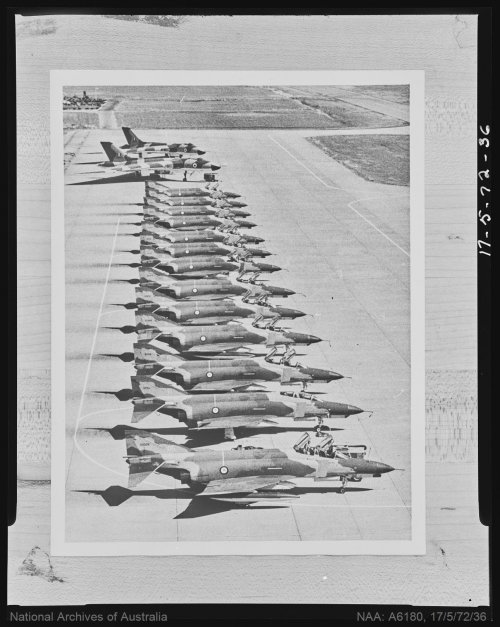
Alternate Australian Defence Force 1970s Procurements?

At minimum, I wonder how many 450kg (1,000-pound) Paveway LGB's you could fit in that Vulcan bomb bay? The Paveway would afford a cost effective means of stand-off capability against an adversary like Indonesia.....

Regards
Pioneer
If only the British fully developed the blue boar tv guided bombs in the 50s
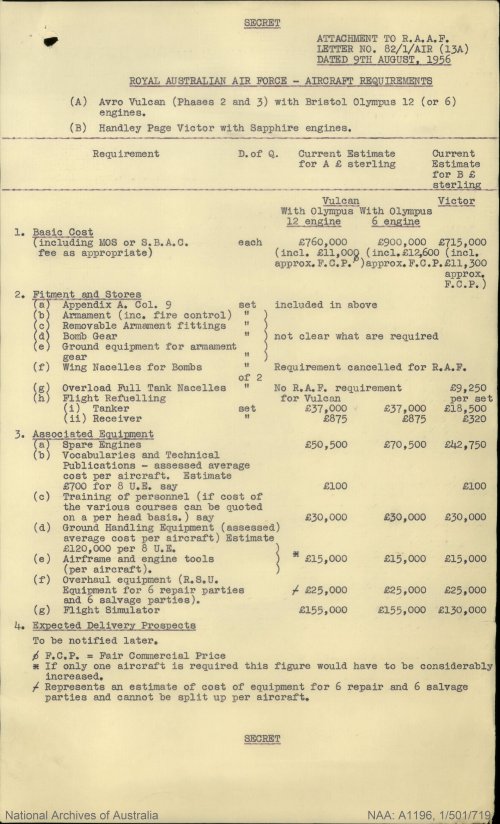
Looking at the 50s Vulcan paper, the number of aircraft proposed in 1955 was 28 down from 39 proposed in 1954 and with a delivery date likely being 1960-61. Given the Vulcan had 4 times the hitting power of the Canberra, required twice as many men and 3 times as much maintenance I'd suggest 28 Vulcans would certainly replace both Amberley based Canberra sqns and likely 2 sqn based in Butterworth as well simply for the cost and manpower.

Such a delivery likely means the RAAF bombers won't be deployed to Vietnam. I suspect Vulcans would still be replaced by F111s, but it won't be the rush job that got us into trouble historically, it will likely be a late 60s decision for an early 70s delivery.
Sounds like a good plan, though would you keep 2sqn Canberra's for FESR commitments?
RAAF Vulcan's joining B52s in the north during rolling thunder would be cool though. maybe used for radar jamming seeing how good they were at entering US airspace in exercise in the 60s
 
Looking at the 50s Vulcan paper, the number of aircraft proposed in 1955 was 28 down from 39 proposed in 1954 and with a delivery date likely being 1960-61. Given the Vulcan had 4 times the hitting power of the Canberra, required twice as many men and 3 times as much maintenance I'd suggest 28 Vulcans would certainly replace both Amberley based Canberra sqns and likely 2 sqn based in Butterworth as well simply for the cost and manpower.

Such a delivery likely means the RAAF bombers won't be deployed to Vietnam. I suspect Vulcans would still be replaced by F111s, but it won't be the rush job that got us into trouble historically, it will likely be a late 60s decision for an early 70s delivery.
FWIW did the report say how much 28 Victors would cost as they had 7 times the hitting power of the Canberra.
 
As a possible POD the 25 Vulcan B.2s that the RAF cancelled in the early 1960s were more advanced than IOTL which made them cheap enough for the RAAF to buy the half-finished aircraft and have them completed.

Correction 22.11.25: The RAF cancelled 25 Victor B.2s in the early 1960s, not 25 Vulcan B.2s.
 
Last edited:
No I don't think so I believe the Vulcan was the preferred aircraft
Unless there's something I don't know (again) the Victor aught to satisfy the requirements of the RAAF more than the Vulcan as it can carry a heavier payload, just as far, with the same size crew and AFAIK cost the same to maintain.

I have proof that in the late 1960s the RAF intended to retire every Vulcan when Polaris replaced the V-Force in the nuclear deterrent role, but it wanted to retain the 3 Victor squadrons in the medium bomber role until the end of the 1970s. I don't know the reasons why this was done, but I suspect that it was because the Victor could carry more bombs than a Vulcan.
 
Last edited:
Unless there's something I don't know (again) the Victor aught to satisfy the requirements of the RAAF more then the Vulcan as it can carry a heavier payload, just as far, with the same size crew and AFAIK cost the same to maintain.

I have proof that in the late 1960s the RAF intended to retire every Vulcan when Polaris replaced the V-Force in the nuclear deterrent role, but it wanted to retain the 3 Victor squadrons in the medium bomber role until the end of the 1970s. I don't know the reasons why this was done, but I suspect that it was because the Victor could carry more bombs than a Vulcan.
Honestly I dont know why but everything i have read about the v bombers for the RAAF states the Vulcan was the preferred option.
Maybe it was because of the vulcan had a lower max take off weight than the victor. Meaning we would have had to do less airfields upgraded for them.
Didn't the Vulcan have better clearance for missiles like the sky bolt or alcm than the victor?
which was the better low level aircraft?
Other than blue boar where there any other pgms that the British were planning for the v bombers?
 
FWIW did the report say how much 28 Victors would cost as they had 7 times the hitting power of the Canberra.

The estimated cost in about 1954-55 was £Stg538,000 but by August 1956 had risen to £Stg760,000 with the Olympus 12 engine and £Stg900,000 with the Olympus 6. This didn't include spares or any support.
 
The estimated cost in about 1954-55 was £Stg538,000 but by August 1956 had risen to £Stg760,000 with the Olympus 12 engine and £Stg900,000 with the Olympus 6. This didn't include spares or any support.
That looks like the cost of the Vulcan not the Victor as AFAIK there was never a proposal for an Olympus powered Victor.
 
That looks like the cost of the Vulcan not the Victor as AFAIK there was never a proposal for an Olympus powered Victor.

Sorry, yes it's the Vulcan. In any case the V bombers proposal looks a lot like the strike carrier proposal in 1964, too expensive and distorting the rest of Defence.
 
Thank you.

AFAIK (1) the Vulcan with the Olympus 12 was the B.1A and the Vulcan with the Olympus 6 was the B.2 which if correct may explain why the Olympus 6 version was about 20% more expensive. And presumably the Sapphire powered Victor was the B.1 or B.1A, except AFAIK (2) the Victor B.2 was to be powered by 6 Sapphires in 1956 and redesigning it to take 4 Conways after the Sapphire was cancelled was one of the reasons why it entered service later than the Vulcan B.2.
 
Sorry, yes it's the Vulcan. In any case the V bombers proposal looks a lot like the strike carrier proposal in 1964, too expensive and distorting the rest of Defence.
Fair enough. We all make mistakes. However, it looks ridiculously cheap compared to what Australia paid for the first 24 F-111Cs and that's after allowing for inflation.
 
Some more teasing. Victors (with mods) this time:

f8437bce-8387-4a51-b06f-0f6cfbf2e19c.jpg

c4208e02-7fd9-4c6e-bce4-d39d10068655.jpg


From here: http://beyondthesprues.com/Forum/index.php?topic=11525.0

Now back to your speculation...
 
Fair enough. We all make mistakes. However, it looks ridiculously cheap compared to what Australia paid for the first 24 F-111Cs and that's after allowing for inflation.

It looks like £Stg900k for Vulcan B2 and £Stg715k for Victor B1, both of which vastly exceed the estimated cost in about 1954-55 of £Stg538,000.

Is a Vulcan B2 better than a Victor B1?
 
It looks like £Stg900k for Vulcan B2 and £Stg715k for Victor B1, both of which vastly exceed the estimated cost in about 1954-55 of £Stg538,000.
True, but in comparison to the cost overruns on the F-111 and TSR.2 or even the Spey-Phantom.
Is a Vulcan B2 better than a Victor B1?
Yes, but apart from flying higher, I don't know in what ways. The main physical differences between the Mk 1 and Mk 2 Victors and Vulcans is that the latter had more wing area, were heavier and had considerably more powerful engines.
 
Fair enough. We all make mistakes. However, it looks ridiculously cheap compared to what Australia paid for the first 24 F-111Cs and that's after allowing for inflation.
Agree there, plus allows for a purchase of F-111Fs for a replacement
 
Sure, but if the most senior and knowledgeable tank dude says no then it's hardly surprising if he gets listened to.


IIRC that's what C-COSC General Wilton recommended.


I agree, it's a big reason why I see it as a lost opportunity.


I agree. In any case the Melbourne's role would have been the key to everything. It would have been as a gap filler to take pressure off the USN resources, a bit like how Vendetta's Vietnam deployment took the pressure off the DDGs. I'm sure the USN would have worked around the Melbourne's limitations in order to achieve the bigger goal.


I don't think so directly, the Long Tan problem was at least in part because 9sqn had only started flying in Vietnam 6 weeks earlier and hadn't transitioned from a peacetime to wartime risk mentality. If the RAAF had sent the 2 UH1s to Borneo in 1965 as requested I suspect it would loosen some of the peacetime restructions and by Long Tan the RAAF won't be so hesitant to risk helicopters to help soldiers in contact.


I think the 2nd A4 order was because of a bit of a change of role for Melbourne. The first A4 order was so 4 aircraft could give Melbourne some protection whereas the 2nd order was to give Melbourne some offensive capability with the withdrawal of the RN from EoS. In a different scenario a 2nd batch would be a top up for the first and with luck and planning could be tacked onto a NZ buy to reduce costs.

FWIW it appears that the RAN wanted 24 S2 and 18 A4 for the Melbourne at 43m pounds, but these numbers were cut back to 14 and 10 for 25m pounds. Those numbers would better suit a rebuilt Melbourne.
The second A-4 order was funded by not ordering the 7th and 8th Oberons.

There is a paper about the RANs submarine plans that states the original four Oberons were a minimum training capability intended to lead to a full eight boat (or larger) force, with consideration to follow-on boats being nuclear. This was at the time the Federal government was planning to build a nuclear power station at Jervis Bay.

The follow-on Skyhawks and Trackers also coincided with Australia supporting, in fact, pushing, the nuclear non-proliferation treaty. A post Sukano Indonesia switch from the pursuit of nuclear power (and perhaps weapons), seen as necessary for our survival, to a more niche Western alliance supporting, trade protection capability. i.e. perceived threat from a neighbour to a perceived global threat to trade by submarines and surface raiders.
 
True, but in comparison to the cost overruns on the F-111 and TSR.2 or even the Spey-Phantom.

I don't disagree, but the environment in the late 50s is very different to the late 60s. To put it bluntly Australia could afford cost overruns in the late 60s but much less so in the late 50s, not to mention that from the late 50s there was a £A 200m cap on Defence spending.
Yes, but apart from flying higher, I don't know in what ways. The main physical differences between the Mk 1 and Mk 2 Victors and Vulcans is that the latter had more wing area, were heavier and had considerably more powerful engines.

Just in terms of thrust to weight the Vulcan B2 is much more powerful, the Victor B1 looks anaemic by comparison so it's likely quite sluggish in practice.
 
Fair enough. i wonder if the RAN didnt have a big carrier study would the A4s become more strike orientated? I'm surprised the RAAF didnt kick up a fuss about the S2s, saying they could just use the P2s or P3s for MPA and ASW instead
That was an argument used in the 70s and 80s against replacing the Melbourne. P-3 was more capable than the Tracker, and Barra was better than the dipping sonar on the SeaKing. Therefore, replacing the P-3B with the P-3C was a higher priority than replacing the carrier, and we couldn't afford both.
 
I don't disagree, but the environment in the late 50s is very different to the late 60s. To put it bluntly Australia could afford cost overruns in the late 60s but much less so in the late 50s, not to mention that from the late 50s there was a £A 200m cap on Defence spending.
So much like the Australian aircraft carrier thread, this needs to be thread where British arms manufacturers deliver "on time and at cost" on a regular basis and/or Australia maintains defence expenditure at Korean War levels from the end of the Korean War to when Australia's embroilment in the Vietnam War is in full swing.
Just in terms of thrust to weight the Vulcan B2 is much more powerful, the Victor B1 looks anaemic by comparison so it's likely quite sluggish in practice.
I agree.
 
Examples?

Regardless, all I was doing was actually presenting the ACTUAL thinking going on.
I confess that I had the same thought when I was first reading about the Phantom retention in the 80s or 90s. I saw the reasoning, i.e. the cost of the full support package (not needed for the lease but would be needed for the retention), but also the need to disband one of the Mirage Sqns to provide personnel, but by the time I was reading this the reality of what happened was also history too. Things appear very differently in hindsight.

Basically, a Mirage Sqn was disbanded for cost and sustainment reasons. The decision to await developments with the US light fighter programs and NATO competitions meant the Mirage had to be retained for longer, hence the need to reduce fleet flight hours and a larger maintenance pool. This also led to the urgent acquisition of Matra Magic missiles and new 30mm ammunition as the in-service Sidewinders and rounds had lifed out.

No. 2 Sqn was disbanded with the retirement of the Canberra, and with "old mate" winning the argument to buy additional P-3Cs instead of replacing Melbourne, the Trackers and Skyhawks were on the way out.

All of this happened within about a decade of the decision, but would not have been on the radar at all in the early 70s.

Apply hindsight and retaining the Phantom is very sensible, in fact buying additional Phantoms becomes attractive, as does acquiring tankers, AEW and additional P-3C.

Logically, the defence scientific advisors should have been briefing the government very differently from how they were. Reading cabinet papers, I often wonder how these people got their jobs.

There is an explanation, the Flynn Effect. With a drift of two to three IQ points per decade, someone who was considered of superior intelligence when they were young in the 40s or 50s, would only be of upper average intelligence now. Combine the breadth and depth of information and data easily accessible now versus then, our ability to dive into archives from around the world and discuss on forums like this, expanding our knowledge, invalidating biases and assumptions as we analyse and build hypotheses.

There are lots of issues with YouTube experts, but there has never been more good information and so many forums in which to discuss it as we have today.
 
Considering the UK government was playing silly buggers with orders, trying to coerce HP into mergers, Australia could have done a pretty good deal on Victor B2 in the late 60s. It could have been a very versatile platform, not just for strike and tanker, but imagine ELINT, and MPA variants, say a specialised Sverdlov killer?
 
At minimum, I wonder how many 450kg (1,000-pound) Paveway LGB's you could fit in that Vulcan bomb bay? The Paveway would afford a cost effective means of stand-off capability against an adversary like Indonesia.....
Paveway bombs have a ~2ft long proboscis sticking out the front. If I understand the bomb racks correctly, a Vulcan has 7 rows of 3. You'd lose the 1st, 3rd, 5th, and 7th rows to the LGB seekers with bombs on the 2nd, 4th, and 6th rows. From 21x dumb bombs down to 9x smart bombs.

Edit: Nope, racks are 3 sets of 7. So we're looking at losing the forward and aft racks for spacing, so only 7x 1000lb bombs with the folding fins developed for the F-117. Or only 2-3 bombs with the non-folding fins.

But if the racks are physically strong enough, you could hang 9x 2000lb LGBs in there.
 
Last edited:
Apply hindsight and retaining the Phantom is very sensible, in fact buying additional Phantoms becomes attractive, as does acquiring tankers, AEW and additional P-3C.

Logically, the defence scientific advisors should have been briefing the government very differently from how they were. Reading cabinet papers, I often wonder how these people got their jobs.

It's for these reasons why I'm interested in Cabinet decisions and the inputs to them, and not interested in 'paper' planes. I believe that it's easier to change the mind of a handful of Cabinet ministers than it is to invent a new plane or major component. Many decisions are line-ball and could go either way quite legitimaly, and see different planes do different and cool stuff.
 
Paveway bombs have a ~2ft long proboscis sticking out the front. If I understand the bomb racks correctly, a Vulcan has 7 rows of 3. You'd lose the 1st, 3rd, 5th, and 7th rows to the LGB seekers with bombs on the 2nd, 4th, and 6th rows. From 21x dumb bombs down to 9x smart bombs.

But if the racks are physically strong enough, you could hang 9x 2000lb LGBs in there.
9 smart bombs would do more damage than 21 dumb bombs. It shouldn't be that hard to uprate the racks if they couldn't handle 2000lb bombs
 
Paveway bombs have a ~2ft long proboscis sticking out the front. If I understand the bomb racks correctly, a Vulcan has 7 rows of 3. You'd lose the 1st, 3rd, 5th, and 7th rows to the LGB seekers with bombs on the 2nd, 4th, and 6th rows. From 21x dumb bombs down to 9x smart bombs.

But if the racks are physically strong enough, you could hang 9x 2000lb LGBs in there.

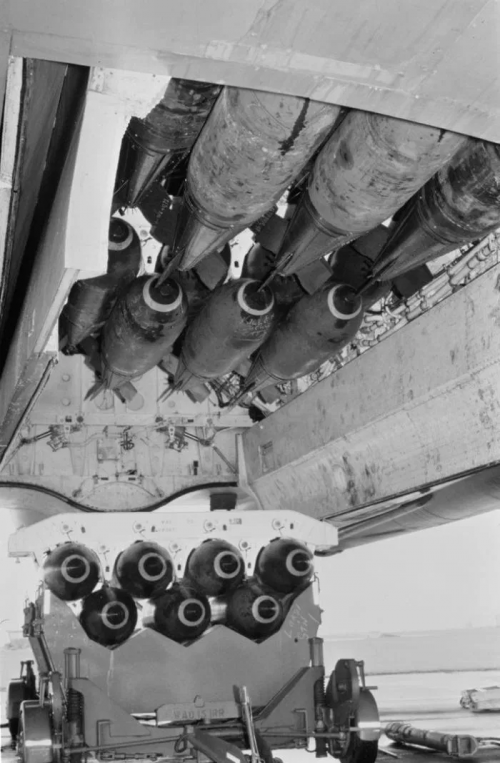
They were arranged 4-wide at the top and 3-wide underneath, and 3 bombs forward to back.

1762912048108.png
 
So much like the Australian aircraft carrier thread, this needs to be thread where British arms manufacturers deliver "on time and at cost" on a regular basis and/or Australia maintains defence expenditure at Korean War levels from the end of the Korean War to when Australia's embroilment in the Vietnam War is in full swing.

Yes, for the on time and budget. That could have fascinating outcomes. Dunno about the Australian Defence spending post Korea.

Personally, I'd like to spin my British virtuous circle idea out to both Britain and the world, but I lack the motivation to do the research and keep learning that what I learned last year is wrong.
 
Okay, only 7 LGBs, with the folding tail fins developed for F-117.

Only 3 LGBs without those folding tail fins.

The Falklands LGB set up was a rush job, I suspect with time a proper project could come up with a neat solution that could carry quite a few LGBs. However the Vulcan likely isn't the best carrier for them, mainly due to its low level speed being limited to 350kts to keep buffeting below 2g. It's no big deal to loiter around at medium level dropping LGBs at leisure, but if a toss attack from low level is required or other attack tactics due to resistance over the target a bomb bay full of LGBs isn't the best thing since sliced bread.

That said, a Vulcan is an intriguing plane full of possibilities. It has heaps of internal room to pack with cool electronics and the bomb bay and pylons could make all sort of fancy weapons combo possible, the Falklands lash-ups show what might be possible.
 
Part of the reason the Cabinet rejected the A5 in favour of the F111 was because the delivery of the F111C was bought forward from 1969-70 to 1967-68, the aircraft were actually built an delivered into storage in 1968.

What if the original 1969-70 delivery time-frame was adhered to? Would the RAAF get 'long wing F111Es' with the improved intakes and perhaps the TF30-P9 engines? Or perhaps would we get a painful F111D with long wings?
 
Part of the reason the Cabinet rejected the A5 in favour of the F111 was because the delivery of the F111C was bought forward from 1969-70 to 1967-68, the aircraft were actually built an delivered into storage in 1968.

What if the original 1969-70 delivery time-frame was adhered to? Would the RAAF get 'long wing F111Es' with the improved intakes and perhaps the TF30-P9 engines? Or perhaps would we get a painful F111D with long wings?
Possibly the F111E is the RAAF was smart but i would say it would be the F-111D. or we could see if the RAAF would wait a bit longer a long wing F-111F though this would be unlikely
The Falklands LGB set up was a rush job, I suspect with time a proper project could come up with a neat solution that could carry quite a few LGBs. However the Vulcan likely isn't the best carrier for them, mainly due to its low level speed being limited to 350kts to keep buffeting below 2g. It's no big deal to loiter around at medium level dropping LGBs at leisure, but if a toss attack from low level is required or other attack tactics due to resistance over the target a bomb bay full of LGBs isn't the best thing since sliced bread.

That said, a Vulcan is an intriguing plane full of possibilities. It has heaps of internal room to pack with cool electronics and the bomb bay and pylons could make all sort of fancy weapons combo possible, the Falklands lash-ups show what might be possible.
View: https://www.reddit.com/r/WeirdWings/comments/lzp73e/avro_vulcan_b3/

According to this reddit post the proposed Vulcan B.3 could carry 48,000lb of bombs with the extra bombs in bomb pods. i wonder how many LG Bombs the B.2 Vulcan could carry on its wings in bomb pods or AGM-86C Missiles?
 
According to this reddit post the proposed Vulcan B.3 could carry 48,000lb of bombs with the extra bombs in bomb pods. i wonder how many LG Bombs the B.2 Vulcan could carry on its wings in bomb pods or AGM-86C Missiles?
FWIW the Wikipedia article on the Victor says its bomb bay could accommodate 48,000lb of bombs and that "One proposed addition to the Victor were underwing panniers capable of carrying a further 28 1,000 lb bombs to supplement the main bomb bay, but this option was not pursued." which depending upon how you do it increases the total to 63 1,000lb bombs or 76 1,000lb bombs.
 
Unless there's something I don't know (again) the Victor aught to satisfy the requirements of the RAAF more then the Vulcan as it can carry a heavier payload, just as far, with the same size crew and AFAIK cost the same to maintain.

I have proof that in the late 1960s the RAF intended to retire every Vulcan when Polaris replaced the V-Force in the nuclear deterrent role, but it wanted to retain the 3 Victor squadrons in the medium bomber role until the end of the 1970s. I don't know the reasons why this was done, but I suspect that it was because the Victor could carry more bombs than a Vulcan.
Would be interesting to know which was easer/harder and cheaper/more expensive to maintain and operate - the Vulcan B.2 or the Victor? As this would undoubtedly be a real Australian/RAAF factor in such a purchase.
Oh, and which was better at low-altitude penatration?

Regards
Pioneer
 
I think @Rule of cool wrote in another thread that the RAAF went "Harpoon mad" in the 1980s. If that's true, how many Harpoons could a Victor or Vulcan carry?
doing a bit of math's with the dimensions of the Vulcan bomb bay it could hold 8+ harpoons depending on the depth of the bomb bay (i cant find that). Not sure how many it could go on hardpoints.
I cant find anything on the Victors bomb bay
 
Oh, and which was better at low-altitude penatration?

I don't think the Victor was really tried out in the low level role, it was pressed into the tanker role prematurely with the grounding of the Valiant fleet. IIUC the Victor would have suffered excessive wing flex and therefore excessive fatigue. Apparently there was a proposal to clip the wingtips to reduce the flexing at low level, but this wasn't taken up for the bombers. When they became permanent tankers it was found the wing flex made the wingtip pods move too much, so the tips were clipped.

The Vulcan was structurally stronger, but the huge wing gave a bad gust response so the Vulcan could only fly at 350 knots to keep the bumps below 2G. 350 knots is pitifully slow, even in the mid 60s.
 
Last edited:
doing a bit of math's with the dimensions of the Vulcan bomb bay it could hold 8+ harpoons depending on the depth of the bomb bay (i cant find that). Not sure how many it could go on hardpoints.
I cant find anything on the Victors bomb bay

The Victor B2 could carry 35 x 1,000lb bombs internally, 5 x standard V-bomber 7-bomb clips to the Vulcan's 3. However the Victor's clips were staggered, 2 higher in the bomb bay and 3 beneath them. There's a photo of Victor dropping 35 bombs that shows this pattern leaving the bomb bay.
 
Back
Top Bottom