Status
Not open for further replies.
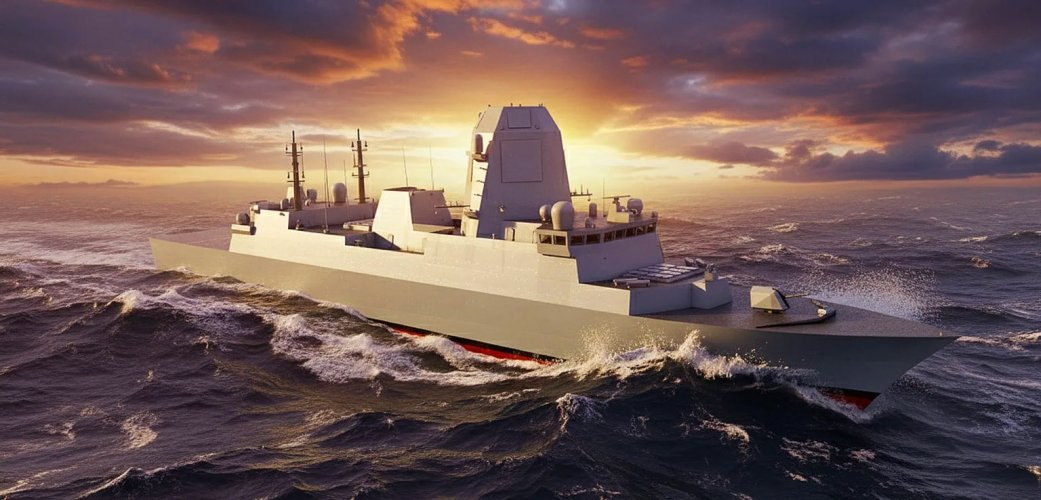
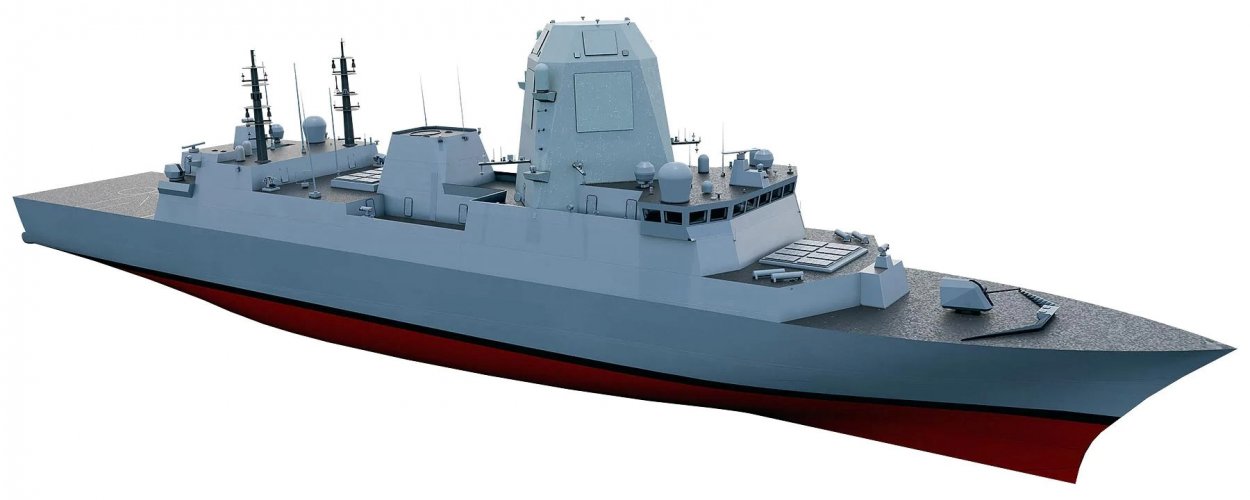
It already looks very close to T26, actually, if not that low forecastle.

1762629811224.png

I wanted to say that it's possible to lengthen the T26 to install the second VLS cluster amidships, and it seems it's exactly what they have in mind. But, for some reason, they lowered the forecastle and raised the flight deck aft.
 
Last edited:
It already looks very close to T26, actually
IF (it's a big if) I am correct in estimating the size, that means that my initial assumption that the ship is slightly shorter and slightly wider than T45 still stands, which in turn means more or less the same displacement, and that it would likely be possible to install the same armament and sensor suite into the T45 hull.

The question, therefore, is why choose T26 as a base and not T45? I can think of serial production advantages, considering the Norwegian order, especially if there is no requirement for high speed.
 
IF (it's a big if) I am correct in estimating the size, that means that my initial assumption that the ship is slightly shorter and slightly wider than T45 still stands, which in turn means more or less the same displacement, and that it would likely be possible to install the same armament and sensor suite into the T45 hull.

The question, therefore, is why choose T26 as a base and not T45? I can think of serial production advantages, considering the Norwegian order, especially if there is no requirement for high speed.
The biggest option (128 VLS) is 160m long, so 10m longer than T45 and significantly wider. I'm pretty sure your image edit is underestimating the size as there's no reason to have the foredeck a fraction of a deck lower, so IMO what they've done is bring the (very low on the T26) flight deck up by a deck to match the foredeck, in the same way that the Absalons have their flight deck one deck higher than the Iver Huitfeldts.
Basically an SUV destroyer.
 
The biggest option (128 VLS) is 160m long, so 10m longer than T45 and significantly wider.
Oh, some numbers at last. Thanks.

Then - why the need for "significantly wider"? And how much is "significantly"?

By lengthening T45 the same 8x8 cluster can be installed amidships, as was suggested on the "land attack" long variant, and one can replace the Sylver + Harpoon place forward.

T45 - 152x21
Chinese 055 - 180x20
 
Oh, some numbers at last. Thanks.

Then - why the need for "significantly wider"? By lengthening T45 the same 8x8 cluster can be installed amidships, as was suggested on the "land attack" long variant, and one can replace the Sylver + Harpoon place forward.
The big fat radar mast- the BAE rep in the Naval News video said that the radar panels weighed 250 tons together. A best-guess estimate for the weight of SAMPSON's rotating mass is ~5t, so you can imagine that a few changes might need to be made to the hull form to add stability.
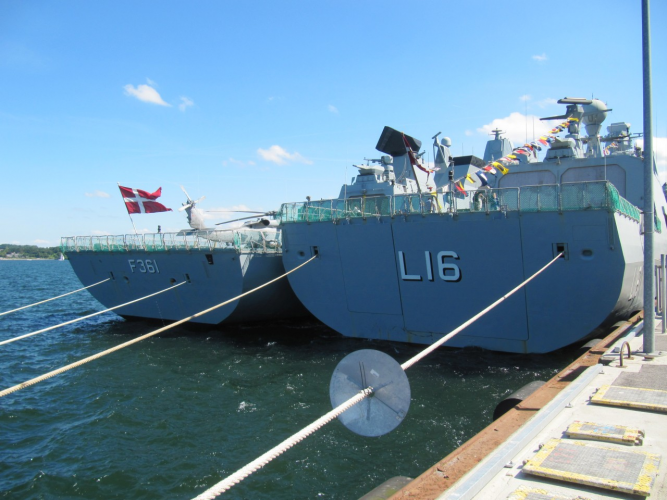
As an indicator for what I meant about Absalon, this is a picture of the sterns of the two variants:
1762632993762.png
 
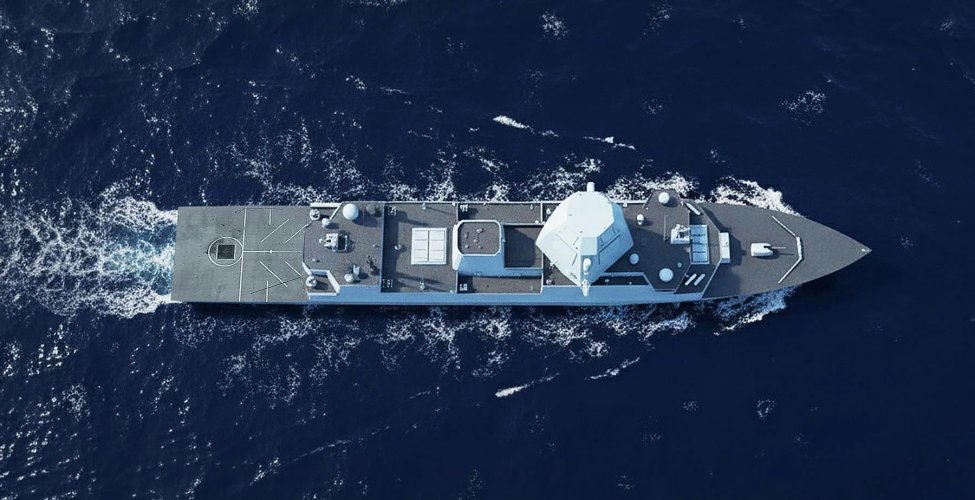
Still doesn't explain the low cut of the forecastle (why raise the VLS, but leave the foredeck low?). And there is a ridiculous amount of deck (and probably internal) space that could have been used for more VLS cells and seems just empty.

If anything it seems overly short for the armament it carries and the role it fills. Compared to the Type 45's Sampson and S1850M, the the Future Air Warfare Command ship's radars are concentrated in a single block (they could be divided between two blocks to as in recent German ships or the Dutch-Belgian ASWF for extra redundancy) and the single uptake amidships suggests that the machinery is not unitised either (very much a retrograde step compared to Type 45).
 
Last edited:
If anything it seems overly short for the armament it carries and the role it fills.
Oh, yes.

Air Warfare Command ship's radars are concentrated in a single block (they could be divided between two blocks to as in recent German ships or the Dutch-Belgian ASWF for extra redundancy) and the single funnel amidships suggests that the machinery is not unitised either (very much a retrograde step compared to Type 45).
Again, Type 42 philosophy manifests itself. "Let's cut double systems to single", etc.

The big fat radar mast- the BAE rep in the Naval News video said that the radar panels weighed 250 tons together.

So we are talking about a hull about 25 meters wide? Almost makes one to suggest to take Bulwark and Albion (176 x 29) and convert them to missile launcher platforms. :)
 
It looks really weird with the forecastle so low. Should be raised a deck, level with the VLS.
It would still look weird, though. They are trying to fit a capital-ship-sized radar system into a light cruiser, and however you put it, it would be awkward. The monstrous contraption requires at least 20k tons of displacement to be comfortable, so natural options (other than converting the Bulwarks) are like Invincible 2.0 or Brit-Kirov, with an equivalent of 200-300 VLS cells. And nobody can afford that.

Why not put the larger radar plates lower, under the bridge, like everybody else does, though? That would solve the bulk of stability issues.
 
Last edited:
It would still look weird, though. They are trying to fit a capital-ship-sized radar system into a light cruiser, and however you put it, it would be awkward. The monstrous contraption requires at least 20k tons of displacement to be comfortable, so natural options (other than converting the Bulwarks) are like Invincible 2.0 or Brit-Kirov, with an equivalent of 200-300 VLS cells. And nobody can afford that.
Sorry- I've looked back at the video and I think the BAE guy is saying that the integrated mast as a whole weighs 250 tonnes, not the panels alone, which is slightly more sensible. No modern ships have an equivalent mast so it's hard to make comparisons. The closest is ASEV, which has very slightly bigger panels at a similar height on 14,000 tonnes and 190m by 25m dimensions. So we can see that the 25m beam is the threshold for really big panels high up, but BAE have gone for a shorter design with more compact superstructure.
Why not put the larger radar plates lower, under the bridge, like everybody else does, though? That would solve the bulk of stability issues.
It's worth remembering in discussions about RN ships that ours is the only navy to have fought against a campaign of sea skimming missiles, and we lost ships to them. As a result, a feature of every ship since the Falklands has been a relatively lightweight radar very high above the water, to push the horizon further away (see Artisan on T23, QEs and Albions, and SAMPSON). Problem is, we now also want to do the counter hypersonics/BMD role, which requires a very big radar. So BAE's thinking seems to be to put a very big radar as high up as they can, to use the same panels for both jobs. An alternative would be big panels low down and a SAMPSON style lightweight radar on a very tall mast, but nobody seems to have gone for that option.
 
An alternative would be big panels low down and a SAMPSON style lightweight radar on a very tall mast, but nobody seems to have gone for that option.
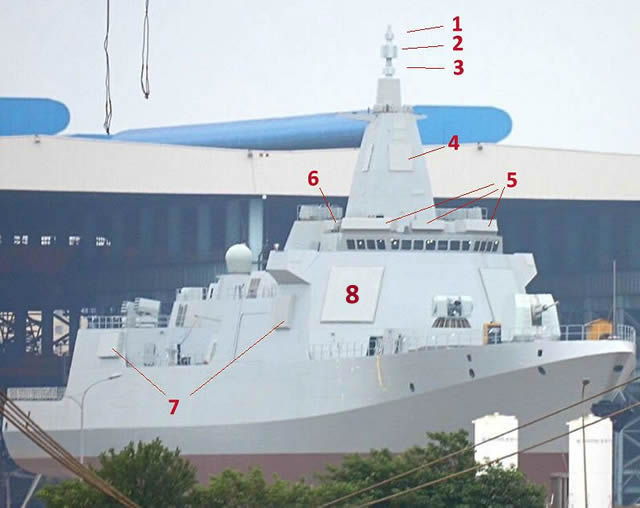
Not exactly the same, but the Chinese Type 055 destroyers distribute their various radar systems both on a mast and below the bridge.
Picture

Those marked 4 are believed to be fire-control radars, whilst the large ones marked 8 are the main air search arrays. Those marked 5 are disputed in their role, but there's some suggestions that they may be secondary air and surface search radars.
 
Not exactly the same, but the Chinese Type 055 destroyers distribute their various radar systems both on a mast and below the bridge.
Picture

Those marked 4 are believed to be fire-control radars, whilst the large ones marked 8 are the main air search arrays. Those marked 5 are disputed in their role, but there's some suggestions that they may be secondary air and surface search radars.

What....you mean their PR department has not revealed what the various parts do??
 
the BAE rep in the Naval News video said that the radar panels weighed 250 tons together.
Sorry- I've looked back at the video and I think the BAE guy is saying that the integrated mast as a whole weighs 250 tonnes, not the panels alone, which is slightly more sensible. No modern ships have an equivalent mast so it's hard to make comparisons. The closest is ASEV, which has very slightly bigger panels at a similar height on 14,000 tonnes and 190m by 25m dimensions. So we can see that the 25m beam is the threshold for really big panels high up, but BAE have gone for a shorter design with more compact superstructure.
Ok, that makes more sense...
I was going to use the 4500 tonnes FDI frigate as a comparison.
  • the Seafire 500 panels weigh a total of 8 tons (4x2 tons)
  • the integrated mast (PSIM) weighs 150 tons.
 
An alternative would be big panels low down and a SAMPSON style lightweight radar on a very tall mast, but nobody seems to have gone for that option.
That is quite exactly what I meant (and I thought about the horizon, of course), and even the new ship's concept shows two sets of panels - larger, heavier, and smaller, evidently lighter, that are situated higher. So it could be - potentially - possible to separate them, American/Spanish/Chinese style, and if it's not enough, add a Sampson on the top of the mast.

The closest is ASEV, which has very slightly bigger panels at a similar height on 14,000 tonnes and 190m by 25m dimensions. So we can see that the 25m beam is the threshold for really big panels high up, but BAE have gone for a shorter design with more compact superstructure.
14ktons and 190m are exactly the absolutely minimal dimensions that feel natural for the requirements, and would look as a normal heavy missile cruiser. And you could easily put a third cluster there, getting 196 cells, maybe even more. But - costs.
 
  • Like
Reactions: DJK
The difference between a radar 50 ft above the waterline and 100 ft above the waterline is 7 km of detection range against sea skimming targets. Right now, I would rather have my missile defense radar lower on the superstructure and a small radar like the Giraffe or TRS-3D at 100 ft, but in the future, I can imagine that stealthy sea skimmers and onboard or escort jammers (imagine a MALD flying with a group of NSMs) would require the additional power to keep warning times sufficient for an effective defense.
 
Not exactly the same, but the Chinese Type 055 destroyers distribute their various radar systems both on a mast and below the bridge.

Those marked 4 are believed to be fire-control radars, whilst the large ones marked 8 are the main air search arrays. Those marked 5 are disputed in their role, but there's some suggestions that they may be secondary air and surface search radars.
Why have they given their premier air defence cruiser eyebrows?
It looks slightly like the Russian system of 'a radar for every weapon' but with phased arrays. Surely the PLAN have better CMSs than that?
 
but in the future, I can imagine that stealthy sea skimmers and onboard or escort jammers (imagine a MALD flying with a group of NSMs) would require the additional power to keep warning times sufficient for an effective defense.
The difference between a radar 50 ft above the waterline and 100 ft above the waterline is 7 km of detection range against sea skimming targets.

Then it would probably be more prudent not penny-pinching making a short-fat hull, and build a 225x25 cruiser with 3-4 x64 vls clusters. :)

*whispers* Could even put some strike capability there and decent artillery.
 
14ktons and 190m are exactly the absolutely minimal dimensions that feel natural for the requirements, and would look as a normal heavy missile cruiser. And you could easily put a third cluster there, getting 196 cells, maybe even more. But - costs.
There is one other reason for the RN choosing a smaller design- the refit facility in #14 and #15 dry docks at Portsmouth only has capacity for ships up to 170m, and a similar limit applies to BAE's build hall in Glasgow.
The RN has no need of a missile cruiser, it wants a command ship to carry CMS and a very powerful radar. Extra capacity will be supplied by T91 missile sloops if necessary, and the priority is getting hulls to sea.
With all of the extra infrastructure that would be required, the choice is between 4-6 large destroyers and 2-3 cruisers and I know which the Navy needs more.
 
Then it would probably be more prudent not penny-pinching making a short-fat hull, and build a 225x25 cruiser with 3-4 x64 vls clusters. :)

*whispers* Could even put some strike capability there and decent artillery.
That ship is going to cost $2 billion and it's going to be carrying $2 billion worth of missiles. Does the RN even have that many? I would rather see a single radar carrying ship armed with self-defense weapons equivalent to ESSM and PAC-3 and then 3 or 4 Arrowheads with 64 Mk.41/SYLVER VLS cells amidships to act as distributed, quiet shooters. Cost and manning requirements may be slightly higher, but I don't think you want to put your eggs into a heavy cruiser basket unless you actually need a big basket for big eggs (aka theater ballistic/hypersonic missiles).
 
Does the RN even have that many?

Yes. RN, and UK MoD in general, might have many flaws....but when it comes to buying appropriate numbers of complex weapons for a capability they don't skimp. Until recently the only other nations I would have put in a similar position would have been China, Russia (specifically for ex Soviet gear in stock), Saudi Arabia and UAE, Israel and possibly Australia, Singapore, South Korea and Japan....and of course the USA. Compared to the rest of Europe the UK's purchases of complex guided weapons post Cold War were positively gargantuan....the only real criticisms of UK MoD is a failure to purchase some categories of obvious weapons (gliding munitions for example) and a very risk averse attitude to long term storage of retired munitions (which perhaps isn't a fault).
 
That ship is going to cost $2 billion and it's going to be carrying $2 billion worth of missiles. Does the RN even have that many? I would rather see a single radar carrying ship armed with self-defense weapons equivalent to ESSM and PAC-3 and then 3 or 4 Arrowheads with 64 Mk.41/SYLVER VLS cells amidships to act as distributed, quiet shooters. Cost and manning requirements may be slightly higher, but I don't think you want to put your eggs into a heavy cruiser basket unless you actually need a big basket for big eggs (aka theater ballistic/hypersonic missiles).
I still think that the most efficient place to put long range missiles is aboard the ship with the radar, but in general I agree.
Buying a cruiser would mean moving from mid-mid with T45 to Hi-hi, when what we need is Hi-Lo with something like FAWCS 160 and then an AAW frigate based on Arrowhead using the smaller panels and 32 mk41 plus ExLS.
 
I still think that the most efficient place to put long range missiles is aboard the ship with the radar, but in general I agree.
Buying a cruiser would mean moving from mid-mid with T45 to Hi-hi, when what we need is Hi-Lo with something like FAWCS 160 and then an AAW frigate based on Arrowhead using the smaller panels and 32 mk41 plus ExLS.
That is also a Hi-Hi fleet structure. Combat systems and radars for AAW are some of the most expensive components of any surface combatant, buying two different classes with similar combat systems will not save you much money, even if one of the classes is smaller in size. This is especially true once you starting looking into crew numbers, for this role you will need at least 120-140 personnel to crew the ship, regardless of ship size.
 
I still think that the most efficient place to put long range missiles is aboard the ship with the radar, but in general I agree.
Of course it's the most efficient option in terms of money and crew allocation, until a single hit knocks out your radar and 200 missiles.
Buying a cruiser would mean moving from mid-mid with T45 to Hi-hi, when what we need is Hi-Lo with something like FAWCS 160 and then an AAW frigate based on Arrowhead using the smaller panels and 32 mk41 plus ExLS.
My point with the Arrowheads is that you can buy three Type 31s for about a billion pounds. An AAW frigate with an Aegis-like system and a multi-panel phased array radar is going to cost nearly that much. Having a backup radar is nice in case the FAWCS goes down, but getting enough VLS cells at sea to handle 200 missile raids is better. The Royal Navy thinks there is utility right now in having a ship with as few combat systems as the Type 31, so those three shooter frigates and a FAWCS would also be better for the peacetime navy than an AAW Arrowhead and a FAWCS or a single heavy cruiser.
 
That ship is going to cost $2 billion and it's going to be carrying $2 billion worth of missiles. Does the RN even have that many?

Yes. RN, and UK MoD in general, might have many flaws....but when it comes to buying appropriate numbers of complex weapons for a capability they don't skimp.


There are other ways:
so natural options (other than converting the Bulwarks) are like Invincible 2.0 or Brit-Kirov, with an equivalent of 200-300 VLS cells.

1. On the cheap - RN has two hulls that are marked for disposal, while still relatively new, very spacious, and can answer those requirements, especially if nobody insists on speed.

2. Revive the command cruiser model, build a hybrid ship with the radar, VLS and carrier capability for F-35.

3. Full fledged missile cruiser.

In current geopolitical climate every one of those options is more practical than the discussed proposal (my whole point being that something is wrong with this design) and there is a window for budget approval because of coming change of government.
 
Last edited:
That is also a Hi-Hi fleet structure. Combat systems and radars for AAW are some of the most expensive components of any surface combatant, buying two different classes with similar combat systems will not save you much money, even if one of the classes is smaller in size. This is especially true once you starting looking into crew numbers, for this role you will need at least 120-140 personnel to crew the ship, regardless of ship size.
When I say AAW frigate I'm not talking about the Iver Huitfeldt type with SM3 capability, I mean a normal T31 with a longer ranged radar to allow effective CAMM-MR use, as well as the VLS upgrades. So the cost would be ~£500m against £350m for T31 and £800m for a true AAW frigate.
BAE think they can get the crew for FAWCS below 100, so a cheaper AAWT31 could go even lower.

Of course it's the most efficient option in terms of money and crew allocation, until a single hit knocks out your radar and 200 missiles.
But if the central sensor gets knocked out under your model, what's the point of the 128 surviving missiles? I'm suggesting 128 on the FAWCS and 32 strike length on each frigate, and not deploying them in the same group. The frigates are just to make up numbers for lower-level missions, the missile bus role is T91.
 
Of course it's the most efficient option in terms of money and crew allocation, until a single hit knocks out your radar and 200 missiles.

There's an argument for adopting a radar arrangement similar to that of the F125 derivative offered to SEA5000, to provide close to 360° radar coverage (aside from the areas that are wooded by the other island) from one island even in the event of action damage destroying the radars in the other island.
 
There is one other reason for the RN choosing a smaller design- the refit facility in #14 and #15 dry docks at Portsmouth only has capacity for ships up to 170m, and a similar limit applies to BAE's build hall in Glasgow.

With all of the extra infrastructure that would be required, the choice is between 4-6 large destroyers and 2-3 cruisers and I know which the Navy needs more.

Ahh, the old infrastructure curse comes back again...and again....and again
 
If anything it seems overly short for the armament it carries and the role it fills. Compared to the Type 45's Sampson and S1850M, the the Future Air Warfare Command ship's radars are concentrated in a single block (they could be divided between two blocks to as in recent German ships or the Dutch-Belgian ASWF for extra redundancy) and the single uptake amidships suggests that the machinery is not unitised either (very much a retrograde step compared to Type 45).
Let's be a bit precise with our wording here: BAE's concept for the FAWCS currently had radars in a single block. There's no guarantee this is BAE's final design, or the design that will be adopted.

WRT two superstructure blocks or one, let's assume it's two with fixed phased arrays - if you take a missile strike in the superstructure from forward or aft, then you lose the block facing up the threat axis, both facing array and the one at 90 degrees to it. If you take a missile strike from the side, there's at least a 50% chance you lose the up axis facing superstructure block, worse if it's got some form of radar homing or smart targeting. So whatever the threat axis and your heading, there's a 75%+ chance you've lost the block facing up axis, and swapping it out so the other superstructure block is now facing up axis means reversing course. If you've lost the forward block and you're trying to proceed on course, you'll only have intermittent radar coverage ahead via zig-zagging, and that opens a big, predictable hole in your coverage.

TLDR: even with two superstructure blocks, there's a pretty good chance a hit in one mission-kills you anyway.
 
Let's be a bit precise with our wording here: BAE's concept for the FAWCS currently had radars in a single block. There's no guarantee this is BAE's final design, or the design that will be adopted.

WRT two superstructure blocks or one, let's assume it's two with fixed phased arrays - if you take a missile strike in the superstructure from forward or aft, then you lose the block facing up the threat axis, both facing array and the one at 90 degrees to it. If you take a missile strike from the side, there's at least a 50% chance you lose the up axis facing superstructure block, worse if it's got some form of radar homing or smart targeting. So whatever the threat axis and your heading, there's a 75%+ chance you've lost the block facing up axis, and swapping it out so the other superstructure block is now facing up axis means reversing course. If you've lost the forward block and you're trying to proceed on course, you'll only have intermittent radar coverage ahead via zig-zagging, and that opens a big, predictable hole in your coverage.

TLDR: even with two superstructure blocks, there's a pretty good chance a hit in one mission-kills you anyway.
That's why the 'star of David' layouts are sometimes proposed, because 3 panels on the surviving mast still gives you decent 360 degree coverage. But because so much of the weight of the mast is the structure itself rather than the radars, having two masts limits you in both height and size which is I think why BAE didn't go for it.
 
It's worth remembering in discussions about RN ships that ours is the only navy to have fought against a campaign of sea skimming missiles, and we lost ships to them.
Given the campaign in the Red Sea, including the 10/7 Houthi attacks, and the Russo-Ukranian war, this isn't true. Also the US dealt with Exocets in the Persian Gulf. Also the Israelis dealt with sea skimmers from Hezbollah.

Hell, the US has engaged as many Houthi sea skimmers in a single action (USS Mason, 15 Aug 2016) as the Argentines had AM.39s in '82.
 
Not exactly the same, but the Chinese Type 055 destroyers distribute their various radar systems both on a mast and below the bridge.
Picture

Those marked 4 are believed to be fire-control radars, whilst the large ones marked 8 are the main air search arrays. Those marked 5 are disputed in their role, but there's some suggestions that they may be secondary air and surface search radars.
5 looks a lot like SYR-1
 
Given the campaign in the Red Sea, including the 10/7 Houthi attacks, and the Russo-Ukranian war, this isn't true. Also the US dealt with Exocets in the Persian Gulf. Also the Israelis dealt with sea skimmers from Hezbollah.

Hell, the US has engaged as many Houthi sea skimmers in a single action (USS Mason, 15 Aug 2016) as the Argentines had AM.39s in '82.
Red sea seems to be mostly drones and AShBMs, with some obsolescent cruise missiles thrown in. The Moskva attack was remarkable, but not relevant to a discussion on modern warship design and the same goes for the other Neptune attacks. I didn't know about the Syrian or Iraqi attacks; that's very interesting and thank you for giving me a new rabbit hole! I should have done some extra research before posting.
But the point is that the RN put a lot of effort into finding the best ways of stopping anti ship missile attacks and it's unlikely their doctrine is going to change for T83.
 
It does appear lower than in Type 26 and Type 31 (level with the helideck rather than a deck level higher). But RN design standards require working in the worst the North Sea and Northern North Atlantic can throw at you, so either it's not representative, or they have a way around it.


I'm not sure how 128xMk 41, 1x57mm, 2x30mm RWS, and 2 Dragonfire equates to 'underarmed'.
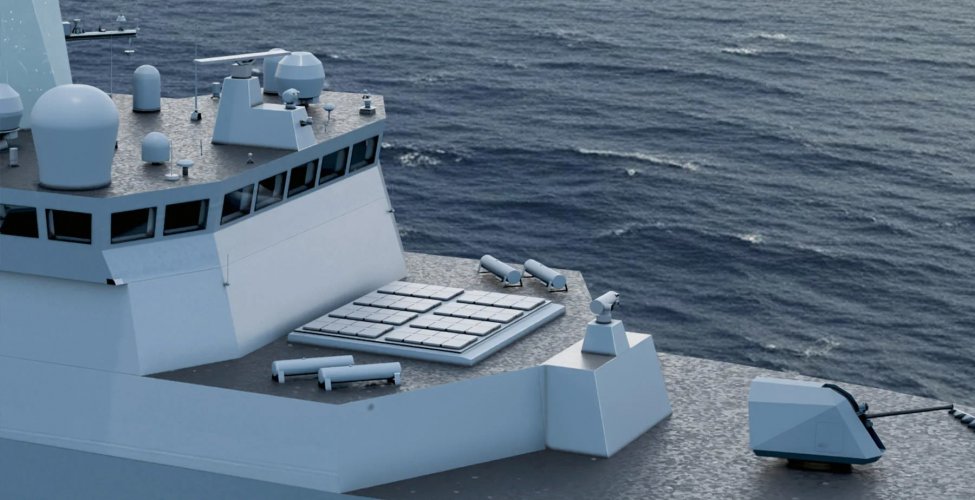
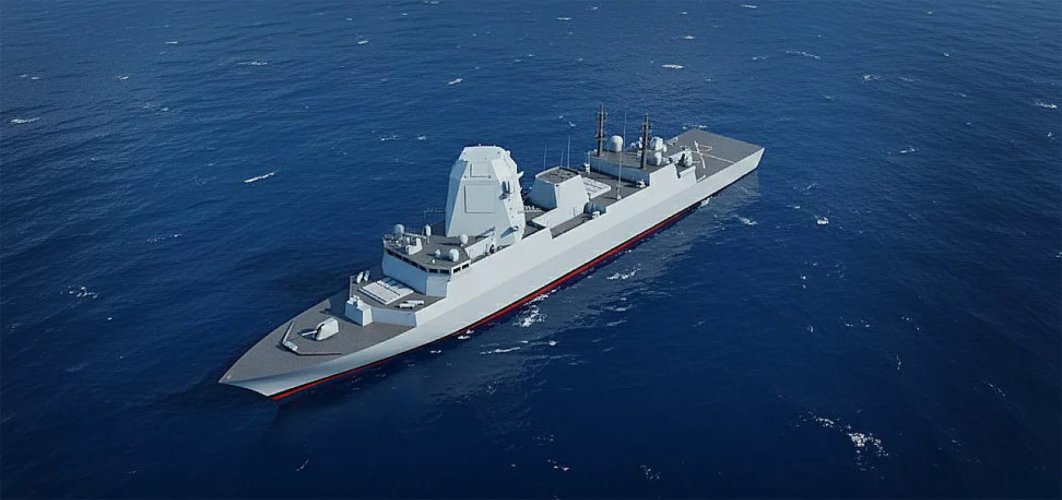
Actually 128xMk 41, 1x57mm, 2x40mm RWS, and 4 Dragonfire. There's two on the sides as well. The Navy Lookout article has some nice pictures of the 160M design.

Also, using the top-down view in that article as a reference the beam comes out to roughly 22 meters, maybe 23.
 

Attachments

  • AAW05.jpg
    AAW05.jpg
    243.6 KB · Views: 61
  • AAW04.jpg
    AAW04.jpg
    216.5 KB · Views: 63
  • AAW03.jpg
    AAW03.jpg
    244 KB · Views: 72
  • AAW02.jpg
    AAW02.jpg
    134.9 KB · Views: 73
  • AAW01.jpg
    AAW01.jpg
    274.9 KB · Views: 69
Red sea seems to be mostly drones and AShBMs, with some obsolescent cruise missiles thrown in. The Moskva attack was remarkable, but not relevant to a discussion on modern warship design and the same goes for the other Neptune attacks. I didn't know about the Syrian or Iraqi attacks; that's very interesting and thank you for giving me a new rabbit hole! I should have done some extra research before posting.
But the point is that the RN put a lot of effort into finding the best ways of stopping anti ship missile attacks and it's unlikely their doctrine is going to change for T83.
The Houthis have been using quite a few YJ83 type AShM! They shot five at USS Mason in a single raid in 2016! And fired something like 9 in a week or two. My point is that the RN does not have an exclusive or even terribly unique experience getting AShM shot at them, especially today. I don't mean to imply that Sea Viper isn't quite good, though it is hampered by the failure to integrate CEC.
 
There is one other reason for the RN choosing a smaller design- the refit facility in #14 and #15 dry docks at Portsmouth only has capacity for ships up to 170m, and a similar limit applies to BAE's build hall in Glasgow.
The RN has no need of a missile cruiser, it wants a command ship to carry CMS and a very powerful radar. Extra capacity will be supplied by T91 missile sloops if necessary, and the priority is getting hulls to sea.
With all of the extra infrastructure that would be required, the choice is between 4-6 large destroyers and 2-3 cruisers and I know which the Navy needs more.
Then you pay to enlarge the drydocks and build hall(s)! FFS is the UK that [expletives deleted] blind?!?
 
Then you pay to enlarge the drydocks and build hall(s)! FFS is the UK that [expletives deleted] blind?!?
The question isn't just cost, it's whether there's the physical space. Portsmouth dockyard's been on its current site since 1194 and is completely surrounded by the city, there might just be space, but if you start impinging on other buildings then there's nowhere else to move them. There are possibly worse issues with the BAE build halls at Govan, if you want to extend them, you have to demolish another large facility, with no obvious place to move it to.
 
The question isn't just cost, it's whether there's the physical space. Portsmouth dockyard's been on its current site since 1194 and is completely surrounded by the city, there might just be space, but if you start impinging on other buildings then there's nowhere else to move them. There are possibly worse issues with the BAE build halls at Govan, if you want to extend them, you have to demolish another large facility, with no obvious place to move it to.
Not to mention that the harbour is riddled with unexploded bombs, so nobody wants to dig foundations for new docks. They got quite a few when dredging the harbour out for the QEs, the area inside the basins would be even worse and you'd have to dig deeper.
 
Status
Not open for further replies.

Similar threads

Back
Top Bottom