Status
Not open for further replies.
When it comes to ships my view, based on experience is you can never have enough room around equipment. Because getting human access into various places is gold dust and having decent space to move things through. Is just good design and better resolved before anything is built.
Frankly if you move furniture through a house and have to fix bits of your house or car. You already know what I'm talking about.

As a plus, the greater the volume, and the lower the density of systems, the lower the probability of a multi-system 'kill' caused by a successful penetration of a warhead exploding inside the ship.
 
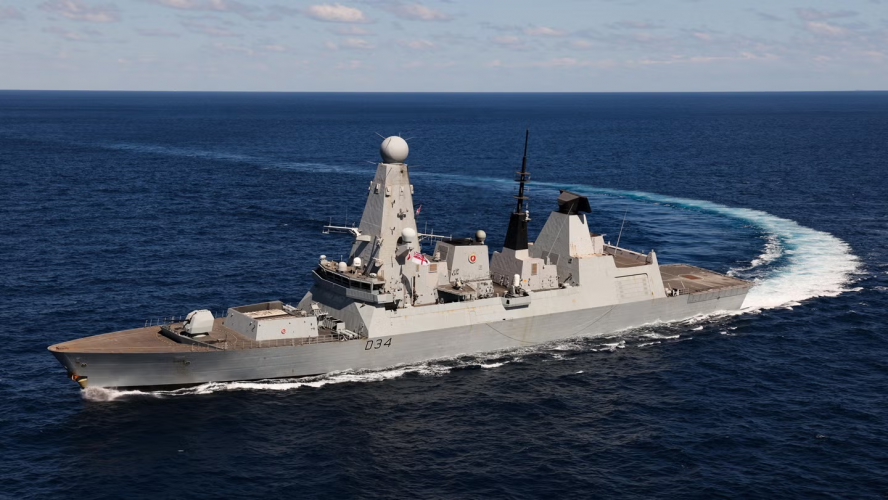
Going for anything less voluminous than the Type 45 would be a mistake, imo, and I'd even argue that the 160m design is a bit on the small side once the potential need to fit larger missiles (and thus fit less of them) is taken into consideration. A 175m design with coresponding beam growth should be the minimum.
 
Going for anything less voluminous than the Type 45 would be a mistake, imo, and I'd even argue that the 160m design is a bit on the small side once the potential need to fit larger missiles (and thus fit less of them) is taken into consideration. A 175m design with coresponding beam growth should be the minimum.
Yes.
After all we should consider the likes of Nightfall as an option as well as the Stratus pair.
 
The article mentions export - I'm struggling to think about who would need a destroyer this size that wouldn't simply build their own. Australia, or the Dutch perhaps? The Nordic navies would prefer a smaller solution I think - perhaps exporting the CMS, radar and drone systems as opposed to the whole ship.
While that's what they'd prefer, there is a lower limit on the size of hull that is capable of operating the radar, cooling, etc.

Note how big the Constellation-class is.
 
While that's what they'd prefer, there is a lower limit on the size of hull that is capable of operating the radar, cooling, etc.

Note how big the Constellation-class is.
A minimised version then, like the version of the Spy-1 used by Norway?
 
The article mentions export - I'm struggling to think about who would need a destroyer this size that wouldn't simply build their own. Australia, or the Dutch perhaps? The Nordic navies would prefer a smaller solution I think - perhaps exporting the CMS, radar and drone systems as opposed to the whole ship.
Could be looking at a joint program perhaps? Or maybe trying to get the Germans to order their design given that they're having problems with their equivalents
 
Could be looking at a joint program perhaps? Or maybe trying to get the Germans to order their design given that they're having problems with their equivalents
But there is quite a strict timeline where they have to come even when we assume some an interim solution. Don't know if they could deliver in that timeframe
 
Could be looking at a joint program perhaps? Or maybe trying to get the Germans to order their design given that they're having problems with their equivalents
I'm not sure about the Germans, they seem to be going all in on their F127. The most recent reporting is that they'll likely up the order to eight ships. They're also doing the drone escorts thing.
 
I'm not sure about the Germans, they seem to be going all in on their F127. The most recent reporting is that they'll likely up the order to eight ships. They're also doing the drone escorts thing.
Those 8 happen independent of F-126 as there is large need for those ships similiar with the USV escorts / munition carrier.
 
A minimised version then, like the version of the Spy-1 used by Norway?
That would be the eventual aim, surely?
That a BAE-owned CMS and radar system can be scaled to fit any requirements, with GCAP-style relatively open integration. As a start, the S-band radar on T83 should be a fixed version of Artisan NG, or vice versa. We would then be able to retrofit as well as do new builds, which opens up new markets relative to the less flexible CMSs.
Mk41 missile integration might be a bottleneck, but IIRC that's a lot easier than CMS integration?
 
An article now on the Type 91 sensor-effector platform.

https://www.navylookout.com/bae-systems-large-uncrewed-warship-proposal/
The initial SEP concept developed by BAES is a 100-metre-class vessel, based on a slightly enlarged version of the Trion hull and conceived to be optionally-crewed or fully autonomous. Each platform could be fitted with up to 32 Mk 41 vertical launch cells (VLS), along with its own radar and defensive guns. By shifting missile magazines away from the core command ship and onto distributed hulls, the RN can increase salvo size and maintain a credible layered defence against saturation attacks. In modern high-intensity combat, the number of silos is less important than how rapidly they can launch weapons in response to threats. SEP would allow for wider geographic dispersal and increased simultaneous launch capacity.

Apart from the missiles, it's armed with a pair of Bofors 40 mm Mk 4s.

https://www.navylookout.com/in-focus-the-bofors-40mm-mk-4-gun-that-will-equip-the-type-31-frigates/
Quite a bit on its direct ancestor, HMS Triton too.
 
Last edited:
In modern high-intensity combat, the number of silos is less important than how rapidly they can launch weapons in response to threats.
For high-intensity combat, that may be correct.

For whatever you want to call the Houthi situation (medium-intensity combat?), that is emphatically not correct.

Though it may be viable to swap out the Type 91s while the Type 83 stays in place.
 
Going for anything less voluminous than the Type 45 would be a mistake, imo, and I'd even argue that the 160m design is a bit on the small side once the potential need to fit larger missiles (and thus fit less of them) is taken into consideration. A 175m design with coresponding beam growth should be the minimum.

I get a strong Type 42 vibe from this latest concept.
 
An article now on the Type 91 sensor-effector platform.

https://www.navylookout.com/bae-systems-large-uncrewed-warship-proposal/
The initial SEP concept developed by BAES is a 100-metre-class vessel, based on a slightly enlarged version of the Trion hull and conceived to be optionally-crewed or fully autonomous. Each platform could be fitted with up to 32 Mk 41 vertical launch cells (VLS), along with its own radar and defensive guns. By shifting missile magazines away from the core command ship and onto distributed hulls, the RN can increase salvo size and maintain a credible layered defence against saturation attacks. In modern high-intensity combat, the number of silos is less important than how rapidly they can launch weapons in response to threats. SEP would allow for wider geographic dispersal and increased simultaneous launch capacity.

Apart from the missiles, it's armed with a pair of Bofors 40 mm Mk 4s.

https://www.navylookout.com/in-focus-the-bofors-40mm-mk-4-gun-that-will-equip-the-type-31-frigates/
Quite a bit on its direct ancestor, HMS Triton too.
And yet the BAE image shows 64 cells...
 
And yet the BAE image shows 64 cells...
Triton-model-2-1732x974.webp

It's 32 cells, in eight blocks of four cells each. You can see the individual cells in the first block in the bank.

Though I don't think that this configuration is currently viable if they intend to use the Mk41, given it comes in a minimum number of eight cells.
 
Don’t get me wrong, I love the ambition and I want this to happen, but I can’t help wondering how the RN plans to actually fill all those VLS cells ?

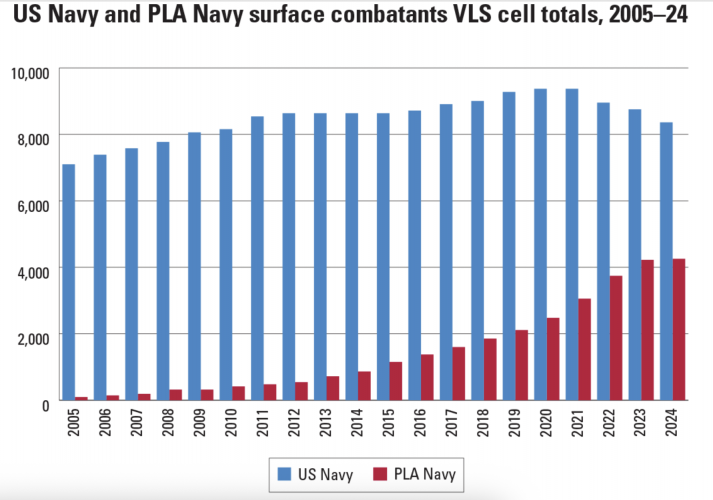
With 8x T26 + 5x T31 + 6 "fleets" of (Type83+Type91) with 128-196 cells for each ... we're looking at 1200-1600 VLS cells

Now according to the IISS, 1200-1600 cells is roughly 15-20% of the current fire power of the entire USN fleet of surface combatants... so the budgets will have to match the ambition.

(BTW with that amout of volume, 150-200 newly built x8 cell launchers, it's borderline criminal to rely on foreign designed and build VLS, be it Sylver or Mk41 ... the S.Koreans understood that)

Also, having this level of ambition for your Navy, but still 0 medium/long range GBAD is pretty astonishing IMHO.

--> https://www.iiss.org/online-analysi...-gap-china-homes-in-on-us-navy-vls-advantage/
Capture d’écran 2025-10-03 à 12.44.20.png

One last note :

That number of VLS cells is also 2 to 2.5 times what I could realistically (and optimistically) see the Marine Nationale operating by 2040 (around 600-750 cells)... talk about getting lapped.

Conversely, the RN is still only planning for 8 Captas4/S2087 equipped ASW frigates, whereas the MN expects to field 13-16 within the next 10 years. Different priorities, perhaps?
 
Last edited:
Triton-model-2-1732x974.webp

It's 32 cells, in eight blocks of four cells each. You can see the individual cells in the first block in the bank.

Though I don't think that this configuration is currently viable if they intend to use the Mk41, given it comes in a minimum number of eight cells.

Lockheed hasn't been why about rolling alternative launcher configurations recently. They haven't shown a four-cell block quite like this but it wouldn't be technologically challenging.
 
Triton-model-2-1732x974.webp

It's 32 cells, in eight blocks of four cells each. You can see the individual cells in the first block in the bank.

Though I don't think that this configuration is currently viable if they intend to use the Mk41, given it comes in a minimum number of eight cells.
I'm pretty sure that's blocks of 8 cells, the standard Mk41 block, just arranged into a single line of 8 sets of 8.
 
I'm pretty sure that's blocks of 8 cells, the standard Mk41 block, just arranged into a single line of 8 sets of 8.

Its definitely not.

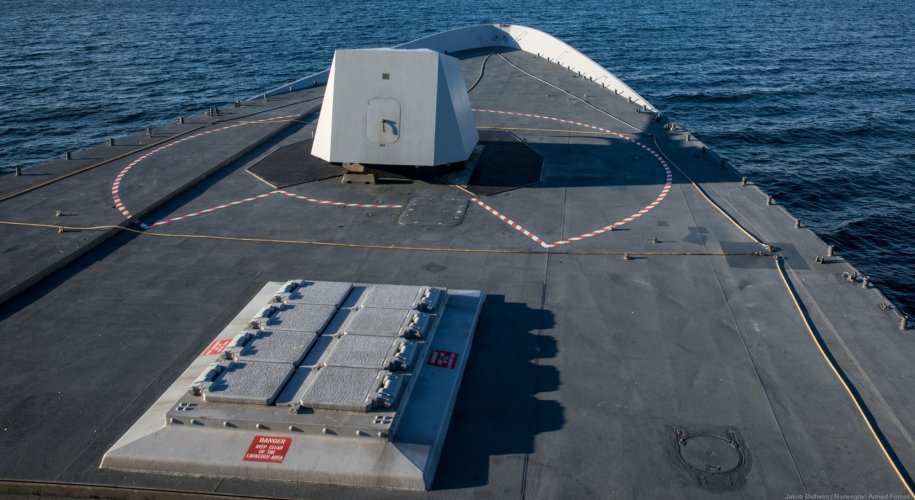
This is what a single 8-cell block looks like from the top.

1759545122688.jpeg
The model clearly shows something different, square rather than rectangular.

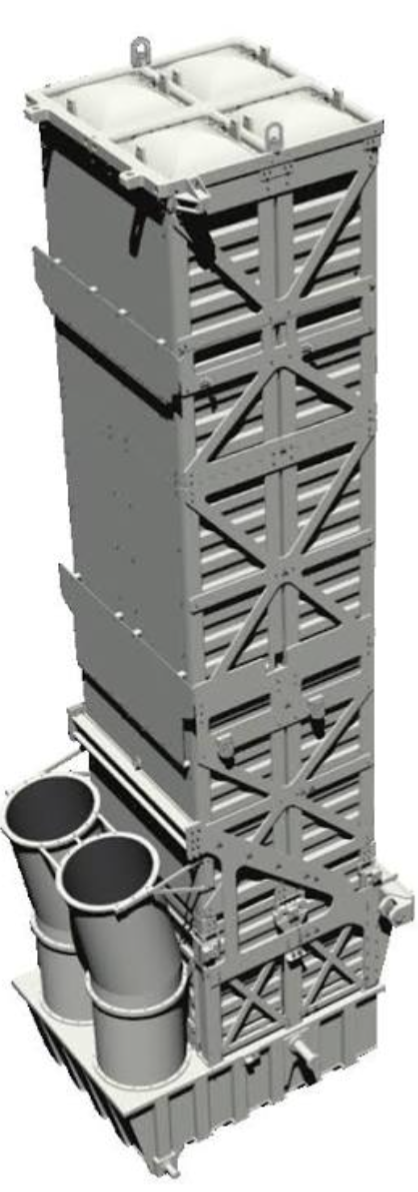
Heck, I just realized that we already know of one new 2x2 Mk 41-derived launcher: the Mk 70. Stand a Mk 70 upright and it looks like this, very similar to the model (minus hatch covers). The only thing missing in the model is exhaust management, and I have some thoughts about what might be happening there.

Screenshot_20251003-224423.png
 
Last edited:
Forgive my ignorance here, but what specifically stops a VLS from being a modular drop-in canister? i.e. something which, having fired all missiles, could be replenished at sea as a unit?
 
Forgive my ignorance here, but what specifically stops a VLS from being a modular drop-in canister? i.e. something which, having fired all missiles, could be replenished at sea as a unit?
They can be replenished at sea, the main issue is that the canisters with missiles in them are very heavy, long, and skinny by nature which requires some mechanism to reload without dropping/bending/snapping one.
 
  • Like
Reactions: zen
Forgive my ignorance here, but what specifically stops a VLS from being a modular drop-in canister? i.e. something which, having fired all missiles, could be replenished at sea as a unit?
The problem navies are having at the moment is not the movement of the missiles onto the vessel to be reloaded- heavy solid RAS jackstays are capable of similarly sized objects- but that the missile canister then needs to be inserted with a quite precise fit into its mounting.
That becomes harder as the object is heavier as it is more likely to swing ( being lifted by a crane) and much harder and more dangerous to stop using human force, not to mention the extra risk of large quantities of solid rocket fuel hitting things with a lot of force. So putting more missiles into each 'block' to be reloaded at once makes the problem harder rather than easier.
That being said, a combined unit of missiles might reduce the precision required for the final fit into position, if the exhaust systems were combined with the canisters before reloading. That way there is no need to seal between the VLS system and the canister and so a more user-friendly guide rail system could be developed.
There is still the problem with lifting tonnes of explosive around the deck of an active warship, though.
 
That becomes harder as the object is heavier as it is more likely to swing ( being lifted by a crane) and much harder and more dangerous to stop using human force, not to mention the extra risk of large quantities of solid rocket fuel hitting things with a lot of force. So putting more missiles into each 'block' to be reloaded at once makes the problem harder rather than easier.
The solution being used by the USN is a gantry which supports the canister across the length, known as TRAM (based on 1990s prototypes), as well as a couple other systems.

https://www.navalnews.com/naval-new...s-at-sea-vls-reloading-during-command-drills/
 
Is there any known reason why a Type 45 hull is not considered as a base for this ship?
 
Early work on a hybrid force, 'Project Beehive.' Don't get too excited - these aren't the actual Type 91s etc, and funding isn't even inked yet, but it's a start.

https://ukdefencejournal.org.uk/britain-looking-to-buy-20-new-naval-drone-vessels/
The vessels will be used by the Surface Flotilla (SURFLOT) in UK and overseas operations, serving as testbeds for emerging technologies and new operational concepts.

The Ministry of Defence stated that the USVs are “key to maintaining operational relevance against peer threats.” The new fleet will allow the Navy to trial advanced autonomous and hybrid capabilities under its ongoing “Hybrid Navy” transition, which aims to combine crewed and uncrewed systems across surface, subsurface, and air domains.
 
I wouldn't be surprised if it was too small.

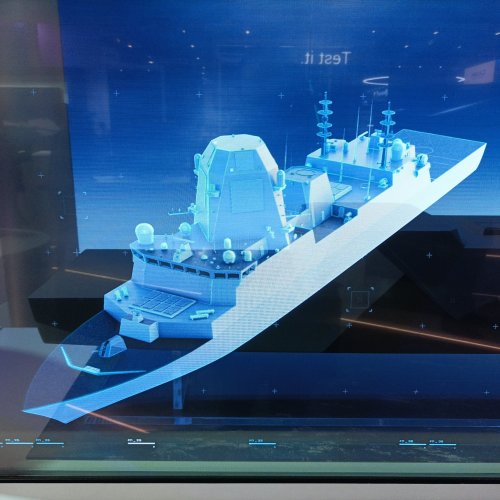
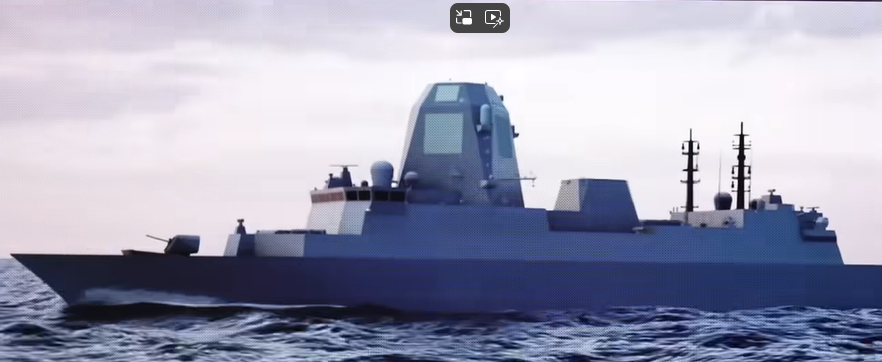
A bit difficult to assess the dimensions from the renders, but I got the impression the hull is rather closer to "short and fat" concept (why I mentioned the Type 42 above), and I kind of see the same potential problems with seakeeping.

Of course, the renders can be misleading or intentionally distorted, but it's still a bit strange.
 
A bit difficult to assess the dimensions from the renders, but I got the impression the hull is rather closer to "short and fat" concept (why I mentioned the Type 42 above), and I kind of see the same potential problems with seakeeping.

Of course, the renders can be misleading or intentionally distorted, but it's still a bit strange.
You could arguably describe the Burkes as "short and fat", their beam is 66ft while the Spruance-class beam is 55ft. And what I remember is that the Burkes are supposed to ride better than the Sprucans.
 
You could arguably describe the Burkes as "short and fat"
There is "short and fat" and there is really short and really fat :)

1762604893042.jpeg

The small 54mm turret distorts the size perception, so I roughly estimate from the size of the bridge and VLS cells - and that gives a ship that is slightly shorter than Type 45 and wider, architecturally closer to a distorted Type 26 with a low-cut forecastle. Arguably, the Type 45 has a lot of unused space that can be filled with VLS proper, and only the width of the mast may be a constraint here, but then you could scale up the whole hull instead of doing... this.

I don't say it won't work, it just looks weird.
 
Last edited:
There is "short and fat" and there is really short and really fat :)

View attachment 790825

The small 54mm turret distorts the size perception, so I roughly estimate from the size of the bridge and VLS cells - and that gives a ship that is slightly shorter than Type 45 and wider, architecturally closer to a distorted Type 26 with a low-cut forecastle. Arguably, the Type 45 has a lot of unused space that can be filled with VLS proper, and only the width of the mast may be a constraint here, but then you could scale up the whole hull instead of doing... this.

I don't say it won't work, it just looks weird.
*57mm

And this is the perfect tactic. Make it so ugly any radar fry and EO/IR sensor crack xD
Then your only danger a submarines who can't see it
 
Last edited:
Early work on a hybrid force, 'Project Beehive.' Don't get too excited - these aren't the actual Type 91s etc, and funding isn't even inked yet, but it's a start.
Given the numbers, I suspect these are likely to be much the same as the 7.2m Rattlers and spend most of their time imitating Opfor USVs and/or trialling concepts for using USVs for force protection vs Opfor USVs.
 
One thing to consider in looking at hull configuration is that there's been a definite tendency in recent design concepts to step back from 30kt plus top speeds to 26/27kts, which will reduce reliance on high length to beam ratios to make the required speeds. Combine that with VLS farms demanding more deck area and we could well be looking at a fundamental shift in what hull forms make sense.
 
One thing to consider in looking at hull configuration is that there's been a definite tendency in recent design concepts to step back from 30kt plus top speeds to 26/27kts, which will reduce reliance on high length to beam ratios to make the required speeds. Combine that with VLS farms demanding more deck area and we could well be looking at a fundamental shift in what hull forms make sense.
Still doesn't explain the low cut of the forecastle (why raise the VLS, but leave the foredeck low?). And there is a ridiculous amount of deck (and probably internal) space that could have been used for more VLS cells and seems just empty.

Seems there are two directions for such ship in contemporary design -

Chinese Type 055 shows how this can be done in a regular way, with a long hull, high speed, and enough cells for any mission outfit.
Korean VLS cruiser also, if they ever build it.

On the other hand, there are
Japanese "arsenal" air-defense ship (that got canceled or delayed very indefinitely) was also "short and fat" but at least it had a forecastle.
American study to turn an LPD into a missile defense ship. Not much for speed, but a lot of space for missiles.

Apparently this variant of Type 83 falls somewhere between the two, but in awkward, underarmed and "let's cut some expenses" way reminiscent, again, of the poor old 42 design.

A pity, IMHO, Type 45, as a design, has sufficient unrealized potential for extension/modernization.
 
Last edited:
Still doesn't explain the low forecastle, that would be problematic in any kind of ocean conditions. And there is a ridiculous amount of deck (and probably internal) space that could have been used for more VLS cells and seems just empty.

Seems there are two directions of such ship in contemporary design -

Chinese Type 055 shows how this can be done in a regular way, with a long hull, high speed, and enough cells for any mission outfit.
Korean VLS cruiser also, if the every build it.

On the other hand, there are
Japanese "arsenal" air-defense ship (that got canceled or delayed very indefinitely) was also "short and fat" but at least it had a forecastle.
American study to turn an LPD into a missile defense ship. Not much for speed, but a lot of space for missiles.

Apparently Type 83 falls somewhere between the two, but in awkward, underarmed and "let's cut some expenses" way reminiscent, again, of the poor old 42 design.
128 VLS says hello to underarmed in the picture you just posted, btw. But I don't think the foredeck is as low as you think it is. From the side profile, we can also see that the T45 has the same flat knuckle line from the bow to the helicopter deck at a similar height. The only difference is that the T45 has a slight upwards curve and a narrower top to the bow, which on FAWCS is very flared.
1762627113088.png
1762627343053.png
 
Still doesn't explain the low forecastle, that would be problematic in any kind of ocean conditions.
It does appear lower than in Type 26 and Type 31 (level with the helideck rather than a deck level higher). But RN design standards require working in the worst the North Sea and Northern North Atlantic can throw at you, so either it's not representative, or they have a way around it.

Apparently Type 83 falls somewhere between the two, but in awkward, underarmed and "let's cut some expenses" way

I'm not sure how 128xMk 41, 1x57mm, 2x30mm RWS, and 2 Dragonfire equates to 'underarmed'.
 
I'm not sure how 128xMk 41, 1x57mm, 2x30mm RWS, and 2 Dragonfire equates to 'underarmed'.
Underarmed is a function of a hull size. This one (for all it's awkwardness) can carry a lot more, or, alternatively, this amount of weapons can be put into a smaller or at least leaner hull.

so either it's not representative, or they have a way around it.
Hopefully :)

128 VLS says hello to underarmed in the picture you just posted, btw. But I don't think the foredeck is as low as you think it is. From the side profile, we can also see that the T45 has the same flat knuckle line from the bow to the helicopter deck at a similar height. The only difference is that the T45 has a slight upwards curve and a narrower top to the bow, which on FAWCS is very flared.
1762627113088.png
If insisted on this hull and dimensions, I would keep the VLS level for the whole forecastle, balance it with a sonar dome, if needed, and probably move the 57mm to the superstructure, one by each side of the funnel, replacing the forward gun with a third VLS cluster (192 is better than 128, isn't it?). But in any case the forecastle begs to be lengthened, for reasons of pure proportionality.
 
Last edited:
Status
Not open for further replies.

Similar threads

Back
Top Bottom