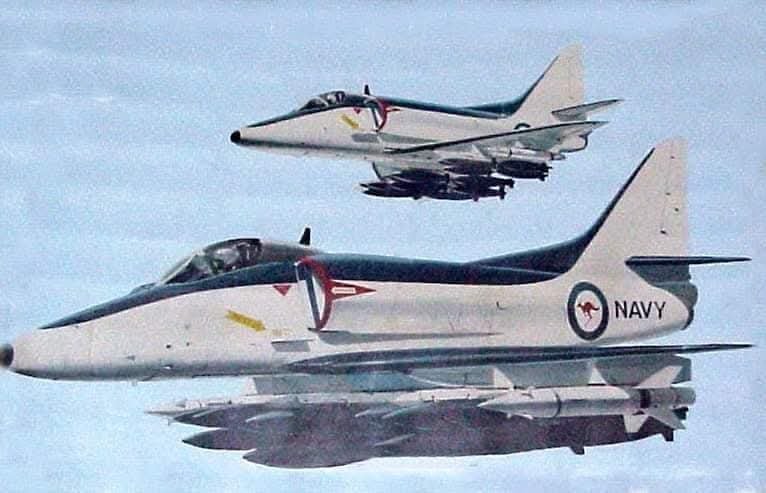
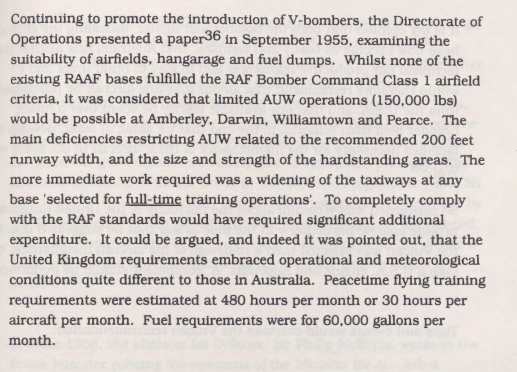
Alternate Australian Defence Force 1970s Procurements?

This makes me think the Avon powered mirage wpuld have been better for the RAAF than the atar powered version. Especially in a scenario where relations with Indonesia don't cool down like the did historical

It certainly appears to be an advantage to the Avon. The situations where an Avon's ability to run for longer than the Atar would occur let alone give a tactical advantage would likely be few and far between.

The longer running Avon would be useful if the Mirage had IFR, but that would mean reducing the number of airfields available due to the refueling system.
 
It certainly appears to be an advantage to the Avon. The situations where an Avon's ability to run for longer than the Atar would occur let alone give a tactical advantage would likely be few and far between.

The longer running Avon would be useful if the Mirage had IFR, but that would mean reducing the number of airfields available due to the refueling system.
Plus the Avon would in theory be cheaper to maintain, through not having to fill it up with new oil every time you want to use it only when an oil changed is required.
In an ideal world with an Avon powered mirage i would like to see at least 1 sqn with IFR to provide more mission flexibility for the RAAF especially if they got A5s and KC130s ins service.
Apparently the RAAF was looking at IFR as earlier as the 50s with the CAC Sabres so i dont think it would be to hard for it to get earlier IRF Capability
 
Would it be possible to retrofit IFR to say 2 sqns of mirage 3s to make the kc130 buy more appealing. Plus you've got the RAN A4s that could use it. What system did the P3s have?
P3s don't need IFR. They shut down an engine or two or three for range, plus have big fuel tanks onboard.
 
P3s shut out one of the outboard engines, the one that doesn't drive any hydraulics or electrical generation.

I don't think we should get too obsessed with range and endurance numbers because human factors kick in after a while. While a P3 may stay airborne for 12-15 hours and the crew can eat something and go to the toilet onboard and there may even by a spare crew or 2 think of what's it's like to sit on a plane for that long; an Aus-LA or Aus-London flight but where you're required to concentrate on your job for hours on end. Similarly, but worse is sitting in the cramped cockpit of a Mirage for longer than 90 minutes, it'd be like driving fast for hours on unfamiliar backroads where you have to concentrate while slowly dehydrating from the dry beathing oxygen and are unable to stop for a rest, toilet and leg stretch.
 
I came across this document today; it's been on my computer for years. It's scan of a typed-up bunch of interviews in the mid 60s with prominent Australians including PM Menzies, Foreign Minister Barwick and COSC ACM Scherger, all about Defence, Foreign Relations, Defence procurement etc for the people involved while it was still fresh.

It has a lot on the RA5C/F111/TSR2/B47 acquisition so far.
 

Attachments

  • Defence paper.pdf
    3.4 MB · Views: 21
Too bad the Draken was never revisited after the original Sabre replacement investigation was shelved. Also too bad enhanced Sabres were never acquired. There were some very interesting proposals and when you look at what NA did with the later Furies a CAC Avon FJ-4B could have been an interesting option for Melbourne.
 
I asked a RAAFie techo his exact question on Monday. He explained that RAAF Mirages were refueled using gravity, a screwdriver was jammed in a vent hole and fuel was pumped into the fuel filler hole from a truck, or drums or whatever was available, when the tanks were full the screwdriver was pulled out and the pumping stopped. In contrast the pressure refueling was like the dry-break system you see in motor racing, where the connection is pressurised and with self contained venting and overflow. Its only the latter which can be adapted for inflight refueling, meaning the RAAF Mirages cannot.
Interesting. This may explain why it took so long to retrofit IFR probes on Mirage III / V / Nesher . And they were ugly contraptions, not on the nose but on the left air intake (Kfir).

Found it at last ! https://forum.warthunder.com/t/mirage-5coam-not-quite-a-kfir/146966

Also why the Mirage 50 borrowed the nose (and de facto, IFR probe) of the Mirage F1.

I have this suspicion 1960's Mirage III derivates had a fuel system (as described above quote) that was too primitive for IFR.

The Mirage F1 borrowed a lot from Mirage V fuselage and only got IFR probes with the F1C-200 in 1980 and beyond.

As far as the AdA was concerned, its first IFR combat jets were Mirage IVA (strategic) and F-100 (tactical) in the 1960's, later followed by Jaguars (IOC 1973).

Now that's an interesting rabbit hole... seems there are two different schools of "Mirage IFR probes."

One comes from Israel and their Kfir (so around 1974) : IFR probe planted behind the air intake.

The other from Dassault and the Mirage 50 (1979) : Mirage F1 -style, that is planted on the nose.

I wonder whether the fuel lines and tanks were modified by Dassault between the Mirage V (1967) and the Mirage 50 (1979) so that the latter could get a F1 IFR probe on its nose. When the former, as modified by Israel, could only get an IFR probe by planting it behind its air intake. Weird.

But I'm veering off topic, so I'll stop there.
 
Last edited:
@Archibald I believe Israel's Mirage IIIC had the pressurized, single point refueling that is suited to having IFR retro-fitted, because Israeli Mirages would operate from bases in Israel that had the specialised refueling facilities which allowed faster turnaround. In contrast Australia's Mirages were expected to deploy all over S.E.A., from the Australian Mainland, islands in the Indian Ocean, Malaya, Borneo, Philippines, Thailand and others. Wherever there was a 7,000' runway, regardless of what refueling facilities existed in those places, hence the primitive system is an advantage.
 
I recommend that you do some research into what actually happened. The Air Board reviewed the ability of the RAAF to keep the F-4Es and found that the cost of keeping them would be prohibitive and cuts in squadrons would be necessary. They actually looked into this.

Books such as:
  • McDonnell F-4 Phantom: Spirit in the Skies by Jon Lake
  • From Controversy to Cutting Edge: A History of the F-111 in Australian Service by Mark Lax
are good starting points.
Further to this, attached are the internal documents related to the F-4E retainment:
  • United States Air Force - Proposal for Australia to retain F4E aircraft - Decision 1405 - This includes internal Australian consideration of this.
  • Cabinet Minute - United States Air Force proposal for Australia to retain F4E aircraft - Submission 901 - this is the resulting confirmation to not accept the offer.
 

Attachments

  • United States Air Force - Proposal for Australia to retain F4E aircraft - Decision 1405.pdf
    862 KB · Views: 13
  • Cabinet Minute - United States Air Force proposal for Australia to retain F4E aircraft - Submi...pdf
    136.8 KB · Views: 12
Further to this, attached are the internal documents related to the F-4E retainment:
  • United States Air Force - Proposal for Australia to retain F4E aircraft - Decision 1405 - This includes internal Australian consideration of this.
  • Cabinet Minute - United States Air Force proposal for Australia to retain F4E aircraft - Submission 901 - this is the resulting confirmation to not accept the offer.

Everything they rejected the Phantom for actually occurred or was even worse.
 
Remember that the A-4s were built around hauling a single early (heavy) nuke. So any carrier with A-4s was potentially a nuclear bomber item.

Sure, but everything I've seen about RAN A4 weapons is particularly light; a pair of 5" Zuni quad rockets, Bullpup and Sidewinder missiles or 4 x 250ln bombs. Almost nothing compared to what it could tote.
 
Sure, but everything I've seen about RAN A4 weapons is particularly light; a pair of 5" Zuni quad rockets, Bullpup and Sidewinder missiles or 4 x 250ln bombs. Almost nothing compared to what it could tote.
Was that because the A4s were mainly used for anti-snooper work/fleet defence instead of being used for strike?
 
I suspect as much, additionally a big attack carrier had just been knocked on the head so there likely wasn't much appetite to talk a big game on strike aircraft.
Fair enough. i wonder if the RAN didnt have a big carrier study would the A4s become more strike orientated? I'm surprised the RAAF didnt kick up a fuss about the S2s, saying they could just use the P2s or P3s for MPA and ASW instead
 
Fair enough. i wonder if the RAN didnt have a big carrier study would the A4s become more strike orientated? I'm surprised the RAAF didnt kick up a fuss about the S2s, saying they could just use the P2s or P3s for MPA and ASW instead

Perhaps if the RAN was a bit more positive and ambitious with the Melbourne from 1959, getting a Karel Doorman refit for example, I think the RAN wouldn't be so shy about the Skyhawk's attack capability.

I think in the NAA doc the P2s and P3s were to fly a distant patrol ahead of convoys and S2s to fly closer between the RAAF aircraft and the ASW helicopters and ships.
 
Perhaps if the RAN was a bit more positive and ambitious with the Melbourne from 1959, getting a Karel Doorman refit for example, I think the RAN wouldn't be so shy about the Skyhawk's attack capability.

I think in the NAA doc the P2s and P3s were to fly a distant patrol ahead of convoys and S2s to fly closer between the RAAF aircraft and the ASW helicopters and ships.
Maybe, plus the K D refit would allow Melbourne to operate more A4s allowing the RAN to feel as though it can use the A4s in a strike role.
I dont remember that in the NAA document, i thought it was the S2s to fly ahead of the convoys and the Helos amongst the ships, cause the were expecting to operate outside of RAAF cover
 
Examples?

Regardless, all I was doing was actually presenting the ACTUAL thinking going on.

It's a good piece of info, all the hand-typed documents that have come up in this thread that give the reasons for decisions are historical gold. There's often an assumption in these sorts of threads that decisions were made out of stupidity, when actually they were well reasoned given the knowledge at the time.

As for he reasoning, they didn't want the Mirage replacement pushed back a few years from 74/75 but in fact it was pushed back to 1979-81! They also stated a Mirage sqn would have to be disbanded for the Phantom, and this still occurred in 1974 even without the great compensation of the Phantom.
 
@Rule of cool that's quite an interesting read. It seems the RAAF was very anti RAN carrier aviation during the 60s.

Heres the one about the proposed acquisition of the Vulcan
Always loved the notion of Avro Vulcan B.2's in RAAF ORBAT, as denoted by the talanted
Claveworks, at Beyond The Sprues forum:

Regards
Pioneer
 

Attachments

  • [WhatIf] RAAF Avro Vulcan B.2 (by Clave).jpg
    [WhatIf] RAAF Avro Vulcan B.2 (by Clave).jpg
    52.9 KB · Views: 35
Last edited:
Always loved the notion of Avro Vulcan B.2's in RAAF ORBAT, as denoted by the talanted
Claveworks, at Beyond The Sprues forum:

Regards
Pioneer
Same mate. I've always wondered if Australia got Vulcans would the get fitted with cruise missiles and upgraded bombing systems?
 
I wonder what airfields the Vulcan could operate from.

The main 'Class I' bases had 9,000' long runways and little things like fillets on taxiway junctions etc., there were 8 + 2 of these in Britain. In the 50s dispersal bases required 6,000' runways, 20 LCN load bearing, room to park 4 V-Bombers near the end of the runway, I think there was 19 of these in Britain although they had other criteria attached so there might have been more airfields that met the physical requirements. In 1961, with the heaver weight of the B2s and Blue Steel, the minimum length for dispersal bases was increased to 7,500', which I suspect there were still plenty of bases in Britain that met this standard.

In the Australian context the hotter weather would likely mean 6,000' would be insufficient for armed Vulcans, I suspect 7,500' would be the minimum. Amberley and Darwin had 10,000' runways and RAF V Bombers deployed to Singapore and Butterworth. RAAF Tindal was upgraded to 9,000' in 1964-67 and RAAF Learmonth upgraded to 10,000' in 1971-73.

I suspect if the RAAF got a sqn of V bombers in the early 60s a rash of airfield upgrades would have ensued and perhaps upgrades to supporting infrastructure as well due to the appetite of these aircraft for bombs and fuel.
 
I wonder what airfields the Vulcan could operate from.

The main 'Class I' bases had 9,000' long runways and little things like fillets on taxiway junctions etc., there were 8 + 2 of these in Britain. In the 50s dispersal bases required 6,000' runways, 20 LCN load bearing, room to park 4 V-Bombers near the end of the runway, I think there was 19 of these in Britain although they had other criteria attached so there might have been more airfields that met the physical requirements. In 1961, with the heaver weight of the B2s and Blue Steel, the minimum length for dispersal bases was increased to 7,500', which I suspect there were still plenty of bases in Britain that met this standard.

In the Australian context the hotter weather would likely mean 6,000' would be insufficient for armed Vulcans, I suspect 7,500' would be the minimum. Amberley and Darwin had 10,000' runways and RAF V Bombers deployed to Singapore and Butterworth. RAAF Tindal was upgraded to 9,000' in 1964-67 and RAAF Learmonth upgraded to 10,000' in 1971-73.

I suspect if the RAAF got a sqn of V bombers in the early 60s a rash of airfield upgrades would have ensued and perhaps upgrades to supporting infrastructure as well due to the appetite of these aircraft for bombs and fuel.
this is from the Vulcan study
1762807924858.png
 
Yet again the devil is in the details :(. Sure, we might have squeezed the money and manpower to get a sqn of Vulcan's. at the expense of a sqn (or 2) of Canberras. However, we'd then have to undertake a HUGE base building/upgrade programme to operate them at their full potential, and that's what knocks the idea on the head.
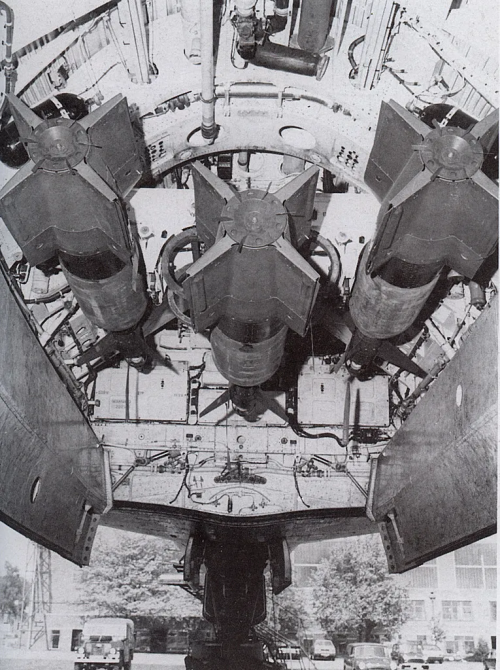
 
Yet again the devil is in the details :(. Sure, we might have squeezed the money and manpower to get a sqn of Vulcan's. at the expense of a sqn (or 2) of Canberras. However, we'd then have to undertake a HUGE base building/upgrade programme to operate them at their full potential, and that's what knocks the idea on the head.
Infrastructure upgrades early on are always worth it. The only way to mess up is to grossly underestimate how much increase you need.
 
Infrastructure upgrades early on are always worth it. The only way to mess up is to grossly underestimate how much increase you need.

Sure, but the biggest Australian airfields could only handle an AUW weight of 150,000lbs for an aircraft that had a MTOW of 167,000lbs for the B1 and 204,000lb for the B2.

What airbase gets upgraded first; Darwin because it's the nearest to the enemy, or Amberley because it's the home base? It's a tossup; Amberley is the training base so could handle the transition to service with a 150,000lb weight limit with Darwin upgraded to the first 'operational' base. But training at maximum weights, bombing etc is also important so there's a case for Amberley being upgraded first and while the Vulcans train to reach Full Operational Capability Darwin gets its upgrade.

Perhaps Tindal and Learmonth get their major upgrades earlier as operational bases and the other airfields like Williamstown and Pearce remain limited until they get upgrades in time.
 
I think I'd upgrade Darwin first, then Amberly. You could do most of the early training at 150,000lbs, then move to Darwin for heavy weight training once the upgrade is done and redo the runways at Amberly.

The weight increase would have been known by 1960 at the latest. And the US might have been willing to throw some money at a couple of bases if Oz allowed them to be used for US aircraft in emergencies. Build them up to 325klbs so you can run KC-135s.
 
I think I'd upgrade Darwin first, then Amberly. You could do most of the early training at 150,000lbs, then move to Darwin for heavy weight training once the upgrade is done and redo the runways at Amberly.

The weight increase would have been known by 1960 at the latest. And the US might have been willing to throw some money at a couple of bases if Oz allowed them to be used for US aircraft in emergencies. Build them up to 325klbs so you can run KC-135s.
Plus the UK for there bombers and tankers as well would find the upgraded bases handy.
I would say Darwin and Amberley would be upgraded first, than probably Williamtown and peace. Than Tindal and Learmonth.
 
FWIW the Vulcan doc say that if Australia placed an order in 1956 the aircraft wouldn't be delivered until 1959, which means they'd be B.2s.
than probably Williamtown and peace. Than Tindal and Learmonth.

I probably wouldn't bother with Williamtown near Newcastle and Pearce near Perth at all for the Vulcan, or at least not until after Tindal and Learmonth. They're too far away from any potential targets to be used for anything other than occasional training, which would mostly be conducted from Amberley, when the RAAF would desperately need more operational Vulcan bases. I'm sure they'd get upgraded in time, but they certainly wouldn't be a late 50s, early 60s priority job.
 
Same mate. I've always wondered if Australia got Vulcans would the get fitted with cruise missiles and upgraded bombing systems?
At minimum, I wonder how many 450kg (1,000-pound) Paveway LGB's you could fit in that Vulcan bomb bay? The Paveway would afford a cost effective means of stand-off capability against an adversary like Indonesia.....

Regards
Pioneer
 
Last edited:
At that time ... none at all ! (NO 'cruise missiles', NO LGB.'s pre 1982, those are all wet dream fantasies within the supposed timeline !)
 
Last edited:
At minimum, I wonder how many 450kg (1,000-pound) Paveway LGB's you could fit in that Vulcan bomb bay? The Paveway would afford a cost effective means of stand-off capability against an adversary like Indonesia.....

Regards
Pioneer

3, but that was a quick lash up for the Falklands. They probably could have carried several more.
 

Attachments

  • v3FjBUv.png
    v3FjBUv.png
    1.4 MB · Views: 24
Looking at the 50s Vulcan paper, the number of aircraft proposed in 1955 was 28 down from 39 proposed in 1954 and with a delivery date likely being 1960-61. Given the Vulcan had 4 times the hitting power of the Canberra, required twice as many men and 3 times as much maintenance I'd suggest 28 Vulcans would certainly replace both Amberley based Canberra sqns and likely 2 sqn based in Butterworth as well simply for the cost and manpower.

Such a delivery likely means the RAAF bombers won't be deployed to Vietnam. I suspect Vulcans would still be replaced by F111s, but it won't be the rush job that got us into trouble historically, it will likely be a late 60s decision for an early 70s delivery.
 
Back
Top Bottom