
You are using an out of date browser. It may not display this or other websites correctly.
You should upgrade or use an alternative browser.
You should upgrade or use an alternative browser.
Gourdou-Leseurre/Gourdou Designations
- Thread starter Apophenia
- Start date

- Joined
- 25 June 2009
- Messages
- 15,515
- Reaction score
- 9,447
Until today, and contrary to many other manufacturers, I had never taken the time to compare my own list with those present in this forum. Also, Gourdou-Leseurre was one of several companies I had not fully explored as I should (although I spent four years in Saint-Maur-des-Fossés, the very city where the company resided—which makes it unexcusable! For the record, one of the city's four senior high schools is called Lycée professionnel Gourdou-Leseurre). I've finally taken the time to look at the list here in a little more detail. Besides the remarks I already made just above, here are a few additional comments/corrections:
The first one [temporary reg. FW-001] had an open one (though it might have been upgraded to enclosed later on, I don't know).
I could share my own list here but I'd rather wait until these questions are addressed by @Apophenia or any other member.
NOT Lioré... LOIRE !- GL 33 : aka Liore-Gourdou-Leseurre 33, LGL 33, or LGL 33 .C1
LGL.34 (not GL.) had a W-type engine, while GL.341 had a V-type one, otherwise they were similar.- GL 34 : aka LGL 34 or LGL 34 C.1, 1 x 450 hp HS 12Gb, 1 built (F-AIIM)
- GL 341: aka LGL 341, 1 x 500 hp Hispano-Suiza 12Hb, 2 built
GL. 391 is new to me. Did it really exist or was it just planned?- GL 391: rengined LGL 32 with HS 9Va [?? same as GL 390 ??]
Or were there two?- GL 430: 1931 shipboard divebomber, 1 x 420 hp G-R 9Ady, 1 prototype
This unbuilt variant used a 500 hp Lorraine-Dietrich 12 Hdr engine.- GL 481: [??]
NOT parasol; the specificity of all three designs was the use of a gull-type wing, attached to the fuselage, ahead of the pilot.GL 480 - parasol monoplane fighter
GL 482: 1933 parasol monoplane fighter
I don't have this one in my list. An unbuilt variant? I strongly suspect this could simply be a typo for the GL.521...GL 531 - 1937 GL 432 deriv. 1 x 750 hp G-R 9 Kfr radial
- GL 531: Long-chord cowling, recontoured fuselage, new tailplane
As already stated by hesham, the existence of those "LGL" designations in 1940 are highly dubious.- GL 610B: [??], Loire-Gourdou-Leseurre 610B, LGL 610B
- GL 611 : [??], Loire-Gourdou-Leseurre 611, LGL 611
I don't have anything on this landplane version. Was it even started?GL 630 - parasol monoplane divebomber (similar to shipboard GL 432)
Do you have a source for this one? I have no other flying boat project between the M.2 and the L.2. Could it have been the "L"?GL 71 - 1930, response to seaplane/flying boat transport aircraft contest
No. Only the second prototype [temporary reg. FW-068] had an enclosed cockpit.-- 2 GL 821 prototypes built (GL 821.01 and GL 821.02), enclosed cockpits
The first one [temporary reg. FW-001] had an open one (though it might have been upgraded to enclosed later on, I don't know).
No. The GL.830 wasn't built. Only one GL. 831 and 22 GL.832 as stated.GL 830 - 2-seat colonial catapult patrol seaplane monoplane for Aéronavale
- GL 830 Hy, 1930 prototype, 1 x 350 hp HS.9Qdr radial engine, 1 built
Do you have a source for this one? The date makes it impossible for it to be a "GL" !GL 840 - 2-seat light observation floatplane, 2 x 140 hp Renault 4p inlines
- GL.820 Hy, 1 prototype, single test flight (1 June 1940)
I could share my own list here but I'd rather wait until these questions are addressed by @Apophenia or any other member.
Last edited:

- Joined
- 26 May 2006
- Messages
- 38,288
- Reaction score
- 20,425
GL 61 - [??]
- GL 610B: [??], Loire-Gourdou-Leseurre 610B, LGL 610B
- GL 611 : [??], Loire-Gourdou-Leseurre 611, LGL 611
I think that,the wrong is in its title,should be Gourdou 610 & 611,
becuase Loire wa left in 1929 and Leseurre was dissolved in 1937.
- Joined
- 25 June 2009
- Messages
- 15,515
- Reaction score
- 9,447
No, Leseurre and Gourdon went separate ways in 1937, but Leseurre apparently tried to develop his own projects, as shown by the mention of a Leseurre 120 B² in the ONERA archives for 1938.Leseurre was dissolved in 1937.
- Joined
- 26 May 2006
- Messages
- 38,288
- Reaction score
- 20,425
No, Leseurre and Gourdon went separate ways in 1937, but Leseurre apparently tried to develop his own projects, as shown by the mention of a Leseurre 120 B² in the ONERA archives for 1938.
OK,but it's nothing to do with Gourdou series after vanishing of
this relationship,so as I mentioned G.610 & G.611 are a logical
development of GL.601 as I think.

- Joined
- 25 July 2007
- Messages
- 4,917
- Reaction score
- 5,538
[...]
GL. 391 is new to me. Did it really exist or was it just planned?
Unclear so deleted. (It can be added back in if and when any evidence emerges.)
[...]
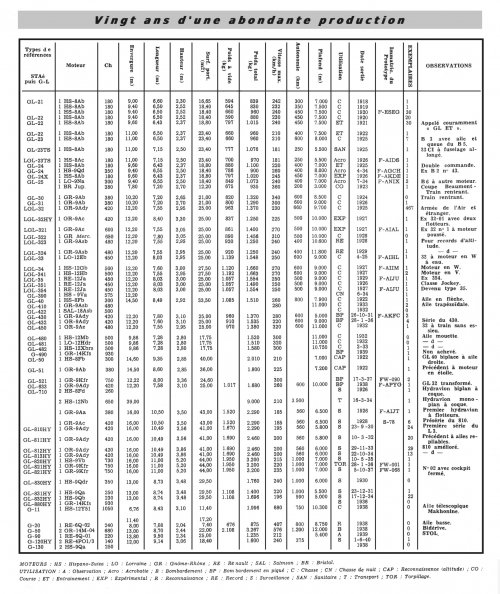
I don't have this one in my list. An unbuilt variant? I strongly suspect this could simply be a typo for the GL.521...
Perhaps a typo for 521. Wayback Machine version of my original source for GL 531:
https://web.archive.org/web/20120312032235/http://military.sakura.ne.jp/world/w_gl432.htm
[...]
I don't have anything on this landplane version. Was it even started?
It would seem so. The prototype GL 630 was reportedly modified and then supplied to the Basques during the Spanish Civil War.
[...]
Do you have a source for this one? I have no other flying boat project between the M.2 and the L.2. Could it have been the "L"?
Sorry, source would've been a few hard drives back ... 'GL 71' deleted.
[...]
Do you have a source for this one? The date makes it impossible for it to be a "GL" !
No. But agreed about the date. The details sound suspiciously similar to those of the G 140 Hy. Deleted.
Thanks for all this work, Stéphane!
- Joined
- 15 February 2024
- Messages
- 691
- Reaction score
- 1,875
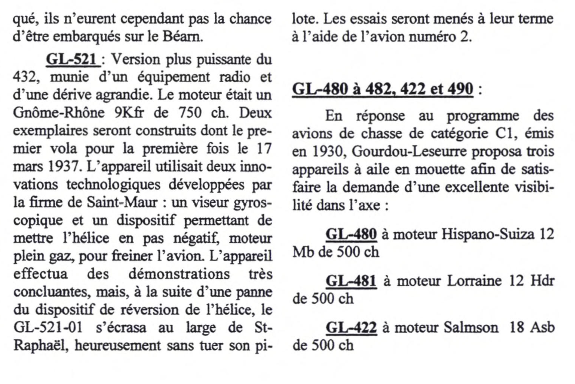
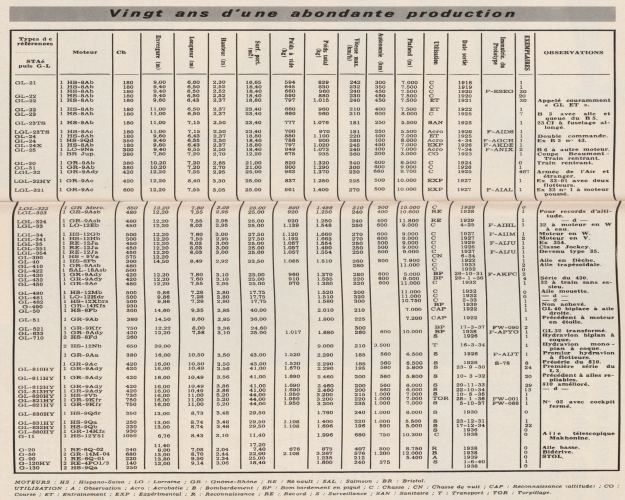
Dear Apophenia, is there a reason why the GL.710 is missing in your list?Gourdou-Leseurre GL Designations
Last edited:
- Joined
- 26 May 2006
- Messages
- 38,288
- Reaction score
- 20,425
- Joined
- 25 June 2009
- Messages
- 15,515
- Reaction score
- 9,447
My cleaned/reworked (but not modified) version of the same document (which misses a few things):from Aviation magazine
- Joined
- 25 June 2009
- Messages
- 15,515
- Reaction score
- 9,447
So definitely a typo. If the source had been a French period document I might have had my doubts. But not here, especially since they say nothing about it that is any different from what the 521 was.Perhaps a typo for 521. Wayback Machine version of my original source for GL 531:
https://web.archive.org/web/20120312032235/http://military.sakura.ne.jp/world/w_gl432.htm
Definitely not the first time we have Spanish War stuff not properly identified. A lot of aircraft were sent in a rush and not properly documented, it seems.The prototype GL 630 was reportedly modified and then supplied to the Basques during the Spanish Civil War.
My pleasure. And also it wouldn't be possible without YOUR work to compare it to and expand from. As I always say, there is nothing like teamwork!Thanks for all this work, Stéphane!

- Joined
- 26 May 2006
- Messages
- 38,288
- Reaction score
- 20,425
My dear Apophenia,
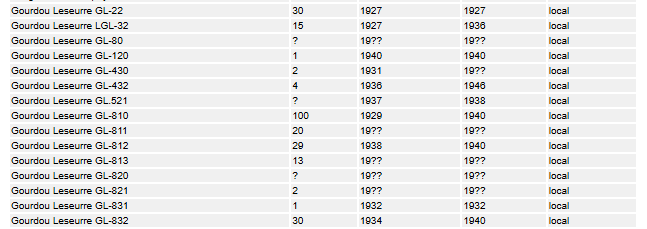
I also found this designation, GL-80,and I don't know what was it ? ;
http://www.aeroflight.co.uk/waf/france/navy/fra-navy-all-time.htm
The source again,
https://web.archive.org/web/2013122...t.co.uk/waf/france/navy/fra-navy-all-time.htm
- Joined
- 25 June 2009
- Messages
- 15,515
- Reaction score
- 9,447
The fact that they have no date and no info about it, along with the absence of GL.810 in their list, proves to me that it was just a typo for "810".The source again
- Joined
- 26 May 2006
- Messages
- 38,288
- Reaction score
- 20,425
The fact that they have no date and no info about it, along with the absence of GL.810 in their list, proves to me that it was just a typo for "810".
Are you sure ?.
Attachments
- Joined
- 25 June 2009
- Messages
- 15,515
- Reaction score
- 9,447
Sorry, I meant GL.830.Are you sure ?.
- Joined
- 25 June 2009
- Messages
- 15,515
- Reaction score
- 9,447
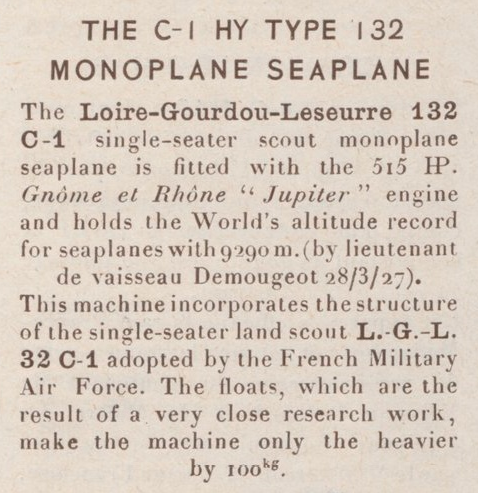
Before I share my own list, and before someone tells me "hey, what's that weird designation??", let me introduce the LGL.132 C1 HY.
It is not a typo, the designation appeared in L'Aéronautique, June 1927 for the floatplane version of the GL.32 (I'll be attaching the entire page in the dedicated Gourdou-Leseurre "projects" topic).
The aircraft itself was not unknown, but Aviation Magazine simply refered to it as the "GL 32 HY". Now this document clearly indicates that the type was an LGL and also that it held the world's altitude record for seaplanes at the time.
The weird thing about this designation is that it was obtained by adding a "1" BEFORE the type number. Consequently, it seems as if it was the second variant of a "Type 13" but of course that didn't exist...

It is not a typo, the designation appeared in L'Aéronautique, June 1927 for the floatplane version of the GL.32 (I'll be attaching the entire page in the dedicated Gourdou-Leseurre "projects" topic).
The aircraft itself was not unknown, but Aviation Magazine simply refered to it as the "GL 32 HY". Now this document clearly indicates that the type was an LGL and also that it held the world's altitude record for seaplanes at the time.
The weird thing about this designation is that it was obtained by adding a "1" BEFORE the type number. Consequently, it seems as if it was the second variant of a "Type 13" but of course that didn't exist...
- Joined
- 26 May 2006
- Messages
- 38,288
- Reaction score
- 20,425
and I have some speculations about
his designations.
Before speculation any designations,there are some mysteries aircraft
in his series,and they are;
GL-37 was mentioned in Czech museum,withourt any details
GL-80 was definitely meant GL-800,because in many sources,
they called GL-81 for GL-810,and so on,
https://www.avionslegendaires.net/encyclopedie/constructeur/gourdou-leseurre/GL-87.192 was also means GL-870
GL-601B1 may it was a single seat light bomber,waiting Philippe
G-610 & G-611 were completely unknown
1927 was commercial flying boat
1928 was military/civil flying boat
1929 was military/civil large flying boat
1929/1930 was military flying boat
Last edited:
- Joined
- 25 June 2009
- Messages
- 15,515
- Reaction score
- 9,447
What are you "waiting" for?? Philippe always names his files accurately. If the file says "GL 601 B1", then a B1 it is! So yes, a single-seat bomber, no doubt. And judging from the torpedo underneath the fuselage, it was a dive bomber. And since it has no arrester hook, it was a landplane diver bomber.GL-601B1 may it was a single seat light bomber,waiting Philippe
- Joined
- 25 July 2007
- Messages
- 4,917
- Reaction score
- 5,538
Dear Apophenia, is there a reason why the GL.710 is missing in your list?
Philippe: As noted in Reply #46, it was just eliminated because I had long since lost my reference to the GL 710 (my attempt at listing these designations dates back to 2013).
As such, it seems sensible at this point to await @Stargazer's updated designation list. Once that is mounted, I can then delete my dated and incomplete lists.
- Joined
- 25 June 2009
- Messages
- 15,515
- Reaction score
- 9,447
You missed the point about the GL.71/710 thing.Philippe: As noted in Reply #46, it was just eliminated because I had long since lost my reference to the GL 710 (my attempt at listing these designations dates back to 2013).
Although the designation GL.71 can be found nowhere and is best off the list for now, the GL.710 was a real aircraft, photos of which have been shared earlier today by Philippe and myself in the "Early Projects" section.
- Joined
- 26 May 2006
- Messages
- 38,288
- Reaction score
- 20,425
1926 was military flying boat
Sorry for this date,I meant 1929/30,becuase its style is from 1920s,
and its base,the wrote Gourdou-leseurre without Loire,so it probably
was after dissolving between them.
I will correct it.
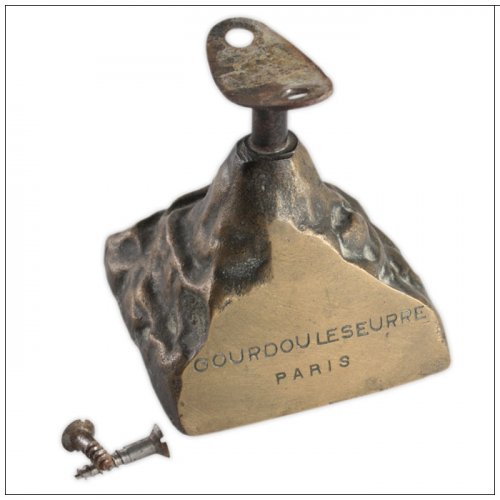
https://www.maquettes-de-soufflerie.com/Maquette_de_soufflerie_projet_Gourdou_leseurre.html
Attachments
- Joined
- 25 June 2009
- Messages
- 15,515
- Reaction score
- 9,447
I don't think it should be labeled as a "military" flying boat.I will correct it.
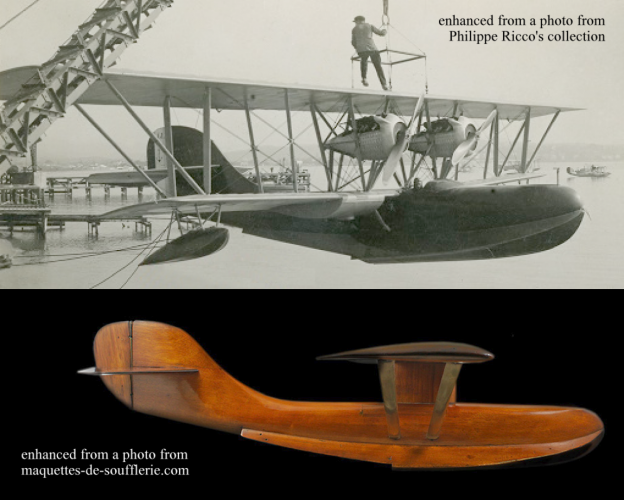 As Philippe @PhR already noted, the undesignated model clearly looks like a monoplane variant of the M.2, which was developed by Leseurre specifically for his wife's project of a northern transatlantic attempt. And so I believe it WAS, indeed, a 1926 project.
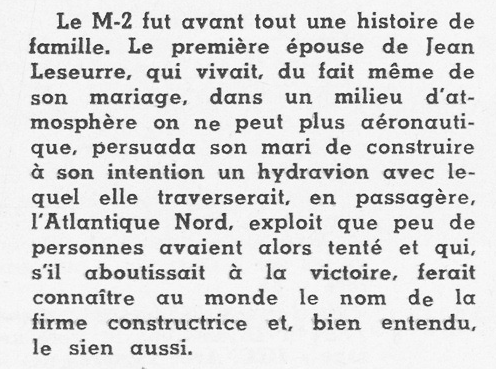
The M-2 was above all a family affair. Jean Leseurre's first wife who, as a result of that very marriage, lived in an environment as aeronautical as could possibly be, persuaded her husband to build a flying boat for her to cross the Northern Atlantic ocean as a passenger—an exploit which few had previously attempted, and which, if successful, would make the name of the building firm, and also hers of course, known to the whole world.
Moreover, Leseurre specifically did NOT want the M.2 to become a military design, so it is very unlikely that the monoplane might have been considered as a military type:

Despite the fact that his LGL-M2 could have fitted in the coastal patrol and small bombardment class of flying boats, Leseurre did not want to see his "raid" plane become a military type.

My hunch (but it's only an educated guess) is that Leseurre tried the design in both monoplane and biplane versions to see which configuration was the soundest for the project, and settled for the biplane instead (making the M.2 the only biplane ever for the company). It is also possible that the monoplane configuration, probably considered before the biplane (since the company dealt only in monoplanes) might have been the unknown Type M.
Last edited:
- Joined
- 25 June 2009
- Messages
- 15,515
- Reaction score
- 9,447
DEBUNKING TIME !
Whatever references you may have found, or notes taken, about a would-be "LGL.27", also sometimes found as "another Type H," is a load of crap. The origin of that confusion lies in the following item from Aviation Magazine International. Some typesetter must have been very confused with all the designations provided by the author, and got completely mixed up:
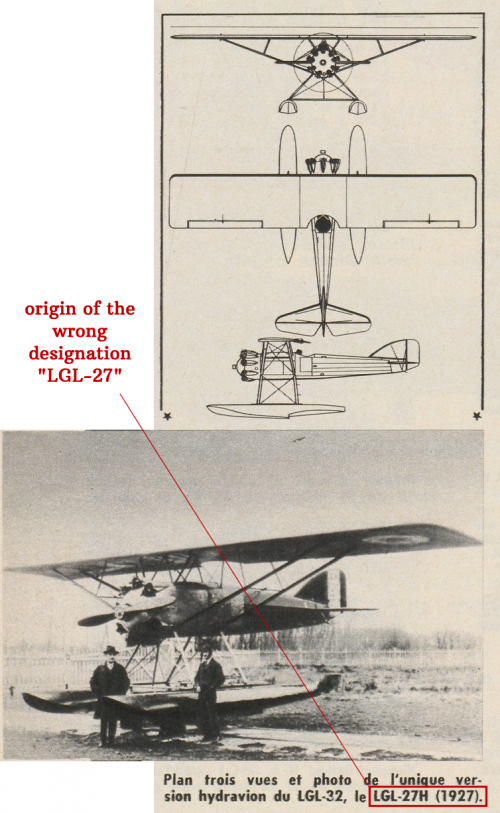
Quite obviously, the guy got mixed up between the aircraft's designation and the year 1927, and produced the fake designation "LGL-27H". The type was actually called the LGL-132 HY, but many sources call it the LGL-32 HY, and the article itself uses the latter. Nowhere in the text does this "LGL-27H" come up. AT ALL!
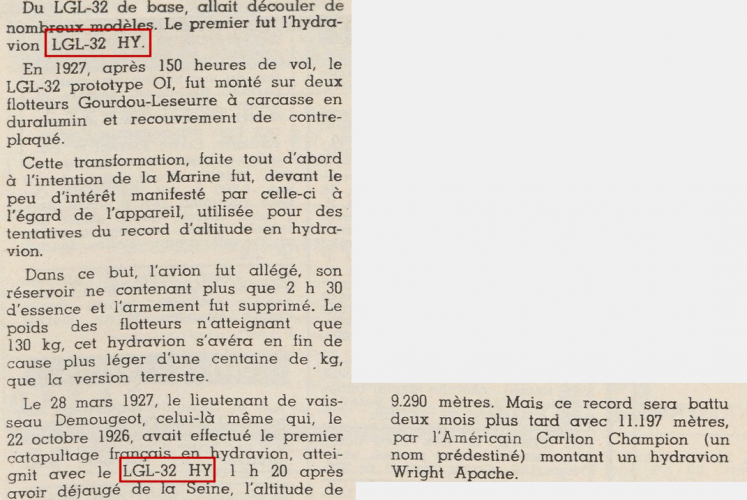
Note that the typesetter also wrote the letters "OI" instead of the number "01" in the second paragraph... That's what happens when the person who types is not conversant with the subject of the article! What is worse is that someone, somewhere, copied that in his notes, and came up with the idea that the "H" suffix letter was indicative of the type's model letter! (the Type H has always been the GL-51).And that's how completely wacky theories get born! So I sincerely believe the "27" slot can be discarded for good from all of our lists. It has certainly left mine...
Another highly dubious designation that I have found no basis for is the would-be "GL-840".
Consider this: that "GL-840" was described as a 1940 light observation prototype with a Renault 4 P engine.
- First of all, Gourdou and Leseurre parted ways in 1936. All the later projects were just G. for Gourdou, not GL. So if that "840" really existed, it would have been a "G". Normally, Gourdou used a new numbering system, but the designation G.490, an unfinished prototype of 1939, proves that designs started before the split retained their numbers, just without the "L."
- A 1940 reconnaissance prototype with a Renault 4 P engine DID exist, but that was the Gourdou G.120 HY. It is unlikely that Gourdou would have produced two so similar prototypes in the same year but that only one would be known.
(more debunking soon?)
- Joined
- 26 May 2006
- Messages
- 38,288
- Reaction score
- 20,425
Type M: Flying boat design
- M : (??)
The M 1 was unknown project,as also a north Atlantic flying
boat of 1925.
- Joined
- 25 June 2009
- Messages
- 15,515
- Reaction score
- 9,447
We have no evidence that the cancelled airplane for the North Atlantic crossing, which became the M-2, had an earlier designation, but if it did, it was not "M-1". If you look at other Gourdou-Leseurre letter type designations, they jump straight from B to B-2 and from I to I-2. The number "1" is never used. So whatever projects existed before the L-2 and M-2, they were simply Type L and Type M.The M 1 was unknown project,as also a north Atlantic flying boat of 1925.
- Joined
- 26 May 2006
- Messages
- 38,288
- Reaction score
- 20,425
We have no evidence that the cancelled airplane for the North Atlantic crossing, which became the M-2, had an earlier designation, but if it did, it was not "M-1". If you look at other Gourdou-Leseurre letter type designations, they jump straight from B to B-2 and from I to I-2. The number "1" is never used. So whatever projects existed before the L-2 and M-2, they were simply Type L and Type M.
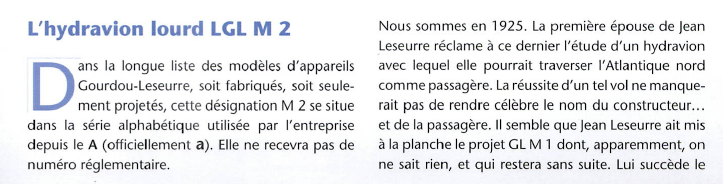
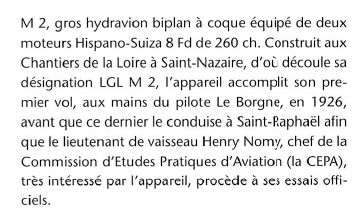
That's from Icare 230,as suggesting from the author.
- Joined
- 25 June 2009
- Messages
- 15,515
- Reaction score
- 9,447
That's from Icare 230,as suggesting from the author.
My Icare N° 230 has been shipped, I'll fetch it tomorrow, and I can't wait!
I'm taking this occasion to thank those who kindly contributed to my PayPal... (they know who they are).
The link will be dead tonight, but if anyone wants me to upload the book once again, I'll gladly do it and provide a new link.
(I wish I could have done an English-language version of the PDF, but it would have taken too long to translate the whole thing...)
- Joined
- 26 May 2006
- Messages
- 38,288
- Reaction score
- 20,425
My Icare N° 230 has been shipped, I'll fetch it tomorrow, and I can't wait!
I'm taking this occasion to thank those who kindly contributed to my PayPal... (they know who they are).
The link will be dead tonight, but if anyone wants me to upload the book once again, I'll gladly do it and provide a new link.
(I wish I could have done an English-language version of the PDF, but it would have taken too long to translate the whole thing...)
Here it's.
Attachments
- Joined
- 26 May 2006
- Messages
- 38,288
- Reaction score
- 20,425
About the GL-840,I was gotten it with its description,but now,I can't
remember the source,but it was based on GL-831.
I try to remember,may the source was Le Fana or Avions magazines ?.
woodville
I really should change my personal text
- Joined
- 15 May 2013
- Messages
- 79
- Reaction score
- 203
woodville
I really should change my personal text
- Joined
- 15 May 2013
- Messages
- 79
- Reaction score
- 203
I only saw the link on Friday when it had expired so I'd really appreciate it if you could provide a new one. Thanks.My Icare N° 230 has been shipped, I'll fetch it tomorrow, and I can't wait!
I'm taking this occasion to thank those who kindly contributed to my PayPal... (they know who they are).
The link will be dead tonight, but if anyone wants me to upload the book once again, I'll gladly do it and provide a new link.
(I wish I could have done an English-language version of the PDF, but it would have taken too long to translate the whole thing...)
- Joined
- 25 June 2009
- Messages
- 15,515
- Reaction score
- 9,447
New link sent in PM.I only saw the link on Friday when it had expired so I'd really appreciate it if you could provide a new one. Thanks.
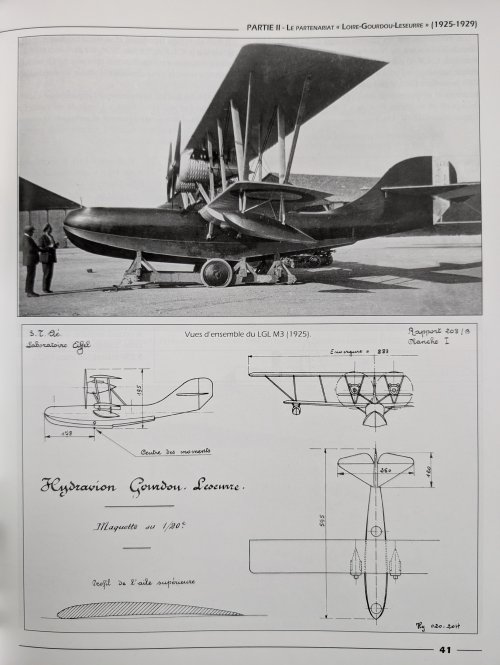
It is possible that the M.2 (Gourdou-Leseurre designation) might have been designated an M3 according to the official nomenclature.According to Gérard Bousquet in Les Avions et Hydravions Loire the M2 was actually designated M3. A Google translation of the relevant text is attached.
It is equally possible that M.2 was G-L's designation for the cancelled transatlantic prototype, and M.3 their designation for the built prototype. It will be difficult to ever know for sure. As clearly stated in Icare #230:
It is necessary to note that, despite precious help and efforts by renowned researchers, some uncertainties, contradictions and gaps (notably in pictures) remain, and that the words "the end" cannot reasonably be written to close this story—all the more so because, with the advent of home computing, the internet has come to spread confusion by adding countless new data of often disputable origin.
woodville
I really should change my personal text
- Joined
- 15 May 2013
- Messages
- 79
- Reaction score
- 203
In a reply to a challenge I'd set on the aerodrome website (this aircraft), Richard Barthel wrote "New link sent in PM.
It is possible that the M.2 (Gourdou-Leseurre designation) might have been designated an M3 according to the official nomenclature.
It is equally possible that M.2 was G-L's designation for the cancelled transatlantic prototype, and M.3 their designation for the built prototype. It will be difficult to ever know for sure. As clearly stated in Icare #230:
The LGL-M2 was designed and built for the Leseurre's wife , who wished to cross the North Atlantic . (as passenger only) .
This private venture was quickly abandoned , and the flying boat was modified for a M-3 program (Blanchard HB3 ,CAMS 33,Latham 42 and Latham 43) It was Unsuccessful .
Source : Aviation Magazine".
I agree with your last comment that the original designation was M2 but as built it became M3.
- Joined
- 26 May 2006
- Messages
- 38,288
- Reaction score
- 20,425
This private venture was quickly abandoned , and the flying boat was modified for a M-3 program (Blanchard HB3 ,CAMS 33,Latham 42 and Latham 43) It was Unsuccessful
In which program or year,also what issue of Aviation magazine ?
woodville
I really should change my personal text
- Joined
- 15 May 2013
- Messages
- 79
- Reaction score
- 203
Unfortunately Richard passed away recently so I can't help you there.In which program or year,also what issue of Aviation magazine ?
- Joined
- 26 May 2006
- Messages
- 38,288
- Reaction score
- 20,425
Unfortunately Richard passed away recently so I can't help you there.
There is no mention to M-3.
https://gallica.bnf.fr/ark:/12148/bpt6k5322860x/f45.item
Attachments
![Aviation_magazine_international___les_[...]_bpt6k5322860x_45.jpeg](/data/attachments/326/326801-b1f0f66796f159fb314b4cfebe79f0be.jpg)
Similar threads
-

-

-
French Competition of 1930 for HA 2 Aircraft
- Started by hesham
- Replies: 11
-

-
Prefix letters for US and Canadian manufacturers' designations
- Started by Stargazer
- Replies: 5