The effect of RAN 1964 Carrier Replacement Plan going Ahead?

According to the AI Overview which appeared after I put "Cost of the Queen Elizabeth class" into my web browser.

***** ***** ***** ***** ***** ***** *****​

The program to build both Queen Elizabeth-class aircraft carriers, including HMS Queen Elizabeth, cost over £6 billion, with the initial budget around £3.9 billion. The unit cost for each carrier is approximately £3 billion.
  • Total program cost: Approximately £6 billion for both carriers, including the HMS Queen Elizabeth and its sister ship, HMS Prince of Wales.
  • Initial budget: The project was initially budgeted at £3.9 billion.
  • Unit cost: The approximate cost per ship is £3 billion.
***** ***** ***** ***** ***** ***** *****​

So one Queen Elizabeth costs three times more than a CVA.01.
I wasnt expecting it to be that much more expensive maybe only 1.5 to 2x more
 
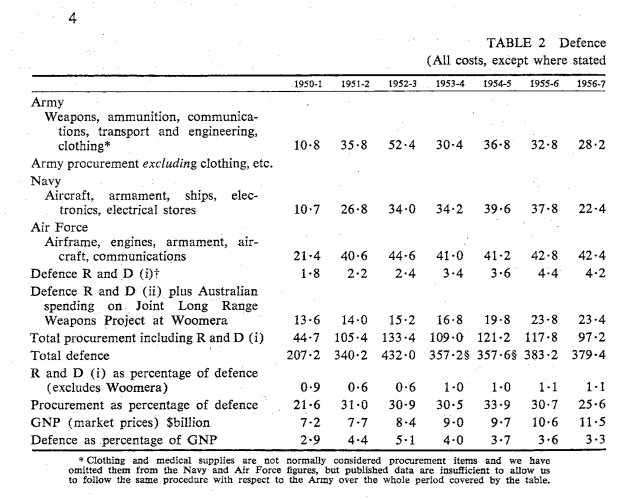
That's even more than I though. I only have the statistics for 1966 to the early 1990s. IIRC my source said about 5.0% from 1966 to the early 1970s, then it fell to 3.0% by the middle 1970s (due to the end of the Vietnam War & Gough Whitlam's defence cuts) and remained at about 3% of GNP from then to the early 1990s.

I used the World Bank figures, other figures I've seen say ~3.9% of GDP was the peak in the late 60s. The truth might well be in between, but the World Bank figures seem closer to me that those in the 3-4% range.

Is Australia reducing defence spending from a peak of 5.9% in 1967 to about 4.0% from the middle 1970s onwards instead of 3.0% from then on realistic? Would Australia's equivalent of the "Man on the Clapham Omnibus" be prepared to pay the higher taxes and/or reduced spending on social services required?

I don't like to fiddle with big things like that, as they accurately reflect what's really going on. If/when Australia is under actual threat defence spending ramps up quite significantly, but when we are fundamentally safe then it drops through the floor. Post-Vietnam/Confrontation Australia was fundamentally safe despite the withdrawal of the UK and to a lesser extent US.

That said I don't think historical defence budgets are sacrosanct in alternative scenarios. If a government has to, they will begrudgingly make money available in a different scenario to the historical one or alternatively will make money available to take advantage of an opportunity.
 
Plus I suspect that some of the claimed AUKUS costs are bases etc that really should not be considered as part of the sub costs.

100%. The huge AUKUS number is for 3 Virginia class, 8 SSN Aukus, investments into the US shipyards to increase capacity, establishment of an East coast base plus driving these subs until 2080 and whatever else the halfwit media can pack on there to make a frightening headline.

That said, the boats are super expensive, a Virginia class costs about USD $4.3b and an Astute is estimated to cost USD $2b.
 
Plus I suspect that some of the claimed AUKUS costs are bases etc that really should not be considered as part of the sub costs.
If it helps, I think the total cost of the British Polaris programme (including shore facilities) was in the region of £350 million while the cost (without missiles) of the 4 submarines was £160 million.
 
Last edited:
100%. The huge AUKUS number is for 3 Virginia class, 8 SSN Aukus, investments into the US shipyards to increase capacity, establishment of an East coast base plus driving these subs until 2080 and whatever else the halfwit media can pack on there to make a frightening headline.

That said, the boats are super expensive, a Virginia class costs about USD $4.3b and an Astute is estimated to cost USD $2b.
Fair Enough
 
I only have the statistics for 1966 to the early 1990s. IIRC my source said about 5.0% from 1966 to the early 1970s, then it fell to 3.0% by the middle 1970s (due to the end of the Vietnam War & Gough Whitlam's defence cuts) and remained at about 3% of GNP from then to the early 1990s.

I've been misreading the graphs.:eek: How embarrassing.

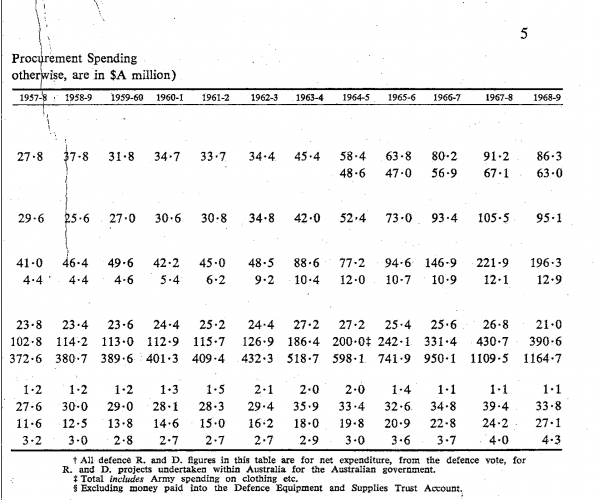
The £200m cap era of the early 60s represented about 2.3%-2.4% of GDP. From 1964 it jumped from 2.6% GDP to over 3.8% in 1968 then dropping back to 2.7% by 1972 and 2.3% by 1973.

However, the economy was booming because the budget went from AUD $432m in 1963 to AUD $1164 in 1968, almost triple despite the percentage of GDP not even doubling.
 
I've been misreading the graphs.:eek: How embarrassing.

The £200m cap era of the early 60s represented about 2.3%-2.4% of GDP. From 1964 it jumped from 2.6% GDP to over 3.8% in 1968 then dropping back to 2.7% by 1972 and 2.3% by 1973.

However, the economy was booming because the budget went from AUD $432m in 1963 to AUD $1164 in 1968, almost triple despite the percentage of GDP not even doubling.
So in other words we could of in theory paid for either the Essex or CVA-01 if the political will was there to spend an extra 1 to 2% more and if the defence cheifs could agree in it.

Just need a earlier and bigger threat from Indonesia that last longer, that cause a big scare maybe.

Though even then I still doubt it would happen
 
If it helps, I think the total cost of the British Polaris programme (including shore facilities) was in the region of £350 million while the cost (without missiles) of the 4 submarines was £160 million.
That sounds about right in terms of shore facilities cost compared to cost of boats.
 
So in other words we could of in theory paid for either the Essex or CVA-01 if the political will was there to spend an extra 1 to 2% more and if the defence cheifs could agree in it.

Just need a earlier and bigger threat from Indonesia that last longer, that cause a big scare maybe.

Though even then I still doubt it would happen

As we've seen the Defence Chiefs appetites were unlimited; CVA01 with F4s, Vulcan bombers, Lacrosse missiles, HAWK SAMs, the list goes on. The real issue is convincing the Government that with a stagnant economy and credit squeeze that they need to spend more on Defence.

As for CVA01 etc. I've posted the Navy procurement and overall Defence budgets 1961-69 earlier in this thread. Even a peak of AUD $105m in 1967 won't go far as an annual instalment on an AUD $300m carrier and aircraft procurement.
 
Can I ask why eighteen helicopters? It's seems a little excessive, what with 12 x S-2's on board. I would have thought 9-12 at Max would be suffice? This would almost allow you close to 24 x F-4's (or 12 x F-4's and 12 x A-7E's).

It looks like the RAN wanted to do what the USN did as their Essex had a similar size air group to the CVS Essex class in USN service. The difference is that they had more fighters and less fixed-wing ASW aircraft. Maybe the RAN preferred to have an air group that was exactly the same, but the risk of air attack was stronger, so they had to trade Trackers for Phantoms.
The thinking of the day was that fixed-wing ASW aircraft would do long-range sweeps ahead of the task force or convoy, while helicopters would provide close-in search and attack. The USN, of course, had the luxury of knowing its CVSs would be operating under the air defence bubble of CVAs, or else safely in rear areas.

The RAN didn't have that luxury, so would have needed to trade something off for increased fighter protection. But they were also evidently anticipating that the threat (Indonesia) would have fewer high-performance submarines. Maintaining the helicopter force for close-in work and trading fixed-wing ASW aircraft for fighters makes sense in that context.

Enough S-3s were purchased to maintain a front-line of 120 in 12 squadrons of 10 aircraft. IIRC (2) that was because the original plan was to retain 6 Essex CVS into the 1970s (before they were replaced one-for-one by the SCB.100) and their 20 Trackers in 2 squadrons of 10 would be replaced one-for-one by 20 Vikings in 2 squadrons of 10.
When the USN got rid of the CVSs, they put half of the ASW wing - 10 VS and 8 HS - on the big-deck carriers. Which, as there were twelve active carriers programmed, meant the same number of aircraft as for six CVSs.
Yeah it does especially compared to the$286 to $386 Billion that the AUKUS Submarines are going to cost
Make sure you're comparing like for like. The figures quoted for the carriers is the cost of acquisition. The figures quoted for the submarines includes all the supporting infrastructure and some period of through-life costs. Opponents of defence spending love to quote whole-life costs and imply that they're acquisition costs.
 
When the USN got rid of the CVSs, they put half of the ASW wing - 10 VS and 8 HS - on the big-deck carriers. Which, as there were twelve active carriers programmed, meant the same number of aircraft as for six CVSs.
I knew already FWIW. Although the HS squadrons were soon reduced to 6 Sea Kings, which had to do SAR and Vertrep as well as ASW because AFAIK the big deck carriers lost their flights of SAR/vertrep helicopters.

Also, FWIW if things had gone to plan the USN of 1975 would have had 15 active CVA, 6 CVS and the training carrier. The CVAs would have been 3 Nimitz class, 9 older super carriers, Midway, FDR modernised to the same standard as Midway and maybe Coral Sea would have had a refit to bring her to SCB.101 standard too. The CVS were intended to be SCB.27C Essex class.

What the USN actually had at 30.06.75 was 15 CVA, no CVS and the training carrier. But the number of attack carrier air wings (CVW) had been reduced from 16 at 30.06.70 to 15 later in 1970 and 14 in 1971. The CVAs were Nimitz class, 9 older super carriers, Midway, FDR (which hadn't been modernised to the same standard as Midway but had gone through a less extensive refit), Coral Sea (which hadn't been modernised at all) and 2 SCB.27C Essex class.

By the end of 1977 this had been reduced to 13 CV, no CVS and the training carrier. The CVs (which were CVAs until the end of June 1975) consisted of Nimitz, Eisenhower, 9 older super carriers, Midway and Coral Sea. However, there were only 12 carrier air wings. The number increased to 14 in 1982 when Carl Vinson was completed, but one of the super carriers was always having a SLEP refit and there were still only 12 carrier air wings.
 
Last edited:
Opponents of defence spending love to quote whole-life costs and imply that they're acquisition costs.
This.

So much this.


By the end of 1977 this had been reduced to 13 CV, no CVS and the training carrier. The CVs (which were CVAs until the end of June 1975) consisted of Nimitz, Eisenhower, 9 older super carriers, Midway and Coral Sea. However, there were only 12 carrier air wings. The number increased to 14 in 1982 when Carl Vinson was completed, but one of the super carriers was always having a SLEP refit and there were still only 12 carrier air wings.
Arguably, the US only needs 2/3rds as many carrier air wings as carriers, if you're willing to rotate wings around to different ships.

Congress yells and calls an admiral up to the inquisition to explain why we have 4-5 carriers without a corresponding air wing and the Admiral looks Congress in the eye to say "because you won't pay for it."
 
For the technically minded folk I'm trying to get a handle on what it would take to bring Melbourne up to the standard of the post refit Karel Doorman and Minas Garais.

Here's a list of what Minas Gerais had done 1957-60, with my comments in red.

Modifications comprised the following:
-Installation of an 8.5-degree angled flight deck. The angle required that an accessway was built around the starboard side of the island superstructure. Its weight acting as a counterbalance for the flight deck's portside overhang. Melbourne will need this.
-Construction of a lattice mast over the Island. Optional or not required.
-New fire control system and radar suite Optional or not required.
-Modified Island, with notably the exhausts truncated unto a new funnel. Optional or not required.
-New and more powerful steam catapult. MG and KD had a hydraulic catapult; Melbourne has a 103' steam catapult with 'port-starboard' machinery. It will need to lengthened to 145' and the machinery relocated to run 'forward-aft'. Perhaps upgraded somewhat but not bought new.
-Stronger arresting gear cables. Melbourne already able to handle 20,000lbs and angled, the angle will need to be increased from 5.5 to 8 degrees.
-Reinforced hangar elevator Melbourne already able to handle 20,000lbs, forward lift needs to be moved across to fit the longer catapult and 'forward-aft'. machinery
-Mirror landing aid (latest British model) on an extended sponson 3/4 port forward of the landing deck. Already fitted.
All these modifications permitted the operation 20,000 pounds (9,100 kg) jets. Melbourne already able to handle 20,000lbs.

Powerplant​

-The ship's boiler capacity was increased. Don't know?
-2500 KW alternating current powerplant was also added, fed by four turbo-generators and a diesel. Don't know?
-The while internal electricity network was converted to AC thanks to the four turbo generators and single diesel generator installed, a necessity to power the electronics. Don't know?

Performances wise, apart boiler changes, the same steam turbines were retained, and the ship maintained 25 knots (46 km/h; 29 mph) at 120 revolutions despite its higher displacement.

KDs 1955-58 refit was expected to cost 11m guilders but cost 25m, about USD $6m. MGs 1957-60 refit cost USD $27m. Given Melbourne already has the strengthening done and already has the steam catapult and machinery how much would the refit for the longer catapult, greater deck angle and other bits and pieces cost in about 1963?

 
At what point does it become more economical and better value for money to design and build a new ship?

By the early 60s, volume, power, cooling, accommodation and hotel systems were far more critical than in the past, arguably more critical than installed weapons systems.

Ships were being retained longer and were not just requiring major refits, but rather full rebuilds, modernisations and life extensions.

Arguably, a large hull carrier could be designed with a low cost of construction and ownership over a thirty- to forty-year lifespan, while still delivering a minimum viable capability, even at end of life.

Two catapults, but space to install longer and additional cats. Space and weight for ship-borne weapons. Space and weight for combat system upgrades, space and weight for additional power generation capacity, cooling etc. Design in access and removal paths for systems.

This all leads to a larger hull being better value for money and having lower through-life costs.
 
At what point does it become more economical and better value for money to design and build a new ship?

By the early 60s, volume, power, cooling, accommodation and hotel systems were far more critical than in the past, arguably more critical than installed weapons systems.

Ships were being retained longer and were not just requiring major refits, but rather full rebuilds, modernisations and life extensions.

Arguably, a large hull carrier could be designed with a low cost of construction and ownership over a thirty- to forty-year lifespan, while still delivering a minimum viable capability, even at end of life.

Two catapults, but space to install longer and additional cats. Space and weight for ship-borne weapons. Space and weight for combat system upgrades, space and weight for additional power generation capacity, cooling etc. Design in access and removal paths for systems.

This all leads to a larger hull being better value for money and having lower through-life costs.

This thread has shown that a new carrier with modern, advanced fighters, ASW & AEW aircraft and helicopters would cost AUD $300m in an era when the procurement budget for the entire RAN peaked at AUD $105m in 1967. Despite everything you've said being true that option is simply beyond Australia's mean in the 60s, therefore Australia's sights should be set on an achievable goal.
 
I have spent too much of my career in "brownfield" projects and modified MOTS projects, i.e. minimum change to a reference design, as such have lived experience in the fallacy of the evolved or existing design.

When minimum viable capability is 18 F-4, F-14, Tracker or Viking per squadron, that is how big your carrier has to be. Does it need an area air defence missile system? Does it need nuclear power? Does it need four cats? Does it need medium calibre guns? Does it need to carry 80 plus aircraft (even though it has space for them)?

Australia's LHDs are armed with a couple of 25mm Typhoons and people are screaming black and blue they should have ESSM, RAM, and Phalanx. If they were speced with those systems they likely would have been seen as too expensive.

The ANZAC class frigates were seen as too large for their role and were built "for but not with" and people screamed and cried about it. The ships being retired now are far more capable than ever expected and are now recognised as having been too small to be upgraded as much as needed.
 
When minimum viable capability is 18 F-4, F-14, Tracker or Viking per squadron, that is how big your carrier has to be. Does it need an area air defence missile system? Does it need nuclear power? Does it need four cats? Does it need medium calibre guns? Does it need to carry 80 plus aircraft (even though it has space for them)?

The thing is 16 F4s, 12 S2s, 4 E1s and 16 Wessex does not constitute minimum viable capability, the history of the Melbourne's CAG replacement shows that ~16 Wessex was the first alternative capability and then 12 Wessex, 6 S2 and 4 A4s and then 6 Sea Kings, 2 Wessex, 6 S2 and 8 A4s. The whole CVA01/F4/Essex saga was ridiculous from the very start, as it started with false assumptions that were later proved erroneous.

I have spent too much of my career in "brownfield" projects and modified MOTS projects, i.e. minimum change to a reference design, as such have lived experience in the fallacy of the evolved or existing design.

Normally I'm with you 100%; In this period, I'd much prefer the 4th DDG and 2 DEs over ludicrous schemes to fit Darings with Tartar and somewhat less ludicrous but still questionable scheme to fit Ikara and Sea cat. However, for the RAN the carrier/CAG replacement is not 'normal', it is a one-off momentous decision that would shape the RAN for a couple of decades and beyond.

For starters in 1959 the Melbourne was only 3 years old, and it was expected to need a major refit in the mid 60s. Its wasteful in the extreme to discard a ship with well over a decade of service life left. Secondly the only new carrier that could be considered was CVA01, which was so out of reach that the RAN might as well have wished for the nuclear JFK. Designs like the Escort cruiser were nowhere near ready or even properly thrashed out and the P1127 Harrier was not in service until 1969 and not at sea with the USMC until after 1971.

The fact of the matter is the Melbourne was a viable capability at least to 1980 and even more so if given a more extensive refit than she historically received for A4s and S2s. The RAN wasted considerable time and likely money, chasing first helicopter carrier then Essex class rainbows instead of going straight up the middle and making best use of the existing asset.
 
This thread has shown that a new carrier with modern, advanced fighters, ASW & AEW aircraft and helicopters would cost AUD $300m in an era when the procurement budget for the entire RAN peaked at AUD $105m in 1967. Despite everything you've said being true that option is simply beyond Australia's mean in the 60s, therefore Australia's sights should be set on an achievable goal.
There was space in the economy and governmental income to do it.

"Yes, this is going to be expensive. It's a once a generation cost but we have to pay it all up front."
 
The thing is 16 F4s, 12 S2s, 4 E1s and 16 Wessex does not constitute minimum viable capability, the history of the Melbourne's CAG replacement shows that ~16 Wessex was the first alternative capability and then 12 Wessex, 6 S2 and 4 A4s and then 6 Sea Kings, 2 Wessex, 6 S2 and 8 A4s. The whole CVA01/F4/Essex saga was ridiculous from the very start, as it started with false assumptions that were later proved erroneous.


Normally I'm with you 100%; In this period, I'd much prefer the 4th DDG and 2 DEs over ludicrous schemes to fit Darings with Tartar and somewhat less ludicrous but still questionable scheme to fit Ikara and Sea cat. However, for the RAN the carrier/CAG replacement is not 'normal', it is a one-off momentous decision that would shape the RAN for a couple of decades and beyond.

For starters in 1959 the Melbourne was only 3 years old, and it was expected to need a major refit in the mid 60s. Its wasteful in the extreme to discard a ship with well over a decade of service life left. Secondly the only new carrier that could be considered was CVA01, which was so out of reach that the RAN might as well have wished for the nuclear JFK. Designs like the Escort cruiser were nowhere near ready or even properly thrashed out and the P1127 Harrier was not in service until 1969 and not at sea with the USMC until after 1971.

The fact of the matter is the Melbourne was a viable capability at least to 1980 and even more so if given a more extensive refit than she historically received for A4s and S2s. The RAN wasted considerable time and likely money, chasing first helicopter carrier then Essex class rainbows instead of going straight up the middle and making best use of the existing asset.
Tartar, Ikara and Seacat were all designed to be fitted to existing and modified designs, as well as to new designs. Tartar was sized to replace a Mk-38 twin 5" and could just as easily replace a Mk-6 4.5" twin; Ikara was designed to replace Limbo and its magazine; Seacat was designed to replace various Bofors mounts. The issue Tartar had was space and weight for the radars and directors required other things to be removed, as well as internal volume for the rest of the system.

Those three systems were pretty much in the "minimum viable capability" basket. Seaslug and Terrier were another matter altogether; they needed a new build designed specifically for them, or for Australia to have made different procurement decisions in the 40s and 50s, resulting in larger, more easily upgraded platforms.

The carrier force was hamstrung by the decision to upgrade and life extend made by the Royal Navy, instead of new builds. Sydney, as delivered, was perfectly adequate for the late 40s to the late 50s, and could have conceivably operated some more modern types, with a minimum upgrade, into the mid 60s.

Melbourne, as delivered, was already less capable in the global scheme of thing than Sydney had been when she was new, eight years earlier. She was a trade protection carrier, a mini CVS, Sydney had been, in reality, a light fleet carrier capable of strike warfare. By the time Melbourne was delivered, Centaur was the new minimum viable; by the time it was decided to upgrade Melbourne for Skyhawks and Trackers, Hermes and Victorious were the minimum.

What the RAN needed for the 60s and 70s didn't exist: a new build light fleet carrier, an RN replacement for the Centaurs, i.e. the 35000 ton carrier concept. Had the UK built new ships, instead of rebuilding Vic, Eagle and Ark, as well as completing Hermes to a new design, there would have been a viable design for the RAN to buy instead of Melbourne.
 
There was space in the economy and governmental income to do it.

"Yes, this is going to be expensive. It's a once a generation cost but we have to pay it all up front."

These are figures that have come up in this thread.

The following is what the Navy spent on Aircraft, armament, ships, electronics, electrical stores, in AUD, and what the total defence spend was.
  • 1960-61 - 30.6m of 401.3m
  • 1961-62 - 30.8m of 409.4m
  • 1962-63 - 34.8m of 423.3m
  • 1963-64 - 42.0m of 518.7m
  • 1964-65 - 52.4m of 598.1m
  • 1965-66 - 73.0m of 741.9m
  • 1966-67 - 93.4m of 950.1m
  • 1967-68 - 105.5m of 1,109.5m
  • 1968-69 - 95.1m of 1,164.7m
Of that between 1961 and 1968 the RAN government spent:
  • $16m for 27 Wessex ASW helicopters
  • $16m for 14 S2E Trackers (& 2 S2As for training)
  • $18m for 8 A4G and 2 TA4G
  • $8m for Melbourne refit that added 9' to the catapult
The NAA document gives the following estimates for the Essex class and aircraft buy, where £1 = AUD $2
  • 28 x F4B A£19,933,700
    • F4B test, support & 1-year spares A£12,031,522
  • 24 x S2E A£10,600,711
    • S2E support & 1-year spares A£4,601,974
  • 8 x E1B A£6,809,104 or A£3,942,117
    • E1B support & 1-year spares A£1,618,886
  • Air armament A£5,434,000
  • Oriskany class carrier A£58,101,449
    • carrier spares A£5,000,000
To get the Essex and aircraft that RAN would need to spend AUD $242,528,718 - $42,,000,000 spent on historic FAA from 1964 + 10% contingency = AUD $220,000,000 extra when the historical RAN procurement budget was $320,000,000 1964-69.. I can imagine an extra $15-20m for a more extensive refit to Melbourne and some more A4s, especially if the entire process was done logically from 1959 and less Wessex were purchased, but $220m is an astronomical number for 1960s Australia.
 
What the RAN needed for the 60s and 70s didn't exist: a new build light fleet carrier, an RN replacement for the Centaurs, i.e. the 35000 ton carrier concept. Had the UK built new ships, instead of rebuilding Vic, Eagle and Ark, as well as completing Hermes to a new design, there would have been a viable design for the RAN to buy instead of Melbourne.

A new built light fleet carrier would have been available: a Clemenceau class. The RAN just like the RN did not like the design (maybe due to the initial stability problems and dreams of 70k lbs aircraft), but it ticks pretty much all the boxes. For fighter, F-8 should do easily, probably F-4 at light weights if you really have to. Modern 2-shaft design, should be much easier to crew than an essex.

It won't help much on the cost front though. About 45-50 mln AusL vs 58 for the refurbished essex.
 
Viable for what?
The minimum fighter and strike option, F-8/A-7(or A-6), or Sea Vixen/Buccaneer, with the future having the F/A-18. The thing is, considering what was achieved with Hermes and Vic, a new design would hopefully have been viable for Phantom and Viking.

A Phantom/Viking air group would be very versatile.

It's not all or nothing, it's either or in a lot of cases.

A ship that can easily operate larger, heavier aircraft has FMS options that a smaller type doesn't, meaning the smaller, cheaper ship will likely require a bespoke air group that drives the overall price higher, while being less capable.

Carriers see two or more generations of aircraft in their lives, so it makes sense to future-proof them by going as large as you can.
 
These are figures that have come up in this thread.

The following is what the Navy spent on Aircraft, armament, ships, electronics, electrical stores, in AUD, and what the total defence spend was.
  • 1960-61 - 30.6m of 401.3m
  • 1961-62 - 30.8m of 409.4m
  • 1962-63 - 34.8m of 423.3m
  • 1963-64 - 42.0m of 518.7m
  • 1964-65 - 52.4m of 598.1m
  • 1965-66 - 73.0m of 741.9m
  • 1966-67 - 93.4m of 950.1m
  • 1967-68 - 105.5m of 1,109.5m
  • 1968-69 - 95.1m of 1,164.7m
Right, so it'd be doable any time after about 1965.

Not necessarily pleasant, and likely a very hard sell, but it is a once in a generation buy that's going to go away once you own the bigger carrier.

Not like how the US runs a 5bn/year jobs program that spits out a carrier every decade. [/sarc]


To get the Essex and aircraft that RAN would need to spend AUD $242,528,718 - $42,,000,000 spent on historic FAA from 1964 + 10% contingency = AUD $220,000,000 extra when the historical RAN procurement budget was $320,000,000 1964-69.. I can imagine an extra $15-20m for a more extensive refit to Melbourne and some more A4s, especially if the entire process was done logically from 1959 and less Wessex were purchased, but $220m is an astronomical number for 1960s Australia.
Again, it's a once-per-generation spend, you're not going to spend that money again for 30 years. (Maybe not for 50 years, but that assumes a major SLEP at about 25 years which isn't cheap either)

Viable for what?
The minimum capable aircraft is now 45,000lbs catapult weight. Your existing carrier is only capable of operating 20klb aircraft.
 
Given the ongoing usefulness of the 'Harrier carrier' from the 80s I see Melbourne with A4s, S2s and helicopters from the mid 60s in the same light. In any case in 1964 Melbourne was only 8 years old, and throwing away a major asset that has at least 15 years of valuable service life is criminally wasteful.
 
What if Melbourne was delivered the same as Sydney in 1948/49 what does the RAN do than? do they modernize both Melbourne and Sydney, or try to acquire a 2nd hand like an centaur or Essex, or do they go for a new build like the 52 design?
 
What if Melbourne was delivered the same as Sydney in 1948/49 what does the RAN do than? do they modernize both Melbourne and Sydney, or try to acquire a 2nd hand like an centaur or Essex, or do they go for a new build like the 52 design?

Probably do a 'mature' steam cat and angled deck rebuild like Karel Doorman rather than the 'interim' cat and deck that Melbourne got as the world's 3rd carrier to get these things.

FWIW Melbourne's electrical system was DC throughout her life, so any major refit doesn't need to do the major change to AC that the Brazilian Minas Garais did.
 
The minimum capable aircraft is now 45,000lbs catapult weight. Your existing carrier is only capable of operating 20klb aircraft.

The A4 Skyhawk was a capable aircraft in the 60s, Israel got their first A4 in 1968 and became the larges non-US user while the USMC didn't acquire the A7 from 1967 like the USN and continued to develop the A4.

It's important keep in mind that in the 60s Australia and the RAN never envisaged that it would be doing 'everything' by itself in a conflict. The RN had 2 carriers EoS that would be expected to participate in any conflict involving Australia and the US would be expected to be an ally in other scenarios and they'd take on the heavy lifting with the RAN in support. Given that scenario it's perfectly reasonable that the RAN contribute to these alliances according to its means, which is a light carrier Task Group, and limit any unilateral actions to what the force structure we can sustain can achieve such as backing down over the Indonesian take-over of West Papua.

FWIW in the early 60s the UK defence budget was about 10 times that of Australia's and even that "wasn't enough" to build a couple of strike carriers.
 
What if Melbourne was delivered the same as Sydney in 1948/49 what does the RAN do than? do they modernize both Melbourne and Sydney, or try to acquire a 2nd hand like an centaur or Essex, or do they go for a new build like the 52 design?
Sorry Caryina2642, I'm not sure if I've missed something, but can you elaborate on "the 52 design" please?

Regards
Pioneer
 
Looking at the table in Message 190 Australia's economy seems to have been growing at the rate of 5-10% every year from 1950 to 1968.

For most the period covered Australian defence expenditure hovered around 3% of GNP. The periods when it was significantly above that level, were 1951-52 to 1955-56 and 1965-66 onwards. The peak was 1952-53 when it was 5.1% and there are only 4 other years when it was over 4%, those being 1951-52, 1953-54, 1967-68 and 1968-69. Or put another way Australia only spent what I would call serious amounts on defence during the Korean and Vietnam Wars, which is what one would expect, because there was a war on.

However, this thread has established that Australia needs to spend about 5% of GNP on defence on a continuous basis to be able to buy an aircraft carrier in the CVA.01 or Oriskany class (including its aircraft) and to keep it in service with the air group required.

Unfortunately, I don't know enough about Australia's political history in the 1950s and 1960s (i.e. I know next to nothing on the subject) to suggest a plausible alternative history where the Australian Government would want to do that and just as important how to get enough Australian voters to elect governments that wanted to raise the extra taxes required to cover the extra spending. We need an ASB forum for so we can say "they just did" for that and for enough Australians to volunteer to serve in the ADF.
 
A new built light fleet carrier would have been available: a Clemenceau class. The RAN just like the RN did not like the design (maybe due to the initial stability problems and dreams of 70k lbs aircraft), but it ticks pretty much all the boxes. For fighter, F-8 should do easily, probably F-4 at light weights if you really have to. Modern 2-shaft design, should be much easier to crew than an essex.

It won't help much on the cost front though. About 45-50 mln AusL vs 58 for the refurbished essex.
Orlovsky, I too, have concluded that a new built derivative of the Clemenceau class, on the tail-end of the French build is probably the best option for the RAN!


Regards
Pioneer
 
What if Melbourne was delivered the same as Sydney in 1948/49 what does the RAN do than? do they modernize both Melbourne and Sydney, or try to acquire a 2nd hand like an centaur or Essex, or do they go for a new build like the 52 design?
I suspect that a Centaur or Essex wouldn't be for sale in the 1950s. The only ships I think the USN would part with in the 1950s are the Independence class (which while faster than the Colossus/Majestic class are worse in all other respects) and the Saipan class.

A new ship like the 1952 Carrier's probably too expensive to buy for the same reasons why CVA.01 or an Oriskany was too expensive. And even if it was @Rule of cool (sort of) says it's ASB to recruit the extra sailors needed for the larger crew. I suspect both would be the case for the smaller aircraft carrier the British studied between abandoning the 1952 Carrier and starting the CVA.01 project.

Therefore, what's left is modernising Melbourne or Sydney because I think there won't be enough money to modernise both and the best that can be done is a refit along the lines of the refits that Karel Doorman and Minas Gerais had in the 1950s.

And the RAN doesn't gain much by having Melbourne completed sooner, because my guess is that they'd have to pay Australia off sooner to provide the crew. IOTL delays to Melbourne led to the RN transferring Vengeance to the RAN in 1952 and IIRC Australia had to be paid off to provide her crew. Further personnel shortages led to Vengeance being downgraded to a training ship rather than an operational aircraft carrier. And when Melbourne finally commissioned Sydney had to be downgraded to a training ship in place of Vengeance which returned to the UK. To summarise all that happens is that the RAN gets its second aircraft carrier in 1948/49 instead of 1952.

FWIW it would be better to have Melbourne completed in 1955 to her OTL standard and pay Sydney off in 1955 to be rebuilt to the same standard as Karel Doorman and Minas Gerais. That's not so far fetched as the original plan was to have Sydney refitted to the same standard as Melbourne after Melbourne joined the fleet. That would take a minimum of 3 years. ITTL the rebuilt Sydney recommissions in 1958 and Melbourne pays off into special reserve in 1958 ITTL instead of Sydney IOTL.

Then Melbourne would recommission as a fast troop transport/training ship in 1962 (instead of Sydney) and remain in service until 1973. But she'd keep her steam catapult and arrester gear which would allow her to be upgraded to an operational aircraft carrier with the same 1960s and 1970s air groups as OTL if the men and money were available. Meanwhile, Sydney continued to be the RAN's operational aircraft carrier and my guess is that she remains in service for as long as Melbourne did IOTL.
 
What if Melbourne was delivered the same as Sydney in 1948/49 what does the RAN do than? do they modernize both Melbourne and Sydney, or try to acquire a 2nd hand like an centaur or Essex, or do they go for a new build like the 52 design?
It has been said that if one asks an Irishman for directions, he'll say "don't start your journey from here, start it from over there" and for may years the was a DJ on BBC Radio 2 called Ken Bruce who's catchphrase was "One year out!"

The relevance of the above is that I'm advising you to start your journey in 1943 when the ships that were completed as Melbourne and Sydney were laid down so they can be built as Centaurs instead of Majestics. The "One year out" is because they were laid down the year before the Centaurs.

So find a plausible way for the 16 aircraft carriers built to the Colossus/Majestic design IOTL to be built to the Centaur design ITTL. I think it can be done in the same time, at negligible extra cost and that the extra materials could be found without sacrificing something else and that if necessary the cruisers laid down from 1941 could be sacrificed to provide said extra materials, money and labour. However, I will write no more on the subject because it upsets @EwenS and I do that too often as it is.

And if even if it could have been done, they'd need larger crews for the more powerful machinery, let alone the larger air groups that they could carry and suggesting ways to improve recruiting and retention rates for the ADF in the 1950s and 1960s upsets @Rule of cool, which is the second reason why I'll write no more on the subject.
 
If the RAN has Melbourne and Sydney (Both straight decks) in the 40/50s it should have the enough personal to crew a bigger carrier say the British 1952 design or a modernize Essex in the Anti-submarine role. The US might allow the the selling of an Essex that is in presrvation or we go for a new build of a British Design of the time.

Another thing i have just though when the RAN were selecting a carrier to buy from the Brits, post war they where offered the Colossus class, Majestics Class or Centaur Class. What Happens if the RAN selects the Centaur Class? This comes from the Empire Defence to Long Haul
 
And if even if it could have been done, they'd need larger crews for the more powerful machinery, let alone the larger air groups that they could carry and suggesting ways to improve recruiting and retention rates for the ADF in the 1950s and 1960s upsets @Rule of cool, which is the second reason why I'll write no more on the subject.

Captain Killjoy for the win!

In my defence anyone can dream up anything, this whole thread comes from the delusion of the CN in 1963-65. While the CVA01/Essex/F4 ideas are delusion I'd say the 1968 offer of Hermes is much more realistic and worthy of more intense scrutiny.
 

Similar threads

Back
Top Bottom