Alternate Australian Defence Force 1970s Procurements?

It would be better to stagger the helicopter purchases, even if that meant retiring some ~5-10 years early (and some ~5-10 years late).

Buy a pile of H-1s (and OH-58s) in the late 1960s/early 1970s. Let's say 1970 for simplicity. Let's say that the Hueys fly the most hours per year, so you retire them around 1985 instead of 1990. Cobras get replaced around 1990. Stretch the OH-58s till 1995.
 
like the bigger force structure to allow for more flexibility in operations, such as a big intervention in say East Timor or more a couple smaller ones at the same time like in Fiji and Solomon Islands

Maybe in the 80s go off what project waler was planing 1st Division's be light and mobile with 2x reg brigades and the 2x QLD Res brigades

3rd Division becomes the Heavy Mechanised Force with 1x Reg and 1x Res brigade

The rest of the reserves in 2nd Division

A better method might be to work how much equipment you have first then see how many units that can equip with it.

By my count in 1960, assuming the Saladins and Saracens are put into the pentropic Recce regiment this gives:
1 x 2 or 3 sqn ARA AR
2 x CMF tank sqns
1 x 2 sqn ARA Wheeled Cav Regt
4 or 5 CMF Scout car sqns

That's enough for a small Regular division able to deploy a Brigade Group and for 2 CMF Brigades to have a 1 tank sqn and 4 or 5 CMF Brigades to have a scout car sqn.

By the mid 70s
1 x 3 sqn Reg AR
2 or 3 Reg Cav regts sharing 2 MRV and 3 or 4 APC sqns (one of these sqns can be merged with an inf btn to become a Mech Btn)
4 or 5 Reserve APC sqns,

That's enough for a heavy regular brigade with tanks, MRV/APC for Recce and enough APCs to lift a btn, and a light regular Brigade with MRV and APC to lift a btn. It also gives 4 or 5 Reserve brigades the ability to lift a btn.

Not fancy or worthy of fancy names like Armoured or Mechanised Brigades, but realistic given what was acquired and useful in the post Vietnam context.
 
It would be better to stagger the helicopter purchases, even if that meant retiring some ~5-10 years early (and some ~5-10 years late).

Buy a pile of H-1s (and OH-58s) in the late 1960s/early 1970s. Let's say 1970 for simplicity. Let's say that the Hueys fly the most hours per year, so you retire them around 1985 instead of 1990. Cobras get replaced around 1990. Stretch the OH-58s till 1995.

The Army bought 56 OH58s in the mid 70s to replace the Bell 47s that were procured in the 60s. They flew until the 2000s.

The RAAF bought a bunch of UH1s in the 60s, flew them extensively in Vietnam and did a 12 unit top up in the mid 70s. The Blackhawks replaced most of them in the mid-late 80s, but the handful of Bushranger gunships stayed on until the late 90s.

The Tiger replaced the OH58s and UH1 Bushrangers, but they were garbage, never reached full capability and are being replaced early by Apaches.
 
With the army armoured vehilces I've been thinking
1970's
Centurion are replaced with Leopard 1
British 50s wheeled AFV's replaced by something like the Canadian AVGP?
1980s
M113 are replaced by Project IFV's
1990s
Bushmaster PMVs
2000's
Leopard 1s need replacing
AVGP are replaced by ASLAV

Is there any chance to raise a Regular Commando Regiment pre 90's?
Also have there been are plans to raise an Australian Marine Corps, based on th Royal Marine
 
I just found this on the Australia Air Defence Artillery Association

"111 LAA Bty was redesignated 111th Surface-to-air Guided Weapon Battery in late 1961.Training began in anticipation of the Hawk missile system being introduced into the Australian Army. However, the cost, coupled with the fact that the Royal Australian Air Force (RAAF) was equipped with the Bloodhound missile system, training was cancelled and Battery reverted to its original name – 111 LAA Bty."

Does anyone have more information and how would have this effected the army going forward if it was not cancelled?
 
According to various AIs the 1965 unit price for a Bell 47 was about USD $53k, a Scout a about £53-60k and an Alouette III about £70k and UH1 about USD $273k.

At 2.8 - 1 exchange rate the Scout is 3 times the price of the Bell 47, so that knock that idea on the head. However at the same exchange rate the 3 Alouette III might be swapped for 4 Scouts or 3 UH1 and retained after the woomera role is finished in 1967.
 
According to various AIs the 1965 unit price for a Bell 47 was about USD $53k, a Scout a about £53-60k and an Alouette III about £70k and UH1 about USD $273k.

At 2.8 - 1 exchange rate the Scout is 3 times the price of the Bell 47, so that knock that idea on the head. However at the same exchange rate the 3 Alouette III might be swapped for 4 Scouts or 3 UH1 and retained after the woomera role is finished in 1967.
What was the exchange rate for the Australian pound to the usd and British pound?
 
To Feb 1966
UK £2.80
Au £2.20
US $1.00

To Nov 1967
UK £2.80
Au $1.12
US $1.00

After Nov 1967
UK £2.40
Au $1.12
US $1.00

It couldn't be more annoying! However, after all these years I've finally learned how to make the £ sign, so that's a bright spot!
 
To Feb 1966
UK £2.80
Au £2.20
US $1.00

To Nov 1967
UK £2.80
Au $1.12
US $1.00

After Nov 1967
UK £2.40
Au $1.12
US $1.00

It couldn't be more annoying! However, after all these years I've finally learned how to make the £ sign, so that's a bright spot!
Thanks i still like the scout idea maybe it could still happen with the high crash rate of the Bell 47 could have gone something different maybe if there was more money
 
Another spanner in the works of my dream of getting something for nothing, so to speak, is what happened to the 2 DHC Otters and 3 Alouette IIIs bought by the RAAF for work at Woomera. They were sold in 1967 to Short Brothers, who continued to use them in support of the activities at Woomera until 1980. I suspect there was a good deal where these aircraft were sold to Shorts at a good price on the proviso that they operate them for as long as required.

There are no neat tricks to make the most of the £200 budget cap. :(
 
Another spanner in the works of my dream of getting something for nothing, so to speak, is what happened to the 2 DHC Otters and 3 Alouette IIIs bought by the RAAF for work at Woomera. They were sold in 1967 to Short Brothers, who continued to use them in support of the activities at Woomera until 1980. I suspect there was a good deal where these aircraft were sold to Shorts at a good price on the proviso that they operate them for as long as required.

There are no neat tricks to make the most of the £200 budget cap. :(
What were the chances of getting the budget increased to say 220 225 million pounds, how hard would it be?

I've also been thinking what changes happens if Australia commits to the confrontations in Borneo instead of Vietnam. I know the confrontation ends in 66, but what happens if Australia comits more troops im 63 or 64. How would this effect the Military
 
What were the chances of getting the budget increased to say 220 225 million pounds, how hard would it be?

I'd say it would be pretty difficult, because as feeble as £200m sounds it represented some 6.2% of GDP in 1962. The Government was committed enough to the cap (as opposed to Value for Money) that they slowed down production of things like the CAC Sabre to fit it under the cap, despite this driving up the unit price of these aircraft and making the overall cost of the programme greater.

I've also been thinking what changes happens if Australia commits to the confrontations in Borneo instead of Vietnam. I know the confrontation ends in 66, but what happens if Australia comits more troops im 63 or 64. How would this effect the Military

The Australian battalion with 28th Commonwealth Brigade wasn't doing nothing despite being in Malaya in 1964. On August 17, 1964, 108 men landed in Malaya by boat and 2 weeks later 98 men were parachuted into Malaya (it would have been more but a 3rd C130 crashed evading a RAF Javelin). These incursions were contained and defeated at the cost of 8 Commonwealth troops killed. Australians weren't a significant part of these operations but were part of the Commonwealth forces and by chance could have been involved more directly.

There really isn't a lot of time for Australia to do more in the Confrontation. Cross border raids started in August 1963, but there were peace talks and infiltration was at a very low level, things didn't really escalate until late 1964.

However, I would have liked to see the proposal to send wheeled AFVs to Malaya undertaken as well as the request to send a pair of UH1s to Borneo. I think these would prove beneficial in the longer term, giving RAAC Wheeled operational experience in tropical conditions and RAAF helicopters to transition from full peacetime safety to a wartime footing for Vietnam.
 
slowed down production of things like the CAC Sabre to fit it under the cap, despite this driving up the unit price of these aircraft and making the overall cost of the programme greater.
Why do governments do this slow things down to save costs but in the end it just drives costs up and making it more expensive

However, I would have liked to see the proposal to send wheeled AFVs to Malaya undertaken as well as the request to send a pair of UH1s to Borneo. I think these would prove beneficial in the longer term, giving RAAC Wheeled operational experience in tropical conditions and RAAF helicopters to transition from full peacetime safety to a wartime footing for Vietnam.
Thats what I meant by a bigger commitment, I couldn't remember what was proposed to also be sent to Borneo.
Agree on the wheeled and the helicopters wpuld have been good experience going into Vietnam
 
I've been misreading the graphs. How embarrassing.

The £200m cap era of the early 60s represented about 2.3%-2.4% of GDP. From 1964 it jumped from 2.6% GDP to over 3.8% in 1968 then dropping back to 2.7% by 1972 and 2.3% again by 1973.

However, the economy was booming because the budget went from AUD $432m in 1963 to AUD $1164 in 1968, almost triple despite the percentage of GDP spent not even doubling.

I'll have to rethink my opinions now.
 
I've been misreading the graphs. How embarrassing.

The £200m cap era of the early 60s represented about 2.3%-2.4% of GDP. From 1964 it jumped from 2.6% GDP to over 3.8% in 1968 then dropping back to 2.7% by 1972 and 2.3% again by 1973.

However, the economy was booming because the budget went from AUD $432m in 1963 to AUD $1164 in 1968, almost triple despite the percentage of GDP spent not even doubling.

I'll have to rethink my opinions now.
So in other words we could have spent an extra 1 or 2% on defence if the political will is there. This could lead to some interesting scenarios and equipment brought
How does this change your opinions?
 
Last edited:
So in other words we could have spent an extra 1 or 2% on defence if the political will is there. This could lead to some interesting scenarios and equipment brought
How does this change your opinions?

I still think the defence spend is an accurate reflection on the security environment combined with the economics of the era. The early 60s Australia was experiencing a credit squeeze, which likely made looking for more money for Defence somewhat difficult. From 1964 to 1970 the Australian economy more than doubled in absolute size compared to the sluggish economy of a few years previously.

In any case the best thing would be to put together an alternative list, see what that costs and work out if it breaks the budget.
 
I still think the defence spend is an accurate reflection on the security environment combined with the economics of the era. The early 60s Australia was experiencing a credit squeeze, which likely made looking for more money for Defence somewhat difficult. From 1964 to 1970 the Australian economy more than doubled in absolute size compared to the sluggish economy of a few years previously.

In any case the best thing would be to put together an alternative list, see what that costs and work out if it breaks the budget.
So would the scout buy be able to happen now?
 
So would the scout buy be able to happen now?

I don't know, the budget is still the budget regardless of whether it's 2.4% of GDP or double that.

The Army is by far the smallest spender in equipment terms, but going from 49 Bell 47s to 40 Scouts changes the price for helicopters alone from about $2.3m to $5.9m in an Army procurement budget that peaked at $67m in 1967. I suppose adding $1m per year for 4 years to the Army budget won't move the needle much.

The biggest problem I have is how to get the Melbourne rebuilt and reequipped with a new generation of aircraft without wasting 1959-63 with the ASW Helicopter carrier nonsense and 1964-65 with the CVA01 and Essex nonsense.
 
I don't know, the budget is still the budget regardless of whether it's 2.4% of GDP or double that.

The Army is by far the smallest spender in equipment terms, but going from 49 Bell 47s to 40 Scouts changes the price for helicopters alone from about $2.3m to $5.9m in an Army procurement budget that peaked at $67m in 1967. I suppose adding $1m per year for 4 years to the Army budget won't move the needle much.

The biggest problem I have is how to get the Melbourne rebuilt and reequipped with a new generation of aircraft without wasting 1959-63 with the ASW Helicopter carrier nonsense and 1964-65 with the CVA01 and Essex nonsense.
Fair enough, so not impossible

For Melbourne maybe get earlier cross deck trials of a4s and s2s in the latest 50s early 60s than after the voyager collision it is decided to rebuild her to the 8 degree standard
 
The S2 entered squadron service in 1954 and the A4 in 1956, if the RAN started investigations in 1959 these aircraft would become obvious very quickly and cross deck trials and other investigations c/would be done by 1961, possibly by the most current and powerful A4C model and Tracker. A procurement plan for these aircraft, the ASW helicopters and the rebuild could then put made to get the best result for the money.

The butterfly effect would likely mean no Voyager collision.
 
The S2 entered squadron service in 1954 and the A4 in 1956, if the RAN started investigations in 1959 these aircraft would become obvious very quickly and cross deck trials and other investigations c/would be done by 1961, possibly by the most current and powerful A4C model and Tracker. A procurement plan for these aircraft, the ASW helicopters and the rebuild could then put made to get the best result for the money.

The butterfly effect would likely mean no Voyager collision.
Sounds like a good plan and what should have happened.

Thats good what about the us destroyer collision.

I wounded if there's no Voyager collision would there be the money for the seacat and ikara refit for the darings?

One downside to now Voyager collision would be 2 less rivers in service or would they still be built to keep ship yards with work?

The 4 DDG would be order too?
 
The RAAF bought a bunch of UH1s in the 60s, flew them extensively in Vietnam and did a 12 unit top up in the mid 70s.
Well, there's a perfect opportunity right there for my twelve UH-1N's!;)
Which also means, when the UH-1's are replaced, that these twelve UH-1N's are the last to be retired or potentially sold to NZ......

The Tiger replaced the OH58s and UH1 Bushrangers, but they were garbage, never reached full capability and are being replaced early by Apaches.
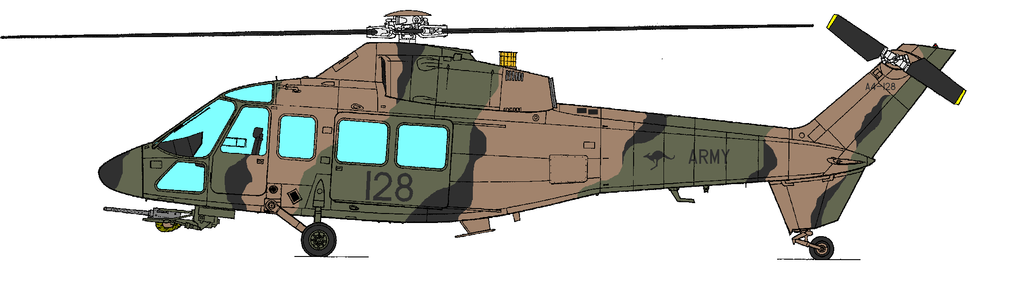
Here's an idea I've always liked and considered for my Alternative ADF ORBAT:

Australia gains the commercial rights from Augusta to licence-manufacture their A129 International and A129 [designated A139 by Agusta] LBH as both a Bell AH-1T and UH-1H/N replacement, instead of the Tiger and UH-60 Blackhawk.
Both the A129 and A129 [A139] LBH would be cheaper in both terns of purchasing and operating, due to their commonality.

[Profile by Jonestgetank / Mark Jones ]

Regards
Pooneer
 

Attachments

  • WhatIf Aust Army Agusta A129 ABH (Mark Jones).png
    WhatIf Aust Army Agusta A129 ABH (Mark Jones).png
    149.2 KB · Views: 9
Well, there's a perfect opportunity right there for my twelve UH-1N's!;)
Which also means, when the UH-1's are replaced, that these twelve UH-1N's are the last to be retired or potentially sold to NZ......


Here's an idea I've always liked and considered for my Alternative ADF ORBAT:

Australia gains the commercial rights from Augusta to licence-manufacture their A129 International and A129 [designated A139 by Agusta] LBH as both a Bell AH-1T and UH-1H/N replacement, instead of the Tiger and UH-60 Blackhawk.
Both the A129 and A129 [A139] LBH would be cheaper in both terns of purchasing and operating, due to their commonality.

[Profile by Jonestgetank / Mark Jones ]

Regards
Pooneer
The A129 is what should have been selected over the Tiger
 
I'm in 2 minds about the A129, it has even a smaller base of support than the Tiger but we wouldn't be the initial operator. In fact the A129 would have a couple of successful active developments before Australia was due to order.
 
I'm in 2 minds about the A129, it has even a smaller base of support than the Tiger but we wouldn't be the initial operator. In fact the A129 would have a couple of successful active developments before Australia was due to order.
And it's those couple of successful active deployments which Australia should have seriously considered, as opposed to Australia's expensive habitual habit of purchasing off the drawing board or non mature designs - such as the Tiger was.

Regards
Pioneer
 
And it's those couple of successful active deployments which Australia should have seriously considered, as opposed to Australia's expensive habitual habit of purchasing off the drawing board or non mature designs - such as the Tiger was.

Regards
Pioneer
Agree there mate
 
And it's those couple of successful active deployments which Australia should have seriously considered, as opposed to Australia's expensive habitual habit of purchasing off the drawing board or non mature designs - such as the Tiger was.

Regards
Pioneer

Which in 2000 puts the AH1W and Apache in the lead.
 
Well, there's a perfect opportunity right there for my twelve UH-1N's!;)
Which also means, when the UH-1's are replaced, that these twelve UH-1N's are the last to be retired or potentially sold to NZ......

Then you've got a small, non standard fleet to sustain. The disadvantages of this outweigh whatever marginal performance gain that might come from 2 engines.
 
Sounds like a good plan and what should have happened.

But what does it cost, in particular the Melbourne rebuild?
Thats good what about the us destroyer collision.

Again, he change from plans in 1961 likely changes history enough that all the schedules that led to the Melbourne hitting both destroyers are changed.

I wounded if there's no Voyager collision would there be the money for the seacat and ikara refit for the darings?

One downside to now Voyager collision would be 2 less rivers in service or would they still be built to keep ship yards with work?

The 4 DDG would be order too?

I don't know, perhaps its decided that the best way to get Ikara and Seacat to sea is in new ships.

If the Melbourne aircraft and refit are underway by 1964 given a 1959 start perhaps the way is clear for a 4th DDG and 2 DEs. Given the DDL project started in 1966 and in the NAA Carrier docs there is talk about the escorts being insufficient all 3 ships might get built.

Its very speculative, but with a single Defence Minister from 1958 all the Army's hand wringing about creating a readily available force fr deployment to S.E.A limited wars that led to the Pentropic organisation may also draw in the RAN and RAAF to their benefit. The Minister may well ask what he RAN and RAAF are going to contribute should the Army deploy one of these newfangled Pentropic battlegroups, will they have a warship and sqn of warplanes attached? If so that could foster the 4th DDG and 2 DEs in 1964.
 
But what does it cost, in particular the Melbourne rebuild?


Again, he change from plans in 1961 likely changes history enough that all the schedules that led to the Melbourne hitting both destroyers are changed.


I don't know, perhaps its decided that the best way to get Ikara and Seacat to sea is in new ships.

If the Melbourne aircraft and refit are underway by 1964 given a 1959 start perhaps the way is clear for a 4th DDG and 2 DEs. Given the DDL project started in 1966 and in the NAA Carrier docs there is talk about the escorts being insufficient all 3 ships might get built.

Its very speculative, but with a single Defence Minister from 1958 all the Army's hand wringing about creating a readily available force fr deployment to S.E.A limited wars that led to the Pentropic organisation may also draw in the RAN and RAAF to their benefit. The Minister may well ask what he RAN and RAAF are going to contribute should the Army deploy one of these newfangled Pentropic battlegroups, will they have a warship and sqn of warplanes attached? If so that could foster the 4th DDG and 2 DEs in 1964.
Probably cost what Karel Doorman costed but brought up for inflation.

Thats good then

I like the seacat and ikara refit cause it would delay the daring replacement to the early 80s, meaning you could do a an extended build to replace the rivers as well driving down unit cost of the replacement.
 
Probably cost what Karel Doorman costed but brought up for inflation.

Thats good then

I've been having a bit of a look at the Karel Doorman and Minas Gerais refits and how they might apply to Melbourne.

These 2 carriers were axial deck with an aircraft weight limit was 15,000lbs and hydraulic catapults, so the cost of their refits included installation of things that Melbourne already had like strengthening to handle 20,000lb aircraft and a steam catapult. The Minas Gerais also had extensive 'Americanisation', including an AC electrical system to make i more compatible with the US sourced ships in their Navy.

The Melbourne's refit to similar standard would be extensive, but not as extensive as the KD and MG so not outrageous and beyond reach of available and realistic budgets.
 
The Tiger replaced the OH58s and UH1 Bushrangers, but they were garbage, never reached full capability and are being replaced early by Apaches.
The Tiger was not garbage and even exceeds AH-64E capability in several areas. The deciding issue was we didn't buy enough in the first place, meaning it would have to be supplemented by another type to meet operational requirements.

This made replacement of the entire fleet instead of embarking on a mid-life upgrade a more realistic option.

Ironically, with the pivot to uncrewed capabilities, it may have been more sensible to upgrade and retain Tiger, supplementing it with UCAVs.

More specifically, Tiger was framed as a replacement for the Bushranger UH-1s and the recce Kiowas assigned to CAV. When they became, by default, the main teeth of the LHDs, we suddenly needed a minimum of six more to sustain deployment of the capability.

AH-1E has a reputation as a bit of a hangar queen, USArmy aviation even warned Australia of this. Then there is the issue of marinisation, i.e. the UK has replaced their original Apaches with Es as upgrades were not value for money, due in large part to corrosion of airframes deployed on HMS Ocean.

The other big factor in the AH-64E selection was the ego of the then DEFMIN and his unwillingness to accept advice. I know one of his junior ministers (and special forces veteran) was pushing an AH-1Z acquisition as it better fit Australia's planned conops, there was also support for this from the then opposition as the bloke who asked me about it was from that side.
 
The Tiger was not garbage and even exceeds AH-64E capability in several areas. The deciding issue was we didn't buy enough in the first place, meaning it would have to be supplemented by another type to meet operational requirements.

The problem with the Tiger is that we got ours before Germany and France got theirs so we, as an export customer on the other side of the world, had to deal with the teething problems that France and Germany should have been dealing with in close cooperation with the manufacturer. If we got ours delivered even 4 or 5 years later, when France and Germany already had a few sqns in service, the Tiger would have been far less troublesome for us.
 
AH-1E has a reputation as a bit of a hangar queen, USArmy aviation even warned Australia of this. Then there is the issue of marinisation, i.e. the UK has replaced their original Apaches with Es as upgrades were not value for money, due in large part to corrosion of airframes deployed on HMS Ocean.

The other big factor in the AH-64E selection was the ego of the then DEFMIN and his unwillingness to accept advice. I know one of his junior ministers (and special forces veteran) was pushing an AH-1Z acquisition as it better fit Australia's planned conops, there was also support for this from the then opposition as the bloke who asked me about it was from that side.

FMS Baby!

The AH64 is an FMS acquisition which ever since the first C17 procurement, have been delivered on time and on or even under budget!
 
FMS Baby!

The AH64 is an FMS acquisition which ever since the first C17 procurement, have been delivered on time and on or even under budget!
Isn't there FMS for the AH1Z also??
I agree the AH1Z suits what the adf is going towards better than the AH64
 
Isn't there FMS for the AH1Z also??

Presumably yes.

I agree the AH1Z suits what the adf is going towards better than the AH64

Perhaps, but the ADF chose the Apache.

Don't get me wrong I like the AH1Z, but it's a development of a type introduced in 1971 that itself was a development of a type introduced in 1967 which itself is a variant of a type introduced in 1959. The Apache is a fundamentally more modern design, which I suspect is a major reason why it has been exported to 18 countries as opposed to 3 for the Viper.
 
Back
Top Bottom