HAWC (Hypersonic Air-breathing Weapon Concept) and HACM (Hypersonic Attack Cruise Missile)

That clip is just the video version of common warzone article, it should be taken as speculation rather than fact.
Given that HAWC and future HALO are both light enough to be carried by F-18E/F, I highly skeptical if HACM is somehow significantly heavier. Especially when we consider that HACM is based on HAWC and HALO is based on HACM
I thought the Navy missile was a separate program?
 
Same hypersonic section, IIRC. Different boosters for surface launch versus air launch.

I do not think the two have any relationship whatsoever, but I’ll yield to better sources. HAWC/HACM is a glider with a fixed inlet and combustion chamber boosted to Mach 4-5. It is hard to imagine any USN weapon could achieve that with the 15 feet length limit and the weight limitations associated with catapult launch.

As to the weight of HACM - even the X-51 stack was only 4000 lbs dry, with 265lbs of fuel. I cannot imagine the new missile is much heavier than that now that the entire engine is 3D printed and half the weight. Minimally the F-15 is the threshold platform, so it can care at least one; I suspect 2-3.
 
Last edited:
First image:

1718736370405.png

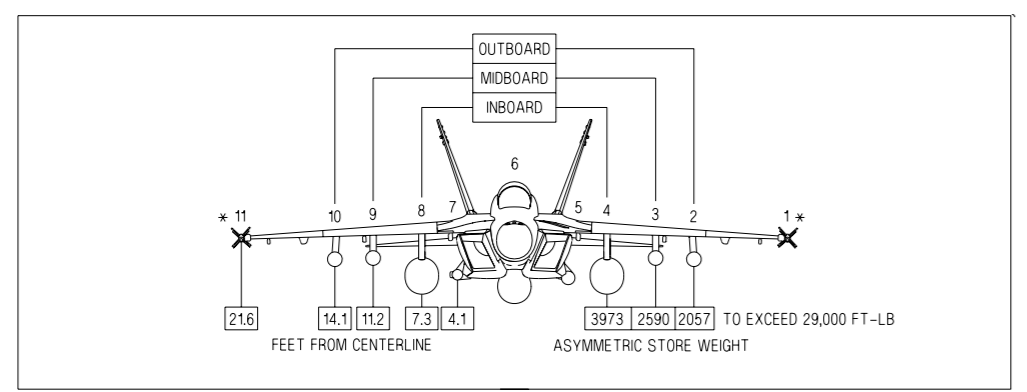
What are the F-18s pylon limits? That would give us an upper bound on HACM launch weight.
There are lots of charts showing which weapons can be loaded where but no actual weights.

I-4-4 (Not sure if this is the right thing.)

1718737159408.png
 
Last edited:
Last edited:
350 lbs seems huge. I would have thought the actual filler would be rather minimal with the energy primarily being kinetic and the explosive just a bursting charge.
 
So, ~1400lbs propellant, assuming a non-explosive front end?

That sounds about right if you count the booster. I think ATACMs has 648 kg of fuel. HACM is probably lighter and more efficient, but then there is still probably some actual warhead HE. The JP-7 of the cruiser might get scored as well in some manner, and there’s probably several hundred pounds of that.
 
Seems like a counter intuitive way of measuring such, but perhaps the focus of this metric is hazzard/safety rather than lethality.
Yes, it's a hazard measure and it's important to note that the explosive part is measured as TNT equivalent, so 100kg of AFX-777 would equate to ~196kg NEW and 100kg of PAX-28 would be 215kg NEW.
 
Last edited:
Does the rocket motor get adjusted for energy density or is 25% just a catch all for that component of a weapon? In particular I wonder how the JP component of air breathing missiles is scored.

But that’s off topic; basically NEW does not tell us much about the weapon since it has both HE and fuel components.
 
Seems like a counter intuitive way of measuring such, but perhaps the focus of this metric is hazzard/safety rather than lethality.
Yes, it's a hazard measure about "what happens if a magazine of these goes off due to a fire" not a lethality measure at impact.


That sounds about right if you count the booster. I think ATACMs has 648 kg of fuel. HACM is probably lighter and more efficient, but then there is still probably some actual warhead HE. The JP-7 of the cruiser might get scored as well in some manner, and there’s probably several hundred pounds of that.
I'd expect the JP7 to get counted at 25% of fuel weight. Not that there's any explosion risk with JP7, but the regulations say "count 25% of fuel weight" so they count 25% of fuel weight.
 
Try this the other way...
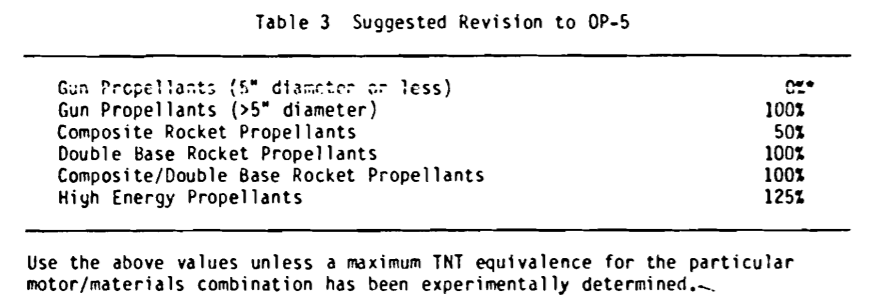
Looks like a pretty important table out of the back of that report, but I'm not sure if it was adopted?

Table 3 Suggested Revision to OP-5
Gun Propellants (5" diameter or less)0%*
Gun Propellants (>5" diameter)100%
Composite Rocket Propellants50%
Double Base Rocket Propellants100%
Composite/Double Base Rocket Propellants100%
High Energy Propellants125%
* 5-inch diameter charges are below the critical diameter for most charges; moreover it is extremely unlikely that a sufficient stimulus can be brought to bear on these rounds, as they are generally stored separately from their projectiles.

 
Does the rocket motor get adjusted for energy density or is 25% just a catch all for that component of a weapon? In particular I wonder how the JP component of air breathing missiles is scored.

But that’s off topic; basically NEW does not tell us much about the weapon since it has both HE and fuel components.
There are weightings for different fuels on p1389 and default weightings to be used if they propellant is not listed on p1390.

Try this the other way...

Looks like a pretty important table out of the back of that report, but I'm not sure if it was adopted?

Table 3 Suggested Revision to OP-5
Gun Propellants (5" diameter or less)0%*
Gun Propellants (>5" diameter)100%
Composite Rocket Propellants50%
Double Base Rocket Propellants100%
Composite/Double Base Rocket Propellants100%
High Energy Propellants125%
* 5-inch diameter charges are below the critical diameter for most charges; moreover it is extremely unlikely that a sufficient stimulus can be brought to bear on these rounds, as they are generally stored separately from their projectiles.
The more important weightings are on p1389, that table shows default figures for when the propellant is unlisted, hence note under table:
p1390
1720549747549.png

p1389:
1720549681410.png
 
There are weightings for different fuels on p1389 and default weightings to be used if they propellant is not listed on p1390.


The more important weightings are on p1389, that table shows default figures for when the propellant is unlisted, hence note under table:
p1390
View attachment 734181

p1389:
View attachment 734180
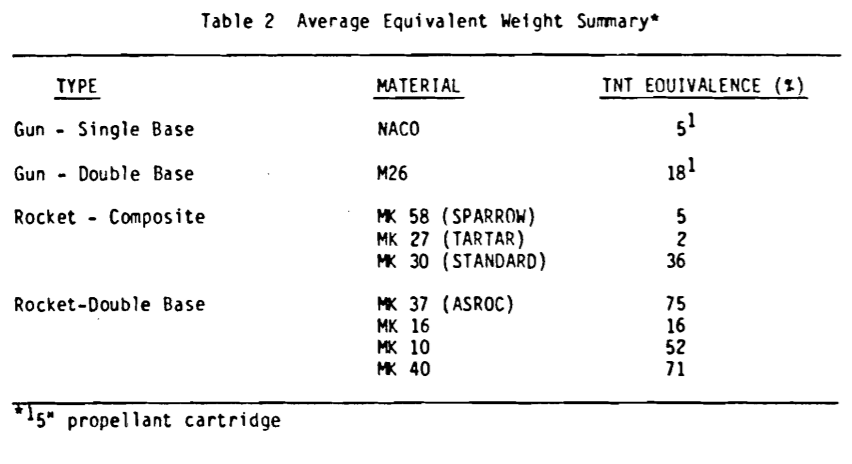
Sure, table 2 is more important to us if we're trying to reverse engineer warhead and fuel loads.
 
The Air Force Materiel Command and Air Force Research Laboratory asking for a more powerful booster presumably to add range to the $1.9 billion RTX/NG HACM scramjet program which said will be small enough to fit fighters than the all but cancelled AGM-183A which required bombers.

 
● Hypersonics: The $802 million devoted to the Hypersonic Attack Cruise Missile—without an evident cut to current capabilities—suggests the weapon is moving beyond experiments toward fielding. This aligns with Air Force desires for a China-relevant, air-launched hypersonic standoff option.
 
A flight of two MQ-25s with two HACMs each give you an interesting loitering hypersonic threat thousands of miles away from a CSG with their own thousand mile threat bubble. Cloud-based, on-demand, long-range strike. which for once plays to a favorable corner of the US cost effectiveness grid, with the bonus of some interesting operational ambiguity - “is that MQ-25 just a tanker? BCN? Sensor? Packing heat? Better send a J-36…”
 
A flight of two MQ-25s with two HACMs each give you an interesting loitering hypersonic threat thousands of miles away from a CSG with their own thousand mile threat bubble. Cloud-based, on-demand, long-range strike. which for once plays to a favorable corner of the US cost effectiveness grid, with the bonus of some interesting operational ambiguity - “is that MQ-25 just a tanker? BCN? Sensor? Packing heat? Better send a J-36…”

HACM is a USAF program; it will never see a USN deck.
 
Ok, that’s the first time I have noticed a differentiation between powered flight and gliding. Good to know. Some range information has been vaguely shared before, but it was never clear how much of that was powered flight vs dead cat bounce. X-51 was powered for a couple hundred miles but IIRC it’s splash down was an extra hundred miles on top, which probably makes for a subsonic, uncontrolled fall into the water with that aerodynamic configuration.

That 15 mile figure is a little higher than I expected too.
 
Second thing I notice:

“Much of the work under the Air Force’s Next Generation Air Dominance umbrella remains unannounced, but penetrating F-47s and space-based capabilities that enable ultra-long kill chains (500+ miles) are likely among the candidate solutions.”

The bold, given the context, implies HACM is directly related to air dominance, not ground attack.
 
Second thing I notice:

“Much of the work under the Air Force’s Next Generation Air Dominance umbrella remains unannounced, but penetrating F-47s and space-based capabilities that enable ultra-long kill chains (500+ miles) are likely among the candidate solutions.”

The bold, given the context, implies HACM is directly related to air dominance, not ground attack.

SEAD/DEAD is considered “air dominance” by USAF so YMMV.
 
Ok, that’s the first time I have noticed a differentiation between powered flight and gliding. Good to know. Some range information has been vaguely shared before, but it was never clear how much of that was powered flight vs dead cat bounce. X-51 was powered for a couple hundred miles but IIRC it’s splash down was an extra hundred miles on top, which probably makes for a subsonic, uncontrolled fall into the water with that aerodynamic configuration.

That 15 mile figure is a little higher than I expected too.

As quellish mentioned, SEAD/DEAD is part of this. You can refer to the doctrinal docs covering counter air for specifics.

That said, in that tweet I was implying both air to surface, and mainly air to air. HACM is preferred by the USAF because of its ability to integrate a seeker more easily than ARRW. And with the ability to add seekers to it, and with a proven engine if/when it is fielded, you have possibilities for expanding scramjet powered cruisers to other missions including very long range air to air. Its a roughly 20 ft long x 20 inch diameter missile that can be carried by the F-15E/EX, F-35 (ext) and bombers. Opens up lots of possibilities and missions if they can integrate a seeker and get it to work.

15 mile / 80k feet is again fairly consistent with where we've demonstrated scramjet flight with the X-51 on though there's potential that HACM has a lower cruiser altitude. We managed 200+ seconds of scramjet run time during the last X-51 test flight. 200+ seconds of powered flight (I think X-51 was 240 total powered seconds of flight as a goal) at Mach 5+ is a reasonable assumption for HACM.
 
Last edited:

Could that nose shape create oblique shockwaves and shock train? I read this comment about the YJ-19 having a round nose being unsuitable for scramjets. That nose also seems round and not flat unlike other renders of HCM's. I'm not well read on scramjets and hypersonic flight so im genuinely unsure if this shadow jackson dude is talking bullshit or not.
IMO the YJ 19 can't be a HCM because the shape of the nose and Intake cannot produce oblique shockwaves and a shock train .

View attachment 783919View attachment 783920
 
I have always expected HACM to have an A2A role against slow multi engine targets myself. It probably would not be able to turn with a fighter that just reversed course at full power with those tiny control surfaces, but I would expect subsonic aircraft to be practically holding still relative to the missile, even if they attempted to maneuver. It seems to me if the AIM-120 seeker can make the transition from A2A to air to surface and back, whatever terminal seeker is on HACM will have no problem with multiple cross domain roles.
 
I have always expected HACM to have an A2A role against slow multi engine targets myself. It probably would not be able to turn with a fighter that just reversed course at full power with those tiny control surfaces
I wasn't talking about the HACM the AF fields in the next 18 months. I'm referring to variants leveraging the same cruiser and propulsion but modified for the mission. It also doesn't have to be against high value targets only. If you can figure out extended range kill chains and have penetrating sensors and counter air platforms that extending that out to other platforms is also possible.
 
Last edited:

Similar threads

Back
Top Bottom