The effect of RAN 1964 Carrier Replacement Plan going Ahead?

I've been thinking if Australia goes down the CVA-01 route instead of the Essex. Would the air wing be the same 18x Helos, 16x F4s, 12x S2s/S3s and 4x E1s/E2s or would it won't a more multi purpose air wing say something like 16x F4s, 12x Buccaneers/A6s/A7s, 10x Helos, 8x S3s and 4x E2s?
 
I've been thinking if Australia goes down the CVA-01 route instead of the Essex. Would the air wing be the same 18x Helos, 16x F4s, 12x S2s/S3s and 4x E1s/E2s or would it won't a more multi purpose air wing say something like 16x F4s, 12x Buccaneers/A6s/A7s, 10x Helos, 8x S3s and 4x E2s?

IIUC the air wing would be more or less the same in either scenario. In either case it would make the RAN-FAA more powerful than the RAAF.
 
IIUC the air wing would be more or less the same in either scenario. In either case it would make the RAN-FAA more powerful than the RAAF.
In what way the RAAF would still.be bigger and have more fighters. The F4s would are alot better than the Mirage IIIO. The P3s are better than the S3s or S2s. The only advantage the RAN FAA would have in the 70s wpuld be the E1s/E2s
 
In what way the RAAF would still.be bigger and have more fighters. The F4s would are alot better than the Mirage IIIO. The P3s are better than the S3s or S2s. The only advantage the RAN FAA would have in the 70s wpuld be the E1s/E2s

Australia was spending 6.2% of GDP in 1962 (the £200m cap years) which went to 5.2% in 1965 and back up to 5.9% in 1967 and you want Australia to spend even more money to get a capability that the CA, CAF and C-COSC don't believe Australia needs and the RAN couldn't crew anyway?

I don't mean to be a killjoy, but anyone can propose anything. Proposing realistic things that can enter service and serve the National Interest is another thing entirely.
 
Australia was spending 6.2% of GDP in 1962 (the £200m cap years) which went to 5.2% in 1965 and back up to 5.9% in 1967 and you want Australia to spend even more money to get a capability that the CA, CAF and C-COSC don't believe Australia needs and the RAN couldn't crew anyway?

I don't mean to be a killjoy, but anyone can propose anything. Proposing realistic things that can enter service and serve the National Interest is another thing entirely.
I agree it's extremely unlikely that it would happen in real life. There's probably a 0.000001% chance it would happen. I am just looking at the effect of if it did happen
 
I agree it's extremely unlikely that it would happen in real life. There's probably a 0.000001% chance it would happen. I am just looking at the effect of if it did happen

I have a vague idea that a better British defence policy and procurement could lead to a better Australian defence policy and procurement, mainly because it's easy to identify the inflections points and they're so close together.
 
I have a vague idea that a better British defence policy and procurement could lead to a better Australian defence policy and procurement, mainly because it's easy to identify the inflections points and they're so close together.
Ok i would really like to hear this idea
 
Ok i would really like to hear this idea

For a very short while after the Malaysia-Singapore split in 1965 there was some talk of Britain relocating its forces there to Australia and making Australia the main base for its EoS operations. I believe the early 1966 DWP which put a 1975 end date to EoS and the fact that British troops would be idle in Australia while Australian troops were fighting in Vietnam ended that idea.

All this was of course during the era where British defence policy decisions basically made Britain a poor ally and partner for equipment procurement. However, if Britain made better/good procurement choices in the 1957-66 period she might have been a better ally to buy defence equipment from. Further if Britain hadn't backed itself into a corner with Defence policy and procurement it may not have done such a precipitous withdrawal from EoS and indeed stationed some force in Australia from the 60s, even if only for a decade. At the very least the British would have expanded Defence facilities in Australia for their own use, such as Fleet Base West and the air bases in WA and NT.
 
I've been thinking if Australia goes down the CVA-01 route instead of the Essex. Would the air wing be the same 18x Helos, 16x F4s, 12x S2s/S3s and 4x E1s/E2s or would it won't a more multi purpose air wing say something like 16x F4s, 12x Buccaneers/A6s/A7s, 10x Helos, 8x S3s and 4x E2s?
If I may, I'd be inclined to go:
-18 x Helicopters;
-16 x F-4's
-12 x S-2 (Turbo Tracker's)
-4 x E-1 (Turbo Tracer's)

The Buccaneer or A-6 would add yet another type of aircraft into the ADF ORBAT, and in such small numbers would only add to the RAN's logistical, training and operational pains.
At the end of the day, the RAN FAA isn't the USN/RN. I think the multi-role/bombload capabilities of the F-4 would be more than suffice, especially if the RAN was smart and kept updated with PGM's/stand-off weapons.
If you had to have a dedicated strike/attack aircraft, my money would be on the LTV A-7E (TF-41/Spey-powered) - cost effective, bomb truck and low deck spotting. The A-7 could also act as a tanker for the F-4's, S-2, E-1's and of course, A-7E's.

Can I ask why eighteen helicopters? It's seems a little excessive, what with 12 x S-2's on board. I would have thought 9-12 at Max would be suffice? This would almost allow you close to 24 x F-4's (or 12 x F-4's and 12 x A-7E's).

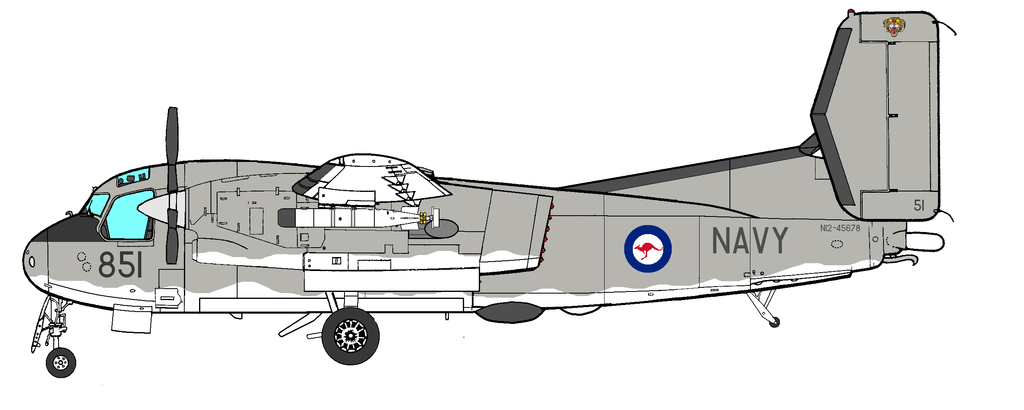
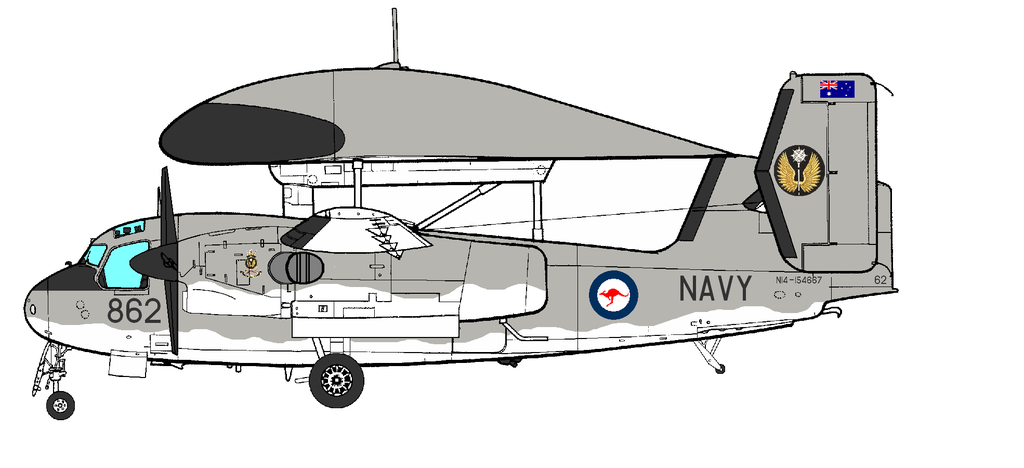
(Profiles by Jonesthetank from Beyond the Sprues at my request)

Regards
Pioneer

 

Attachments

  • WhatIf RAN Grumman SF2-4 (S-2H) Tracker(Mark Jones.png
    WhatIf RAN Grumman SF2-4 (S-2H) Tracker(Mark Jones.png
    134.1 KB · Views: 14
  • WhatIf RAN E-1T Tracer (Mark Jones).png
    WhatIf RAN E-1T Tracer (Mark Jones).png
    157.5 KB · Views: 16
Can I ask why eighteen helicopters? It's seems a little excessive, what with 12 x S-2's on board. I would have thought 9-12 at Max would be suffice? This would almost allow you close to 24 x F-4's (or 12 x F-4's and 12 x A-7E's).
The NAA document states 16x Wessex and 2x SAR Helicopters for the Essex class air wing
 
For a very short while after the Malaysia-Singapore split in 1965 there was some talk of Britain relocating its forces there to Australia and making Australia the main base for its EoS operations. I believe the early 1966 DWP which put a 1975 end date to EoS and the fact that British troops would be idle in Australia while Australian troops were fighting in Vietnam ended that idea.

All this was of course during the era where British defence policy decisions basically made Britain a poor ally and partner for equipment procurement. However, if Britain made better/good procurement choices in the 1957-66 period she might have been a better ally to buy defence equipment from. Further if Britain hadn't backed itself into a corner with Defence policy and procurement it may not have done such a precipitous withdrawal from EoS and indeed stationed some force in Australia from the 60s, even if only for a decade. At the very least the British would have expanded Defence facilities in Australia for their own use, such as Fleet Base West and the air bases in WA and NT.
This would be a good way to get more infrastructure down earlier. I wonder if stationed in Australia, Britain would have kept a small force say a frigate, submarine, 1 or 2 RAF sqn and maybe a battalion in Australia post 75
 
Oh it definitely does i think with 12 S2s you probably need no more than 10 maybe 12 for 2 SAR helicopters
Not a Navy man, but by chance, did Wessex operate in Hunter and Killer fashion? hence the 18 x helos?

Pioneer
 
Last edited:
Not a Navy man, but by chance, did Wessex operate in Hunter and Killer fashion?

Pioneer
I believe it could operate by it self but they might have wanted to operate in the Hunter killer fashion
By the time of these Essex investigations the RAN had received 27 Wessex, so might as well use them.
That is true but it is over half of the total Wessex the RAN being deployed on the Essex
 
I don't mean to be a killjoy, but anyone can propose anything. Proposing realistic things that can enter service and serve the National Interest is another thing entirely.
Alternatehistory.com has an ASB forum for things like this. Does Secret Projects?
 
Not a Navy man, but by chance, did Wessex operate in Hunter and Killer fashion? hence the 18 x helos?

Pioneer
No it didn't and AFIAK neither did the Seabat that is was developed from. The USN had a squadron of 16 Seabats on every Essex class CVS plus a few other helicopters for SAR & Vertrep which they replaced with Sea Kings on a one-for-one basis, i.e. a squadron of 16 Sea Kings plus a few other helicopters for SAR & Vertrep.
 
Can I ask why eighteen helicopters? It's seems a little excessive, what with 12 x S-2's on board. I would have thought 9-12 at Max would be suffice? This would almost allow you close to 24 x F-4's (or 12 x F-4's and 12 x A-7E's).
FWIW the air group of a CVS Essex was 4 A-4s, 20 S-2s, 4 E-1s, one C-1, 16 SH-3s and a pair of SAR/Vertrep helicopters for a total of 47 aircraft.

IIRC (1) the size of air group for SCB.100 CVS was similar, except it had F-4s to drive off shadowers instead of A-4s, S-3s instead of the S-2s, E-2s instead of the E-1s and C-2s instead of the C-1s.

Enough S-3s were purchased to maintain a front-line of 120 in 12 squadrons of 10 aircraft. IIRC (2) that was because the original plan was to retain 6 Essex CVS into the 1970s (before they were replaced one-for-one by the SCB.100) and their 20 Trackers in 2 squadrons of 10 would be replaced one-for-one by 20 Vikings in 2 squadrons of 10.

It looks like the RAN wanted to do what the USN did as their Essex had a similar size air group to the CVS Essex class in USN service. The difference is that they had more fighters and less fixed-wing ASW aircraft. Maybe the RAN preferred to have an air group that was exactly the same, but the risk of air attack was stronger, so they had to trade Trackers for Phantoms.
 
For a very short while after the Malaysia-Singapore split in 1965 there was some talk of Britain relocating its forces there to Australia and making Australia the main base for its EoS operations. I believe the early 1966 DWP which put a 1975 end date to EoS and the fact that British troops would be idle in Australia while Australian troops were fighting in Vietnam ended that idea.
As Ken Bruce would say "one year out", because the 1966 DWP was to cut the strike carriers by 1975 while the (supposedly cheaper) island bases were set up. At that time HMG was saying in public that they intended to maintain a military presence East of Suez until at least 1985.

The decision of to withdraw from East of Suez by 1975 was announced in 1967 and in 1968 a further deterioration in the British economy forced them to bring the withdrawal forward to the end of 1971.
 
Australia was spending 6.2% of GDP in 1962 (the £200m cap years) which went to 5.2% in 1965 and back up to 5.9% in 1967 and you want Australia to spend even more money to get a capability that the CA, CAF and C-COSC don't believe Australia needs and the RAN couldn't crew anyway?
That's even more than I though. I only have the statistics for 1966 to the early 1990s. IIRC my source said about 5.0% from 1966 to the early 1970s, then it fell to 3.0% by the middle 1970s (due to the end of the Vietnam War & Gough Whitlam's defence cuts) and remained at about 3% of GNP from then to the early 1990s.

Although I said.
Fair enough. I think the RAN couldn't get one ether. That is short of spending the thick end of an extra one percent of GNP on defence or not buying F-111 and using the money saved to buy a CVA.01 and its aircraft.
Is Australia reducing defence spending from a peak of 5.9% in 1967 to about 4.0% from the middle 1970s onwards instead of 3.0% from then on realistic? Would Australia's equivalent of the "Man on the Clapham Omnibus" be prepared to pay the higher taxes and/or reduced spending on social services required?
 
Maybe the RAN preferred to have an air group that was exactly the same, but the risk of air attack was stronger, so they had to trade Trackers for Phantoms.
I would say so cause the RAN was turning towards the USN at the time. In the NAA the RAN was pretty worried about Indonesia Tu16s carrying AShM which is why the wanted they F4 with its BVR missiles
 
Just wondering im today's money how does the cost of the Essex and CVA-01 compare to the nuclear subs we are buying?
 
Just wondering I'm today's money how does the cost of the Essex and CVA-01 compare to the nuclear subs we are buying?
The NAA document says the estimated cost of CVA.01 in 1964 was £A72.5 million.
  • Or £58.0 million Sterling at the exchange rate of the day.
  • According to the Bank of England Inflation calculator £58 million in 1964 was worth £1,036.13 million in August 2025.
  • Which at the current exchange rate is GPB 1.0 = AUD 2.07 is A$2,144.79 million
Which is ridiculously cheap to me.
 
Last edited:
The NAA document says the estimated cost of CVA.01 in 1964 was £A72.5 million.
  • Or £58.0 million Sterling at the exchange rate of the day.
  • According to the Bank of England Inflation calculator £58 million in 1964 was worth £1,036.13 million in August 2025.
  • Which at the current exchange rate is GPB 1.0 = AUD 2.07 is A$2,144.79 million
Which seems is ridiculously cheap to me.
Yeah it does especially compared to the$286 to $386 Billion that the AUKUS Submarines are going to cost
 
58 mio Aus£ ~ 130 mio US$ 1964 ~ 1.36 billion US$ 2025 using CPI.
Of course that is for a ww2 carrier with 1960s tech at best.
 
Dunno, but CVA01s contemporary SSNs Valiant and Warspite cost 25m and 21m pounds.
Valiant was completed in 1966 at a cost of £25.3 million which according to the Bank of England Inflation Calculator was worth £415.13 in August 2025, which is A$859.31 million at today's GBP to AUD exchange rate.

Warspite was completed in 1967 at a cost of £21.5 million, which according to the Bank of England Inflation Calculator was worth £344.86 million in August 2025, which is A$713.85 million at today's GBP to AUD exchange rate.
 
58 mio Aus£ ~ 130 mio US$ 1964 ~ 1.36 billion US$ 2025 using CPI.
Of course that is for a ww2 carrier with 1960s tech at best.
It was 72.5 in Australian Pounds. The £58.0 million was in Pounds Sterling. Also as it's a ship that's built in the UK rather than the USA, therefore British inflation is the more suitable than American inflation.
 
Valiant was completed in 1966 at a cost of £25.3 million which according to the Bank of England Inflation Calculator was worth £415.13 in August 2025, which is A$859.31 million at today's GBP to AUD exchange rate.

Warspite was completed in 1967 at a cost of £21.5 million, which according to the Bank of England Inflation Calculator was worth £344.86 million in August 2025, which is A$713.85 million at today's GBP to AUD exchange rate.
Okay why is CVA-01 and Nuclear Subs cheaper even with inflation than todays AUKUS Subs?
 
It was 72.5 in Australian Pounds. The £58.0 million was in Pounds Sterling. Also as it's a ship that's built in the UK rather than the USA, therefore British inflation is the more suitable than American inflation.
I was doing the nrs for the essex.
 
Okay why is CVA-01 and Nuclear Subs cheaper even with inflation than todays AUKUS Subs?
I don't know, but it's probably 2020s technology v 1960s technology.

The price of new military kit usually rises at a faster rate than the rate of inflation AND at a faster rate than the economy grows. That's due to each generation of military kit incorporating more advanced technology, which is usually a lot more expensive. IIRC one Batch 1 Type 22 cost at least twice as much as a Batch 3 Leander after allowing for inflation.
 
I don't know, but it's probably 2020s technology v 1960s technology.

The price of new military kit usually rises at a faster rate than the rate of inflation AND at a faster rate than the economy grows. That's due to each generation of military kit incorporating more advanced technology, which is usually a lot more expensive. IIRC one Batch 1 Type 22 cost at least twice as much as a Batch 3 Leander after allowing for inflation.
Fair enough what is the coast difference between CVA-01 and Queen Elizabeth?
 
Fair enough what is the coast difference between CVA-01 and Queen Elizabeth?
I haven't the foggiest.
But IIRC Dr Clarke says that some of cost of the the Queen Elizabeth class was due to the Government slowing down their construction to save money in the short term, but made them cost more in the long term with the result that they could have built 3 for the OTL cost of 2.

I think he said similar things about the Type 45 destroyer with the result that they could have built 12 (as originally planned) for the OTL cost of 6.
 
But IIRC Dr Clarke says that some of cost of the the Queen Elizabeth class was due to the Government slowing down their construction to save money in the short term, but made them cost more in the long term with the result that they could have built 3 for the OTL cost of 2.

I think he said similar things about the Type 45 destroyer with the result that they could have built 12 (as originally planned) for the OTL cost of 6.
So in other words the UK goverment shot themselves in the foot and the RN could have be better equipped today.
Fair enough. its just hard to wrap my head around how even with inflation the CVA-01 seems so cheap inn todays money. I guess electronics are the real cost killer when it comes to military equipment compared to steel.
It just makes me think if Australia had a slightly bigger economy it might have happed but it is still most likely not happening
 
So in other words the UK Government shot themselves in the foot and the RN could have be better equipped today.
It depends upon whether it was a forced or unforced error. Plus, there isn't a long term, if one doesn't survive the short term.
Fair enough. its just hard to wrap my head around how even with inflation the CVA-01 seems so cheap inn todays money. I guess electronics are the real cost killer when it comes to military equipment compared to steel.
It just makes me think if Australia had a slightly bigger economy it might have happed but it is still most likely not happening.
That and the 1964 Estimate of CVA.01's cost may have been too low.
 
It depends upon whether it was a forced or unforced error. Plus, there isn't a long term, if one doesn't survive the short term.

That and the 1964 Estimate of CVA.01's cost may have been too low.
That is true, wouldn't surprise if it was low to help get it through
 
Fair enough what is the coast difference between CVA-01 and Queen Elizabeth?
I haven't the foggiest.
According to the AI Overview which appeared after I put "Cost of the Queen Elizabeth class" into my web browser.

***** ***** ***** ***** ***** ***** *****​

The program to build both Queen Elizabeth-class aircraft carriers, including HMS Queen Elizabeth, cost over £6 billion, with the initial budget around £3.9 billion. The unit cost for each carrier is approximately £3 billion.
  • Total program cost: Approximately £6 billion for both carriers, including the HMS Queen Elizabeth and its sister ship, HMS Prince of Wales.
  • Initial budget: The project was initially budgeted at £3.9 billion.
  • Unit cost: The approximate cost per ship is £3 billion.
***** ***** ***** ***** ***** ***** *****​
The NAA document says the estimated cost of CVA.01 in 1964 was £A72.5 million.
  • Or £58.0 million Sterling at the exchange rate of the day.
  • According to the Bank of England Inflation calculator £58 million in 1964 was worth £1,036.13 million in August 2025.
  • Which at the current exchange rate is GPB 1.0 = AUD 2.07 is A$2,144.79 million
Which is ridiculously cheap to me.
So one Queen Elizabeth costs three times more than a CVA.01.
 

Similar threads

Back
Top Bottom