A Submarine War In The Pacific ?

I did a quick search for South China Sea, and it appears the central basin is very deep, plenty of 100m+ deep water for SSNs to operate in.

The Sunda Shelf is a pretty big area of shallow open water that would be difficult for an SSN to operate effectively. However, that is hemmed in by chokepoints to the south and the South China Sea SSN playground to the north, so wouldn't give China much sea room to sail imports through.
Along the coastline from Singapore to Haiphong, the sea area extending 200 kilometers offshore is mostly shallow, with the exception of the deeper waters near Quy Nhon to Nha Trang. This deeper section also falls within the coverage range of Hainan Island's naval and air forces. Merchant ships can fully transport goods along the Singapore-to-Haiphong coastline to areas near China's coast, under the protection of coastal nations.

Once they enter the waters north of Da Nang and Sanya, merchant ships are almost entirely safe. Would you attack any merchant ships entering or leaving this area? Drag Vietnam into the war? Moreover, the ships entering these waters won’t just be from China and Vietnam—they will also come from Southeast Asia, South Asia, and any other parties looking to benefit from the situation. Are you certain you want to sink them?

Sea transport is just one method. Southeast Asia shares a land border with mainland China, so goods don’t necessarily need to enter the South China Sea—they can be unloaded and transported overland to China. China is constructing and investing in various highways, railways, and canals across the Indochinese Peninsula.

What matters is not whether merchant ships entering the South China Sea risk being sunk by submarines, but rather that once resources enter Southeast Asia, they will reach China through various means. Similarly, when Chinese semi-finished products and components enter Southeast Asia, they will be distributed worldwide through various channels. Southeast Asia will not cooperate with your blockade.

Depth is not the only factor affecting submarine operations.

If blockading the South China Sea were easy for the U.S. Navy, it would be just as easy for the Chinese Navy. The South China Sea is not an open water; it is connected to the outer oceans by several straits. The Chinese Navy's submarines and unmanned underwater vehicles can easily patrol and lie in wait nearby, ready to target U.S. nuclear submarines entering the South China Sea.

The South China Sea is close to Chinese bases but far from American ones. China's infrastructure in the region far surpasses that of the United States. On Hainan Island, China has airfields and naval ports, has fortified several reefs into strongholds, and has established an underwater monitoring system. What about the United States? You lack sufficient air and naval bases in the South China Sea. Perhaps you could rebuild your facilities in the Philippines, but that would take time, and even if completed, the support capacity may not match China's. Without adequate infrastructure, you cannot provide sufficiently powerful surface fleet and air support for submarine operations. This means China's surface ships and anti-submarine aircraft can more comfortably hunt U.S. nuclear submarines, and the U.S. lacks the means to counter them.
 
The SCS that is bordered by Indonesia, Philippines, and Vietnam (just to name the big 3)?

Ignoring the Straits of Malacca as a chokepoint to work with (or rather the northern and southern ends of the approaches, plus the eastern side of the Straits).
Countries bordering the South China Sea such as Indonesia, Vietnam, Malaysia, and Cambodia will not participate in the U.S. blockade. On the contrary, the U.S. blockade would provoke them. If these countries do not cooperate, the U.S. blockade in the Strait of Malacca will not succeed.

It is not easy to change or move cargo containers at sea.

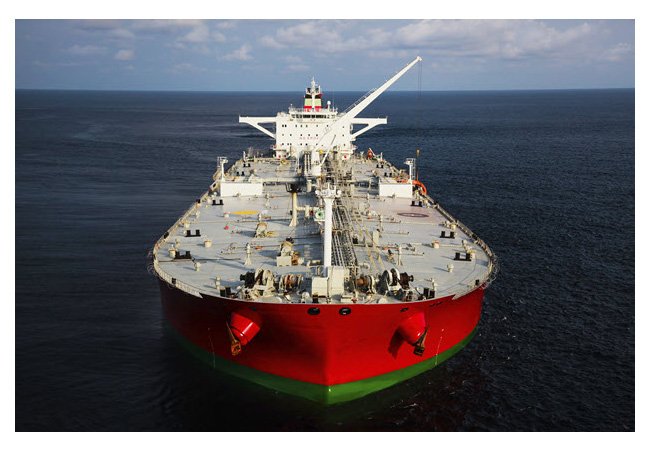
Bulk cargo like oil is actually practical to transfer at sea, but requires some extra, very visible bits on the ships to set up.
Transferring goods at sea is not the only method I mentioned. Transferring oil at sea does not require significant modifications—it simply involves opening valves. Pump ships can transfer oil to another vessel via pipelines, with minimal adjustments needed.

Those rail lines? They are only present in Vietnam, and China has been doing its best to piss off the Vietnamese for the last 25 years. Not to mention the generational hate from multiple invasions.
Laos has already completed the railway to the Thai-Lao border, and Thailand is currently constructing the railway from Bangkok to the Thai-Lao border. By 2030, a direct connection from Bangkok to Vientiane to Kunming will be achieved.

I do not deny that there are territorial and maritime disputes between China and Vietnam, but I do not believe such friction will lead Vietnam to align with the United States. The economic ties between China and Vietnam are extremely close. Do you know what the ratio of Vietnam's trade with China to its GDP is? 43%. Can’t you see what this implies?

Haven’t the Americans provoked the Vietnamese? Didn’t Trump’s tariffs harm Vietnam’s economy?

Just in 2023, U.S.-backed militants massacred an Vietnamese police station—what do you think the Vietnamese people feel about that?

Vietnam and the United States do not share the same ideology—aren’t the Vietnamese aware of this? The disputes between China and Vietnam are about territory and maritime boundaries, while the conflict between Vietnam and the United States is a struggle for the survival of their political system. China will not overthrow Vietnam's communist regime.

Also, when you recall the war between China and Vietnam, I suggest you also remember the war between Vietnam and the United States. The Vietnamese hold military parades to commemorate driving out the Americans, not the war with China!

The same India that is in a just-short-of-shooting border war with China?
Yes, same. And the same India, which imports over a hundred billion dollars worth of goods from China. India needs Chinese products, as evidenced by its nearly hundred-billion-dollar trade deficit with China. This figure clearly demonstrates how reliant India’s manufacturing sector and consumers are on Chinese goods.

In 1971, when India and the Soviet Union voted in favor of China reclaiming its seat in the United Nations, it had been only nine years since one (India) had a border conflict with China, and only two years since the other (the Soviet Union) had a border conflict with China. What stance benefits India, I believe India understands very well.

The chances of India working with China is between slim and none. IMO India would be a lot more likely to join on the side fighting China, to grab another valley or two, or maybe even liberate Tibet.
This is not about joining China's camp. It is merely an action based on reality and economic interests. India needs to trade with China before the war, and India will still need to trade with China during the war—is there any difference? Did India join China's camp before the war? I think not.

Is India, which resells Russian oil, now part of Russia's camp? I think not. Otherwise, Biden wouldn’t let a country in Russia’s camp join his bu**sh*t "Summit for Democracy."

Even if India were to decide to go to war, it would not be able to seize the entirety of Tibet. The terrain of the Himalayas ensures that any conflict along the Sino-Indian border would remain limited in scale. The People's Liberation Army would not require a massive troop deployment to significantly slow down the Indian military's advance. Moreover, the Indian army holds no advantage over the PLA in terms of precision munitions and long-range firepower, and the Indian Air Force would be unable to achieve air superiority.
 
Last edited:
Along the coastline from Singapore to Haiphong, the sea area extending 200 kilometers offshore is mostly shallow, with the exception of the deeper waters near Quy Nhon to Nha Trang. This deeper section also falls within the coverage range of Hainan Island's naval and air forces. Merchant ships can fully transport goods along the Singapore-to-Haiphong coastline to areas near China's coast, under the protection of coastal nations.

Once they enter the waters north of Da Nang and Sanya, merchant ships are almost entirely safe. Would you attack any merchant ships entering or leaving this area? Drag Vietnam into the war? Moreover, the ships entering these waters won’t just be from China and Vietnam—they will also come from Southeast Asia, South Asia, and any other parties looking to benefit from the situation. Are you certain you want to sink them?

Sea transport is just one method. Southeast Asia shares a land border with mainland China, so goods don’t necessarily need to enter the South China Sea—they can be unloaded and transported overland to China. China is constructing and investing in various highways, railways, and canals across the Indochinese Peninsula.

What matters is not whether merchant ships entering the South China Sea risk being sunk by submarines, but rather that once resources enter Southeast Asia, they will reach China through various means. Similarly, when Chinese semi-finished products and components enter Southeast Asia, they will be distributed worldwide through various channels. Southeast Asia will not cooperate with your blockade.

Depth is not the only factor affecting submarine operations.

If blockading the South China Sea were easy for the U.S. Navy, it would be just as easy for the Chinese Navy. The South China Sea is not an open water; it is connected to the outer oceans by several straits. The Chinese Navy's submarines and unmanned underwater vehicles can easily patrol and lie in wait nearby, ready to target U.S. nuclear submarines entering the South China Sea.

The South China Sea is close to Chinese bases but far from American ones. China's infrastructure in the region far surpasses that of the United States. On Hainan Island, China has airfields and naval ports, has fortified several reefs into strongholds, and has established an underwater monitoring system. What about the United States? You lack sufficient air and naval bases in the South China Sea. Perhaps you could rebuild your facilities in the Philippines, but that would take time, and even if completed, the support capacity may not match China's. Without adequate infrastructure, you cannot provide sufficiently powerful surface fleet and air support for submarine operations. This means China's surface ships and anti-submarine aircraft can more comfortably hunt U.S. nuclear submarines, and the U.S. lacks the means to counter them.

A lot to unpack there.

A rule of thumb is that areas were SSNs are supreme squeeze merchant traffic into limited and crowded shipping lanes great places for mining, diesel subs and stand-off air attack.

The reason I harp on about this is because China has a Malacca Dilemma, the most obvious being that 80% of China's imported oil comes through the Malacca Strait. As much as people bang on about Taiwan, I believe this Malacca dilemma drives Chinese assertiveness by a similar amount.

While there are other ways to move goods around S.E.A. these can't move close to the volume of the large number of Malaccamax ships. What's more transshipment in 3rd countries in wartime will involve these countries in the war on China's side, which may not be what these countries want.

Finally, the era of economics being the be-all and end-all at the expense of geopolitics is long gone. China has benefited from the USN facilitated 'Rules Based International Order', boosting its wealth greatly, but this has introduced vulnerabilities, and China needs to consolidate these wealth gains by political means. Taking Taiwan and controlling the Malacca strait gives China great economic security in the long term, despite the much-vaunted short term economic costs, through unrestricted (or at least difficult to interdict) access to the Pacific and Indian oceans.
 
I wonder if some form of submarine tender could provide a forward arming and replenishment point but that takes spending money that the government probably doesn't want to spend. Greater interoperability with the Black Powders or permanent basing in the Top End could be mutually beneficial. Pure speculation of course
The US does need to replace the positively ancient sub tenders, so it might be negotiable for Oz to buy another ship of the same class. (or more, but at least one RAN subtender) You'd be looking at around 1000 crew for that ship, based on the Land-class sub tenders that we're talking about replacing.


What's the minimum a sub tender would need? Fuel of course, but how hard is it to reload torpedoes, could a small merchant ship be rigged up in short order?
Torpedoes are kinda heavy as a rolling load, they're moved around base on a flatbed semi trailer. (25" square box in terms of padding/cradles, 21ft long minimum, ~3500-4000lbs each)

So they're not really something you'd want to move by air, if only because load per flight is crap. C130? 40,000lbs total load, you'd be looking at 4 or 5 torpedoes on a trailer due to width limits, and maybe 6 total torpedoes due to (aircraft) weight limits.

A ro-ro ship would be your best bet, and one that happens to have a materials-handling crane with access to the vehicles deck could simply reload directly to the sub, no cross-decking to the tender then to the sub required.

Remember, we're talking about reloading most of 3 dozen weapons into a sub.


Transferring goods at sea is not the only method I mentioned. Transferring oil at sea does not require significant modifications—it simply involves opening valves. Pump ships can transfer oil to another vessel via pipelines, with minimal adjustments needed.
The critical modification is that it requires a kingpost like on a warship to support the steel cables supporting the fuel hoses.

A submarine can see that at basically however far it is to the ship hull down over the horizon. Not to mention intelligence efforts to ID those ships and vector attacks according to transponder ID.
 
The US does need to replace the positively ancient sub tenders, so it might be negotiable for Oz to buy another ship of the same class. (or more, but at least one RAN subtender) You'd be looking at around 1000 crew for that ship, based on the Land-class sub tenders that we're talking about replacing.
I fear we’d start moving beyond the scope of the thread however I reckon future sub tenders will likely only service 1-2 subs at a time. My reasoning is that they are such valuable assets but they’d be better off distributed. To that end I think the RAN could certainly operate a 1-2, especially given how heavily the offensive arm of the RAN will be SSN based. It also helps that Aussie companies have had some recent experience designing and delivering submarine support/rescue equipment
 
Torpedoes are kinda heavy as a rolling load, they're moved around base on a flatbed semi trailer. (25" square box in terms of padding/cradles, 21ft long minimum, ~3500-4000lbs each)

So they're not really something you'd want to move by air, if only because load per flight is crap. C130? 40,000lbs total load, you'd be looking at 4 or 5 torpedoes on a trailer due to width limits, and maybe 6 total torpedoes due to (aircraft) weight limits.

A ro-ro ship would be your best bet, and one that happens to have a materials-handling crane with access to the vehicles deck could simply reload directly to the sub, no cross-decking to the tender then to the sub required.

Remember, we're talking about reloading most of 3 dozen weapons into a sub.

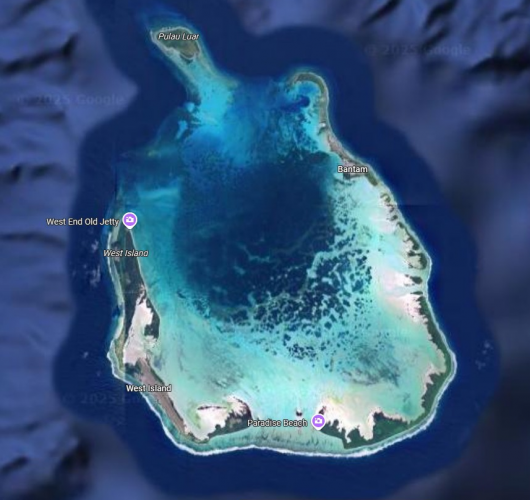
To clarify, I was thinking about RAN Collins be resupplied somewhere much closer to the Sth China Sea, like the Cocos. If an SSN is going as far as the Cocos then it way as well go all the way to Perth for proper facilities.

A Collins has about 22 weapons, and I think a single smallish merchant ship could be rigged up to transit between Perth and Cocos to do a quick and dirty turnaround of a Collins.

A lot of merchant ships have onboard cranes; would they be sufficient to move a torpedo from the hold (or even deck) to the sub's reload hatch in an emergency?
 
To clarify, I was thinking about RAN Collins be resupplied somewhere much closer to the Sth China Sea, like the Cocos. If an SSN is going as far as the Cocos then it way as well go all the way to Perth for proper facilities.

A Collins has about 22 weapons, and I think a single smallish merchant ship could be rigged up to transit between Perth and Cocos to do a quick and dirty turnaround of a Collins.
You're still talking about reloading some 20 weapons, if the sub Captain was holding a couple weapons in reserve for the trip home.

Not something you're going to fly into anywhere via C-130!


A lot of merchant ships have onboard cranes; would they be sufficient to move a torpedo from the hold (or even deck) to the sub's reload hatch in an emergency?
Those cranes would need to be able to pick up 5-10 tons and hold it ~60ft up in the air ~30ft off the side of the hull. I suspect that the limiting factor in usable cranes is more height than distance.

I'd want to do that in a nice calm atoll harbor, but the leeward side of an island might do in a pinch if the seas weren't bad.
 
Those cranes would need to be able to pick up 5-10 tons and hold it ~60ft up in the air ~30ft off the side of the hull. I suspect that the limiting factor in usable cranes is more height than distance.
Not that you're holding the torpedo up that high horizontally, but rather that you're holding 21+ft of weapon vertically at least 20ft above the water, plus extra to allow for ship motions relative to each other.
 
A rule of thumb is that areas were SSNs are supreme squeeze merchant traffic into limited and crowded shipping lanes great places for mining, diesel subs and stand-off air attack.
Even without war, merchant traffic is forced into limited and congested shipping lanes due to geographical factors.

Americans need to be clear about who the target is. If the United States controlled the Strait of Malacca, Chinese merchant ships would not approach it. If China controlled the Strait of Malacca, it would not be exclusively used by Chinese merchant ships. Would you attack any ship there with mines, submarines, or stand-off strikes? Would you wage unrestricted submarine warfare against most Southeast Asian countries?

The reason I harp on about this is because China has a Malacca Dilemma, the most obvious being that 80% of China's imported oil comes through the Malacca Strait. As much as people bang on about Taiwan, I believe this Malacca dilemma drives Chinese assertiveness by a similar amount.
Without war, China does not face a "Malacca Dilemma." If war were to occur, the Malacca Dilemma would not have a fatal impact on China.

If the United States controlled the Strait of Malacca, could it determine the final destination of every ship passing through? Could the U.S. force merchant ships to use the Strait of Malacca instead of alternative routes, such as the Lombok Strait? Oh, and are you aware that the Strait of Malacca is not solely controlled by Singapore? Malaysia and Indonesia also share its jurisdiction, and they host no U.S. military bases to support a blockade. Even the narrowest part of the Singapore Strait is shared by Indonesia and Singapore.

If China were to seek control over the Strait of Malacca—primarily by neutralizing U.S. military presence in Singapore—it would not be particularly difficult. Singapore is far from any major U.S. military base, making reinforcement highly challenging. The U.S. military presence in Singapore is not Beijing’s primary concern; its main consideration is the reaction of Southeast Asian countries. Nonetheless, I believe this issue can be easily resolved.

While there are other ways to move goods around S.E.A. these can't move close to the volume of the large number of Malaccamax ships.
If you think land transport capacity is insufficient, then shipping can continue.

Chinese ships or "ghost ships" can go to Southeast Asian ports to pick up goods unloaded by Southeast Asian ships. Only Chinese ships enter and leave Chinese ports, southeast Asian ships only need to transport the resources to Southeast Asian ports.

The key issue is whether the United States can maintain a stable and strong military presence in the South China Sea. Otherwise, even if there is a large amount of intermediary trade in this region, the U.S. will be unable to interfere. Even if there are no foreign ships in Chinese ports, and even if Chinese merchant ships can only operate in Southeast Asia, China will still be able to import the resources it needs from abroad and conduct some exports.

What's more transshipment in 3rd countries in wartime will involve these countries in the war on China's side, which may not be what these countries want.
They do not want to be drawn into a war, and by the same token, they do not wish to blockade China.

The vast majority of Southeast Asian countries are located more than a thousand kilometers away from Taiwan (with the exception of the U.S.-aligned Philippines). Moreover, Taiwan is not a critically important trading partner for them. None of the Southeast Asian nations maintain official diplomatic relations with Taiwan; some even openly recognize Taiwan as part of China.

So, what reason would they have to participate in a blockade? On the contrary, it is the intervention and blockade by the United States that increase the risk of Southeast Asian countries being dragged into conflict and disrupt their normal economic and trade activities.

Finally, the era of economics being the be-all and end-all at the expense of geopolitics is long gone. China has benefited from the USN facilitated 'Rules Based International Order', boosting its wealth greatly, but this has introduced vulnerabilities, and China needs to consolidate these wealth gains by political means. Taking Taiwan and controlling the Malacca strait gives China great economic security in the long term, despite the much-vaunted short term economic costs, through unrestricted (or at least difficult to interdict) access to the Pacific and Indian oceans.
"Economics being the be-all and end-all at the expense of geopolitics" — no, this does not describe China.

Its economic ties with Southeast Asian nations are, in fact, its strongest geopolitical weapon in the region.

The fact that most Southeast Asian countries refuse to align completely with the United States is itself a victory in geopolitical terms.

In my view, America’s so-called control over the Strait of Malacca is far from solid. Geopolitical influence built on the threat of force is inherently fragile—especially when your “big stick” isn’t necessarily the biggest.
 
Last edited:
The critical modification is that it requires a kingpost like on a warship to support the steel cables supporting the fuel hoses.

A submarine can see that at basically however far it is to the ship hull down over the horizon. Not to mention intelligence efforts to ID those ships and vector attacks according to transponder ID.
Like this?
hempel.jpg

I see. That appears to be the configuration for many tankers. But can the U.S. Navy actually verify the final destination of a merchant ship's cargo? Is the U.S. Navy really going to attack every tanker with cranes in this area?
 
First of all, most shipowners will flee the region the moment a conflict breaks out. No matter how much money the government in Beijing offers, there will only be a handful willing to go along with it. Thus, the Chinese Navy will be left with mobilized vessels and those they seize in their own ports. That number is finite, so knowing which ships need to be sunk is not particularly difficult.


The very first thing the US Navy will do in the event of a Taiwan campaign will be to clear the Spratly Islands and the Paracel Islands of Chinese presence.
 
First of all, most shipowners will flee the region the moment a conflict breaks out. No matter how much money the government in Beijing offers, there will only be a handful willing to go along with it. Thus, the Chinese Navy will be left with mobilized vessels and those they seize in their own ports. That number is finite, so knowing which ships need to be sunk is not particularly difficult.
"The region", where? South China Sea?
 
Like this?
More like this:
640px-085-tom-e-ligth-line_ABC_9999_%2832594758742%29.jpg


But that's actually unnecessary. Lightering is the operation of transferring liquids between ships at sea, and is a common operation in the tanker world. Usually it's done to offload a ship that can't get into a particular port - but there's no reason you couldn't do it with an entire cargo to try and avoid a blockade.

All the complex stuff that navies use is because they don't want to stop and anchor to transfer fuel. But lightering lets you use more and bigger hoses - RASing the entire load of a VLCC through 150mm hoses would be tedious at best.

Similar logic applies to bulk solid cargo like coal and iron ore. For that one, somebody needs handling gear, but there are plenty of geared bulkers out there.

Of course, if a submarine finds two tankers moored together and stationary, and the Rules of Engagement allow, that's called 'jackpot'.
 
You're still talking about reloading some 20 weapons, if the sub Captain was holding a couple weapons in reserve for the trip home.

Not something you're going to fly into anywhere via C-130!

The RAAF has 8 C17s. You'd think that in unusual circumstances a C17 load of torpedoes could be flown to Cocos Island airfield. However, I agree that air freighting Mk48 heavyweight torps to Cocos Island is not a sustainable logistic option.

I'd want to do that in a nice calm atoll harbor, but the leeward side of an island might do in a pinch if the seas weren't bad.

Check this out.

For scale, there's an 8,000' runway at the lower 'West Island' label and there's a 77m ferry that goes between islands, but I don't know if the atoll is deep enough for a surfaced Collins.

1756415776282.png
 
First of all, most shipowners will flee the region the moment a conflict breaks out. No matter how much money the government in Beijing offers, there will only be a handful willing to go along with it.

What's more the Chinese Navy lacks the blue-water power-projection capability to fight convoys of critical materials through any blockade even if they could find the merchant ships and willing sellers of the materials. In a war with the US and its stated allies it would face a distant blockade from at least the '2nd island chain' and a submarine campaign within this outer blockade cordon.
 
The RAAF has 8 C17s. You'd think that in unusual circumstances a C17 load of torpedoes could be flown to Cocos Island airfield. However, I agree that air freighting Mk48 heavyweight torps to Cocos Island is not a sustainable logistic option.
Exactly.

You can do it with C-17s if you had to, but you would not want to make that your primary/only way of moving reloads around.


Check this out.

For scale, there's an 8,000' runway at the lower 'West Island' label and there's a 77m ferry that goes between islands, but I don't know if the atoll is deep enough for a surfaced Collins.

View attachment 782948
The blue water between "West End Old Jetty" and "Bantam" looks like it's time to send UDTs or SEALs for a beach survey.

At first assumption it's probably deep enough, but I remember a story of the UDTs getting sent to an island in WW2 for a survey where the "blue water" was a big seaweed field and the water was ~3ft deep there.
 
Like this?
View attachment 782889

I see. That appears to be the configuration for many tankers. But can the U.S. Navy actually verify the final destination of a merchant ship's cargo? Is the U.S. Navy really going to attack every tanker with cranes in this area?
Are you familiar with the phrase "unrestricted submarine warfare"?

The USN would very likely attack every ship with a PRC flag on it, as well as any ship going to or coming from a Chinese port. It may go so far as to be "every ship above [just bigger than a private fishing boat] in the SCS regardless of flag" if the US is supremely angry about something.

This is not a covert operation. This is open declared war between two major powers. If you're not one of those two powers, you're running like hell and praying the brown stuff doesn't splash after it hit the fan.
 
Are you familiar with the phrase "unrestricted submarine warfare"?

The USN would very likely attack every ship with a PRC flag on it, as well as any ship going to or coming from a Chinese port. It may go so far as to be "every ship above [just bigger than a private fishing boat] in the SCS regardless of flag" if the US is supremely angry about something.
The problem is, that you cannot attack all ships flying the Chinese flag, all ships entering or leaving Chinese ports, or all ships larger than fishing boats in the South China Sea.

Some ships will inevitably be sunk, but the number would be acceptable. After all, China has the world's largest merchant fleet. Meanwhile, U.S. nuclear submarines would be sunk at a rate of one per month, or even one per week—a level of loss the U.S. military cannot sustain.

Like I said, first, the South China Sea is not an open water; the PLA's submarines and UAVs only need to wait near a few key straits for U.S. submarines to enter or exit. Second, the U.S. military lacks sufficient bases in the South China Sea to support the necessary naval and air power to protect its nuclear submarines, whereas the PLA has enough bases to sustain strong naval and air forces for hunting U.S. nuclear submarines.
This is not a covert operation. This is open declared war between two major powers. If you're not one of those two powers, you're running like hell and praying the brown stuff doesn't splash after it hit the fan.
The Southeast Asian nations have already been splashed with mud. The unwarranted blockade initiated by the United States will inevitably cause them losses amounting to hundreds of billions of dollars.

The U.S. is, of course, furious, but the Southeast Asian countries are equally enraged. Does the U.S. have hundreds of billions of dollars in interests to placate their anger? If not, they will naturally continue trading with China to compensate for their losses.

Moreover, if the U.S. fails to achieve a decisive victory in the Taiwan Strait and the South China Sea, trade between Southeast Asian nations and China will only increase, not decrease. After all, your big stick does not intimidate them.
 
What's more the Chinese Navy lacks the blue-water power-projection capability to fight convoys of critical materials through any blockade even if they could find the merchant ships and willing sellers of the materials. In a war with the US and its stated allies it would face a distant blockade from at least the '2nd island chain' and a submarine campaign within this outer blockade cordon.
China does not need to break through distant blockade lines. It only requires "neutral" Southeast Asian countries to transport goods to their ports, which can then be shipped to Chinese ports or inland areas via road, rail, Chinese vessels, or "ghost ships."

The United States cannot maintain a strong and prolonged presence within the First Island Chain (especially in the South China Sea), so shipping in China's coastal waters will not be significantly affected. Unless the U.S. achieves a decisive victory in the South China Sea and the Taiwan Strait, it will be unable to pressure Southeast Asia to halt intermediary trade.
 
China does not need to break through distant blockade lines. It only requires "neutral" Southeast Asian countries to transport goods to their ports, which can then be shipped to Chinese ports or inland areas via road, rail, Chinese vessels, or "ghost ships."

Only?

The United States cannot maintain a strong and prolonged presence within the First Island Chain (especially in the South China Sea), so shipping in China's coastal waters will not be significantly affected. Unless the U.S. achieves a decisive victory in the South China Sea and the Taiwan Strait, it will be unable to pressure Southeast Asia to halt intermediary trade.

The USN has over 50 SSNs.

What good is coastal shipping when Australian LNG, Iron Ore and Bauxite and Mid East crude oil can't even get into archipelagic S.E.A. let alone the Chine coast?

I don't know how well it is known, but in WW1 and WW2 the vast majority of the blockade work wasn't done by the Navies surrounding Germany and its allies but by British/Allied agents in ports all around the world checking manifests, insurance, cargoes and the like. They identified when everything was in order and alerted the Navy/Local Authorities when it was not.

Something similar is happening today with Russian sanctions, the ghost fleet has sprung up because ships involved in questionable trade cannot get insurance in order to enter ports. In wartime such ships will be quickly identified and dealt with and law-abiding ships will get plenty of work outside the war zone.
 
Are you familiar with the phrase "unrestricted submarine warfare"?
It's a war crime though, and existential threat to this entire part of the world. Shortest way to turn entire SEA red.

Not that it terribly matters for modern US, but it is generally a concept favoring superior shipbuilding power, and first nation to suffer from unrestricted warfare won't be China but US east Asian allies.
What's more the Chinese Navy lacks the blue-water power-projection capability to fight convoys of critical materials through any blockade even if they could find the merchant ships and willing sellers of the materials. In a war with the US and its stated allies it would face a distant blockade from at least the '2nd island chain' and a submarine campaign within this outer blockade cordon.
They do not lack neither power projection nor capabilities to fight convoys - they have more of this capability than US does, and frankly up to debate if allies (with unavoidable own interests) can compensate for this.

That China still lacks are amphibious, offensive submarine and carrier capability. And this is changing really fast.
 
What do you want to say?

The USN has over 50 SSNs.
China has 185,000 merchant ships.

China's anti-submarine aircraft, unmanned and manned surface ships with towed sonar, submarines, unmanned underwater vehicles, undersea listening array... the number of these anti-submarine platforms and facilities is several times larger than 50.

What good is coastal shipping when Australian LNG, Iron Ore and Bauxite and Mid East crude oil can't even get into archipelagic S.E.A. let alone the Chine coast?
How do you plan to stop the flow of goods in and out of Southeast Asia? By imposing import and export quotas on Southeast Asian countries? A complete blockade? Installing trackers on every iron ore? Stop provoking Southeast Asian nations further.

I don't know how well it is known, but in WW1 and WW2 the vast majority of the blockade work wasn't done by the Navies surrounding Germany and its allies but by British/Allied agents in ports all around the world checking manifests, insurance, cargoes and the like. They identified when everything was in order and alerted the Navy/Local Authorities when it was not.
I believe most people are aware of this: during WW I and WW II, the Middle East and Africa were essentially colonies of the West. Naturally, these regions followed the orders of the West. But that is no longer the case today.

Now, China is the largest trading partner for both Africa and the Middle East. The governments of these regions will not fully comply with your blockade—they will turn a blind eye. You might have spies gathering intelligence, but without the cooperation of local governments, their effectiveness will be greatly diminished. Moreover, spies cannot detain suspicious goods; only local governments have that authority. Oh, and another important thing: No government likes it when foreign spies get a little too busy on their soil.

Australia might go along with the U.S. blockade, but what about Brazil? Russia? Angola? Nigeria? Iran? India? South Africa? Yeah, Middle Eastern countries might kinda play along too—but let’s be real, they’re not exactly gonna be enthusiastic about it.

Something similar is happening today with Russian sanctions, the ghost fleet has sprung up because ships involved in questionable trade cannot get insurance in order to enter ports. In wartime such ships will be quickly identified and dealt with and law-abiding ships will get plenty of work outside the war zone.
No, they won't get plenty of work. When war breaks out in East Asia and Southeast Asia is under some form of blockade, it affects 30% of the world's trade—and that’s just in terms of trade volume. From a supply chain perspective, the impact is far greater than 30%.

When production activities in East Asia, Southeast Asia, and South Asia decline, the resources extracted from Africa and the Middle East lose their value. Without components such as chips, screens, batteries, motors, and sensors from East Asia, Southeast Asia, South Asia, and Latin America won’t be able to assemble a wide range of products. How, then, will the Western world consume without products? Therefore, the impact on global trade won’t be just 30%; it will exceed 50%. This would deal a massive blow to the shipping industry.
 
Last edited:
The problem is, that you cannot attack all ships flying the Chinese flag, all ships entering or leaving Chinese ports, or all ships larger than fishing boats in the South China Sea.

Some ships will inevitably be sunk, but the number would be acceptable. After all, China has the world's largest merchant fleet. Meanwhile, U.S. nuclear submarines would be sunk at a rate of one per month, or even one per week—a level of loss the U.S. military cannot sustain.
In WW2, the US lost 1 out of every 6 subs sent out. 50 out of 300.

This was seen as acceptable losses.


It's a war crime though, and existential threat to this entire part of the world. Shortest way to turn entire SEA red.
No, it's not.

Nuremburg trials demonstrated that, when US Admirals Lockwood and Nimitz testified on behalf of German Admiral Donitz.

It's literally how submarines have to fight.
 
What do you want to say?

'Only' and 'Just' tend to mark minimisation of problems. For example there are 3 oil/gas pipelines into China; from Russia, Central Asia and Myanmar and these carry about 20% of China's oil imports. The rest comes by sea, the vast majority from the mid east by ship through the Malacca strait. There simply isn't enough slack in alternative delivery methods to make of for a sea blockade.

China has 185,000 merchant ships.

There are only about 30,000 merchant ships in the world, and about 5,000-7,300 are Chinese flagged.

How do you plan to stop the flow of goods in and out of Southeast Asia? By imposing import and export quotas on Southeast Asian countries? A complete blockade? Installing trackers on every iron ore? Stop provoking Southeast Asian nations further.

How are all these good getting from S.E.A. to China?

No, they won't get plenty of work. When war breaks out in East Asia and Southeast Asia is under some form of blockade, it affects 30% of the world's trade—and that’s just in terms of trade volume. From a supply chain perspective, the impact is far greater than 30%.

Evasive routing and convoys will make up for that drastic change to world trade pattersns.

I believe most people are aware of this: during WW I and WW II, the Middle East and Africa were essentially colonies of the West. Naturally, these regions followed the orders of the West. But that is no longer the case today.

These agents operated in neutral countries most of all, that's where they were needed given the lack of direct control you have noted.
 
Stop provoking Southeast Asian nations further.
Both PRC (SCS incidents) and USA (tariffs) are quite adept at that. Any chance of them being in cahoots?
Submarine war in the Pacific - escalation a near certainty - film at eleven.
 
In WW2, the US lost 1 out of every 6 subs sent out. 50 out of 300.

This was seen as acceptable losses.
This is not an acceptable loss, because the United States today is not the same as it was in 1945. The current U.S. production capacity is two SSNs per year. Even if we assume the U.S. enters a miraculous wartime industrial state and can produce four SSNs a year, it still cannot sustain losses of one ship per month, let alone one per week.
 
Both PRC (SCS incidents) and USA (tariffs) are quite adept at that. Any chance of them being in cahoots?
Submarine war in the Pacific - escalation a near certainty - film at eleven.
"Cahoots"? Are they trying to eliminate the aliens? Or the European Union? That works too.
 
No, it's not.

Nuremburg trials demonstrated that, when US Admirals Lockwood and Nimitz testified on behalf of German Admiral Donitz.

It's literally how submarines have to fight.
US are not law, law of armed conflict at sea (1907 Hague specifically) here exists and is well established. In Nuremberg US were covering themselves, for initiating unrestricted warfare even before japanese...approaches to naval warfare became well known(order was given by Halsey before start of hostilities, and it wasn't big secret).
Otherwise be careful what you wish for. Even unrestricted warfare wasn't aimed at everything aflot - at most everything explicitly sailing towards hostile ports; China isn't a nation most dependant on ME; South Korea is. Japan was a case of (1)vae victis, and (2)victim being so poisonous that almost anything could be written off.
I think people seriously struggle to adjust to the reality, where China is emerging as preeminent naval power essentially as we speak - and the only capability where it will take a while to match is carrier numbers. "A while" meaning at least two digits in this case.

And, of course, in a situation where US can't approach to match China at both new SSN induction tempo and fails miserably at escort construction - what's the plan really when submarine campaign turns 2-sided? Japan didn't aim for offensive submarine campaign, but this isn't the case for China.
There is too much relying on undigested Pacific war experience and force ratio takes from the past. US is just not a preeminent shipbuilding power anymore.
For example there are 3 oil/gas pipelines into China; from Russia, Central Asia and Myanmar and these carry about 20% of China's oil imports.
20% isn't capacity limit, it's a limit in order to control exposure to single sources.
For example, you may find that Russian share of Chinese oil imports is also just under 20%(19.6 iirc?). It's a policy.
 
Last edited:
'Only' and 'Just' tend to mark minimisation of problems. For example there are 3 oil/gas pipelines into China; from Russia, Central Asia and Myanmar and these carry about 20% of China's oil imports. The rest comes by sea, the vast majority from the mid east by ship through the Malacca strait. There simply isn't enough slack in alternative delivery methods to make of for a sea blockade.
First, wartime oil control can be implemented.

Second, China itself is the world's fifth-largest oil producer. Currently, self-produced oil can meet nearly 30% of its own demand, and production can be further increased.

Third, China's ongoing electrification reform is gradually reducing the reliance on oil. More electric vehicles = Less oil consumption.

Fourth, China possesses coal-to-liquid technology, and given China's construction speed, scaling up this technology would not be slow.

Fifth, in the future, we will not stop building oil and gas pipelines to Russia and Central Asia, and this will continue even during wartime.

Sixth, a significant portion of China's energy is originally used for producing export goods. Since exports are decreasing, doesn't this also reduce some of the demand for oil? (Of course, the booming military industry will, to some extent, offset the demand for oil.)

There are only about 30,000 merchant ships in the world, and about 5,000-7,300 are Chinese flagged.
That statistic likely refers to larger merchant ships or those focused on international routes. If we only consider voyages within Southeast Asia, the number is definitely higher than 5,000–7,300. Moreover, 5,000–7,300 is not a small figure. The production of Liberty ships was 2,710, and the number of merchant ships lost by the Allies during the Battle of the Atlantic was between 3,500 and 5,000. For the U.S. Navy to sink 5,000–7,300 ships—well, that would take quite some time.

How are all these good getting from S.E.A. to China?
I've said this many times. Ships from Southeast Asia (or elsewhere) transport goods to Southeast Asian countries along the South China Sea coast, and unload the cargo at their ports. The goods are then reloaded onto Chinese ships and transported from these Southeast Asian countries along the South China Sea coast to China's coastal regions.

Evasive routing and convoys will make up for that drastic change to world trade pattersns.
This does not change the fact that the global shipping industry has less cargo to transport. With less cargo, there are more empty ships. Can evasive routing and convoys fill those ships?

These agents operated in neutral countries most of all, that's where they were needed given the lack of direct control you have noted.
This does not affect my view: without the cooperation of the local government, their efficiency would not be high.
 
"Cahoots"? Are they trying to eliminate the aliens? Or the European Union? That works too.
I think both are involved in policies that will seriously upset potential allies. Or current allies. Either one could make hay of the situation if they would just play nice while the other one persists.
YMMV.
 
Last edited:
This is not an acceptable loss, because the United States today is not the same as it was in 1945. The current U.S. production capacity is two SSNs per year. Even if we assume the U.S. enters a miraculous wartime industrial state and can produce four SSNs a year, it still cannot sustain losses of one ship per month, let alone one per week.
It still says the US is expecting to lose 1 in 6 subs sent out to battle. That's losing roughly 10 boats out of the current fleet, plus however many get produced during the war (probably zero).

That it will take the US a very long time to recover from this is a separate issue. And also a known issue that we're working on.
 
I'm a bit confused. Any war would still completely paralyze the region. Besides submarines themselves, aircraft will play a secondary role in crippling enemy convoys. It could even lead to a situation where both sides would target patrol and anti-submarine warfare aircraft as HVTs. If port installations in Hawaii and the West Coast aren't threatened, Guam and Okinawa would be targeted by Tu-16s, and Chinese ports would be targeted by B-52s, B-1Bs, B-2s, and B-21s.

Countries in the region that aren't involved, plus other EU powers, will organize convoys carrying critical supplies.
 
Any war would still completely paralyze the region.

100% true, the entire S.E.A. region would be a dead zone for any sort of serious commerce from Sumatra to Japan. Most of Asia is new to the middle income country category and doesn't have the decades and even centuries to build resilience in the advanced sectors of their economies. A major war will hit them hard, and that most certainly includes China itself.
 
Most of Asia is new to the middle income country category and doesn't have the decades and even centuries to build resilience in the advanced sectors of their economies. A major war will hit them hard, and that most certainly includes China itself.
883754.jpg
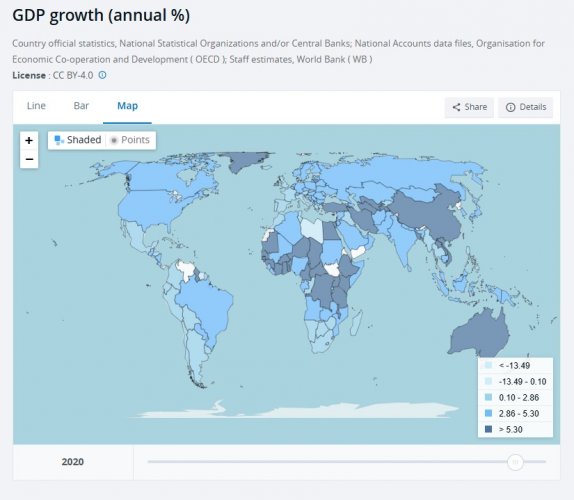
Honestly, 2020 is a good example. The whole supply chain mess from COVID? It's kinda similar to what a war would cause.

Those countries that supposedly "spent decades or even centuries building economic resilience" – they didn't actually do that well. Meanwhile, East and Southeast Asia had better economic performance.

(The legend is incorrect. However, countries with darker blue colors have higher economic growth rates.)
 
Last edited:
The US Navy would need new capabilities to wage unrestricted submarine warfare against the Chinese; and honestly, that's the stupidest way to interdict Chinese shipping. 50 SSNs and 1,000 Mk48s (publically provided inventory; total production since 1980 is reportedly 3,000 torps) isn't very much against the Chinese merchant fleet of many thousand large cargo ships and >100,000 smaller ships, oceangoing barges, fishing boats with crates on them etc (remember, the USN was sinking Marus - little junks, barges, coastal traffic - in WW2 by the hundreds!). Smaller torpedoes, JDAMs, Quicksink, mines, AUVs and so on will be far more critical for commerce raiding.

It would be orders of magnitude easier to roundup the allies and pressure the neutrals and restrict traffic at source, in the Middle East, in the Indian Ocean, and to conduct expeditionary operations around the flanks in Central Asia and SEA.

But even with these considerations, China has sufficient industrial capability and surplus capacity and domestic offsets and a sufficiently secure Russian backyard that while a conventional war would cause much hardship and pain, it would not precipitate rapid collapse. A commerce campaign, even conducted successfully, is not immediately fatal--because the Chinese have seen it coming for decades, and have laid in backup plans (surplus industrial overcapacity, electrification, coal, solar, food stores, the entente with the Russians etc).

The USA cannot defeat China, it can only make China suffer--and at great cost to the USA itself.
 
Last edited:
This is the reason why I dislike countries that pursue the offshore balancing strategy: they harm others without benefiting themselves.
 
The US Navy would need new capabilities to wage unrestricted submarine warfare against the Chinese; and honestly, that's the stupidest way to interdict Chinese shipping. 50 SSNs and 1,000 Mk48s (publically provided inventory; total production since 1980 is reportedly 3,000 torps) isn't very much against the Chinese merchant fleet of many thousand large cargo ships and >100,000 smaller ships, oceangoing barges, fishing boats with crates on them etc (remember, the USN was sinking Marus - little junks, barges, coastal traffic - in WW2 by the hundreds!). Smaller torpedoes, JDAMs, Quicksink, mines, AUVs and so on will be far more critical for commerce raiding.
Yeah, I've watched this thread with some amusement but I find this derailment into "how submarines could attack shipping" a bit puzzling.

This isn't WW2 and this isn't what modern nuclear submarines do.
 
The US Navy would need new capabilities to wage unrestricted submarine warfare against the Chinese; and honestly, that's the stupidest way to interdict Chinese shipping. 50 SSNs and 1,000 Mk48s (publically provided inventory; total production since 1980 is reportedly 3,000 torps) isn't very much against the Chinese merchant fleet of many thousand large cargo ships and >100,000 smaller ships, oceangoing barges, fishing boats with crates on them etc (remember, the USN was sinking Marus - little junks, barges, coastal traffic - in WW2 by the hundreds!). Smaller torpedoes, JDAMs, Quicksink, mines, AUVs and so on will be far more critical for commerce raiding.

It would be orders of magnitude easier to roundup the allies and pressure the neutrals and restrict traffic at source, in the Middle East, in the Indian Ocean, and to conduct expeditionary operations around the flanks in Central Asia and SEA.

But even with these considerations, China has sufficient industrial capability and surplus capacity and domestic offsets and a sufficiently secure Russian backyard that while a conventional war would cause much hardship and pain, it would not precipitate rapid collapse. A commerce campaign, even conducted successfully, is not immediately fatal--because the Chinese have seen it coming for decades, and have laid in backup plans (surplus industrial overcapacity, electrification, coal, solar, food stores, the entente with the Russians etc).

The USA cannot defeat China, it can only make China suffer--and at great cost to the USA itself.
We thought the same about Russia before 2022 — perhaps not the most modern armed forces in the world, but with deep reserves seemingly capable of delivering a short-term shock to Europe and NATO’s eastern flank. Yet, as we now know, the king was naked and had to ask for help from Iran and North Korea.


Returning to the main question — as you yourself point out, even if torpedoes are not used, cheap and plentiful aerial and naval munitions will be employed. Aircraft and submarines will also mine the coastal waters.


It must be remembered that the primary objective of the United States will be to crush the Chinese landing on Taiwan and to deploy its own reinforcements on the island. Therefore, apart from blocking the routes between China and Taiwan, they will not be chasing every fishing boat in the region. There may even be the establishment of an operational zone, similar to what was done during the Falklands War
 
I find it strange to think that an economy 2/3 the size of the US that imports 80% of it's oil and 80% of that by sea through S.E.A., (not to mention the rest of it's global economic exposure) is going to sustain a high-intensity war of stealth fighters, hypersonics, space systems and the like with junks and coastal barges so small that they don't even register as merchant ships.
 
Back
Top Bottom