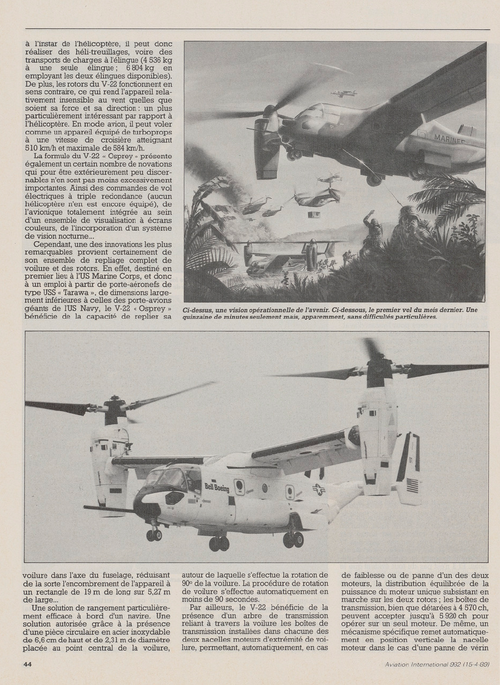
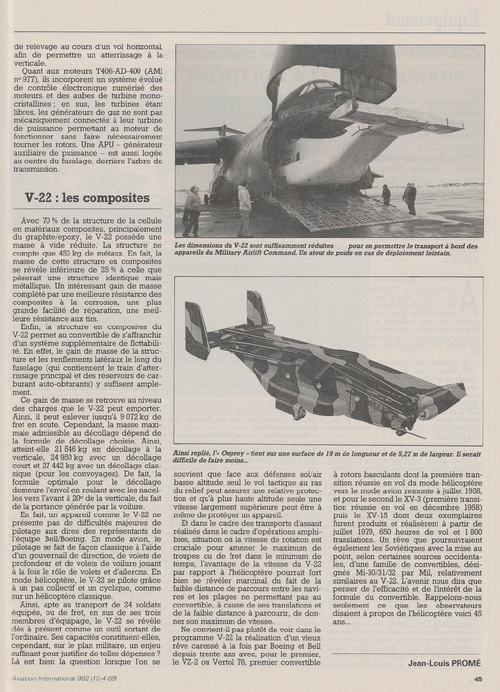
A great read on the causes of the crash off Japan in 2023 (material failure and faulty assumptions on the user side):


Highly recommended!
Yeah, that sounds like a training issue with Osprey crews... a Chip Light is a "land right effing NOW" item for helicopters!
 
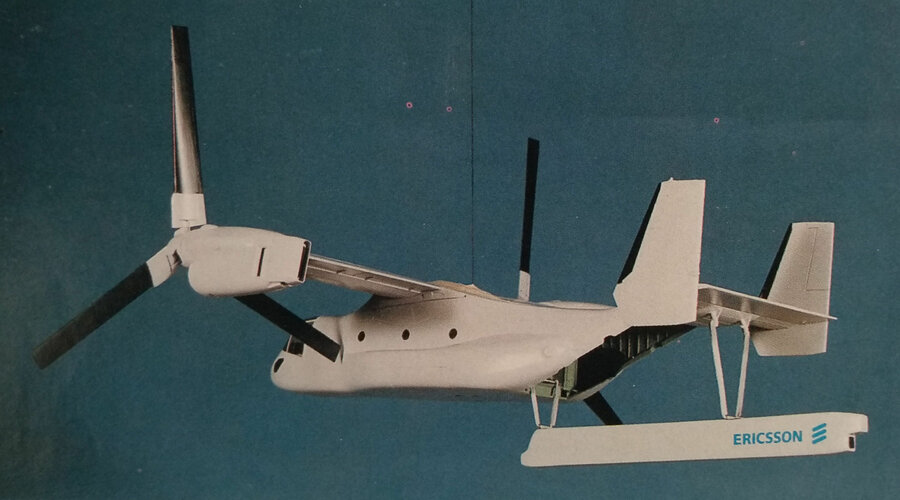
Exactly what it looks like
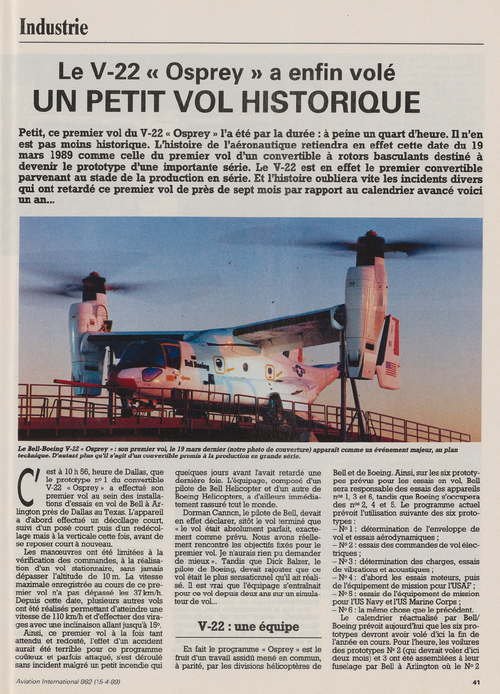
Google Translation:

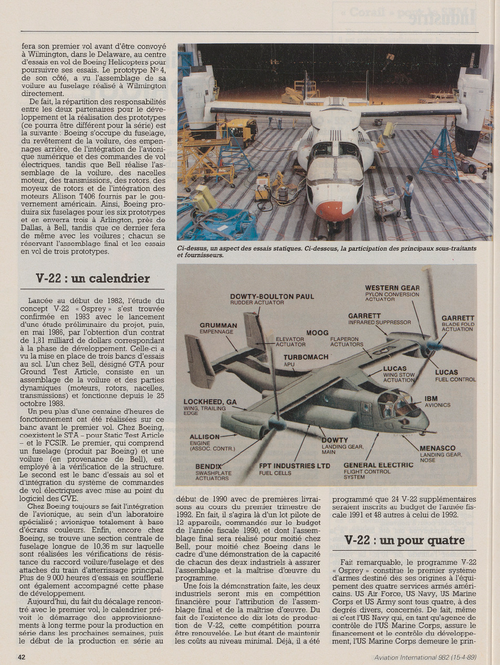
And the internet doesn't know about this, because it's an analog photo. The V-22 Osprey model with the ASC-890 Eireye radar, similar to the one on our Saab 340 AEWs.So what could have gone wrong here?

I mean, it's definitely a concept I've thought about before. But you can see some issues -- the radar beam translates back and up for landing, so the resulting aircraft is going to be extremely long. Maybe you could also slide it forward into the cabin, but you're going to need space in the cabin for operators.

As the comments note, vibration seems like it would be an issue, too. That's not a very rigid-looking structure and the last thing you want is the bean wobbling around. Seems like it would play hell with getting good resolution.

Unholy aft CG, batman!

Yeah, that also. I mean, I assume it's within limits, because the beam isn't the only heavy part of the radar. Big chunk of signal processing stuff probably placed as far forward as possible.
 
I mean, it's definitely a concept I've thought about before. But you can see some issues -- the radar beam translates back and up for landing, so the resulting aircraft is going to be extremely long. Maybe you could also slide it forward into the cabin, but you're going to need space in the cabin for operators.
I was assuming that the front A frame rolled like 270deg to stick the end of the beam into the cargo bay, then the aft A frame pushed the whole mess forwards.


Yeah, that also. I mean, I assume it's within limits, because the beam isn't the only heavy part of the radar. Big chunk of signal processing stuff probably placed as far forward as possible.
Yeah, it just looks particularly awful.
 
oft badly made gears?

That will outright RUIN any aircraft design type.

Let allow a sub type of the, 66600 parts flyong in close formation, that are helicopters.
 

There is a some truth here but "Hunterbrook Media" looks extremely sketchy to me, being affiliated with "Hunterbrook Capitol" , which took a short position on Universal Stainless stock before their Media arm published this tweet and video, two months after the original Military.com story. That feels very much like an attempt to move the stock price to cover their short.

Here is the original article, BTW.

 
Great idea!
The Royal Canadian Air Force needs a squadron or three of those Ospreys for the long-range CASR role in the high Acrtic.
They could get by with a simplified, non-folding version to reduce parts-count.
While a non-folding version is simpler, it's also then different than what the US uses and only on a couple dozen airframes. So all the development costs of the fold-less version get applied to those airframes alone. There's probably pins that get installed for maintenance that you could likely leave in place to permanently disable the fold.

I mean, the USAF Ospreys still have all the fold gear of the USN/USMC versions.


But yes, Ospreys, AW609s, or V280s for long range CSAR. That's literally what the Osprey was born to do.
 
While a non-folding version is simpler, it's also then different than what the US uses and only on a couple dozen airframes. So all the development costs of the fold-less version get applied to those airframes alone. There's probably pins that get installed for maintenance that you could likely leave in place to permanently disable the fold.

Not much development needed - there would be no changes in the wing shape/structure, and so on - other than the removal of unneeded systems and parts related to swiveling the wing and installing bolts instead of the pins.

The main issue would be what the weight reduction does to center-of-mass etc - which shouldn't be too significant.

I mean, the USAF Ospreys still have all the fold gear of the USN/USMC versions.

That's so they can transport them long distances quickly via C-17 & C-5.
 
Not much development needed - there would be no changes in the wing shape/structure, and so on - other than the removal of unneeded systems and parts related to swiveling the wing and installing bolts instead of the pins.
Just permanently changing how the wing attaches to the fuselage.

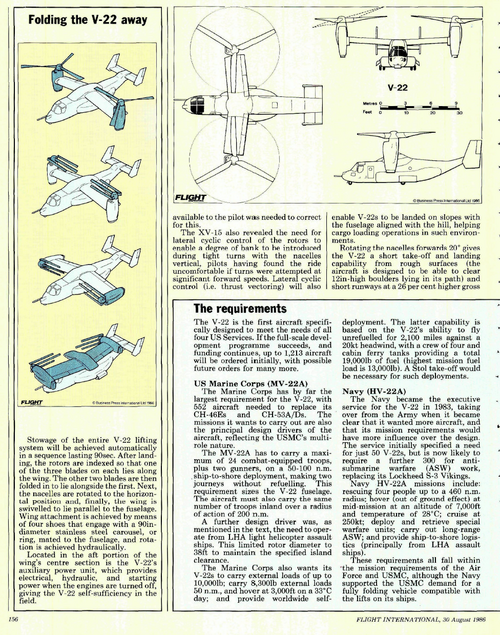
Right now, the Osprey is basically built as two separate pieces, Wing and Fuselage. These then are held together through the fold pin.

You're not saving any serious weight until you get to redesigning the wing-to-fuselage joint into something that bolts the wing spars to the fuselage directly, and that's not going to be cheap to design.
 
About the only thing you could do is make a new wing with ~20 years more advanced composites and structures, with a V-280/FLRAA stationary nacelles. I suppose some of the hydraulic equipment necessary for folding could be removed for some weight saving, but likely less than we might think. But the redesign, build, and testing alone would make the cost unaffordable if there was not hundreds of aircraft being built/refitted.
Personaly I do not think the Canadian government would want to accept MV-22B that are redundant, due to the popular press.
 
About the only thing you could do is make a new wing with ~20 years more advanced composites and structures, with a V-280/FLRAA stationary nacelles. I suppose some of the hydraulic equipment necessary for folding could be removed for some weight saving, but likely less than we might think. But the redesign, build, and testing alone would make the cost unaffordable if there was not hundreds of aircraft being built/refitted.
Exactly what I was getting at.

Personaly I do not think the Canadian government would want to accept MV-22B that are redundant, due to the popular press.
I honestly hope that the US Coast Guard can grab the USAF extras, since they're already set up for nightmare weather SAR.
 
Just permanently changing how the wing attaches to the fuselage.

Right now, the Osprey is basically built as two separate pieces, Wing and Fuselage. These then are held together through the fold pin.

You're not saving any serious weight until you get to redesigning the wing-to-fuselage joint into something that bolts the wing spars to the fuselage directly, and that's not going to be cheap to design.

About the only thing you could do is make a new wing with ~20 years more advanced composites and structures, with a V-280/FLRAA stationary nacelles. I suppose some of the hydraulic equipment necessary for folding could be removed for some weight saving, but likely less than we might think. But the redesign, build, and testing alone would make the cost unaffordable if there was not hundreds of aircraft being built/refitted.
Personaly I do not think the Canadian government would want to accept MV-22B that are redundant, due to the popular press.

None of which actually needs to be done.

The Osprey works just fine with the current wing & wing-fuselage joint, the idea is to simply disable the wing rotation mechanism, replace the retractable locking pins with bolts, and remove the motor that rotates the wing.

The stated idea was to reduce maintenance needs, not to drastically reduce weight.
 
None of which actually needs to be done.

The Osprey works just fine with the current wing & wing-fuselage joint, the idea is to simply disable the wing rotation mechanism, replace the retractable locking pins with bolts, and remove the motor that rotates the wing.

The stated idea was to reduce maintenance needs, not to drastically reduce weight.
Agreed!
In summary, a hypothetical RCAF CSAR version would use 95 percent stock parts except for some of the folding hydraulics. Since most of the deleted folding hydraulics would be near the center-of-gravity, any weight reduction would have minimal effect on balance. Locking pins would be replaced by semi-permanent bolts. Weight-savings would be minor with the key goal being to reduce parts-count and maintenance hours.

For comparison, the CF-18As that I worked on 40 years ago had landing gear hundreds of times more complex than needed for runway operations, but MD needed to squeeze Northrup out of the fighter market, so the RCAF got screwed out of the proposed simplified F-18L with shorter and simpler landing gear. The Australians, Finns, Kuwaitis, Swiss, etc. would also have benefited from simplified landing gear.

Before working on CF-18s, I spent 5 years greasing Sikorsky Sea King helicopters onboard HMCS Athabaskan and HMCS Iroquois, so am intimately familiar with hydraulic folding mechanisms.
 
Since most of the deleted folding hydraulics would be near the center-of-gravity, any weight reduction would have minimal effect on balance.
I'd say you could leave the hydraulics in place and isolate them, so they can serve as ballast at negligible R&D cost. They then wouldn't require any maintenance because their entire role would be 'be a thing the same size and shape as themselves'.

But I suspect the aviation safety regime would have a screaming fit at that approach.
 

Attachments

  • IMG_3715.jpeg
    IMG_3715.jpeg
    352.7 KB · Views: 92
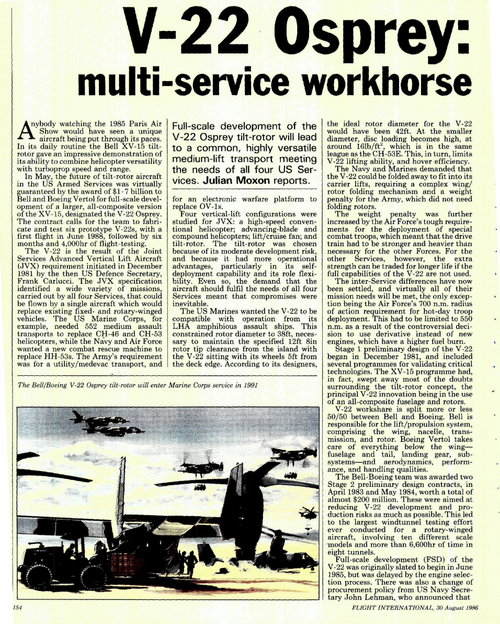
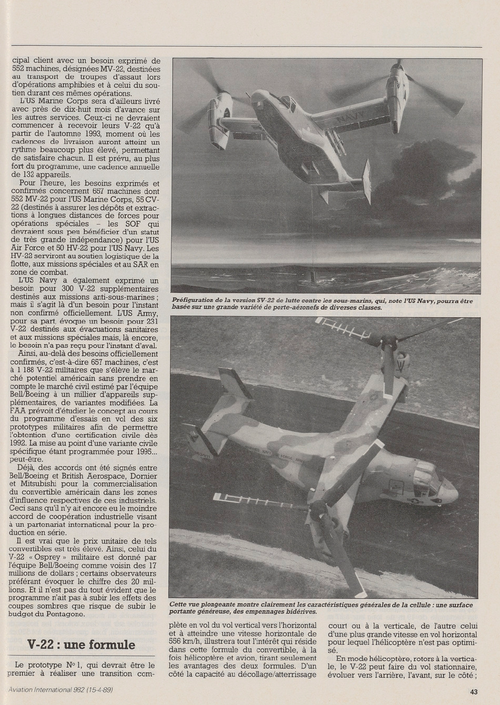
The Marine Corps has spent the past five years re tooling to fight in the Pacific and the submarine threat can’t be ignored. The MV-22B complements the Navy’s capabilities so well that it’s hard to believe this wasn’t thought of sooner. We’ve validated the utility of both amphibious warships and littoral forces, demonstrating the ability to fight as the landward component of the fleet.

100% original thinking o_O

 
Now lets see an actual SV-22
While Osprey ASW is theoretically do-able, it probably wouldn't be using a dipping sonar. Ospreys are not particularly efficient or good in the hover, and using dipping sonar means lots of time spent hovering. If someone was stubborn enough about it, SV-22s using dipping sonar would absolutely be possible. Enlarge the access hole in the belly for sling loads so that the dipping sonar can pass through that spot.

It'd be some heavy modifications, but I'd install the AFSOC "combat doors" with drop tubes in them on both sides aft of the wing. Yes, I know that Ospreys don't have doors there. That's part of what would be so expensive: making the space to install the combat doors.

I'd further replace the rear ramp with one that had Sonobuoy tubes on both sides and leaving only a walkway up the center of the ramp. Split Common Launch Tubes on the rear ramp would be another option. MC-130s have 10x CLTs in a single block, I'd run 2 sets of 4x if possible.

Torpedoes and/or depth charges would need to be carried either on the wings or on the sponsons.


EV-22 (I vote Erieye, although that pesky wing "fold" would make it difficult).
I mean, there's a hinge pin in the wing fold, I'm assuming that it's hollow and you could rig the radar leads through that point. Have a non-rotating pin that comes up to the radar beam to support it, and wrap an aerodynamic shroud around it that is attached to the pin.

Probably have to anchor the beam to the top of the tail fins at the rear, though.

 
Re ASW -22…Purpose built UAV, sized to house just the dipping sonar and other minimums, seems like a better solution.

Re RCAF just keep it as is. Folding is good for maximizing heated hanger space in cold conditions. Keeps with CONOPS, maintenance, procedures and logistics of other V-22 operators.
 

Similar threads

Back
Top Bottom