jsport
what do you know about surfing Major? you're from-
- Joined
- 27 July 2011
- Messages
- 8,647
- Reaction score
- 6,942


The Navy identified three vessel concepts varying in capability. The most relevant to the service’s requirements is a solution for an unmanned ship that can support a payload of two 40-foot ISO containers and cruise at a sailing speed of 25 knots for up to 2,500 nautical miles in sea state four. The other two concepts examine different payloads, from one to four ISO containers without specifying range or speed. The Navy wants responses to the solicitation by Aug. 11
these new concepts should be able to support numerous missions from their containerized payloads, including “Intelligence, Surveillance, Reconnaissance, and Targeting (ISR&T), Information Operations (IO) missions, and serve as an adjunct magazine.”
The Navy stressed that the USVs should be a “non-exquisite vessel design.” The solicitation emphasized that the platform should have commonality with commercial standards to maintain, repair and build at multiple shipyards and support scaling production

The Navy identified three vessel concepts varying in capability. The most relevant to the service’s requirements is a solution for an unmanned ship that can support a payload of two 40-foot ISO containers and cruise at a sailing speed of 25 knots for up to 2,500 nautical miles in sea state four. The other two concepts examine different payloads, from one to four ISO containers without specifying range or speed. The Navy wants responses to the solicitation by Aug. 11
these new concepts should be able to support numerous missions from their containerized payloads, including “Intelligence, Surveillance, Reconnaissance, and Targeting (ISR&T), Information Operations (IO) missions, and serve as an adjunct magazine.”
The Navy stressed that the USVs should be a “non-exquisite vessel design.” The solicitation emphasized that the platform should have commonality with commercial standards to maintain, repair and build at multiple shipyards and support scaling production
Perhaps the MUSV prototype being built for the EU's Euroguard project would be a good baseline... 45m long, ~250 tonnes approx... seems about right for the capability required.


Ideally it doesn't have to have any exquisite stealth coatings but at least have some fairly stealthy shaping going on so that it'll make them a little harder to target while they are doing ISR or launching missiles.Perhaps the MUSV prototype being built for the EU's Euroguard project would be a good baseline... 45m long, ~250 tonnes approx... seems about right for the capability required.


MUSV seems to be dead. USN is full speed ahead with optionally manned MASC.Who merged the MUSV and MASC threads? They are linked but separate programs.
Nice, but cannot meet the minimum sustained cruising speed of 25kts. Should also add budget for this single vessel was EUR 95M (US $110M) - a bit pricy even for built in EstoniaPerhaps the MUSV prototype being built for the EU's Euroguard project would be a good baseline... 45m long, ~250 tonnes approx... seems about right for the capability required.
https://www.janes.com/osint-insights/defence-news/sea/baltic-workboats-lays-keel-for-euroguard-usv
MUSV seems to be dead. USN is full speed ahead with optionally manned MASC.
MASC (Modular Attack Surface Craft) is a whole new program to replace LUSV and MUSV. It also signals a shift in US Navy thinking around the actual maturity of maritime autonomy by also requiring that the designs ideally be based upon existing commercial designs that are optionally manning-capable, and Class society-approved.Isn't the MASC program just a refinement of the requirements for MASC?
MASC (Modular Attack Surface Craft) is a whole new program to replace LUSV and MUSV. It also signals a shift in US Navy thinking around the actual maturity of maritime autonomy by also requiring that the designs ideally be based upon existing commercial designs that are optionally manning-capable, and Class society-approved.
The MUSV (Medium Unmanned Surface Vessel) never had such requirements imposed, i.e., high minimum speeds, crew habitability, etc. Also there has been a shift in the US Navy/ US DoD in the use of Class standards to drive down costs and improve delivery of vessels from US Tier II and Tier III shipyards.And that is different than MUSV how?
The MUSV (Medium Unmanned Surface Vessel) never had such requirements imposed, i.e., high minimum speeds, crew habitability, etc.
It's more than that, it's a shift back towards reality. Unmanned and autonomous vessels, in simple terms, are not yet mature enough to accomplish specific key missions. There are still missions where it makes sense to have a sailor in the loop.So it's a refinement of the requirements.
Id hate to be the three dudes that have to man one of these things while adrift in the pacific, possibly behind enemy lines and utterly alone.There are still missions where it makes sense to have a sailor in the loop.
Minimum manning for a ship is closer to 12.Id hate to be the three dudes that have to man one of these things while adrift in the pacific, possibly behind enemy lines and utterly alone.
And when you arent alone, its because the enemy found you and is now sending drones after you.
Although realistically it'll be a bit like manning torpedo boats in WWII...
The MASC is the modern-day analogy to the PT Boats of WWII. This is not a bad thing when you take into account that during WWII, the Japanese were never able to counter the USN's PT Boats effectively. The PT Boats earned the nickname "Devil Boats" from the Japanese. They wreaked havoc upon the Tokyo Express and other supply lines to forward-deployed Japanese forces and, by extension, upon the vast majority of Japanese outposts across the Pacific. Their origin was also a product of a time at the end of the 1930s when the US Navy and its supporting Tier I shipyards were not yet truly ready and capable of building the larger capital ships they knew they needed to win a war they knew was likely coming! General MacArthur and Admiral Nimitz advocated for them.Id hate to be the three dudes that have to man one of these things while adrift in the pacific, possibly behind enemy lines and utterly alone.
And when you arent alone, its because the enemy found you and is now sending drones after you.
Although realistically it'll be a bit like manning torpedo boats in WWII...
MASC currently calls out for a min crew of 8, however, if assuming full watch standing does indeed need to be able to host 12-16. That said, modern OSVs can run with smaller crews - the challenge will however come in minimum manning depending upon mission profile and mission systems requirements.Minimum manning for a ship is closer to 12.
Helmsman, engineer, and sensors operator times 3 watch sections makes 9. Officer in Charge, cook, and doc makes 12. Add at least 3 more if the USN requires a lookout in addition to sensor watches (they do when subs are surfaced, so...).
I'd also want a 4th watch section standing a fixed watch (say, 18-24), so that the regular 3 get a better break. This would add another 3+lookout(s).
Example: Section 1 starts off standing the 06-12 watch Monday, the next time they're on watch is midnight-6am Tuesday. They'd normally also stand the 18-24 watch Tuesday but section 4 is kicking them so their next watch isn't until 12-18 on Wednesday (30 hours off watch!). Thursday they're back on the 06-12 watch and pattern repeats.
carry a 40-ton payload with a top speed of more than 50 knots, payload depending, and a range of 1,000 nautical miles
The most relevant to the service’s requirements is a solution for an unmanned ship that can support a payload of two 40-foot ISO containers and cruise at a sailing speed of 25 knots for up to 2,500 nautical miles in sea state four.

Seven designs have been tapped by the Navy to develop medium unmanned surface vessel prototypes as part of the sea service’s foray into robotic systems, USNI News has learned.
Out of about two dozen options submitted for the MUSV marketplace, the unspecified shipbuilders will develop vessels that will be tested against Navy requirements for the robotic craft, service spokesperson Capt. Ron Flanders said in a Friday statement to USNI News.
“The Navy selected seven entrants in the Medium Unmanned Surface Vessel (MUSV) marketplace to advance to the next phase – prototype evaluation,” Flanders said. “Selected industry partners must successfully complete at-sea demonstrations to prove the maturity of their systems… After successful at-sea demonstrations prior to October 2026, the Navy plans to work with industry to have vessels available for Navy leasing or procurement in fiscal year 2027.”
In its recently released long-range shipbuilding plan, the Navy outlined intensions to buy 36 MUSV in Fiscal Year 2026 as part of the $5 billion in the 2026 Reconciliation Act using “other transaction authority,” which allows the service to sidestep regular public contract reporting requirements.
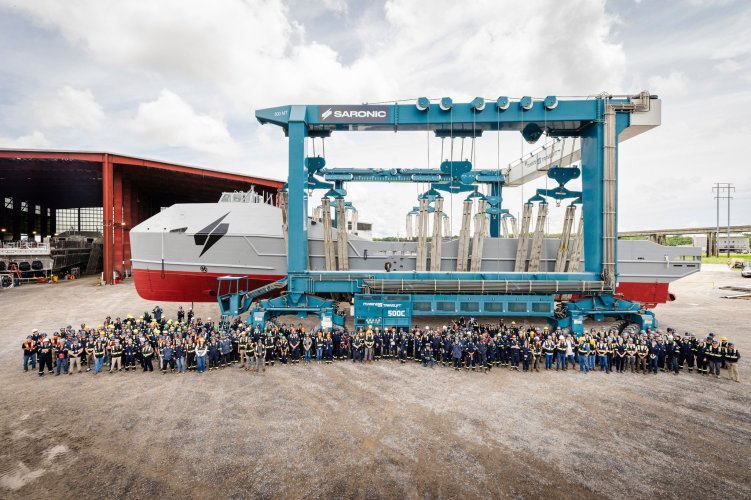
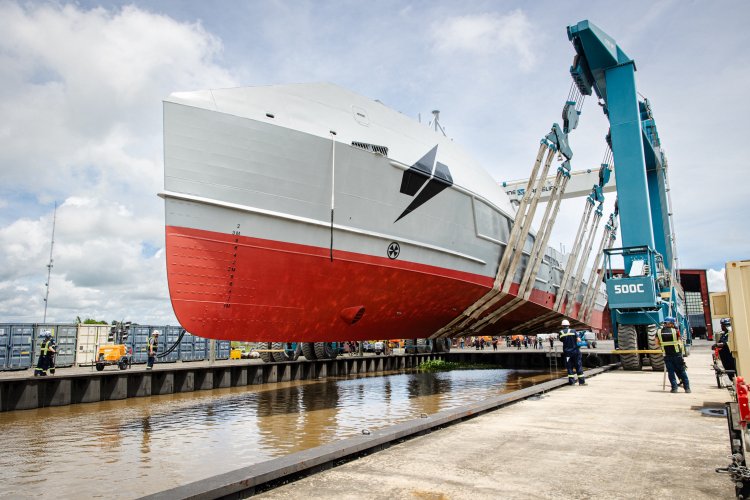
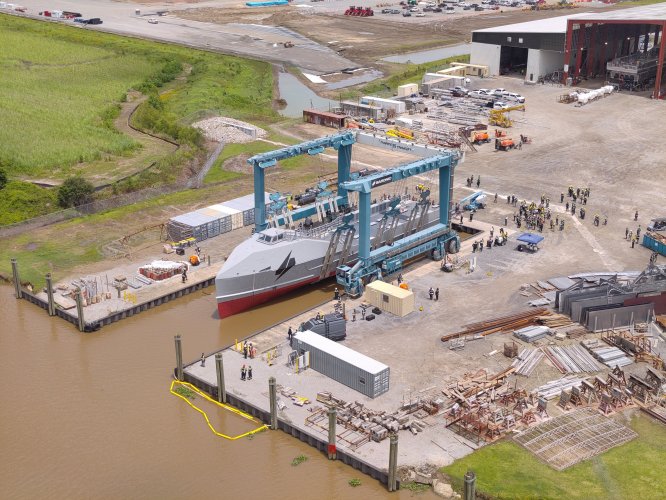
Saronic today announced the launch of its first Marauder Medium Unmanned Surface Vessel (MUSV), designed to deliver dual-use autonomous capability far from shore across the full range of defense and commercial applications. The first Marauder hull moved from initial design to on-water trials in under a year, a pace not seen in American shipbuilding since World War II, validating both Saronic’s development approach and the integrated production model by which it was built.
With a top speed of 25+ knots and a range of up to 5,400 nautical miles, Marauder can reposition rapidly and sustain operations across vast ocean distances. Its 150-metric-ton payload capacity, configurable to accommodate up to four 40-foot or eight 20-foot ISO containers, gives operators the flexibility to tailor the vessel’s mission load to meet their varied needs, including logistics, research, maritime domain awareness, persistent intelligence, surveillance, and reconnaissance (ISR), or other payloads without modifying the platform itself. That modularity across applications is critical to serve a broad base of customers who need a vessel that can adapt as mission requirements evolve.
The U.S. Navy’s Medium Unmanned Surface Vessel (MUSV) program selected 7 separate designs to advance towards at sea testing, with further scaling following suit as a part of the several billion dollar initiative to regain the U.S. Navy’s mass.
The 7 companies selected by the Navy include, Sea Machines, Leidos, Saronic Technologies, Galliano Marine Services, PacMar Technologies, Birdon, and Huntington Ingalls Industries (HII). The selection of these firms represents a mix of already established and large scale defense firms and the introduction of several newer companies.