martinbayer
ACCESS: Top Secret
- Joined
- 6 January 2009
- Messages
- 4,738
- Reaction score
- 6,491



 neverwasmag.com

If that project had gone through, all plant and animal life in and around the Mediterranean would be dead. Read about California's Salton Sea and imagine it several thousand times biggerThis proposal is dead, so what of dead...
Note: the Nazi show no interest in this project even forbid further study on this project.
View: https://www.youtube.com/watch?v=9kd5feloqSU


This urban form is standard in large parts of cities like Hong Kong, and has been since the 1970s. Indeed, a lot of the circulation systems in Hong Kong would have been initially designed in cooperation with British planners.The cancelled Hook New Town which was to be built west of London. Uniquely, it would have a town center where pedestrians and motor vehicles would be on separate levels.
The fact that we don't have such convenient and efficient circulation systems is a testament to the limitations of current building materials that much such verticality prohibitively expensive.


Space is at an extreme premium in Hong Kong, so double decking the streets pencils out. There are few other places where that's the case.This urban form is standard in large parts of cities like Hong Kong, and has been since the 1970s. Indeed, a lot of the circulation systems in Hong Kong would have been initially designed in cooperation with British planners.
This is a very pleasant middle-class development built in the 70s, still very competitive, in many ways as good as or better than modern developments (better access to parks, more retail options etc).
 View attachment 778599
In addition to the famous Central Mid Levels escalator network in the financial district, footbridge networks to ensure grade separation of foot traffic and road traffic can be found all around Hong Kong. They weave between malls (many with air-conditioning) and various retail arcades located along the footbridge networks, and typically lead to subway stations.
Tsuen Wan footbridge network - Wikipedia
en.wikipedia.org
View attachment 778600
Different implementations of mixed retail + pedestrian grade separation from different eras (1980s, Sha Tin New Town vs 2000s, Tseung Kwan O New Town). Note the air-conditioned footbridges leading into the subway station/giant mall/transit hub podium thing in the new iteration. Also note residential developments on top. Retail is integrated into the pedestrian walkway system as in the original concept. These are all upper middle class to upper class developments.
And yes, the New Town terminology was carried over by British and British-adjacent urban planners. They might not have been able to build a New Town in Hook, but they sure as hell were able to build a New Town in Sha Tin.
These things were first popularized by Magic Motorways back in the late 1930s and the GM World's Fair Futurama in 1939, but implementation has been non-uniform.
View attachment 778602

Exactly, it's almost exclusively the province of lavishly funded urban renewal and new town projects as well as the skyway systems found in Minneapolis and most Canadian cities, the purpose of which isn't protecting pedestrians from cars, but from extremely cold winters.Concept of Separate Auto ( & public transport) from pedestrians is old
Already proposed in 1900s, it was took over by Le Corbusier and others
in 1950s to 1970s it was quite popular in City design like London, Paris or Tokyo
most [in]Famous like the Barbican Complex in London or The Front de Seine district in Paris.
Actually, it goes back further than that. Da Vinci proposed an "ideal city" where, among other things, horse traffic would be banished into tunnels.Concept of Separate Auto ( & public transport) from pedestrians is old
Already proposed in 1900s, it was took over by Le Corbusier and others
in 1950s to 1970s it was quite popular in City design like London, Paris or Tokyo
most [in]Famous like the Barbican Complex in London or The Front de Seine district in Paris.
that would be this hereActually, it goes back further than that. Da Vinci proposed an "ideal city"

Not a materials strength limitation. A materials cost limitation. You're building roads and then bridges on top of them. Or building tunnels and running roads through them. Ignoring costs of bridges, you're paying for roads twice (once for cars, once for pedestrians).View attachment 778486View attachment 778487View attachment 778488View attachment 778489View attachment 778490View attachment 778491
The cancelled Hook New Town which was to be built west of London. Uniquely, it would have a town center where pedestrians and motor vehicles would be on separate levels.
The fact that we don't have such convenient and efficient circulation systems is a testament to the limitations of current building materials that make such verticality prohibitively expensive.
If materials were stronger, you would need to use less of them, especially when you consider how weight compounds on itself. It would also reduce the cost of assembly as you could use fewer workers and lighter duty equipment.Not a materials strength limitation. A materials cost limitation. You're building roads and then bridges on top of them. Or building tunnels and running roads through them. Ignoring costs of bridges, you're paying for roads twice (once for cars, once for pedestrians).

Chongqing is a more extreme version of this.This urban form is standard in large parts of cities like Hong Kong, and has been since the 1970s. Indeed, a lot of the circulation systems in Hong Kong would have been initially designed in cooperation with British planners.
This is a very pleasant middle-class development built in the 70s, still very competitive, in many ways as good as or better than modern developments (better access to parks, more retail options etc).
View attachment 778599
In addition to the famous Central Mid Levels escalator network in the financial district, footbridge networks to ensure grade separation of foot traffic and road traffic can be found all around Hong Kong. They weave between malls (many with air-conditioning) and various retail arcades located along the footbridge networks, and typically lead to subway stations.
Tsuen Wan footbridge network - Wikipedia
View attachment 778600
Different implementations of mixed retail + pedestrian grade separation from different eras (1980s, Sha Tin New Town vs 2000s, Tseung Kwan O New Town). Note the air-conditioned footbridges leading into the subway station/giant mall/transit hub podium thing in the new iteration. Also note residential developments on top. Retail is integrated into the pedestrian walkway system as in the original concept. These are all upper middle class to upper class developments.
And yes, the New Town terminology was carried over by British and British-adjacent urban planners. They might not have been able to build a New Town in Hook, but they sure as hell were able to build a New Town in Sha Tin.
These things were first popularized by Magic Motorways back in the late 1930s and the GM World's Fair Futurama in 1939, but implementation has been non-uniform.
View attachment 778602
A materials cost limitation. You're building roads and then bridges on top of them. Or building tunnels and running roads through them. Ignoring costs of bridges, you're paying for roads twice (once for cars, once for pedestrians).
Concrete may be cheap, but you need to put in rebar, build formwork, and wait 30 days for it to harden. You also need a crane to move precast slabs into place.To a degree, yes, but concrete is fairly cheap. Typical costs in China are 30 bucks a square meter, so even if you need a square kilometer of it it'll only be a few tens of millions of dollars. Megablock construction is very common in Xiaoqu (microdistrict) urban form in China as well, and they also use a lot of grade separation.
You don't have to go so far as Hong Kong, actually. They did it in quite a few places in the UK, at least in part. Cumbernauld is somewhat notorious for it, with the town centre repeatedly voted 'Britain's most hated building'. On the other hand, the Barbican Estate was designed with similar principles and is quite well regarded.And yes, the New Town terminology was carried over by British and British-adjacent urban planners. They might not have been able to build a New Town in Hook, but they sure as hell were able to build a New Town in Sha Tin.
Yes, this is what I remember from seeing some EPCOT plans some time ago(there is a thread in AlternateHistory.com that talks about EPCOT, and had plans of it).Does anyone have plans/cross-sections of the old EPCOT town? Or did I miss them earlier in this thread?
Supposedly, Walt had designed it so that utilities were in tunnels below the commercial vehicle access levels, which were below the private-automotive access levels, which were below the pedestrian/commuter pod surface level. This meant that utility work never blocked streets, and neither did moving or deliveries. Then you could have total green space around homes, with some small paths/rails for the quiet electric commuter pods.
London has survived many attempts to unleash architectural eyesores worse than the many that it does have.
A summary here
Unbuilt London
From a Ponte Vecchio-style bridge across the Thames to a monorail running through Regent Street.

It's a few days, not thirty. Slipform is easily 4-8 meters per day, although usually the cadence is one floor per week (it can be done faster. Prefab construction brings this to one floor every five days and one house every two days, as was deployed by real estate developers like Country Garden, that prized speed above all else.Concrete may be cheap, but you need to put in rebar, build formwork, and wait 30 days for it to harden. You also need a crane to move precast slabs into place.


The difference, of course, is that one was viewed as a flagship development and maintained properly, while the other was viewed as a population sink in a declining area.

Thank you!Yes, this is what I remember from seeing some EPCOT plans some time ago(there is a thread in AlternateHistory.com that talks about EPCOT, and had plans of it).
Da Line is a thing because Saudi Arabia is a very wealthy country that can afford such vanity projects. Clean sheet construction goes on everywhere in the world, almost none of it separates pedestrians and motor vehicles vertically.=/=
Incidentally, this is also why Da Line is a thing in Saudi Arabia. Clean sheet construction on a desert semi-voluntarily cleared of inhabitants is not expensive, especially at humungous scale and with imported labor from all corners of the world. Reinforced concrete, tower cranes, giant diggers etc are all very low cost (indeed, usually the bigger the machine, the cheaper it is to operate per unit output!) making ridiculous constructions quite economical in the grand scheme of things.
(compare Da Line with that silly railway stationtop apartment; instead of plating the hill in concrete, filling it full of foundations and tunnels, and then trying to build huge apartment complexes atop the whole thing, it would have been way cheaper to bulldoze the entire hill if that had been an option - hence, Da Line bulldozes all the intervening terrain!)
View attachment 778780
I would argue that failing to separate pedestrians and motor vehicles vertically is a sign your civil engineers need to go back to school.Clean sheet construction goes on everywhere in the world, almost none of it separates pedestrians and motor vehicles vertically.
Clean sheet construction goes on everywhere in the world, almost none of it separates pedestrians and motor vehicles vertically.

I would argue that failing to separate pedestrians and motor vehicles vertically is a sign your civil engineers need to go back to school.
If it is physically impossible for pedestrians to step into traffic, you cannot have pedestrians getting run over. Similarly, if it is impossible for pedestrians to step onto train tracks or cars to drive onto train tracks, you cannot have trespasser strikes.
), which gives you more retail storefront and less mall space.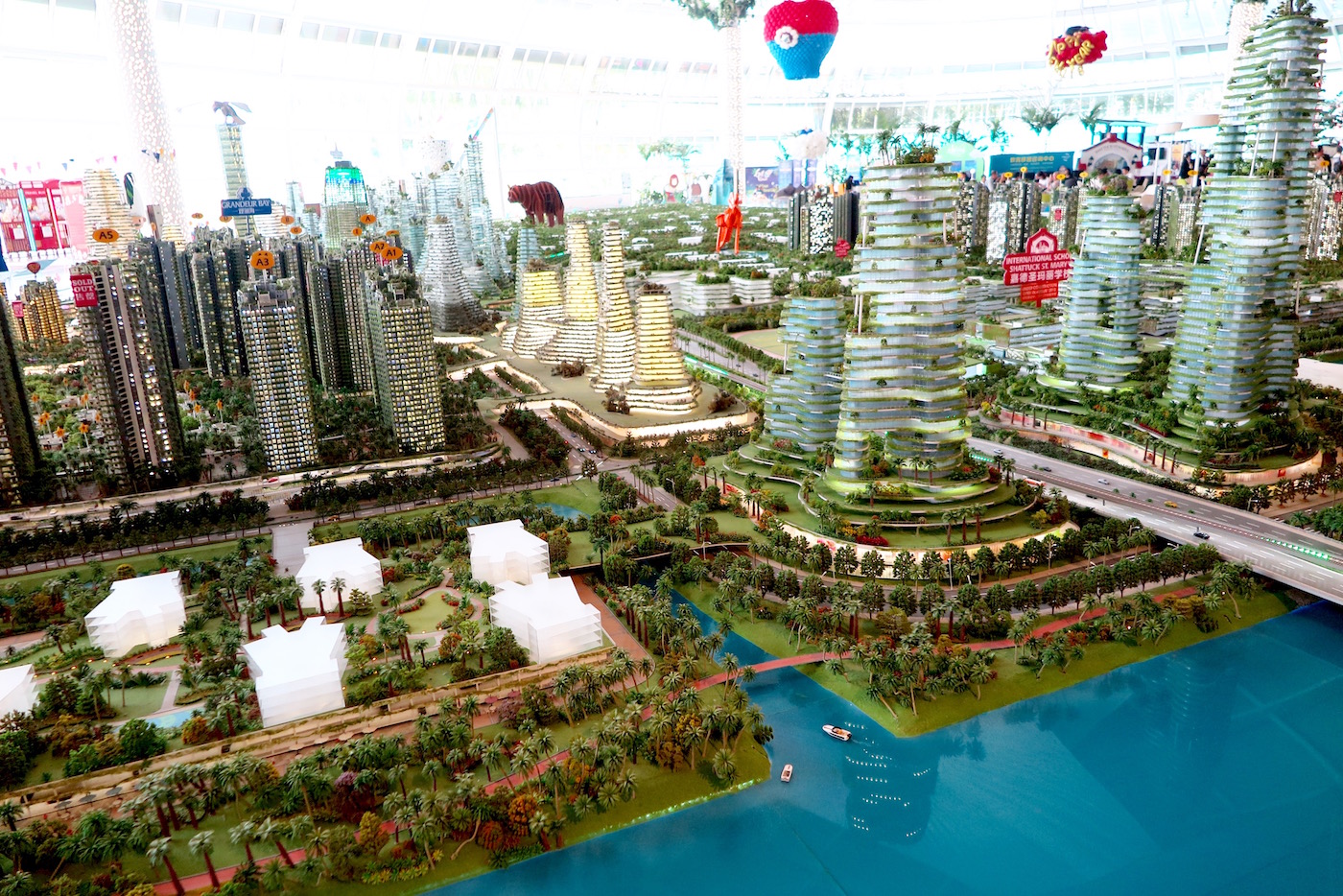


Well, yeah, the whole point of the pedestrian level is retail storefronts! Apartments and condos go on top of the retail spaces.Well, you end up with utilization issues if there's not enough density to support the extra space; walkways without retail are potentially hazardous if there are no eyes on the street or if they're too empty and if the urban environment is crime-ridden. It is in theory difficult for police on motor vehicles to patrol elevated podiums.
Yeah, those people are misguided at best, IMO.Some people, especially in the US and even in East Asia, have expressed opposition to this kind of urban form for allegedly breaking down community bonds, and for making streets un-street-like, and empowering megacorporations and chain retail as opposed to smaller operators (the urban form necessitates a degree of scale). Recently, there has been a move away from integrated podium developments back to some sort of fine grained street grid (but still with megacorporate developers and retail arrangements
Of course, you end up sweating under the sun in tiny streets designed by people with no common sense (or people who live in a temperate environment) to include a proper overhang or cover for rain and sun in a tropical environment (which they did back in ye ancient times and ye olden days!), which reminds you why they went from fine-grained street grids to integrated podiums in the first place...
Definitely a reasonable concern. I think for general design purposes I'd want to use cloth awnings over big concrete shades, though.Urban design has many cultural and climate and soft aspects - overhangs might be less desirable in cooler climates, where an overriding concern might be getting enough sunlight on the street level to warm people up.
Yes, that is exactly the kind of thing I was talking about!Also see Johor Forest City, a city of a million that was to be built by Country Garden (now bankrupt) in Singapore; note the extensive grade separation proposed in the (unbuilt) downtown core
A civic outcry in Malaysia forces a Chinese builder to live up to its eco-friendly tag
JOHOR BAHRU, Malaysia – On Jan. 1, 2014, fishermen near Kampong Pok, a village on Malaysia’s southern shore, were alarmed to find a fleet of barges and dredgers dumping sand on their fishing ground. Up until that moment, they’d heard nothing about land reclamation planned for their neighborhood...news.mongabay.com
Indeed, but retail has to be scaled to the population and foot traffic.Well, yeah, the whole point of the pedestrian level is retail storefronts! Apartments and condos go on top of the retail spaces.
Yeah, those people are misguided at best, IMO.

Fair point.Tarps and awnings have their uses but they get moldy fast in heavy tropical rain, and the runoff is annoying.


The way I look at it: here in Phoenix, most apartment complexes provide tenants with covered parking so that the interiors of their cars don't get damaged by the UV rays of the relentless Arizona sun, but I haven't seen any places that allow the tops of these shades to be walked on.It's a few days, not thirty. Slipform is easily 4-8 meters per day, although usually the cadence is one floor per week (it can be done faster. Prefab construction brings this to one floor every five days and one house every two days, as was deployed by real estate developers like Country Garden, that prized speed above all else.
Rebar, cranes, etc are also very cheap. A typical thirty storey building in parts of China is buildable for as little as 500 USD per square meter.
The most expensive place to build in Asia is Hong Kong (just across the border from China!), at 4,500 US dollars per square meter thanks to Anglo-style cost disease. And that's with huge multistorey podiums and overengineered typhoon resistance and sixty storey apartments and 45 degree unstable slopes that have been heavily reinforced with ridiculous foundation work (so extensive you can barely tell where the hill ends and where the building begins) and so on.
(this was supposed to be a hill, they replaced it with concrete so they could build a railway station in it and so the railway company could sell pretty apartments on top of the station to fund the railway; the hill is more a theoretical construct these days, being filled with rail and highway and pedestrian tunnels and topped by endless parks on little platformy things like a Mario game and a mix of very old and brand new housing - you can do anything, anything, with enough concrete)
And housing prices are easily double that 4,500 dollar per square meter price tag even after the housing market collapse, so the construction cost is a minor component of the total cost (although that depends on how much value is captured by the government and how that all shakes out; the proceeds from land sales are mostly ploughed into infrastructure in Hong Kong and China, like mass transit, high speed rail, new sewers, water treatment plants etc that greatly contribute to the value of the land, value capture at work blah blah blah).
Ultimately, concrete, steel, formwork, cranes, and other machines are cheap. What is not cheap is labor, permitting, building around old infrastructure, and building all the supporting physical and social infrastructure and paying for all of that plus the rest of society (what they call externalities) - that is, cost disease (or at least, what I might speculate to be major contributors to cost disease).
View attachment 778779
Steel is 230-400 USD a tonne depending on market conditions, concrete is 60 bucks a cubic meter (my earlier estimate was probably a bit off, sorry). You only need a cubic meter of concrete per square meter of high rise, and only a few hundred kilos of that at most need be steel. Most of the cost is not the bill of materials.
Yeah, the architecture is only a small part of the overall problem; you need proper maintenance, upkeep and actual proper use. You need a village to raise a child, you need a village to raise a village.
=/=
Incidentally, this is also why Da Line is a thing in Saudi Arabia. Clean sheet construction on a desert semi-voluntarily cleared of inhabitants is not expensive, especially at humungous scale and with imported labor from all corners of the world. Reinforced concrete, tower cranes, giant diggers etc are all very low cost (indeed, usually the bigger the machine, the cheaper it is to operate per unit output!) making ridiculous constructions quite economical in the grand scheme of things.
(compare Da Line with that silly railway stationtop apartment; instead of plating the hill in concrete, filling it full of foundations and tunnels, and then trying to build huge apartment complexes atop the whole thing, it would have been way cheaper to bulldoze the entire hill if that had been an option - hence, Da Line bulldozes all the intervening terrain!)
View attachment 778780
Yes, that explains it quite nicely, you live in Phoenix, Arizona, in houses built by Americans under American conditions out of American wood to American preferences.The way I look at it: here in Phoenix,
Bamboo, silly.You won't find a construction company in Hong Kong or Shenzhen that builds wood buildings - even two-story houses are sometimes built out of reinforced concrete, because that's what people are familiar with. Plus typhoon resistance.
Where would you get the wood for the 5 over 1? Wood would be extraordinarily expensive! Mainland Asia has seen heavy historical deforestation.
Very much agree here.Floating cities are a maintenance nightmare, the primary advantages are the possibility of mass producing the houses in giant yards in China for pennies on the dollar and shipping them around the world, and also the vague possibility of relocating the houses at some point in their lifespan, although given corrosion issues and the general messiness and damp I would not be optimistic.
Ceramics don't corrodeFloating cities are a maintenance nightmare, the primary advantages are the possibility of mass producing the houses in giant yards in China for pennies on the dollar and shipping them around the world, and also the vague possibility of relocating the houses at some point in their lifespan, although given corrosion issues and the general messiness and damp I would not be optimistic.
Apartment buildings in Phoenix and most of the United States are not made of woodYes, that explains it quite nicely, you live in Phoenix, Arizona, in houses built by Americans under American conditions out of American wood to American preferences.
I am honestly, truly, deeply sorry to have to inform you that Hong Kong *IS* a part of China as a socalled "Special Administrative Region" (yeah, right!) since 1997, when the Brits cowardly handed it back to the socalled "Communist" *deeply* capitalist mainland dictatorship as per prior *contractual* agreements. But welcome to the 21st century, you have so much recent history to catch up on, young Padawan!The most expensive place to build in Asia is Hong Kong (just across the border from China!), at 4,500 US dollars per square meter thanks to Anglo-style cost disease.
The high rise residential Tower is obviously going to be concrete, but the American five over one is wood frame over a concrete podium for the parking. The typical American suburban house is also as I understand it wood framed, or perhaps steel framed with wood construction.Apartment buildings in Phoenix and most of the United States are not made of wood

 mtcopeland.com
They don't, but your walls get all moldy and there is a bit of scum over the concrete and you end up with lots and lots of little shellfish and barnacles dotting the concrete, and you get the occasional bit of water damage and the papers in your drawer get moldy and the paint goes all brown and so on.Ceramics don't corrode

 e360.yale.edu

They use it for scaffolding in Hong Kong, but not anywhere else. Not quite considered robust for high rise, and you would probably need some sort of specialized fiber board/composite, since you can't use these as 2x4s or structural members directly.Bamboo, silly.
Indeed.Bamboo, silly.
Grows like grass. Is a grass, actually. Grows fast enough to get 20ft lengths in a couple of years.

 www.archdaily.com


