
You are using an out of date browser. It may not display this or other websites correctly.
You should upgrade or use an alternative browser.
You should upgrade or use an alternative browser.
US Navy 6th Gen Fighter - F/A-XX
- Thread starter overscan (PaulMM)
- Start date

It matters only in that the majority of the fleet still isn't anywhere near 9000 hour mark.First, in my original post, "bearing" should have been "nearing". This was a typing mistake, but should not matter.
No I was pretty clear and linked source documents that indicated as such.Second, your statements here are incorrect.
The F/A-18E, as delivered from the factory, was "certified" for 6000 hours.
The Service Life Extension Authorization process allows individual aircraft, after inspection, to be authorized ("placarded") to fly up to 7500 hours total before requiring a Service Life Extension. This is Phase I of the Service Life Modification program. Super Hornets that reach 6000 flight hours must either undergo the SLEA process or be removed from service.
Phase II of the SLM process involves extensive modification and upgrade of the aircraft, including to "Block III" standards (new cockpit, etc.). This is intended to extend the life of the airframe further, however this too is specific to individual airframes. Not every aircraft will have its life extended to 10,000 hours.
Apologies, as I had cited everything else I referenced you can see this was an error, not an intent.This chart is from page 5 of the 2023 CBO report "Availability and Use of the F/A-18E/F Super Hornet Fighter Aircraft", which unfortunately you do not specifically cite.
The primary reason for the additional aging was the increased galvonic corrosion in the airframe over the classic Hornet. The other significant factor was the underfunding of maintenance by the USN. That has subsequently been rectified and the availability rates for the aircraft have increased significantly.Strangely, later you cite a 2024 presentation, "Declines in Availability of Super Hornet Fighter Aircraft", which is based on two separate 2023 CBO reports, the previously mentioned one and "DECKPLATE and AMSRR: Comparing Two Ways to Measure the Availability of F/A-18E/F Super Hornet Aircraft ". We will come back to this.
The focus of this report was the "availability" of the F/A-18E to perform missions (training, combat, etc.). The analysis found that a 10 year old Super Hornet is equivalent to a 20 year old F/A-18(A/B/C/D) in terms of availability. The Super Hornets are both physically and operationally aging much faster than the Original Recipe Hornet. The same analysis estimates that the availability of Super Hornets will stabilize or decline further.
Disagree with your statements. The number of flight hours on airframes was inferred based on the graphs linked as I made that clear in my statement as well.What the chart illustrates is: "Availability Rates and Flying Hours of Super Hornets and Other Navy Fighter and Attack Aircraft, by Age", where "age" is the age of the individual airframe in years.
Had you cited the 2024 report 61347 "Availability, Use, and Operating and Support Costs of F-35 Fighter Aircraft" you would have seen more specific numbers (and pretty graphs) such as on page 14, where the specific average number of flying hours for the F/A-18E in 2024 is given (221). This, too, is a naive "total flying hours / total number of aircraft owned".
But because both of these reports focus on the availability to perform missions there is a lot of information missing that is relevant to the discussion of both airframe aging and hours. How did CBO calculate the "average" number of flying hours? Did they (like you) perform a naive "total flying hours / total number of aircraft owned"? Or did they account for the number of airframes in depot maintenance , undergoing life extension, or otherwise non-operational but "owned" (and not accumulating flight hours)?
If you had the data the Navy provided to CBO (from DECKPLATE and AMSRR) you might know the answers to this and other questions about the CBO report and wether their analysis is relevant to your hypothesis.
The reality, from the same data CBO used, is that of the aircraft that COULD fly, the availability rate was higher, and the hours accumulated was higher as well. Aircraft that CAN fly are being flown at a much higher rate than those that cannot fly (due to depot maint, etc.). In the naive "flight hours / number of aircraft owned " analysis this is not taken into account. Nor are all the factors of operating carrier aircraft. For example, an airframe that is on shore after depot repair is not "operational" again until the carrier returns to port.
The data clearly shows the flight hours for each aircraft. The 2024 data shows a number of Super Hornets that are over 6000 flight hours and have no SLEA.
I was very clear that some airframes will have flown more than the average and some less.This first aircraft (BuNo 166619) to enter SLM was delivered in 2004. In 14 years it accumulated 5600 hours. Using your "simple maths" (5600/14), this is an average of 400 flight hours a year.
This should be “impossible” according to your “simple maths” approach.
I understand the dynamics of managing the fleet of aircraft and the hours on them. What I have stated is not in contradiction to the documents I sourced nor the age of the current fleet.Yes, after the 18 month SLM upgrade process it was placarded for 7500 hours. Not 9000 or 10000 hours, 7500 hours. Which, using the "simples maths" above of an average 400 flight hours per year, gives the airframe less than 5 years of additional life. It should be removed from operational service right about... now. It was scheduled to be removed from service by the end of 2025, but was lost to friendly fire in December 2024.
The fact is the majority of the Super Hornets (well over 60%) were produced before 2010. The data from the Navy shows that the distribution of flight hours is weighted heavily on those aircraft (the same data the CBO used in their 2023 and 2024 reports). The distribution of flight hours greatly affects aircraft availability fleet wide. The 2023 CBO reports found this, and the slide deck you cited as a source highlighted it. Those aircraft produced before 2010 have accumulated a very large number of flight hours and are the majority of the Navy Super Hornet fleet. These aircraft are swiftly approaching 9000 hours and the Navy projects that they will get there by about 2030.
I do get the feeling you may not have read or understood the very documents you are citing. For example, the slides on page 10 and 11 of "Declines in Availability of Super Hornet Fighter Aircraft" clearly show that the distribution of flying hours is very different than what you have claimed.
My inference wasn't specific to that airframe and if it was taken that way then it was not intentional.You may be confusing this aircraft with some other. 166619 was not in SLM from 2022 to 2024 and was photographed in 2022, 2023, and 2024 before being lost to friendly fire in December. Navy records for this aircraft confirm this, and do not show it was placarded for a 10000 hour service life.
That would do us both a favour. I will agree to disagree and also would prefer responding to other forum users who are more respectful in their tone and discussion.Citing or referencing sources without reading or understanding them is pointless. It does not help anything. Creating fictional information to support some position or agenda is equally futile. In this case, it appears that the "sources" were picked because they appeared to support someone's position and some of the data was used to "extrapolate" using "simple maths" fictional numbers. It does not seem any attempt was made at all to understand the information that was used or the data it was based on. And at that point, why bother with sources at all?
But anyone is free to do.... that. And over the last year, in particular threads, I have seen a pattern of this behavior from certain individuals. They are free to do..... that. And I am free to decline to engage with those individuals, and any thread they participate in. And that is what I am going to do moving forward.

allendoc
ACCESS: Restricted
- Joined
- 4 June 2025
- Messages
- 30
- Reaction score
- 95
“Absolutely we can do it, and so can the industrial base, and so can the engine manufacturers. So I don't see that as being an issue,” Boeing defense and space CEO Steve Parker told reporters Monday at the Paris Air Show.
https://www.defenseone.com/business...x-and-f-47-rejecting-secnavs-concerns/406115/
https://www.defenseone.com/business...x-and-f-47-rejecting-secnavs-concerns/406115/

RegularGuy12
ACCESS: Restricted
- Joined
- 14 May 2025
- Messages
- 11
- Reaction score
- 46
H. Rept. 119-162 - DEPARTMENT OF DEFENSE APPROPRIATIONS ACT, 2026
“F/A-XX
The Committee is deeply concerned by the Navy's declining
investment in strike fighter aircraft, particularly at a time
when carrier air wings are sustaining high operational tempo
across global theaters. This shortfall comes as the People's
Republic of China is rapidly out-producing the United States in
advanced fighters and threatens to surpass U.S. air superiority
in the Indo-Pacific, as the Commander of U.S. Indo-Pacific
Command recently testified. China's continued advancements in
carrier aviation underscores the urgent need to modernize and
enhance the Navy's carrier air wing.
The Committee continues to strongly support the Navy's
efforts to develop the F/A-XX, a next-generation, carrier-
capable strike fighter to replace the aging F/A-18E/F Super
Hornet fleet. The Committee recognizes the unique capability
that Navy's F/A-XX program will provide in terms of air
superiority to the fleet, including greater operational range,
speed, stealth, and enhanced survivability. The Committee
understands the Navy's requirement for a sixth-generation
fighter remains unchanged and emphatically notes that the Air
Force's F-47 program is not interchangeable with Navy's
carrier-capable program. The Committee notes that both programs
are necessary parts of the future joint fight and failure to
pursue Navy's F/A-XX program risks leaving the U.S. dangerously
outmatched in a high-end conflict.
The Committee is dismayed by recent actions within the
Department to pause or delay progress on this critical program,
despite strong bipartisan and bicameral congressional support.
In fiscal year 2025, Congress provided $453,828,000 with the
clear expectation that the Navy would award an Engineering and
Manufacturing Development (EMD) contract. To date, no contract
has been awarded, which the Committee considers a failure to
execute congressional intent.
The Committee recommendation for fiscal year 2026 includes
$971,580,000 to continue development of the F/A-XX program and
directs the Secretary of Defense to obligate these and any
prior funds in a manner that supports accelerated design,
system integration, and risk reduction activities to achieve an
accelerated Initial Operational Capability (IOC).
Further, the Secretary of the Navy is directed, not later
than August 12, 2025, to submit a report to the congressional
defense committees that details: (1) the current acquisition
strategy and updated schedule for awarding the EMD contract;
(2) a revised development and fielding timeline for the F/A-XX
program to meet an accelerated IOC; (3) any programmatic,
budgetary, or policy barriers that have delayed execution of
prior-year funds.”
“F/A-XX
The Committee is deeply concerned by the Navy's declining
investment in strike fighter aircraft, particularly at a time
when carrier air wings are sustaining high operational tempo
across global theaters. This shortfall comes as the People's
Republic of China is rapidly out-producing the United States in
advanced fighters and threatens to surpass U.S. air superiority
in the Indo-Pacific, as the Commander of U.S. Indo-Pacific
Command recently testified. China's continued advancements in
carrier aviation underscores the urgent need to modernize and
enhance the Navy's carrier air wing.
The Committee continues to strongly support the Navy's
efforts to develop the F/A-XX, a next-generation, carrier-
capable strike fighter to replace the aging F/A-18E/F Super
Hornet fleet. The Committee recognizes the unique capability
that Navy's F/A-XX program will provide in terms of air
superiority to the fleet, including greater operational range,
speed, stealth, and enhanced survivability. The Committee
understands the Navy's requirement for a sixth-generation
fighter remains unchanged and emphatically notes that the Air
Force's F-47 program is not interchangeable with Navy's
carrier-capable program. The Committee notes that both programs
are necessary parts of the future joint fight and failure to
pursue Navy's F/A-XX program risks leaving the U.S. dangerously
outmatched in a high-end conflict.
The Committee is dismayed by recent actions within the
Department to pause or delay progress on this critical program,
despite strong bipartisan and bicameral congressional support.
In fiscal year 2025, Congress provided $453,828,000 with the
clear expectation that the Navy would award an Engineering and
Manufacturing Development (EMD) contract. To date, no contract
has been awarded, which the Committee considers a failure to
execute congressional intent.
The Committee recommendation for fiscal year 2026 includes
$971,580,000 to continue development of the F/A-XX program and
directs the Secretary of Defense to obligate these and any
prior funds in a manner that supports accelerated design,
system integration, and risk reduction activities to achieve an
accelerated Initial Operational Capability (IOC).
Further, the Secretary of the Navy is directed, not later
than August 12, 2025, to submit a report to the congressional
defense committees that details: (1) the current acquisition
strategy and updated schedule for awarding the EMD contract;
(2) a revised development and fielding timeline for the F/A-XX
program to meet an accelerated IOC; (3) any programmatic,
budgetary, or policy barriers that have delayed execution of
prior-year funds.”

FighterJock
ACCESS: Above Top Secret
- Joined
- 29 October 2007
- Messages
- 7,256
- Reaction score
- 8,570
About time someone told the US Navy to get a move on about the F/A-XX, the F/A-18 Super Hornets won't last forever.
allendoc
ACCESS: Restricted
- Joined
- 4 June 2025
- Messages
- 30
- Reaction score
- 95
Could there not being a CNO have delayed any announcement of Contract award? I could only assume both Boeing and NG have a working prototype at this point in the Contract award, complete assumption. Well, now there is a CNO:
https://defensescoop.com/2025/06/18/trump-nominates-adm-caudle-chief-of-naval-operations-cno/
https://defensescoop.com/2025/06/18/trump-nominates-adm-caudle-chief-of-naval-operations-cno/
About time someone told the US Navy to get a move on about the F/A-XX, the F/A-18 Super Hornets won't last forever.
If the delays concerning the F/A-XX continue to drag on what are the odds that the USN will be forced to order new Super Hornets from Boeing just to simply replace the current airframes with the most flight hours on them?

Manuducati
ACCESS: Secret
- Joined
- 25 November 2020
- Messages
- 421
- Reaction score
- 1,421
Probably doable. But ordering Super Hornet in the 1990's was underwhelming ("good enough" due to USSR collapse and lack of short-term menace), ordering new ones in 2025 (in front of... well, you know) would be very short-sighted.If the delays concerning the F/A-XX continue to drag on what are the odds that the USN will be forced to order new Super Hornets from Boeing just to simply replace the current airframes with the most flight hours on them?
Ordering more F-35C (if LM can fully unf*ck TR3/Block4) would probably make more sense.
Caution, the following is purely humorous:
Or the Navy could just wait and buy the French SCAF in a dozen years, maybe with a couple of leased Rafale M in the meantime.

FighterJock
ACCESS: Above Top Secret
- Joined
- 29 October 2007
- Messages
- 7,256
- Reaction score
- 8,570
I can't see that ever happening Manuducati the US Navy buying the French SCAF and Rafale M as a stop gap measure, the SCAF is having it's own set of problems as well and won't be in service until the mid 2030s at least that is if France can get their issues sorted out in time.
I can't see that ever happening Manuducati the US Navy buying the French SCAF and Rafale M as a stop gap measure
The USAF and USN have historically been very, VERY resistant to purchasing foreign aircraft unless they need them badly and have no viable domestic alternative, the EE Canberra (Built in the US as the B-57) and the HS/BAe Harrier.
FighterJock
ACCESS: Above Top Secret
- Joined
- 29 October 2007
- Messages
- 7,256
- Reaction score
- 8,570
Also the US Navy bought the Hawk trainer and converted it into the navalised Goshawk which has served them well for over thirty years.
Also the US Navy bought the Hawk trainer and converted it into the navalised Goshawk which has served them well for over thirty years.
For some reason the T-45 slipped my mind but you're right.

- Joined
- 9 March 2021
- Messages
- 172
- Reaction score
- 758
My understanding is that Adm Kilby's (act'g CNO) briefing in mid-March 2025 to Hegseth was built around the critical need to replace Super Hornets, driven not only by the remaining service life, but also because of mission effectiveness shortfalls against high-end threats.About time someone told the US Navy to get a move on about the F/A-XX, the F/A-18 Super Hornets won't last forever.
The urgency in "the US Navy" up through the highest uniformed officer is not the issue as far as I can tell. The issue is budgetary. Without a plus-up from Congress, the USN would be forced to do what it does all-too-often: rob Peter to pay Paul.
My guess is after SECNAV Phelan was sworned in March 25th, he decided to not pursue the F/A-XX funding difficulty. We'll see if/when Congress eventually adds the big $$ to fully fund F/A-XX development, which seems not likely at this point.
FighterJock
ACCESS: Above Top Secret
- Joined
- 29 October 2007
- Messages
- 7,256
- Reaction score
- 8,570
So in other words Josh_TN the F/A-XX is playing second fiddle to the F-47 for now.
Manuducati
ACCESS: Secret
- Joined
- 25 November 2020
- Messages
- 421
- Reaction score
- 1,421
I can't see that ever happening Manuducati the US Navy buying the French SCAF and Rafale M as a stop gap measure, the SCAF is having it's own set of problems as well and won't be in service until the mid 2030s at least that is if France can get their issues sorted out in time.
Maybe you missed the "Caution, the following is purely humorous" part?
Caution, the following is purely humorous:
So in other words Josh_TN the F/A-XX is playing second fiddle to the F-47 for now.
Personal guess, based on the conflicting desires of the USN military hierarchy and the installed civilian hierarchy.
FighterJock
ACCESS: Above Top Secret
- Joined
- 29 October 2007
- Messages
- 7,256
- Reaction score
- 8,570
Unless something has to give out and the US Navy gets the F/A-XX eventually whenever that will be I would not like to guess at this point in time.
So, the F/A-XX project will eventually be canceled due to budget shortfalls?My understanding is that Adm Kilby's (act'g CNO) briefing in mid-March 2025 to Hegseth was built around the critical need to replace Super Hornets, driven not only by the remaining service life, but also because of mission effectiveness shortfalls against high-end threats.
The urgency in "the US Navy" up through the highest uniformed officer is not the issue as far as I can tell. The issue is budgetary. Without a plus-up from Congress, the USN would be forced to do what it does all-too-often: rob Peter to pay Paul.
My guess is after SECNAV Phelan was sworned in March 25th, he decided to not pursue the F/A-XX funding difficulty. We'll see if/when Congress eventually adds the big $$ to fully fund F/A-XX development, which seems not likely at this point.
- Joined
- 28 January 2008
- Messages
- 1,669
- Reaction score
- 4,262
Remember the previous rhetoric regarding USAF NGAD budgeting, may get cancelled and so forth then here comes F-47 and oh by the way, been flying classified demonstrators since 2019. Could be a another deception ploy to throw the international community off? US black world is very busy, especially NG and LM. With NG, F/A-XX may be pretty far along?
So, the F/A-XX project will eventually be canceled due to budget shortfalls.
A news article seems to imply that Phalen is currently focusing on issues in the shipbuilding industry, possibly directing the budget towards it. There are indeed significant issues in the US shipbuilding industry, but given the urgency of USN's determination of F/A-XX, I am puzzled as to why the project was "on hold" instead of an additional budget. Maybe, just because President Trump chose to go all in F-47 project?Remember the previous rhetoric regarding USAF NGAD budgeting, may get cancelled and so forth then here comes F-47 and oh by the way, been flying classified demonstrators since 2019. Could be a another deception ploy to throw the international community off? US black world is very busy, especially NG and LM. With NG, F/A-XX may be pretty far along?
https://nationalsecurityjournal.org/the-us-navys-new-f-a-xx-6th-generation-fighter-is-on-hold/
- Joined
- 28 January 2008
- Messages
- 1,669
- Reaction score
- 4,262
If Boeing is stating they could build both the F-47 and F/A-XX, that is a potential huge risk in my opinion. I would put more faith in NG pulling off both B-21 and F/A-XX. If the program is truly on hold then the USN maybe honking things up unfortunately.A news article seems to imply that Phalen is currently focusing on issues in the shipbuilding industry, possibly directing the budget towards it. There are indeed significant issues in the US shipbuilding industry, but given the urgency of USN's determination of F/A-XX, I am puzzled as to why the project was "on hold" instead of an additional budget. Maybe, just because President Trump chose to go all in F-47 project?
https://nationalsecurityjournal.org/the-us-navys-new-f-a-xx-6th-generation-fighter-is-on-hold/
Dunno, the Su-33, Mig-29K and Rafale-M are all somewhat modifed versions of land-based fighters, and they all seem to do just fine, and the J-35 is also going down that path. Hell, you could even count the Super Hornet a bit, although most people maintain it's mostly a clean sheet design in the shape of the old one.If Boeing is stating they could build both the F-47 and F/A-XX, that is a potential huge risk in my opinion. I would put more faith in NG pulling off both B-21 and F/A-XX. If the program is truly on hold then the USN maybe honking things up unfortunately.
Nope, the carrier suitability of Su-33/J-15 is poor than F-14, such as towing/turning radius and maintain convenience. And the Rafale M has taken carrier-based requirements into consideration from the beginning of the project. Similar to the F-35, it is not a true land-based fighter. Same as J-35. Traditional land-based fighters were converted into carrier-based aircraft, the most successful of which was the YF-17. But according to the committee's report, the F-47 and F/A-XX are two completely different aircraft.Dunno, the Su-33, Mig-29K and Rafale-M are all somewhat modifed versions of land-based fighters, and they all seem to do just fine, and the J-35 is also going down that path. Hell, you could even count the Super Hornet a bit, although most people maintain it's mostly a clean sheet design in the shape of the old one.
https://www.congress.gov/congressional-report/119th-congress/house-report/162/1
RegularGuy12
ACCESS: Restricted
- Joined
- 14 May 2025
- Messages
- 11
- Reaction score
- 46
If the One Big Beautiful Bill Act passes with the expected 500MM-1B allocated for the FA-XX in 2025 money, I don’t see why the navy wouldn’t carry on with the program. Seeing as DOD has only requested 75ish thousand in the FY 26 defense budget for it, maybe their plan all along has been to get congress to just fund it via reconciliation. That way they can get funding for everything they want without explicitly asking for it.


dark sidius
ACCESS: Top Secret
- Joined
- 1 August 2008
- Messages
- 1,633
- Reaction score
- 1,736
Is the Navy know what realy they wants they seem to be unable to fight for the FA/XX?If the One Big Beautiful Bill Act passes with the expected 500MM-1B allocated for the FA-XX in 2025 money, I don’t see why the navy wouldn’t carry on with the program. Seeing as DOD has only requested 75ish thousand in the FY 26 defense budget for it, maybe their plan all along has been to get congress to just fund it via reconciliation. That way they can get funding for everything they want without explicitly asking for it.

mokahete
ACCESS: Confidential
- Joined
- 18 April 2025
- Messages
- 196
- Reaction score
- 298
Will be true for all the expensive future systems.After reading so many reports, I think that the obstacles to the US sixth-generation aircraft program are more political and financial problems than technical problems.

- Joined
- 3 June 2011
- Messages
- 20,986
- Reaction score
- 19,253
Remember the previous rhetoric regarding USAF NGAD budgeting, may get cancelled and so forth then here comes F-47 and oh by the way, been flying classified demonstrators since 2019. Could be a another deception ploy to throw the international community off? US black world is very busy, especially NG and LM. With NG, F/A-XX may be pretty far along?

- Joined
- 28 January 2008
- Messages
- 1,669
- Reaction score
- 4,262
You know Sferrin, anything can happen in this industry, sit back and enjoy the ride.
- Joined
- 3 June 2011
- Messages
- 20,986
- Reaction score
- 19,253
Oh, I wasn't mocking you. Just saying I'd like to believe, but it's difficult with all the cancellations, failures, and stretches.You know Sferrin, anything can happen in this industry, sit back and enjoy the ride.
- Joined
- 9 March 2021
- Messages
- 172
- Reaction score
- 758
Don't know what SECNAV Phelan is up to... maybe this is his way of getting Congress to add to the Navy budget topline, i.e., his try at the 'art of the deal'. Understandable that he is unable/unwilling to use the Columbia sub program and/or various ship programs as the 'bill payers'. And dipping into Marine accounts (for amphibs and aircraft) is also a non-starter politically -- too bad, a lot to mine there...So, the F/A-XX project will eventually be canceled due to budget shortfalls?
Last edited:
Don't know what SECNAV Phelan is up to ... maybe this is his way of getting Congress to add to the Navy budget topline, i.e., his try at the 'art of the deal'. Understandable that he is unable/unwilling to use the Columbia sub program and/or various ship programs as the 'bill payers'. And dipping into Marine accounts (for amphibs and aircraft) is also a non-starter politically -- too bad, lots to mine there...
I think its more than budget shortfalls.
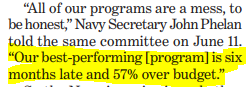
Phelan made remarks to the effect that every Navy program he's looked at is a sheep-show. Over budget, behind schedule, under performing.
I honestly think his assessment is the Navy can't pull off FA-XX currently without it being a debacle.
Phelan seems to favor taking a pause on many programs until the Navy can sort itself out program management wise.
This could also mean Boeing had the strongest proposal for FA-XX but Phelan doesn't believe they have the bandwidth to deliver on two different new fighters concurrently.
Maybe, but given Phelan's lack of experience in defense matters I'm not beyond assuming he's out of his depth and making bad decisions. Visions of another McNamara.Phelan made remarks to the effect that every Navy program he's looked at is a sheep-show. Over budget, behind schedule, under performing.
I honestly think his assessment is the Navy can't pull off FA-XX currently without it being a debacle.
Maybe, but given Phelan's lack of experience in defense matters I'm not beyond assuming he's out of his depth and making bad decisions. Visions of another McNamara.
Maybe he just doesn't understand behind schedule, over budget and under performing is the Navy way!
- Joined
- 3 June 2011
- Messages
- 20,986
- Reaction score
- 19,253
I think its more than budget shortfalls.
Phelan made remarks to the effect that every Navy program he's looked at is a sheep-show. Over budget, behind schedule, under performing.
I honestly think his assessment is the Navy can't pull off FA-XX currently without it being a debacle.
Phelan seems to favor taking a pause on many programs until the Navy can sort itself out program management wise.
This could also mean Boeing had the strongest proposal for FA-XX but Phelan doesn't believe they have the bandwidth to deliver on two different new fighters concurrently.
The winner in this might be Lockheed Martin as they will push for advanced versions of the F35.
- Joined
- 28 January 2008
- Messages
- 1,669
- Reaction score
- 4,262
Oh, I know you were not mocking me, I'm good.Oh, I wasn't mocking you. Just saying I'd like to believe, but it's difficult with all the cancellations, failures, and stretches.
Similar threads
-
 Leonardo TH-73 US Navy Advance Helicopter Training System
- Started by RavenOne
- Replies: 17
-
 USAF/USN 6th Gen Fighters - F/A-XX, F-X, NGAD, PCA, ASFS News & Analysis [2008- 2025]
- Started by Matej
- Replies: 10K
-

-
Northrop Gamma 3 series (U.S. Navy XFT-1 and XFT-2, Gamma 3A)
- Started by Justo Miranda
- Replies: 2
-
