All these highly advanced systems are fascinating, but if terrorists can launch drones from a truck, or hijack an airliner with a cutter, the dome will be of no use.

Only an effective combination of internal hostile population control, orbital sensing, and interception systems can work, and not always and not in all cases.
Every missile defensive network ever, particularly IAMD, relies first and foremost on offensive action to function.
 
But a really good video on why even if space x has made this idea very very hard insted of the impossible it was back in the 80s, the economics still do not make sense, inorder to just gard against north korean missiles you are going to need more missiles in orbit then how many thaad interceptor and sm-3's have been made combined.
Thing is, you can make a really cheap orbital-phase interceptor. All you need is the sensors and minimal fuel to put it in the way, and let closing velocity do all the destruction for you.

And we can make sensors stupid cheap these days. My phone was ~$200 and has at least 4 cameras on it, plus a whole set of accelerometers to make an IMU. There's probably already a target-seeking app written by a Ukrainian, so all you'd need to add to a burner smartphone is the DACS thruster rings.
 
Thing is, you can make a really cheap orbital-phase interceptor. All you need is the sensors and minimal fuel to put it in the way, and let closing velocity do all the destruction for you.
Essentially yes. The trickiest part would be the precise maneuvering system, capable of handling the high angular velocities. Homing itself would be rather trivial; even an analogue of phone camera (IR-capable, of course) would be able to track ICBM flame.
 
What was the old Safeguard radar plan, wasn't it only like 11 radar stations for the entire US? 1 in Alaska, at least 1 in Hawaii and IIRC 2+, and only like 7 in the Lower 48.
Safeguard had seven Perimeter Acquisition Radars in the Lower 48, along with twelve Missile Site Radars. The earlier, more comprehensive, Sentinel plan only had five, plus one in Alaska, and seventeen missile site radars.

The really ambitious Nike-X plans called for many more radars - including a high-performance long-range Multifunction Array Radar - and thousands of missiles.
 
Safeguard had seven Perimeter Acquisition Radars in the Lower 48, along with twelve Missile Site Radars. The earlier, more comprehensive, Sentinel plan only had five, plus one in Alaska, and seventeen missile site radars.
Huh. That's less than I expected.
 
Huh. That's less than I expected.
Safeguard only protected a pretty limited area - really just ICBM fields so didn't need lots of missiles and radars.

Likewise, Sentinel was only quite a thin screen (but over a larger area), so didn't need lots of capacity. Conceptually it was a lot like the current GMD system - only replace 'North Korea' with 'China'. The Spartan didn't have the kinetics of GBI, so 480 missiles in 16 locations were needed to get comparable coverage to 40 missiles in Alaska.
 
Is there anything unclassified that says how many radar sites the Nike-X plans called for?
There are three different plans that I've seen:

1965 plan1966 Posture A1966 Posture B
PAR-66
MAR178
TACMAR-73
MSR1602695
Zeus/Spartan4901,2001,200
Sprint14,1521,1007,300

The 1966 plans are described here, in the report which fundamentally argues they're all a waste of money:

The 1965 plans are described here:

They're really interesting because it's explicitly describing an integrated Continental Air and Missile Defence system. For the largest 47 cities, as well as Nike-X, there's Patriot (SAM-D) to provide terminal defence against bombers and cruise missiles. There's Improved Hawk for 175 smaller cities. There's F-12s and AWACS to deal with bombers and cruise missiles further out. And there's even mention of the importance of ASW - this lot was supposed to be sufficiently effective that the USSR's best weapon would be SLBMs fired against those smaller cities defended only by Improved Hawk. Heady stuff!
 
The 1965 plans are described here:
https://www.esd.whs.mil/Portals/54/Documents/FOID/Reading%20Room/Joint_Staff/jt_strat_plan1970-74_VI.pdf
They're really interesting because it's explicitly describing an integrated Continental Air and Missile Defence system. For the largest 47 cities, as well as Nike-X, there's Patriot (SAM-D) to provide terminal defence against bombers and cruise missiles. There's Improved Hawk for 175 smaller cities. There's F-12s and AWACS to deal with bombers and cruise missiles further out. And there's even mention of the importance of ASW - this lot was supposed to be sufficiently effective that the USSR's best weapon would be SLBMs fired against those smaller cities defended only by Improved Hawk. Heady stuff!

What are the odds that this would've been implemented if that bottomless money-pit known as the Vietnam war had never occurred?

Trump and Musk don't seem to get along anymore...

Clash of the Egos.

So Trump has no reason to use SpaceX to build his Golden Dome...
Nothing to see anymore

I think we'll see it happening as Trump was very impressed in his first term with Israel's Iron Dome (Even though he doesn't appear to properly understand how it works).
 
There are three different plans that I've seen:

1965 plan1966 Posture A1966 Posture B
PAR-66
MAR178
TACMAR-73
MSR1602695
Zeus/Spartan4901,2001,200
Sprint14,1521,1007,300

The 1966 plans are described here, in the report which fundamentally argues they're all a waste of money:

The 1965 plans are described here:

They're really interesting because it's explicitly describing an integrated Continental Air and Missile Defence system. For the largest 47 cities, as well as Nike-X, there's Patriot (SAM-D) to provide terminal defence against bombers and cruise missiles. There's Improved Hawk for 175 smaller cities. There's F-12s and AWACS to deal with bombers and cruise missiles further out. And there's even mention of the importance of ASW - this lot was supposed to be sufficiently effective that the USSR's best weapon would be SLBMs fired against those smaller cities defended only by Improved Hawk. Heady stuff!
So, I'd say that Golden Dome would look like Posture B for a starting point.

6x really big radars. PAR equivalent
~11x big radars. MAR/TACMAR equivalent
many terminal radars, IIRC over 300 needed for (edit) hypersonic defense

~1500x GBIs
~7500x Sprint-class ABMs

Over 3000x Glide Breakers, over 300x sites times 8-12x missiles per site.

THAAD+Patriot around the largest cities (exact number TBD), also around the major power generation locations that are out in the country as well as around various locks and bridges etc.


=================

How does Aegis, or rather SPY6 or SPY7 compare to PAR?
 
Last edited:
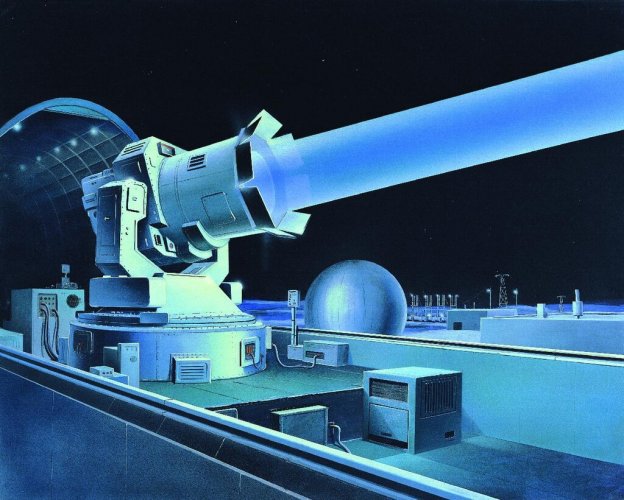
I think only a system based on lasers or particle beams has any hope of being useful. Interceptor missiles will always pose an unfavorable cost-exchange ratio.
 
I think only a system based on lasers or particle beams has any hope of being useful. Interceptor missiles will always pose an unfavorable cost-exchange ratio.

There's no silver bullet. I don't know whether you've read through the entire conversation but the whole proposition (whatever it's been named) has always been based on probabilities and a layered system (technologically speaking, if one really wants to minimize damage in an all out nuclear exchange scenario). This latest iteration is multifaceted still but (again, technologically speaking) tries to leverage newly lower orbital launch costs and scaled satellite constellations in the service of boost phase interception especially.

This is very sensitive to minute changes in adversary booster (and other) variables though. That's why I shuddered a little when you referred to the cost-exchange ratio as that's a very fuzzy metric indeed when it comes to deterrence. Its sustainability is a tenuous proposition at the best of times and with the best of intentions, morals and logic. Systems such as these have sociopolitical implications on a vast scale as wealth transfer and (likely) concentration mechanisms also; thus across decision making perceptions of cost-exchange and self-interest vary greatly to the extent of being mutually incompatible. It would be great if lasers and particle beams could resolve some of these contradictions and sociopolitical risks but am unaware how that currently could be the case. Maybe you can elaborate on that?

Anyway, as I understand it, interceptor missiles' relative favorability is never appraised as a stand-alone capability but is scaled as a function of the whole defense and deterrence system.
 
Has anything concrete been proposed already? If it has, what are its permanent and expendable parts?
 
I lived through Reagan Raygun's strategic defense initiative, and I thought I was serious. Experts say that Russians also believed it, invested too much in something that was not possible and destroyed their economy.
 

Attachments

  • v1-bluffing-in-texas-hold-em.jpeg.jpeg
    v1-bluffing-in-texas-hold-em.jpeg.jpeg
    50.1 KB · Views: 14
  • nnmi.jpg
    nnmi.jpg
    7.8 KB · Views: 8
  • Ground-based-laser-DIA.jpg
    Ground-based-laser-DIA.jpg
    210 KB · Views: 7
Can you expand on this?

Arms Control Wonk did a podcast on it shortly before the announcement of the "Golden Dome" (though I'd like it to be called the "Shield of Damocles"). I guess they knew what was coming. The math involved isn't new as such, it's been well known since previous cold war missile defense projects and available in research papers and associated literature. I did post the podcast on the SDI Brilliant Pebbles thread:

View: https://youtu.be/GyFcSmm_4vc


I'd suggest you just watch it, draw your own conclusions and/or go from there rather than read what I've contributed here. I've posted several messages before on this thread and you can search for those; they're somewhat repetitive and meandering though and not always pertinent to your question.
 
Our ability to stop a nuclear missile is iffy, but we certainly do know how to reduce the impact of nuclear explosions at very low cost: whitewashing windows and not leaving flammable materials out in the open. This would require some advance warning before an attack but it would tremendously reduce the damage from thermal radiation, which would likely be the deadliest effect.

The main problem is people don't want to talk about civil defense
 
I think only a system based on lasers or particle beams has any hope of being useful. Interceptor missiles will always pose an unfavorable cost-exchange ratio.
Lasers have the advantage of having a very cheap cost per kill, but have the largest up-front cost.

Particle beams are only effective in vacuum, so need to be launched into orbit in addition to being expensive to build.

Missiles have the cheapest up-front costs, even if any given missile is $5-10mil or more. Missiles are mobile once built. You can put "missiles" almost anywhere. Including in orbit.

If you put the interceptor from the SM3 into a tracking "shed" to point the missile at the target and could make that entire shed fit into a Starlink rack for launch, well, you'd have about the cheapest launch costs possible.
 
Lasers have the advantage of having a very cheap cost per kill, but have the largest up-front cost.

Particle beams are only effective in vacuum, so need to be launched into orbit in addition to being expensive to build.

Missiles have the cheapest up-front costs, even if any given missile is $5-10mil or more. Missiles are mobile once built. You can put "missiles" almost anywhere. Including in orbit.

If you put the interceptor from the SM3 into a tracking "shed" to point the missile at the target and could make that entire shed fit into a Starlink rack for launch, well, you'd have about the cheapest launch costs possible.
Because directed energy weapons can travel at the speed of light, you need far fewer satellites to ensure global coverage.

You also seem eager to gloss over the high cost of interceptors. It's just not going to work if we need to use $5 million missiles to destroy $100 decoys, the enemy can just add more decoys.

One idea is unguided projectiles launched by railguns. They would essentially be machine guns that would fire off bullets in the hope that one of them hits the warhead.
 
Last edited:
Because directed energy weapons can travel at the speed of light, you need far fewer satellites to ensure global coverage.
Lasers still expand, the beam isn't perfectly parallel.

And when last I ran the numbers for "range at which beam pointing accuracy times spot size exceeded the size of a 1m target"**, lasers only ended up with a range under 2000km for 200nm (pretty deep UV). IR lasers had an even worse range, down around 300-400km IIRC.

** basically the definition of "effective range of a small arm."


You also seem eager to gloss over the high cost of interceptors. It's just not going to work if we need to use $5 million missiles to destroy $100 decoys, the enemy can just add more decoys.
Not really.

Lasers are utterly ineffective until the entire facility is built; power generator, beam generator, and beam pointer.

Missiles are somewhat effective even if you only have a small number of them and their effectiveness increases as you buy more of them.

(I'm assuming that both missiles and lasers will use the same detection gear, so that part of the equation cancels out)


One idea is unguided projectiles launched by railguns. They would essentially be machine guns that would fire off bullets in the hope that one of them hits the warhead.
Where's that video of the cutscene in Mass Effect, two dudes getting dressed down for firing before the computer has locked on... "Sir Isaac Newton is the deadliest sumbitch in the galaxy!"

 
Lasers still expand, the beam isn't perfectly parallel.

And when last I ran the numbers for "range at which beam pointing accuracy times spot size exceeded the size of a 1m target"**, lasers only ended up with a range under 2000km for 200nm (pretty deep UV). IR lasers had an even worse range, down around 300-400km IIRC.

** basically the definition of "effective range of a small arm."


Not really.

Lasers are utterly ineffective until the entire facility is built; power generator, beam generator, and beam pointer.

Missiles are somewhat effective even if you only have a small number of them and their effectiveness increases as you buy more of them.

(I'm assuming that both missiles and lasers will use the same detection gear, so that part of the equation cancels out)


Where's that video of the cutscene in Mass Effect, two dudes getting dressed down for firing before the computer has locked on... "Sir Isaac Newton is the deadliest sumbitch in the galaxy!"
I'm confused, 2000 KM (1200 miles) seems like a pretty good range. Missiles may be able to go a longer distance but they take much longer to reach their targets. Also, they can make lasers with shorter wavelengths. X-ray lasers exist and gamma lasers are being explored.
 
I'm confused, 2000 KM (1200 miles) seems like a pretty good range. Missiles may be able to go a longer distance but they take much longer to reach their targets.
Remember that we're talking range in a 3d situation for ballistic missiles. Say, 1000km apogee times your 1000km cross range. Laser range is now 1400km.


Also, they can make lasers with shorter wavelengths. X-ray lasers exist and gamma lasers are being explored.
They do, but have complicated and/or expensive generation methods. Or just flat use a nuclear bomb as the laser generator.
 
I'm starting to get the feeling that the US Golden Dome will end up with anti-drone missiles and other systems around various critical infrastructure bits as well as the obvious military bases.

Highway and railroad bridges across the various large rivers. Powerplants. Locks.
 
I'm starting to get the feeling that the US Golden Dome will end up with anti-drone missiles and other systems around various critical infrastructure bits as well as the obvious military bases.

Highway and railroad bridges across the various large rivers. Powerplants. Locks.
You don't need missiles to stop drones. You can just use machine guns.
 
How many many 50 cal rounds can you buy for the price of one surface-to-air missile?

You buy a LOT of 0.50" BMG rounds for that but remember all of those rounds fired that don't strike the target WILL come down somewhere and you don't want to be on the receiving end of 0.50" calibre brass-jacketed lead "Rain".
 
Last edited:
You buy a LOT of 0.50" BMG rounds for that but remember all of those rounds fired that don't strike the target WILL come down somewhere and you don't want to be on the receiving end of 0.50" calibre brass-jacketed lead "Rain".

How many 50cal rounds hitting someone's house do you want to pay for?
Cumulatively, the damage from thousands of stray bullets landing under only the force of gravity will be far lower than the debris from one interceptor
Gtn89bqXkAAq9uE.jpeg
 

Similar threads

Back
Top Bottom