Long-range and more payload has been stated many times before to congress arms committee.
Besides this deficit has been pretty much discussed almost right then when the F35 just came into service. People already talked about missileers and having bombers carry them...
> When it comes to Air Mass Flow the smallest CS perpendicular to air flow is taken, not area of angled wedge inlet lip or outermost edges. So imagine a wedge intake like F-14/15/Su-3X with frontal CS as 1x1=1sqm, angled wedge edge area as 3 sqm, then 1x1 sqm matters.
Ofc cross section are always perpendicular who would do it otherwise.
Besides my statements referred to the aircraft section not the intake cross section which I stated and wrote on the image was divided into 33% and 66%.
I thought the benefit of the third stream from adaptive engines was a) higher bypass for cruise efficiency b) power generation c) cooling and for less conventional things like fluidic thrust vectoring or novel control effectors. Given the rumors the first spiral of F-47 won’t have a three stream engine, we probably have to wait some time for the more fully realized version (hopefully not as long as Block 4 F-35!).
The confusion we have is due to people & reporters not understanding what's been said.
The AETD demonstrator engine was projected too bee to big and costly for the F35, hence, was canceled.
If you look at the image https://aviationweek.com/sites/defa...blic/2020-07/df-ngadtech_usairforce_promo.jpgthey modified an existing engine with big pipes and a huge nozzle section.
This modification exceeded any available or alloecateable space on legacy ACs. The additional mechanics for the planned nozzle also required more space and extended further behind the ACs. This would have broken their design center of mass etc.
That's why they said legacy engines won't get a 3rd stream. A complete redesign probably would have worked but it still wouldn't have worked for the new nozzle.
As for NGAP I've no doubt it will have it all and more. So conservatively I would assume a proportional area increase in diameter with thrust increase. Currently that's +20% or 42000 lbf class.
That’s not at all my understanding and I wouldn’t read anything into a non-production rig like that. AETP generated XA100/101 which would fit F-35A and C but not B. Hence the costs extend not only from designing for and implementing a new powerplant, but having to sustain and maintain two different engines for now five distinct flavors of F-35. Hence the ECU and PTM upgrade as being far more budget doable, despite it being more incremental in improvement.
Didn't made the effort to try an alignment with the CGI released so far. This is my own interpretation and rather a mash up of F-22 (nose/caret inlet) and Boeing Model 988-119 (canard/wing/exhaust).
Length: 19,0 m
Wingspan: 16,5 m
Main wing reference area: ~80m²
Solid body volume: ~66 m³
Didn't made the effort to try an alignment with the CGI released so far. This is my own interpretation and rather a mash up of F-22 (nose/caret inlet) and Boeing Model 988-119 (canard/wing/exhaust).
Length: 19,0 m
Wingspan: 16,5 m
Main wing reference area: ~80m²
Solid body volume: ~66 m³
Didn't made the effort to try an alignment with the CGI released so far. This is my own interpretation and rather a mash up of F-22 (nose/caret inlet) and Boeing Model 988-119 (canard/wing/exhaust).
Length: 19,0 m
Wingspan: 16,5 m
Main wing reference area: ~80m²
Solid body volume: ~66 m³
Thrust vectoring, clamshell wingtips and differential elevon/flaperon actuation, all off them working in concert and dependent on actual flight condition.
Thrust vectoring, clamshell wingtips and differential elevon/flaperon actuation, all off them working in concert and dependent on actual flight condition.
I'm rather interested in the general layout and design parameters. For instance fuselage volume consumed by ducts and bays. Most artist impression are indeed focused on visual appearance and do not consider things like that. I always try to work from something existing, e.g. F-22, PW F119, AMRAAM,... to keep things feasible
I'm rather interested in the general layout and design parameters. For instance fuselage volume consumed by ducts and bays. Most artist impression are indeed focused on visual appearance and do not consider things like that. I always try to work from something existing, e.g. F-22, PW F119, AMRAAM,... to keep things feasible
What software did you use? It looks very clean! I factor that into my 3D models, not the simple planes ones, but my sketchup models. I used to be very good at it but learning to get into the test pilot stuff has taken over my time to get in deep on 3d design like that anymore. Here's were some I did of my "NGAD" flat plate vortex model from many moons ago. Modeled and tested in solid works. I think it was in 17-18
What software did you use? It looks very clean! I factor that into my 3D models, not the simple planes ones, but my sketchup models. I used to be very good at it but learning to get into the test pilot stuff has taken over my time to get in deep on 3d design like that anymore. Here's were some I did of my "NGAD" flat plate vortex model from many moons ago. Modeled and tested in solid works. I think it was in 17-18
Didn't made the effort to try an alignment with the CGI released so far. This is my own interpretation and rather a mash up of F-22 (nose/caret inlet) and Boeing Model 988-119 (canard/wing/exhaust).
Length: 19,0 m
Wingspan: 16,5 m
Main wing reference area: ~80m²
Solid body volume: ~66 m³
...
Didn't made the effort to try an alignment with the CGI released so far. This is my own interpretation and rather a mash up of F-22 (nose/caret inlet) and Boeing Model 988-119 (canard/wing/exhaust).
Length: 19,0 m
Wingspan: 16,5 m
Main wing reference area: ~80m²
Solid body volume: ~66 m³
The canards are on the noze in the rendering of the USAF not on the inlets, the wing don't match too it doesn't look to be behind like your rendering and with more dihedral. The nose is square shape and more elongated in the USAF rendering https://www.artstation.com/artwork/WX3V12This design could be very near of the real design.
The canards are on the noze in the rendering of the USAF not on the inlets, the wing don't match too it doesn't look to be behind like your rendering and with more dihedral. The nose is square shape and more elongated in the USAF rendering https://www.artstation.com/artwork/WX3V12This design could be very near of the real design.
Didn't made the effort to try an alignment with the CGI released so far. This is my own interpretation and rather a mash up of F-22 (nose/caret inlet) and Boeing Model 988-119 (canard/wing/exhaust).
Length: 19,0 m
Wingspan: 16,5 m
Main wing reference area: ~80m²
Solid body volume: ~66 m³
Downscaling is no issue in CAD. The issue is printing of thin structures and sharp edges like the wing's leading and trailing edges. For instance, at this scale a radius of 15mm will shrink to 0,1 mm.
More square and flat than the VTOLicious rendering , the canards are near the front , not on the inlets, do you see the inlets on this rendering ? For tthe wing shape it could be but with more dihedral than VTOLicious rendering.
More square and flat than the VTOLicious rendering , the canards are near the front , not on the inlets, do you see the inlets on this rendering ? For tthe wing shape it could be but with more dihedral than VTOLicious rendering. View attachment 770361
No, the issue I meant was that the nose top portion was very flat, while the underside curves up dramatically like it's the bow of a boat. Which is why I asked of it's amphibious. And nothing really indicates that the F-47 is a hognose snake
No, the issue I meant was that the nose top portion was very flat, while the underside curves up dramatically like it's the bow of a boat. Which is why I asked of it's amphibious. And nothing really indicates that the F-47 is a hognose snake
moving away from the renders and on to the specifications I think are relevant to design (for artists) which may be more or less my "wish list" mind you:
engine inlet/intake area 10-20%: intake area ~0.8 m²; engine diameter ~1.1 m
42000 lb class => supercruise increase from 1.9x to ~2.2 for same Cd; my guess 2.35; with afterburner ~2.6
thrust to weight ratio 10.0-12.0
at MTOW wing load 100 lb/sq ft => MTOW 100000 lbs => wing area 1000 sq ft
with 50% internal fuel (combat) wing load 71.43 lb/sq ft
preferable less wing load
chord thickness ~5% or less => <84.5% less fuel (relatively)
2x range and assuming improved fuel consumption 25% => 27000 lb internal fuel
I assume less if flight profiles are considered but no less than 25000 lb
many assume 1500 NM range so the upper end would be 40500 lb
I think that's too much so my bet is no more than 36000 lb
internal ordnance: up to 13400 lb
external ordnance (6 stations): 22000 lb
I assume empty weight will be <33500 lb
MTOW: 95900 - 104900
combat 50% fuel thrust to weight ratio 1.4+ desired
combat weight <<64900 lb => 90860 lb thrust needed
got 1.29 > F22
Downscaling is no issue in CAD. The issue is printing of thin structures and sharp edges like the wing's leading and trailing edges. For instance, at this scale a radius of 15mm will shrink to 0,1 mm.
Totally spitballed that. I meant the trailing edge of the canards. All renditions seem to show it aft swept but I don't think the whitehouse renditions show that.
So after mix matching around and trying other designs with the graphics from before.
It turns out my pet-idea design is the best fit (to the specs & smallest size) except the top mounted intakes are bit too far behind and too close to the gun port. It's bad if fumes get in!
The other two designs I tried are based on the Bird of Prey and ██████ both from Boeing.
Due to their form and intakes their body became bigger ealier which required wings to be pushed back further leading to larger sizes. With some trickery I could cut them down, though. But unlike my pet-idea the forward weapon bay could not be enlarged without breaking their "tighter"/slimmer bottom forebody. They also could only fit two side bays at best or not at all even.
So I merged my pet-idea with the Bird of Prey for best result.
Since the top intakes are now right behind the canopy my pet-idea is splitting them for a smaller cross-section became a moot-point.
The chines are retained for stability, though.
I don't think the canards are needed but having them is nice to have. However, as before their placement isn't ideal; in this case interferring with the wing rather than intakes.
The design does need large control surfaces at the end. In this case I just left the F22's setup. Ofc it's a tailess design so no vertical tails. I imagine the elevator (horizontal tails) could fold up to serve as tails. That would be best. I don't think feathers and X-36 ends are sufficient.
Two additional side weapons bays are possible but I counted them toward internal fuel tanks.
I played around with having the hind wheel go into the wings. But having them right next to the engine (F22) would be best. I just didn't bother here.
Now to the stats:
length: 23.610 m
height: 3.307389 m
wing span: 17.045968 m
wing area : ~133.5 m²/1437 sq ft
internal fuel: 30049 lb (freed space from F22's internal intake ducts not included: ~8493 lb available)
aerodynamic center: ~13.092 m from nose (not precise)
I assume the center of gravity is right behind and very close.
Overall, the design fullfills all the specs I've set out to match. In some cases better than expected. The wing tank capacity was dissapointing low, though.
Since, air launched ballistic missiles has apparently become popular these days I think it's prudent to change the specs for the wing stations a bit. One reason being the F-111 & F-15 that had been used for extra ordinary loads will no longer be available. Future designs will have to take up the slack.
From what I see it seems necessary to raise the load for the inner wing station to at least 7500 lb (see Blue Arrow & anti-satellite weapons).
The outer most 5 & 6 wing station will only have deal with "missiles", preferable the MALD decoys. Best would be a triple rack so they can be launched on mass before entering the combat area, then the pylons would be ejected for a clean stealth profile.
Considering this, I think something more interesting than a simple pair of caret intakes is what's going to be under that duckbill. I think the state of the art has moved on considerably.
Considering this, I think something more interesting than a simple pair of caret intakes is what's going to be under that duckbill. I think the state of the art has moved on considerably.
Or maybe there's something like this, which is part of a Boeing patent:
An intake with a variable DSI.
If it's true, as I read in a publication, that the F47 will be capable of reaching speeds close to Mach 3, an air intake like this would make a lot of sense despite its complexity.
I think that when we see the F47, the evolutionary leap will be considerable. Perhaps even greater than the leap from the fourth to the fifth generation.
Best regards!
Or maybe there's something like this, which is part of a Boeing patent: View attachment 770738
An intake with a variable DSI.
If it's true, as I read in a publication, that the F47 will be capable of reaching speeds close to Mach 3, an air intake like this would make a lot of sense despite its complexity.
I think that when we see the F47, the evolutionary leap will be considerable. Perhaps even greater than the leap from the fourth to the fifth generation.
Best regards!
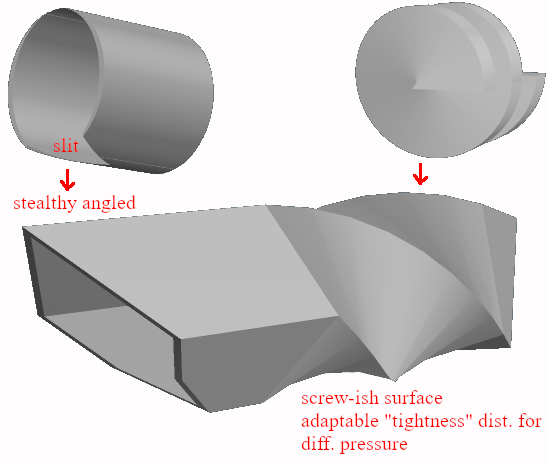
Yes, screwish intake ducts are capable to get an aircraft to hypersonic speeds as seen in Lockheed's patent:
And I think that's what the chinese might have used with their J-50. The reason being the pentagon was not able to push the patent onto the chinese, hence, deny them its use (as with other certain patents).
That said I doubt the F-47 will go Mach 3 because:
1. that's thee mission the SR-72 was made to do
2. the aircraft would need engines in the 50-55k lb class
3. the necessary form isn't suitable for dogfights unless the USAF gives up on this requirement
4. don't forget the cooling!
None-the-less this variable design is certainly the best in shortening the duct length but it uses a lot of space with its wiggling. So I do bet on it, too, albeit not as high as I would like to. There's only so much that can be done without having to use mechnics. Especially with spilling exess air. This is where the slit design comes in. Imho combining both is the way to go. Whelp, we'll see..
I've found an alternative solution for an extra stream:
As you can see it's basically a transmission coupling design similar to the F-35's. It could be a solution for legacy AC or top mounted engines. I doubt it's gonna be used, though.
I also found several Boeing patents with the same solution as my pet idea for the ssplitting up the intake:
This one is for the boundary control:
This one is for countering and nullifying the shockwave:
There's more but these are the most likely ones that could be used.
I know this one has been used on the latest magazine cover print for the European FCAS/GCAP (?).
It looks similar to the F-117 but it's not. It's a cluster of micro ducts shaped like big ones. So this shortens the duct. But it seems the solution could also involve a ramp system for finer tuning.
I've found an alternative solution for an extra stream:
View attachment 770994
As you can see it's basically a transmission coupling design similar to the F-35's. It could be a solution for legacy AC or top mounted engines. I doubt it's gonna be used, though.
I also found several Boeing patents with the same solution as my pet idea for the ssplitting up the intake:
This one is for the boundary control: View attachment 770995
This one is for countering and nullifying the shockwave: View attachment 770996
There's more but these are the most likely ones that could be used.
I know this one has been used on the latest magazine cover print for the European FCAS/GCAP (?). View attachment 770997
It looks similar to the F-117 but it's not. It's a cluster of micro ducts shaped like big ones. So this shortens the duct. But it seems the solution could also involve a ramp system for finer tuning.
This site uses cookies to help personalise content, tailor your experience and to keep you logged in if you register.
By continuing to use this site, you are consenting to our use of cookies.