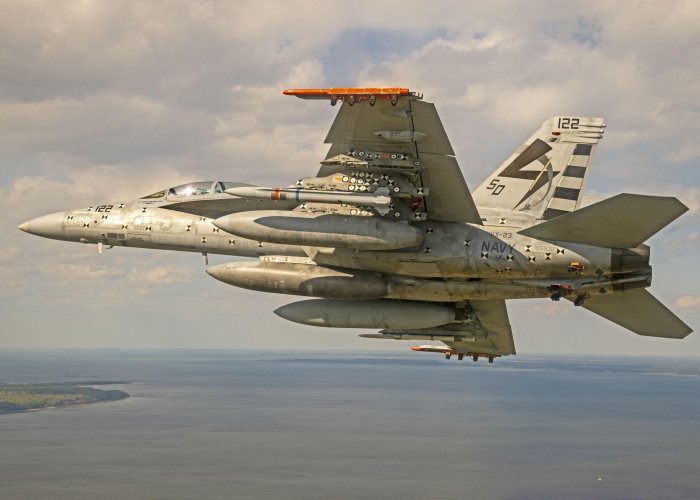
No doubt the USN will attempt to salvage the F/A-18E wreck to stop hostile foreign powers (PRC, Iran or maybe even Russia) from trying to raise would is no doubt a largely intact aircraft to examine its' tech.

While I'm sure neither of these sides would complain about such an opportunity, one has to ask realistically if:

a) is there still a lot to learn for China and Russia from an aging Super Hornet

and

b) if that potential intel is worth trying to salvage the wreckage with an entire US Navy CSG in close proximity

By the time the Truman leaves, significant portions of the aircraft would most likely be unusable. I think the US may raise the wreckage, but not necessarily because they're afraid of intel getting leaked. In the age of cyberwarfare and large scale hacker attacks, I wouldn't be surprised if China and Russia have plenty of digital Intel on various US systems. Same thing the other way around, obviously. Surely the "real deal" is always a bit different, but cost, time and effort have to be taken into account as well.
 
We've been hitting them for months, just blew up a port a few days ago. All it's accomplished it's getting a bunch of reapers shot down, a Rhino in the drink, and using up weapons we could be detering PRC with. But hey at least the President Who Will End All Wars has articulated a coherent strategy about.....well F-ing nothing at all really.

I don't really understand what the point of the US involvement is anyway. If a multi year, Saudi led coalition couldn't root them out, how is an half assed bombing campaign supposed to do that??? Just like the Taliban, the Houthis are most likely here to stay, like it or not. In my eyes the only viable options are diplomacy and funding regional proxies as rivals to undermine and degrade them. Such approaches also wouldn't waste precious munitions, let alone my beloved F/A-18E/Fs.

Obviously there would also be the option of a real invasion, but that would be political suicide for the current US government.

I bet China loves to see all the material getting wasted for nothing in the Red Sea.
 
Two comments with reference to the Chinese and the mission and matériel being used.

If this level of military conflict and use of ordinance emboldens the Chinese to invade Taiwan (or weakens deterrence to the same end) we’re in far worse shape militarily than anyone can even imagine.

The Cold War 2 1/2 war doctrine has become the “fight one small regional terrorist organization and leave the rest of the world to our adversaries doctrine”
 
Realistically a war with China would take up all the U.S. bandwidth except for minor contingencies. I doubt the Red Sea is a serious consideration for the Chinese one way or other, but it does seem to be ineffective and a waste of resources.
 
Last edited:
so they managed to lost 3 F-18s during the operations against Houthis?
1 because of "friendly fire", 1 due to it being unsecured while the carrier was taking evasive manuevers and now this?
I mean come on thats enough help for the Houthis. Anymore and they actualy get close to an good K/D Ratio
 
If this level of operation is risking world wide critical munitions shortages then start learning Mandarin cause it’s over.

Given the assertion that these strikes might enable the "govt of Yemen" to displace the Houthis, the rest of the article is completely non-serious.
 
SEAD mission, not DECM escort with the capability to knock off 1 radar site if needed.

Back in Desert Storm there were strike missions flown with A-6Es and with EA-6B escort jamming - some of the A-6Es carried a HARM in addition to their main ordnance load, while there was also an A-6E or two carrying 4 HARMs.

The all-HARM A-6Es were tasked solely with radar site destruction, while the "bomber" A-6Es used their HARMs on SAM radars near their strike target.

See Angles of Attack: An A-6 Intruder Pilot's War by Peter Hunt for the above actions.

He was piloting one of the strike A-6Es that carried a HARM "for self-defense" - because in the pre-strike briefing he had noticed a SA-2 site near his planned flight path to his target that had not been allocated to one of the SEAD aircraft. He requested, and received, permission to adjust his ordnance to accommodate the missile.

When the SA-2 site launched missiles then "went active" to guide them, he fired the first HARM ever launched from an A-6E in combat - the radar went dead, and never came back on the entire air campaign. ;)
Apparently on opening night of Desert Storm, at one point, they had 200 HARMs in the air at the same time.
 
Ward Carol has a new video out about the latest loss of an F/A-18F Super Hornet:


Carrier Air Wing One aboard the USS Harry S Truman has lost another Super Hornet. Navy officials confirmed that about 9 PM Red Sea time on May 6 an F/A-18F, the two-seat model of the Super Hornet, assigned to VFA-11 The Red Rippers, had what they described as a failed arrestment during nighttime flight operations. The pilot and weapons system officer successfully ejected and suffered only minor injuries. The Super Hornet was lost over the side of the carrier and sunk into the sea.
 
The red sea is also quite a narrow space for a carrier with few opportunity to evade the fight for more relaxed time b/w operations.
 
Last edited:
IMO, given the number of local bases in the gulf, there’s no reason CSGs should be tasked there.

Those bases come with host nation vetos over what kinds of operations can be done from them. That's the point of the pitch line for carriers: "4.5 acres of sovereign US territory."
 
Those bases come with host nation vetos over what kinds of operations can be done from them. That's the point of the pitch line for carriers: "4.5 acres of sovereign US territory."

What military option is the U.S. going to exercise without local cooperation?
 
What military option is the U.S. going to exercise without local cooperation?

There have been several strikes or potential strikes in the region where local allies declined to allow offensive operations from their territory.

To pick two examples at the opposite ends of the GWOT era.


Ok. But was the U.S. capable of those operations just using carriers or long range aircraft operating in international airspace? How realistic is that?
 
Those bases come with host nation vetos over what kinds of operations can be done from them. That's the point of the pitch line for carriers: "4.5 acres of sovereign US territory."

Which country who hosts a US base is sympathetic to the Houthis in Yemen?
 
In the case of the Saudis it's a matter of saving face. Especially if the Americans succeed in putting the Houthis out business after the Saudis spent billions and several thousand troops and failing miserably.
 

Historically have they ever actually stopped a U.S. operation or just gone through the motions? And again, if U.S. aircraft cannot into KSA or Qatari airspace, what exactly is the plan to bomb Iran, or Syria, or whatever?
 
Historically have they ever actually stopped a U.S. operation or just gone through the motions? And again, if U.S. aircraft cannot into KSA or Qatari airspace, what exactly is the plan to bomb Iran, or Syria, or whatever?
To be precise I answered the question which was to identify a country hosting US bases that are sympathetic to the Houthis.

Everything that happens in Qatar happens as a balance. The US have the ability to undertake certain actions but that comes at a cost of supporting Qatar in another area. Nothing in the Middle East is ever free...
 
To be precise I answered the question which was to identify a country hosting US bases that are sympathetic to the Houthis.

Everything that happens in Qatar happens as a balance. The US have the ability to undertake certain actions but that comes at a cost of supporting Qatar in another area. Nothing in the Middle East is ever free...

A use case for a CSG in the Red Sea is a lot easier than one in the Persian gulf, which was the body of water I was discussing.
 
我 am curious about if F/A-18 is supersonic with the load of 4*AIM-174Bs, 4*AIM-120s and 2*sidewinders, but I have a little information to estimate. So who has any idea?
 
OK, not my area at all, but, I thought the reason carrier landings were so hard was the full throtlte into the arrestor approach so they could turn the landing into a touch and go.

Obviously at some stage in the procedure the throttle will be reduced to idle possibly but it certainly looks odd from the footage I have seen.
 
The throttle is pulled back only after the arresting wire slows the aircraft significantly.
 
AARGM. Along with probably mockup Sidewinders, but that pod labeled PAX0037 is new for me...

The wingtip stations have camera pods for filming the store separation test.

The "PAX0037" pod is probably some bit of test equipment as well, with PAXnnnn being an inventory number (PAX for Pax River).
 
Back
Top Bottom