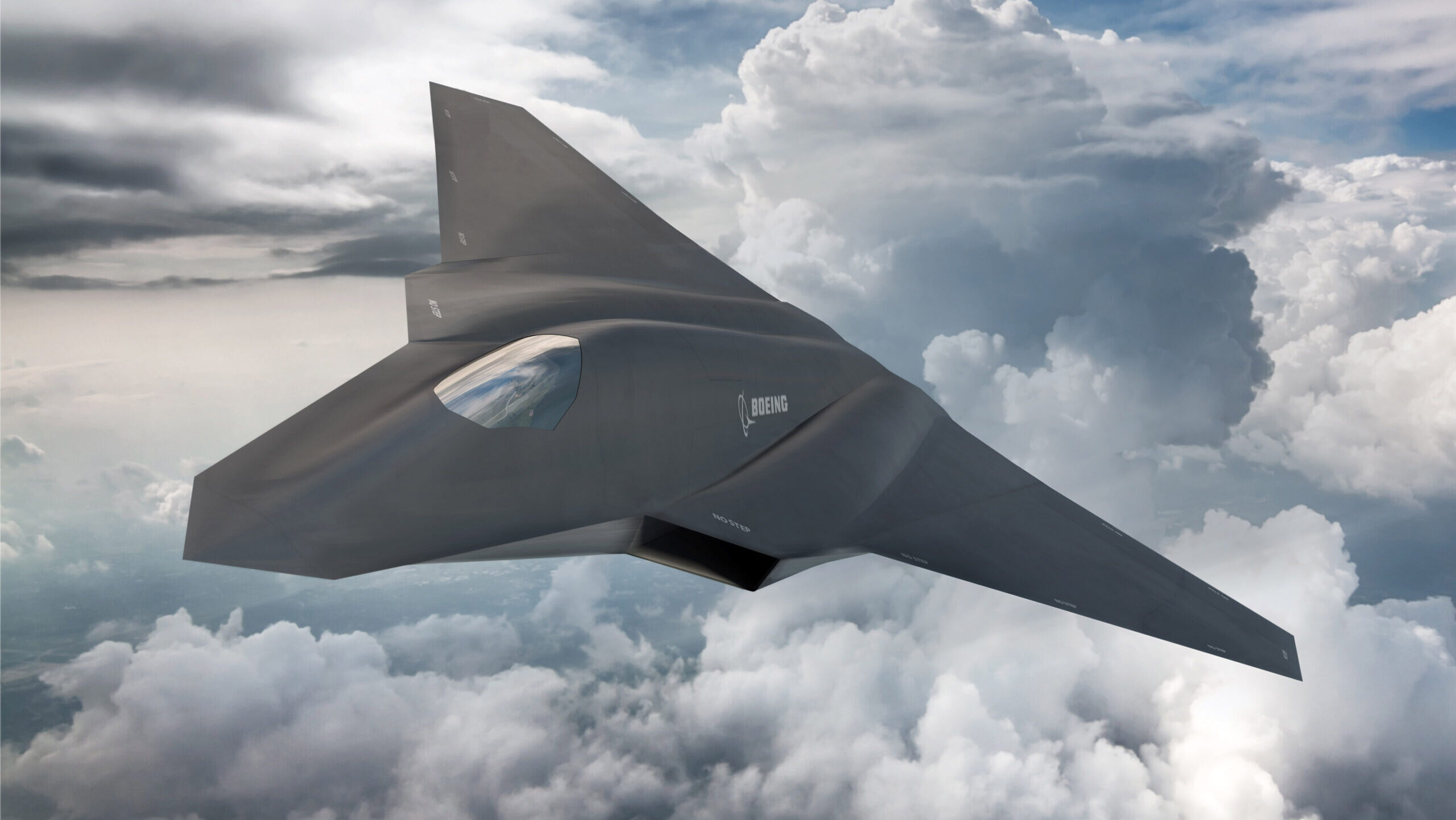
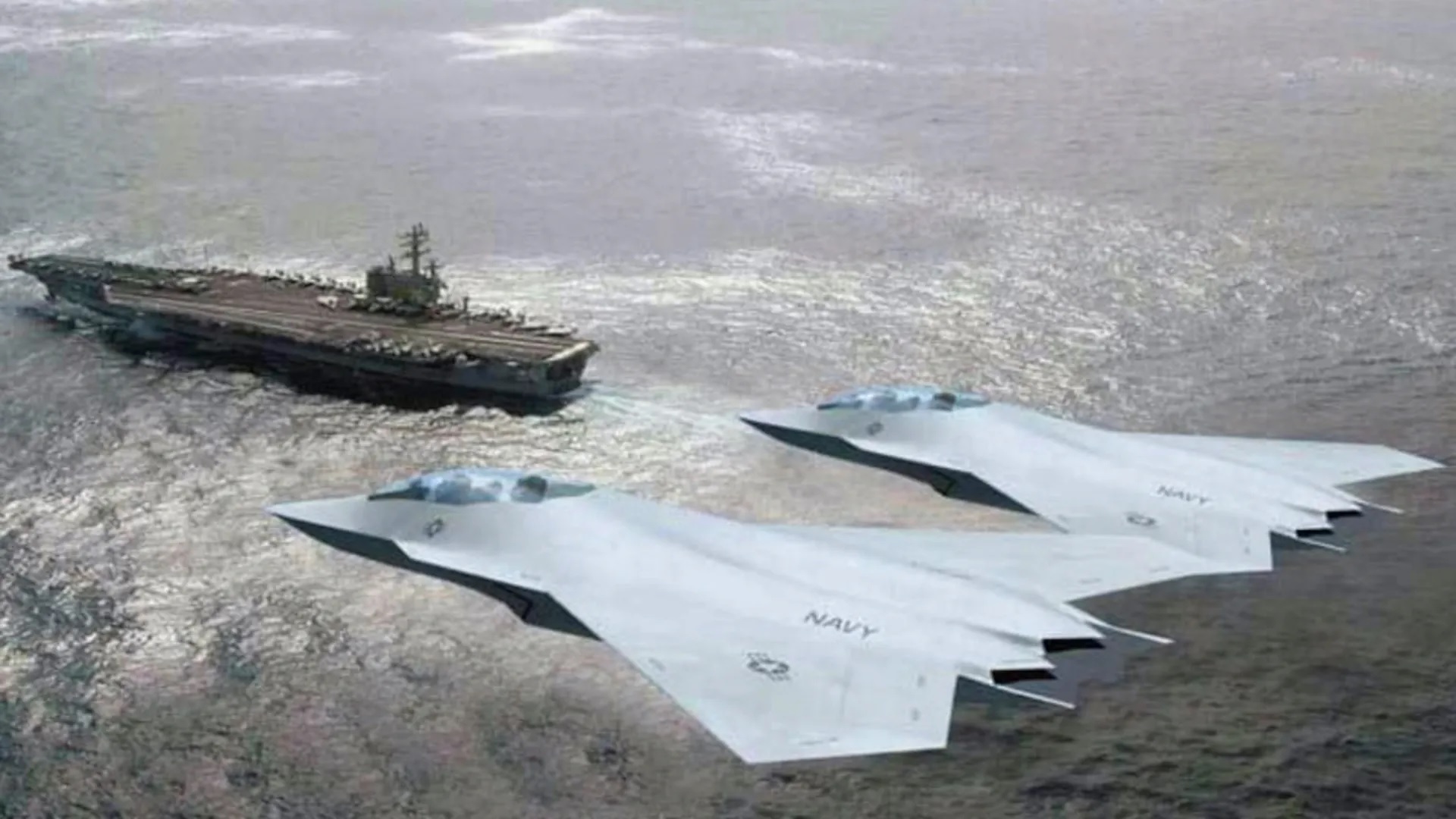
USAF/USN 6th Gen Fighters - F/A-XX, F-X, NGAD, PCA, ASFS News & Analysis [2008- 2025]

Status
Not open for further replies.
Any headline that ends in a question, the answer is automatically "NO".

Assuming that the range requirement of "more range than the F-35" remains in place, that means a larger airframe, and a larger airframe is automatically more expensive.

Or a higher fuel fraction, or more efficient engines.
 
Larger airframe equals higher fuel fraction, and more efficient engines would have to be developed.

Both mean more expensive planes.

NGAP is a program developing a more efficient engine for NGAD and other programs. It also delivers an absurd amount of cooling and electrical power.

High fuel fraction is high fuel fraction. Small aircraft can have high fuel fractions. Large aircraft can have low fuel fractions.

For example, AMBER had a very high fuel fraction.

What makes aircraft expensive is the cost of operating them over their lifetime.
 
It could have been worst: a reverse engineered NGAD flying in China...

Anyhow, I think the tempo is important. By flying them publicly days before the next administration takes office, it is an other push forward for F-35 cancelation (allegedly the 35 being decades old tech).
Any good American will however decipher the message, no matter what their TikTok level are: if Russia and China are both trying to push you in a direction...
 
Don't laugh too much yet, given how 'leaky' the US defence industry seems to have been over the last few years. Just how much of what they have is NGAD or related?
 
Don't laugh too much yet, given how 'leaky' the US defence industry seems to have been over the last few years. Just how much of what they have is NGAD or related?

I'd advise against underestimating China though. There are a lot of people and a lot of educated engineers now... best not to fall into stereotypes.
 
No stereotype required, research and development is so much easier when someone else pays for at least half of it.......

NB, the Rolls Royce engines sent to Russia by Churchill et al.
 

View: https://x.com/AirPowerNEW1/status/1872649383847829940

We want to see concrete instead of rumors.
 
It could have been worst: a reverse engineered NGAD flying in China...

Anyhow, I think the tempo is important. By flying them publicly days before the next administration takes office, it is an other push forward for F-35 cancelation (allegedly the 35 being decades old tech).
Any good American will however decipher the message, no matter what their TikTok level are: if Russia and China are both trying to push you in a direction...

I am not quite sure what the message is, and I think it would be even harder to discern how it might be received, but the PRC regularly makes a show of force when there is a change of administration. The timing is definitely not accidental.
 
It could have been worst: a reverse engineered NGAD flying in China...

Anyhow, I think the tempo is important. By flying them publicly days before the next administration takes office, it is an other push forward for F-35 cancelation (allegedly the 35 being decades old tech).
Any good American will however decipher the message, no matter what their TikTok level are: if Russia and China are both trying to push you in a direction...
If they have time machine, then it's truly hopeless.
Time is on China's side, comrade.
1000011079.jpg

But with Chinese next gen effort, the message is clear.
Soviet union didn't claim anything special with mig-25, it simply shown that it's airpower isn't done after 1967.
Everything else was American own overthinking, which USSR simply let go - for fun purposes.

China, on the other hand, very obviously means it. It's a very direct, Dreadnought-like, challenge.
 
Last edited:
There may not be an answer to this question but typically how far is a program along to be able to “guesstimate or more accurately estimate” an actual per unit cost?

From a probably limited analogy I can guesstimate the cost of finishing my basement but estimate after I’ve done a lot of actual pricing work on electrical, plumbing, framing, etc.

Does the current estimate lend itself to a project further along then we know? Or not relevant to making that determination?
 
Cost estimates require attempting to predict development costs and timelines as well as total production run, etc, even if you actions the program goals and requirements. I think any number anyone came up would be meaningless. We can probably generalize that larger aircraft or more expensive and that more engines increase costs as well.

EDIT: thought I was responding to the PRC 6th Gen thread
 
Last edited:
There may not be an answer to this question but typically how far is a program along to be able to “guesstimate or more accurately estimate” an actual per unit cost?
You'll have a good idea from way before EMD in the concept design phase and also the spread of costs over 10, 50, 90 % probability distribution. But this is dependent on program assumptions which can change during the program. e.g. if the max production rate changes then the unit costs are also going to change from the initial estimate - but you can simply change the assumptions to get out a new estimate.

From the 10, 50, 90 spread then you'll likely end up with a -25% to +50% spread on unit costs, but this uncertainty will shrink during the course of the program.

But you still may end up being in the 99% and seeing horrific cost growth like JWST etc.

The numbers people will be throwing around (like £300m) are likely 50% or median estimates

I think any number anyone came up would be meaningless
As above, anyone can just pluck any number, but there is significant skill and experience in actually producing a meaningful number. But going through and doing this generally creates a lot of value in understanding the program and trade offs in program or technology.
 
Last edited:
Worth remembering that for the LRS-B, the USAF used multiple cost-estimates during evaluation including IIRC an ICE done by CAPE. They used the highest cost estimate for their baseline cost/budget assumptions and appear to be beating it in early LRIP lots.
 
Worth remembering that for the LRS-B, the USAF used multiple cost-estimates during evaluation including IIRC an ICE done by CAPE. They used the highest cost estimate for their baseline cost/budget assumptions and appear to be beating it in early LRIP lots.

CAPE has been engaged extensively on NGAD and F/A-XX.
- Various analysis of alternatives
- Study on wether "Digital Century Series" could work and would be worthwhile
- IIRC study on CCA
 
As above, anyone can just pluck any number, but there is significant skill and experience in actually producing a meaningful number.
NGAD as a program is fairly far along. Seems the price of everything in a large program is likely to creep north, but not given. The $300m figure, as you note, is for a given set of circumstances. A certain number of airframes across a set amount of time. And probably optimistic regarding development hiccups.
 
NGAD as a program is fairly far along. Seems the price of everything in a large program is likely to creep north, but not given. The $300m figure, as you note, is for a given set of circumstances. A certain number of airframes across a set amount of time. And probably optimistic regarding development hiccups.

There is a maturity floor set for programs of this scale to enter EMD. So barring approved last minute changes or programatic disruption most large EMD programs should allow a high fidelity cost estimate to be performed. IIRC, on the B-21, requirement stability was paramount and changes had to be approved by the most senior AF/DOD officials.

On NGAD, there was this talk about IG launching a review to determine whether NGAD was mature for the type of milestone transition they were envisioning this summer. But AFAIK, that review never really occured. Instead we saw a SecAF triggered review by the five person blue ribbon committee. Depending on what course the AF decides to pursue, that IG review could resurface.

 
It's funny. China shows a new strike aircraft that we knew was going to fly soon and everyone starts panicking because they were the ones who weren't paying attention. Although, I did enjoy laughing at all of the fanbois posts on Twitter talking about how it was a hypersonic super duper multi thrust vectored mega fighter that the world could never conceive of.

Anyway, NGAD need not be a large aircraft due to the increased efficiency of the new engines. People just like to assume it will be a large aircraft because the first three stream engines developed were for the F-35 and they are just using two of those to base their guess, and they are guesses, of the fighter's size on. The fuel efficiency of the three stream engine paired with the maneuvering requirement and the required internal load of the manned piece of the NGAD system will determine it's size and none of us here know what that is. However, I wouldn't expect it to be much larger than an F-22, unless it is required to carry a much larger internal payload. IIRC, the AIM-260 is supposed to fit within the AMRAAM's foot print, so I wouldn't expect more than six of those and two AIM-9X's. Is Cuda still a thing? But we have yet to hear what the review decided in terms of requirements and we probably won't have an idea of what those are until the first one rolls out.

What I want to know about is the F/A-XX, since down select for it will be happening relatively soon. I know it's in 2025 but has anyone heard which quarter within which that will occur?
 
What I want to know about is the F/A-XX, since down select for it will be happening relatively soon. I know it's in 2025 but has anyone heard which quarter within which that will occur?
Based on this,
According to Donnelly, the F/A-XX program is on track for the Milestone B decision to move the Engineering and Manufacturing Development (EMD) phase by the end of fiscal year 2025.

but money is still short,
In the Navy’s case, the 2025 budget for the new aircraft suffered a cut of 67%, with the $10.3 billion requested between 2025 and 2028 reduced to just $3.3 billion. The senate voted to restore $450 million to the budget but, even if approved, there would still a cut of 59% compared with last year’s budget.
same link as above.

At this point even if a decision is made it looks like there won't be a lot of funding available to progress forward. The USN is talking about "sometime in the 2030s" now for F/A-XX so it is also murky as to when it will actually arrive and the funding profile doesn't look great for it to be early 2030s.
 
Based on this,


but money is still short,

same link as above.

At this point even if a decision is made it looks like there won't be a lot of funding available to progress forward. The USN is talking about "sometime in the 2030s" now for F/A-XX so it is also murky as to when it will actually arrive and the funding profile doesn't look great for it to be early 2030s.
There is a hurry now , there is no time to wait Chinese 6th gen are flying.
 
I'd advise against underestimating China though. There are a lot of people and a lot of educated engineers now... best not to fall into stereotypes.
China's issue is the lack of a Quality Assurance/Quality Control culture. They figure that out, the US is fucked.


Anyway, NGAD need not be a large aircraft due to the increased efficiency of the new engines. People just like to assume it will be a large aircraft because the first three stream engines developed were for the F-35 and they are just using two of those to base their guess, and they are guesses, of the fighter's size on. The fuel efficiency of the three stream engine paired with the maneuvering requirement and the required internal load of the manned piece of the NGAD system will determine it's size and none of us here know what that is. However, I wouldn't expect it to be much larger than an F-22, unless it is required to carry a much larger internal payload. IIRC, the AIM-260 is supposed to fit within the AMRAAM's foot print, so I wouldn't expect more than six of those and two AIM-9X's. Is Cuda still a thing? But we have yet to hear what the review decided in terms of requirements and we probably won't have an idea of what those are until the first one rolls out.
Assuming that those 3-stream engines are 25% more fuel efficient than F119s, that still won't get an F22 sized aircraft to a 3000nmi combat range/1000-1200nmi combat radius.
 
Assuming that those 3-stream engines are 25% more fuel efficient than F119s, that still won't get an F22 sized aircraft to a 3000nmi combat range/1000-1200nmi combat radius.
F-22 is just designed with such range.
More could be done just by specifying more and going for a different design.

Like, Su-57 (f-22 sized aircraft) hits all those metrics on 117 engines, which aren't exactly cutting edge.

China's issue is the lack of a Quality Assurance/Quality Control culture. They figure that out, the US is fucked.
Everywhere (Japan, Korea, ROC, PRC) this was just a function of going up market, and subsequent laborious job to remove all mistakes.

US may give a distorted picture(protected market), but there's reason premium Chinese gadgets up to cars take over rest of the world.
They don't break any more than best competition anymore.
And combat planes are turning into another gadgets, fast.
 
Assuming that those 3-stream engines are 25% more fuel efficient than F119s, that still won't get an F22 sized aircraft to a 3000nmi combat range/1000-1200nmi combat radius.
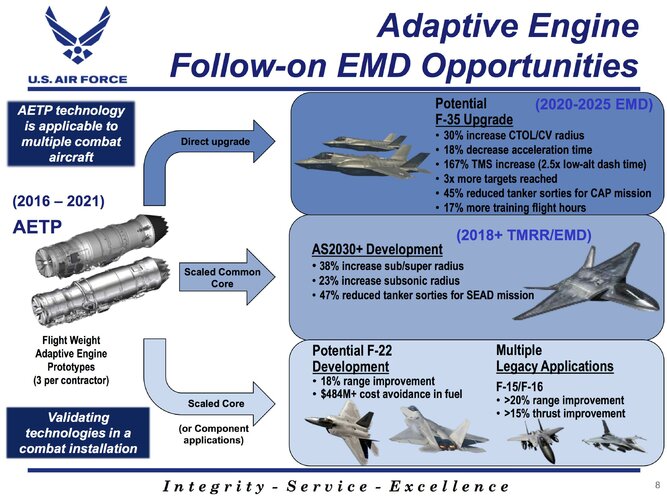
NGAP engines (XA102 and XA103) can stand to gain quite a bit over the F119. An AFRL slide deck in 2018 alluded to as much. When you combine that with a substantially higher fuel fraction by relaxing certain parameters that are less relevant, you can get significant increases in range.
 

Attachments

  • IMG_1261.jpeg
    IMG_1261.jpeg
    561.7 KB · Views: 156
NGAP engines (XA102 and XA103) can stand to gain quite a bit over the F119. An AFRL slide deck in 2018 alluded to as much. When you combine that with a substantially higher fuel fraction by relaxing certain parameters that are less relevant, you can get significant increases in range.
That says 18% over F119. Nice, and a significant improvement.

But I repeat, even a 25% increase in efficiency over the F119 will not give the range they're talking about in an F-22 sized airframe.
 
That says 18% over F119. Nice, and a significant improvement.
18% over the F119 when used within the F-22. F-35A/C is a 30% increase likely because the airframe can better use the third stream.
But I repeat, even a 25% increase in efficiency over the F119 will not give the range they're talking about in an F-22 sized airframe.
You would expect an airframe designed around the AETP would see at least a 25% improvement over existing platforms and I expect likely closer to 40% for some mission profiles.

Edit: the key though is combining with CCA and NGAS to enhance not only the range but the persistence. CCA would provide magazine depth and NGAS the additional persistence for both platforms. 6th gen gets full integrated AI so the pilot can operate for longer due to less taxing mentally or even pass to AI control for portions so the pilot can rest.
 
Last edited:
That says 18% over F119. Nice, and a significant improvement.

But I repeat, even a 25% increase in efficiency over the F119 will not give the range they're talking about in an F-22 sized airframe.

If you optimized the airframe for range at cruise at the cost of maneuverability, why not? Trade offs in acceleration also could be made.
 
If you optimized the airframe for range at cruise at the cost of maneuverability, why not? Trade offs in acceleration also could be made.
There are several compromises that can improve range dramatically. F-101B managed to squeeze in more total fuel for less efficient engines, an internal bay, SAGE equipment, and still boasted about twice the combat range in comparison to the larger, heavier Phantom.
 
It is important to question narratives but what I see in here is that some people are turning to coping by making somewhat indirect racist arguments.


Alleged sixth-generation aircraft;):D.
What are the de facto expected capabilities of 6th gen fighters?

  • Increased size and thus space for installation of future-avionic upgrades
  • Larger/more spacious weapons bay(s)
  • VCE/ACE Engines
  • Much more fuel for longer range/patrol time
  • Increased computation power, cooling and power generation for DEW and much more powerful sensors
  • Enhanced sensors
  • Ability to command Loyal Wingmen/CCAs
  • All-aspect broadband Low Observability

and so on...

Since we're talking about CAC's aircraft; way I see it, the J-36 design fulfills all of these requirements perfectly.

So why say "its not 6th gen bc its Chinese!" when the American side even claims the B-21 bomber to be "6th gen"?

Moreover, this jet identically follows J-20's development path; so as "36011", it is much more mature in it's development than what people make it out to be.

The concept of generations itself is originally a marketing play developed by American manufacturers, yes; but this underestimating and slandering your rival's efforts is a big NO NO in my book.

------

The copious amount of similar arguments that I've seen online in the last couple of days is quite worrying.


So let's all try to keep up the quality of this thread...

This is not directed towards you, by the way @NMaude
 
Last edited:
Status
Not open for further replies.

Similar threads

Back
Top Bottom