Falcon-Armed F-86Ds

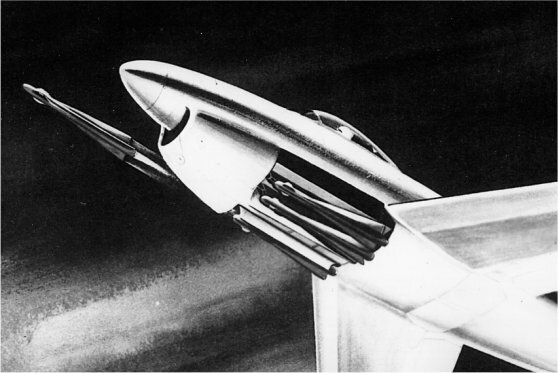
As early as November 1950, North American Aviation (NAA) had proposed its “Advanced F-86D Transonic Interceptor” to USAF Air Materiel Command. Among its features, the Advanced F-86D would incorporate a low-mounted horizontal tailplane; a 45-degree swept wing, ‘Coke bottle’ area-ruled fuselage and inboard ailerons. Powerplants ranged from the ‘ultimate J47’ to Pratt & Whitney’s J57. Armament was to be a combination of up to 60, 2.75-inch FFAR rockets (and no other armament) or four MX-904 missiles and 36 FFAR rockets. The proposed aircraft would, according to NAA’s proposal, complete its first flight in early 1952 and be ready for service the following year.

It is likely that a routine line of communication was established between the AMC and its contractor for discussion of this topic, though no budget appears to have been put in place for further development under Air Force funding at that time.

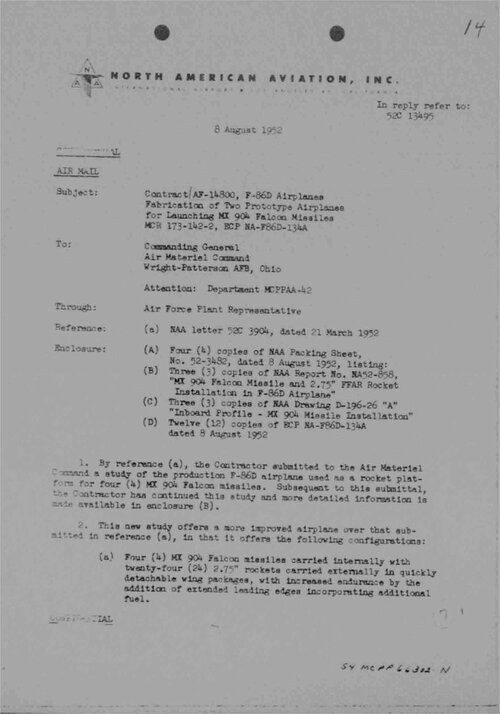
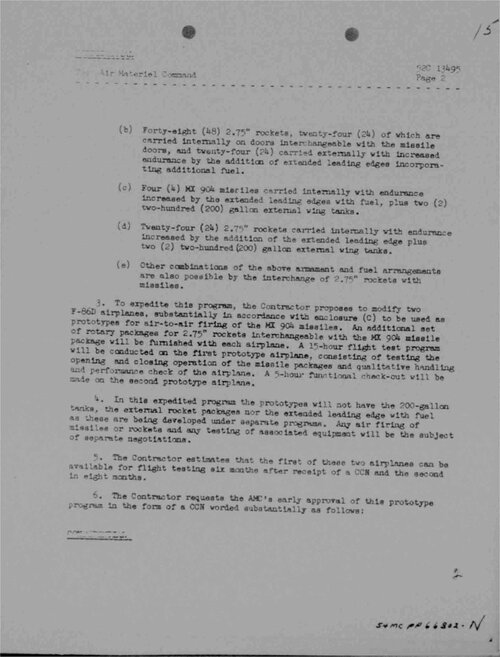
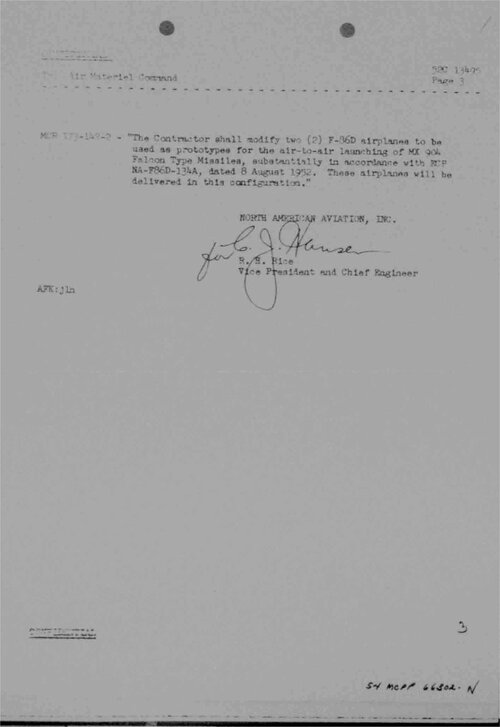
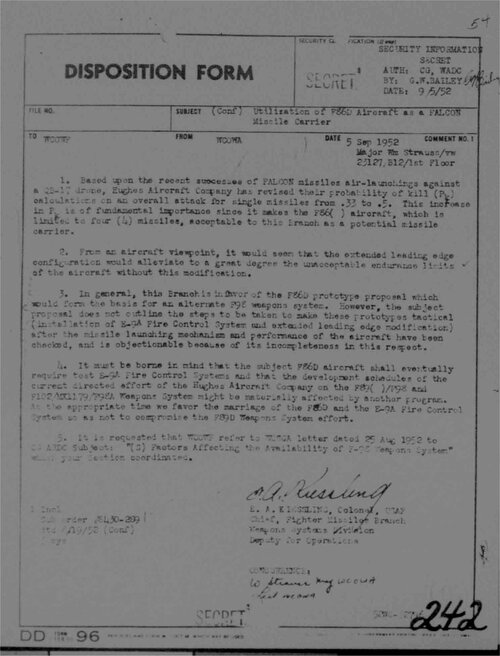
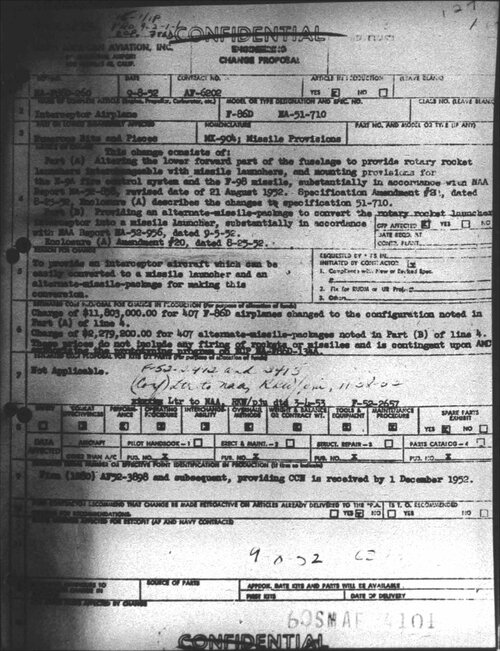
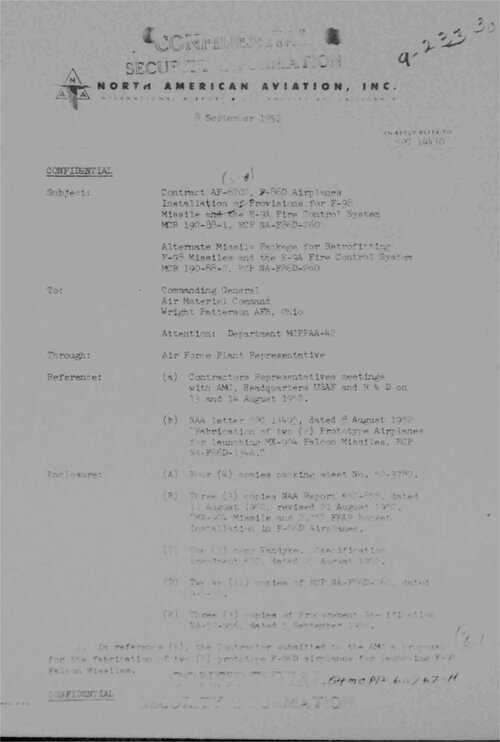
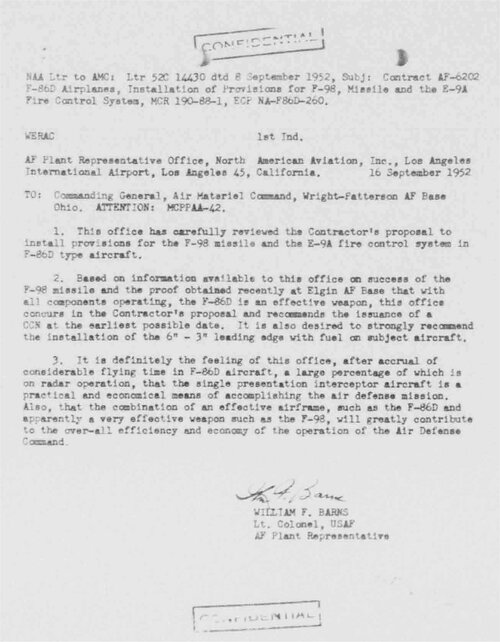
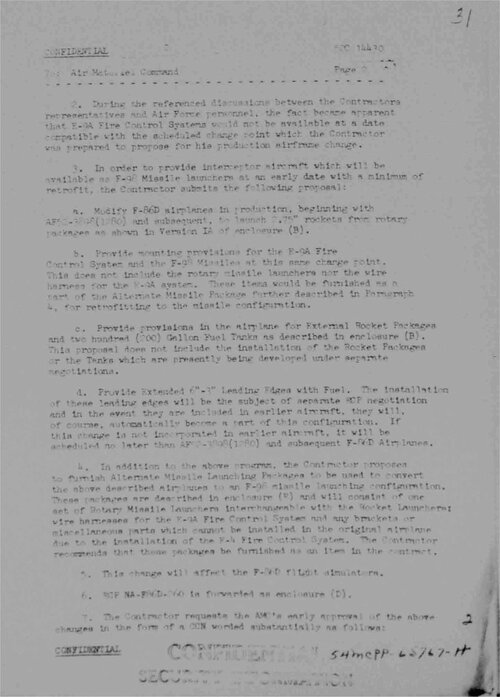
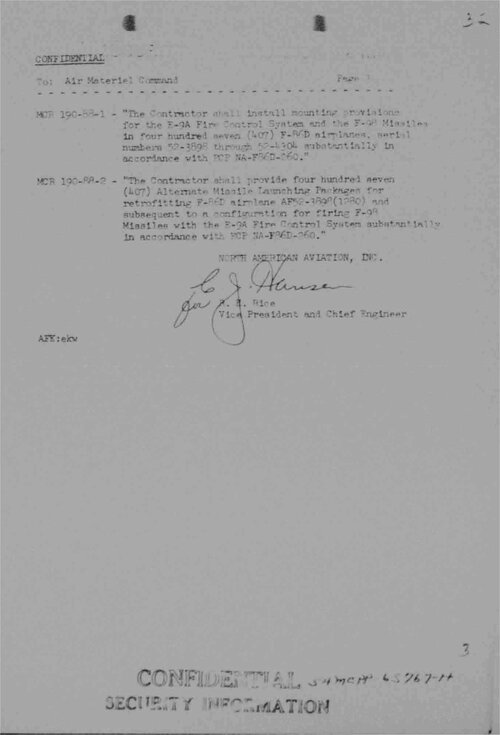
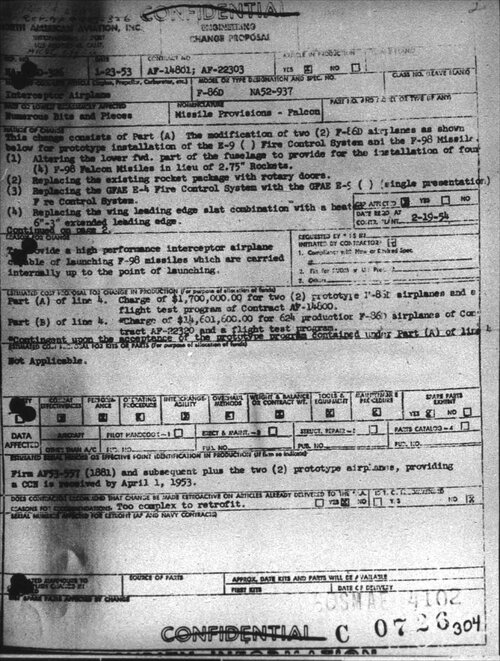
Then in March 1952, NAA submitted a further study to AMC, which it continued to refine until August of that year when a less radical proposal for “MX-904 Falcon Missile and 2.75” FFAR Rocket Installation in F-86D Airplane” was proffered. This proposal was for a new-production version of the F-86D with four Falcon missiles replacing the internal Mighty Mouse complement of the standard F-86D and up to 24 of the unguided rockets now in wing packages or various other combinations. An extended ‘wet’ wing leading edge was also proposed, which would carry fuel and offset deletion of external drop tanks. A Hughes E-9A fire control system was a key component of the new F-86D proposal.

NAA proposed the conversion of two existing F-86Ds to test the Falcon installation, though modification of existing F-86Ds for the full (service use) configuration was deemed to be too complex to be worthwhile when ranged against new-build machines. North American suggested that if accepted, the revised configuration could be introduced on F-86D s/n 52-3898 (the first F-86D-45), providing agreement had been reached by 1 December 1952; a revised Engineering Change Proposal was prepared on 23 January 1953, this time proposing to introduce the configuration as a production fit from F-86D-55 s/n 53-557 so long as a contractual note had been received by 1 April 1953.

Ultimately no contract for prototype or production aircraft was set up, undoubtedly because funding was thought to be better spent on dedicated Century-series Falcon-equipped machines as well as similarly armed F-89H Scorpions in the interim.

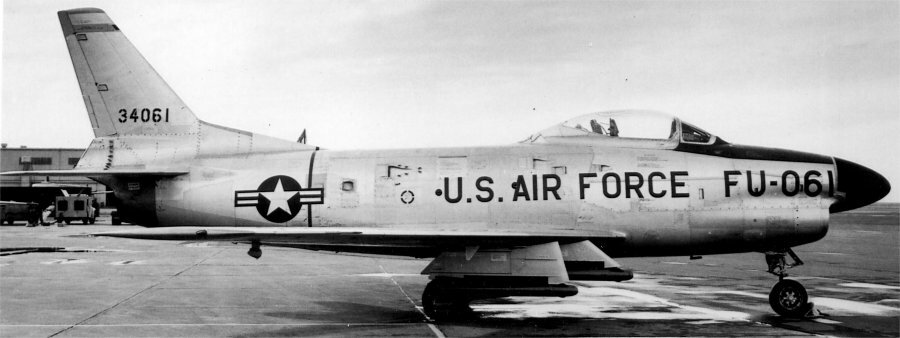
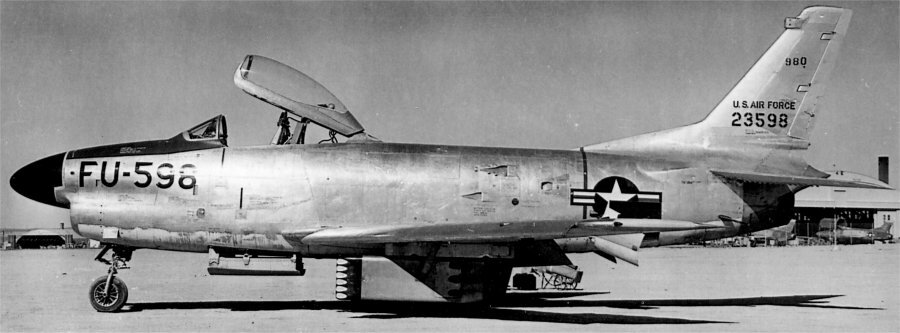
NAA did however test the external Mighty Mouse rocket packages on s/n 52-3598 (the first F-86D-40 airframe) and the Falcons (externally) on F-86D-60 s/n 53-4061, the latter with the extended-chord wing later installed on F-86L interceptors.
 

Attachments

  • 520808a Falcon.jpg
    520808a Falcon.jpg
    268.5 KB · Views: 415
  • 520808b Falcon.jpg
    520808b Falcon.jpg
    343.9 KB · Views: 163
  • 520808c Falcon.jpg
    520808c Falcon.jpg
    154.1 KB · Views: 130
  • 520905 Falcon.jpg
    520905 Falcon.jpg
    259.7 KB · Views: 128
  • 520908 Falcon.jpg
    520908 Falcon.jpg
    778.8 KB · Views: 119
  • 520908b Falcon.jpg
    520908b Falcon.jpg
    201.8 KB · Views: 114
  • 520908a Falcon.jpg
    520908a Falcon.jpg
    207.9 KB · Views: 120
  • 520908c Falcon.jpg
    520908c Falcon.jpg
    292 KB · Views: 109
  • 520908d Falcon.jpg
    520908d Falcon.jpg
    170.4 KB · Views: 126
  • 530123 Falcon.jpg
    530123 Falcon.jpg
    560.1 KB · Views: 331
  • Falcon (3).jpg
    Falcon (3).jpg
    51.8 KB · Views: 489
  • Falcon (2).jpg
    Falcon (2).jpg
    57.3 KB · Views: 389
  • Falcon.jpg
    Falcon.jpg
    40.2 KB · Views: 478
Last edited:
After this incident were gunsights restored to the F-89s?
If I recall correctly, no. At this time F-89D were already refitted to F-89J standard - with AIR-2 Genie rockets - and nuclear air-to-air rocket isn't exactly the kind of weapon, for which gun sight may be of any use. The F-89H model, that was armed with both FFAR rockets and Falcon missiles have a more advanced E-9 fire control system, that did not have problems with maneuvering targets.
 
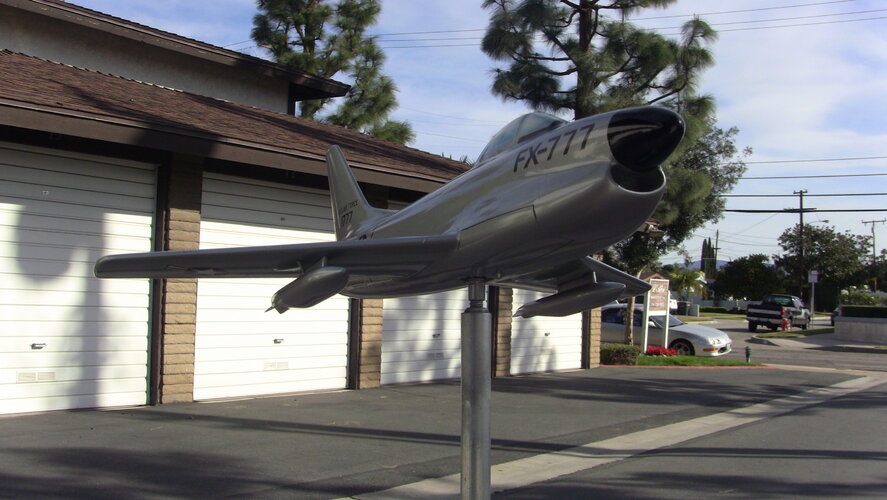
Feast your peepers on this factory model....... and yes Virginia, pigs can fly!
Very cool!!!

And mounting the Falcons on the door then simply rotating the whole door... hrm... Not sure about that, I think it takes up more volume than simply opening doors like with the Comanche.
 
And mounting the Falcons on the door then simply rotating the whole door... hrm... Not sure about that, I think it takes up more volume than simply opening doors like with the Comanche

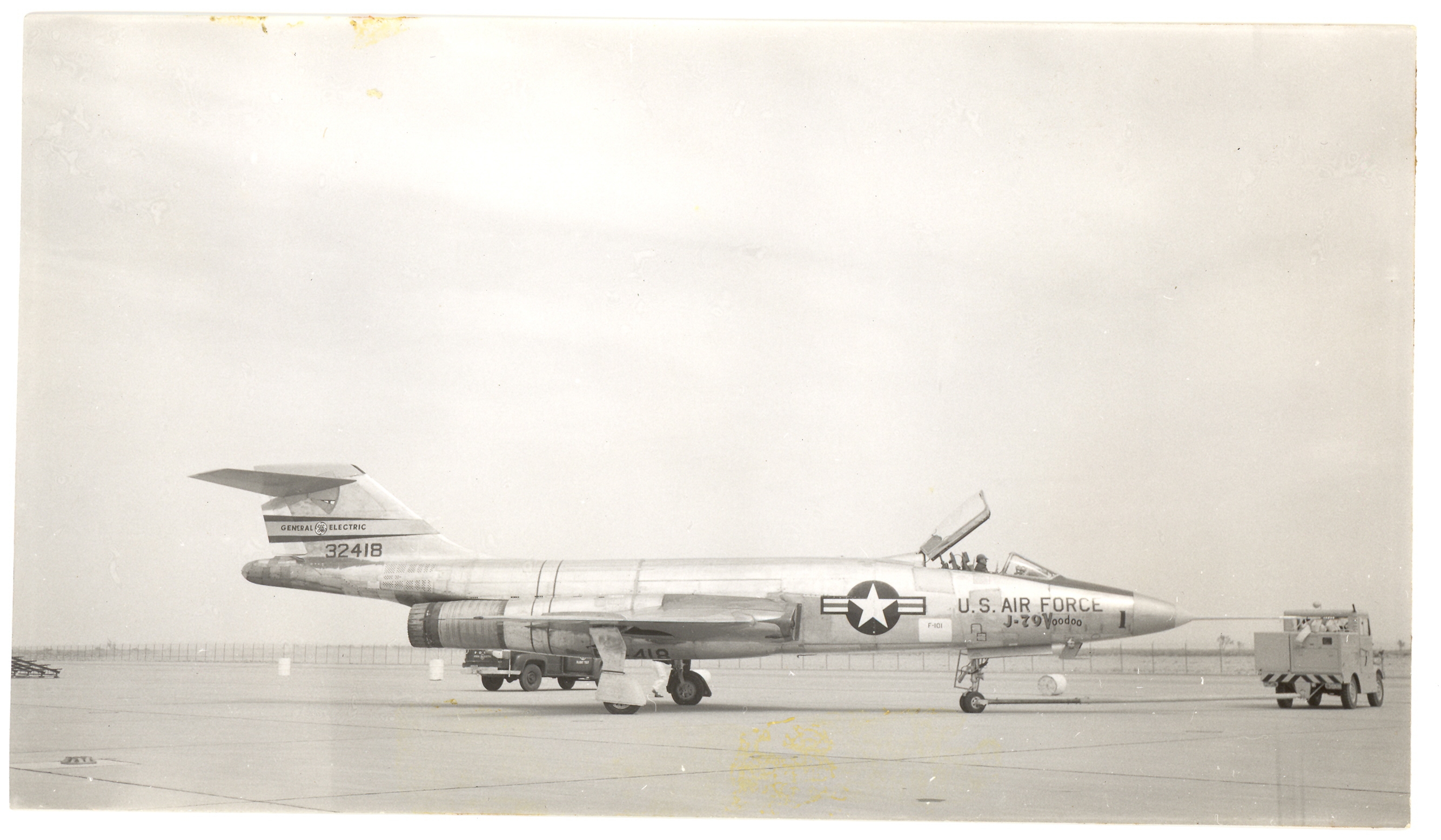
What about an F-101B voodoo interceptor style revolving door launcher?
 
It is an elegant design but it's a pity it wasn't equipped with J79s.
One was:

4499258214_015b7924b6_o.jpg
 
They should have made a bigger one of these. Twin-engine, two-crew, and a big radar in front. Might have scratched an itch for the Navy, and if it worked well-enough, maybe they could have eventually talked the air force into it. Might have even replaced the Lightning in RN/RAF service if they never got their acts together. Could have defined a generation.
 
They should have made a bigger one of these. Twin-engine, two-crew, and a big radar in front. Might have scratched an itch for the Navy, and if it worked well-enough, maybe they could have eventually talked the air force into it. Might have even replaced the Lightning in RN/RAF service if they never got their acts together. Could have defined a generation.
They did, it was called the F-4 Phantom. And it DID define a generation!
 
Now what would've been interesting is if the USAF had developed an improved version of the F-86D (Call it the F-86M) which carried four or maybe six AIM-4s launched from a detachable Avro Arrow style weapons bay.
 
Fantastic! I've been trying to track down info on the six shot / all Falcon configuration for quite a few years. I had been able to track down some low-detail drawings and a single photo, possibly of a mockup.
It appears that the six-Falcon pallet was no longer available after 1961. The Genie capability precluded the three-Falcon arrangement on one side so a whole new pallet was fielded. Two AIR-2 on one side, two AIM-4D on the other.
 
Not exactly. The rockets were fine - the E-6 fire control system was not designed to dealt with small circling target (because strategic bombers kinda not do that). The radar could not get a lock, so computer could not work out automated firing solution. The pilots were forced to fire rockets on manual control, and since they did not even have standard gun sights for that (they were removed, because viewed as redundant) they utterly failed.
More importantly, in the aircraft involved the E-6 failed to work and the pilots were reduced to trying to aim by Mk I eyeball.
 
More importantly, in the aircraft involved the E-6 failed to work and the pilots were reduced to trying to aim by Mk I eyeball.
IRRC it failed exactly because radar could not maintain lock on small circling target, and E-6 computer could not get proper data. To work properly, E-6 required range data, that could not be obtained by manual means. Since radar could not lock on drone, there weren't range data for E-6 to work.
 
IRRC it failed exactly because radar could not maintain lock on small circling target, and E-6 computer could not get proper data. To work properly, E-6 required range data, that could not be obtained by manual means. Since radar could not lock on drone, there weren't range data for E-6 to work.
The E-6 actually failed to work in automatic. The system had a design flaw that prevented it from actually working in automatic. Somewhere I have a lengthy AF paper on these systems and their design and problems. Hughes was continually pressed by the AF to make improvements to this fire control series and many of the ones in the middle were riddled with bugs and reliability problems. These were often--I can't remember off hand if the E-6 was one of these but it likely was--just upgraded older systems usually from the E-4.

Interestingly, the pilots did report actually hitting the target with at least one and possibly several rockets that struck at such an oblique angle they skidded off and failed to detonate.
 
Good for speculative cutaway drawing

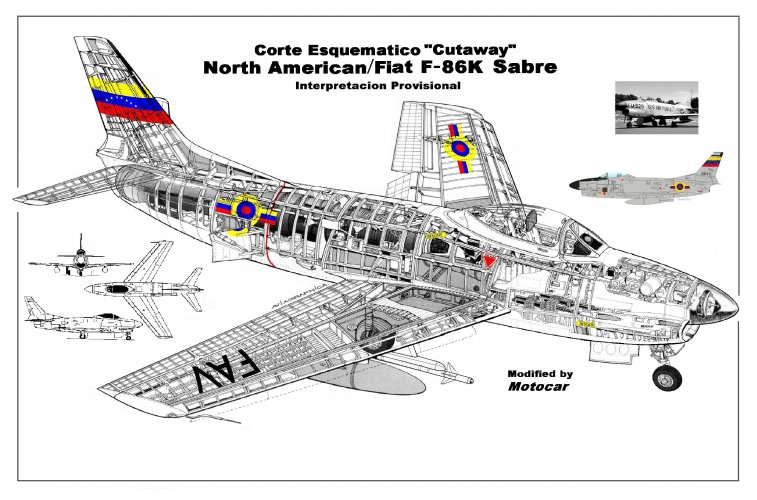
Repost Cutaway North American F-86K, modified by Motocar
 

Attachments

  • 25d5f5635229db36ab3aa4817bbce58a.jpg
    25d5f5635229db36ab3aa4817bbce58a.jpg
    788.9 KB · Views: 87
Work in progress...!

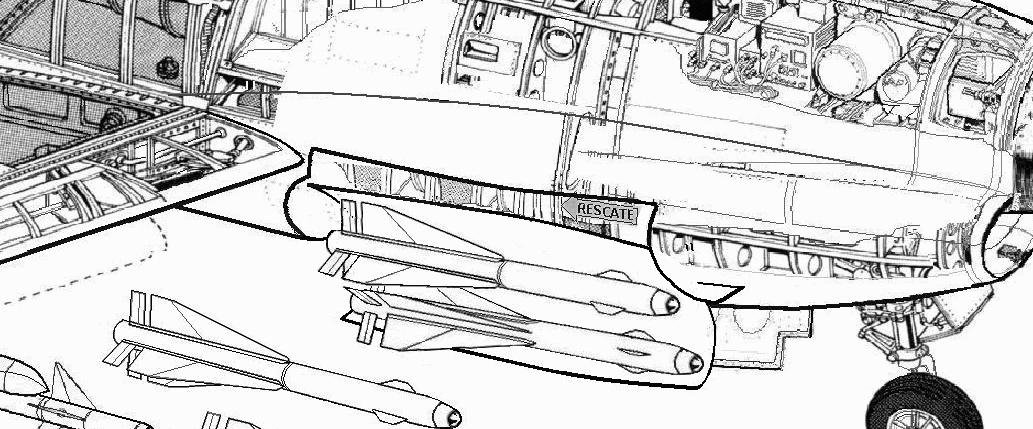
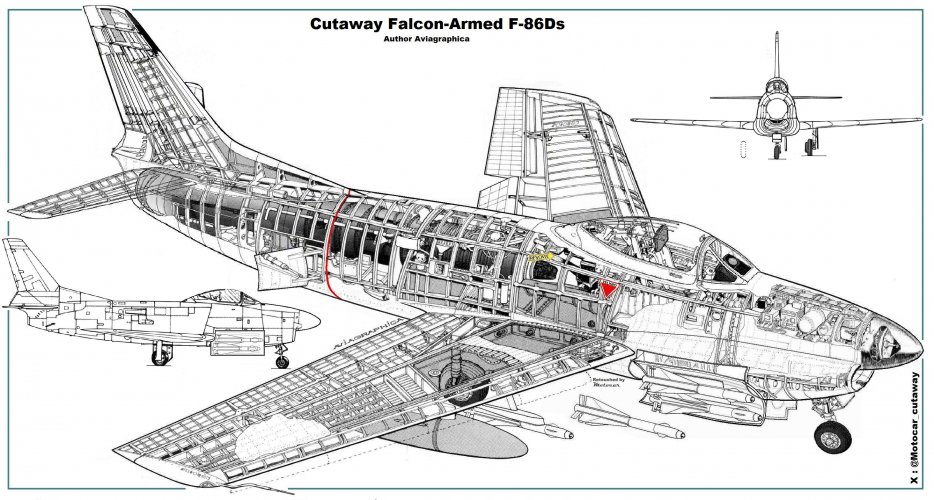
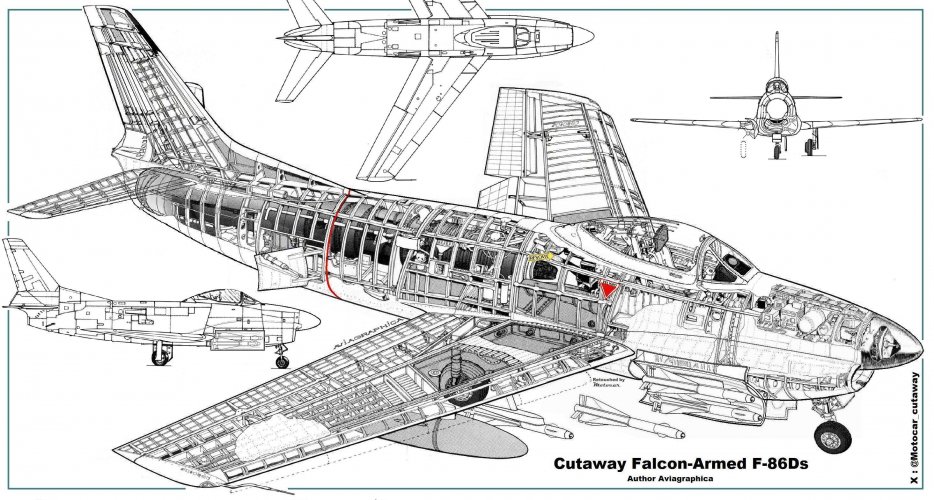
Ready Cutaway North American F-86D Falcon armed speculative drawing
 

Attachments

  • Work in progress.jpg
    Work in progress.jpg
    121.3 KB · Views: 48
  • Cutaway F-86D Falcon Missile.JPG
    Cutaway F-86D Falcon Missile.JPG
    804.7 KB · Views: 52
Last edited:
I wonder what the outcome of that test-programme was?

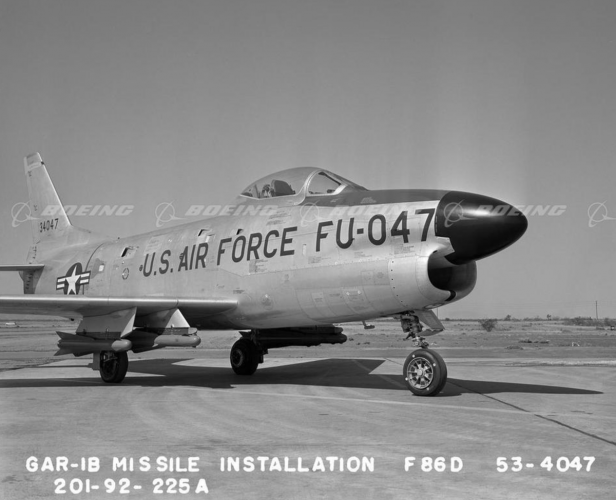
Driven by an HQ ARDC GAR-1B Feasibility Study of 24 May 1955, firings of unguided Falcon missiles were carried out in July of the same year aboard a basic test F-86D. These firings, singly and in salvoes of two, showed great promise but a more detailed and operationally representative installation would be required to fully understand the capabilities of this weapon/aircraft combination.

Now encompassing the Sidewinder missile, the US Air Force initiated a project known as “All Weather Interceptor Weapon System, F-86D/L 206A”, approved in October 1955 and aimed at incorporating an additional armament capability consisting of guided aircraft rockets equipped with infra-red seekers. Its purpose was to provide concurrent prototype installations of both GAR-1B and Sidewinder on separate F-86D aircraft in order to select by test and/or study the best missile installation from a technical, operational and logistic viewpoint. Its objectives were to provide:
  • Day/visual firing capability
  • Night/visual firing capability
  • Non-visual, day or night firing capability in clear air masses.

Both systems would complement the existing Mighty Mouse rocket armament with a minimum of change and degradation to the aircraft being stipulated. The project required that two aircraft be modified to test each system but in the event three F-86Ds were used in the GAR-1B project, two F-86D-31s (51-5973 and 51-6009) and an F-86D-60 (53-4061). Aircraft 51-6009 was nominated as a Hughes development flight test aircraft while the other two were allocated as “Air Force Evaluation” airframes. Modification was performed by North American Aviation, after which structural demonstrations were completed and Phase IV performance testing accomplished at the Edwards AFB Air Force Flight Test Center. Aside from the NAA-derived airframe modifications, the Hughes Aircraft Company at Culver City would supply the Fighter Missile System electronics portion, aircraft 51-6009 being fully equipped first, initially with a pre-production version of the FMS. Hughes delivered the first ‘production’ FMS to Inglewood (for installation in s/n 53-4061) on 24 August 1956 and the second set of equipment for s/n 51-5973 was supplied at the beginning of November.

For reasons unknown, F-86D s/n 51-5973 was not eventually included in the Eglin evaluation, instead completing the AFFTC Phase IV test from April 1956 (minus FMS) and was then sent back to Inglewood on a bailment test contract. In its place the ‘Hughes’ development aircraft was deployed to Eglin AFB (on 1 May 1957), along with the F-86D-60 which reached Eglin on 17 July.

The APGC flight test evaluation was ultimately terminated by HQ USAF on 10 September 1957 on the grounds of budget limitations and changes in the F-86D Force Structure. Nevertheless the Sidewinder modification would be later taken ahead for retrofit on a number of F-86Ds supplied to other nations.
 
Last edited:
IRRC it failed exactly because radar could not maintain lock on small circling target, and E-6 computer could not get proper data. To work properly, E-6 required range data, that could not be obtained by manual means. Since radar could not lock on drone, there weren't range data for E-6 to work.
I could see it being unable to manage the data updates. The technology to lock the radar on a target and track it was old school by then. The SCR 584 and SCR 520 could do that back in 1943. However, the analog computers of that era were slow, and it could be that the system simply couldn't keep up with the data flow rate. That's simple compared to generating a fire control solution.

The Nike suffered a similar problem with jamming where it could be intermittently jammed, and the fire control system would then have to take several seconds to reacquire and begin generating the intercept data because of how slow the system was. This meant that if it were jammed every few seconds, it would not be able to generate a fire control solution.

I can see the E-6 being like that with a target moving on an arc. It locks on but the data keeps constantly changing so the fire control computer never reaches a firing solution.
 
Ready Cutaway North American F-86D Falcon armed speculative drawing original author Aviagraphica and retouched by Motocar
 

Attachments

  • Cutaway F-86D Falcon Missile.JPG
    Cutaway F-86D Falcon Missile.JPG
    804.7 KB · Views: 51
  • Cutaway F-86D Falcon Missile (1).JPG
    Cutaway F-86D Falcon Missile (1).JPG
    853.6 KB · Views: 23

Similar threads

Back
Top Bottom