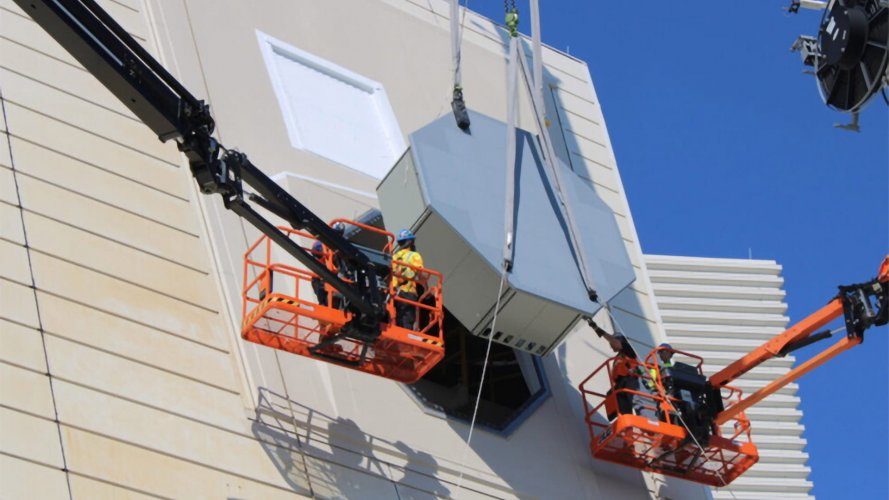
AMDR ships

AEGIS midcourse engagements routinely use one DDG to detect/track and another to shoo the SM-3, in this case 125 with it's SPY-6 was the former and 85 was the latter.

What is reason for this? Is it to test the data sharing between platforms as well as the radar? Is DDG-85 a non ABM vessel?
 
What is reason for this? Is it to test the data sharing between platforms as well as the radar? Is DDG-85 a non ABM vessel?

To test data-sharing. Because there are lots of engagement scenarios where the optimum geometry puts the sensor and the shooter in different places.
 
As a reminder, because I had to look it up: SPYU-6(v)4 is the 24-RMA retrofit version for the DDG-51 Mod 2.0 retrofit.
Reposting since it got lost in the forum Snap:
Raytheon/RTX is hoping to convince Japan to upgrade their existing DDGs using the v4. I haven't seen an official "JMSDF DDG 2.0" program mooted yet, but it seems pretty likely they're thinking about such an upgrade for the same reasons USN is doing it.
 
Last edited:
So, what were the options, SPY6 and SPY7? Any European options?
From the outset of the program, they were open to SeaFire and Kronos as well as the US radars. They signed onto the SPY6 program prior to this award and got FMS approval earlier this year, but Germany being Germany it wasn't certain they would stick with it
 
SPY-6 procurement schedule:

A brief overview of the SPY-6 variant mission requirements and array configuration is provided as follows:

  1. AN/SPY-6(V)1 is designed to meet mission performance and size, weight, and power – cooling (SWAP-C) requirements of the DDG-51 FLT III ships with AEGIS Baseline 10 (BL 10) combat system. The AN/SPY-6(V)1 will provide volume search, tracking, Ballistic Missile Defense (BMD) discrimination, and missile communications in a wide diversity of environments and conditions. This variant includes 37 Radar Modular Assemblies (RMAs) per array, each which contain independent transmit and receive LRUs and provide SPY +16 minimum sensitivity. There are 4 arrays per shipset.
  2. AN/SPY-6(V)2 is designed to meet Air Defense and Air Traffic Control mission performance and SWAP-C requirements of the CVN (Nimitz) class carriers, Landing Helicopter Assault (LHA) hulls, and Landing Platform/Dock (LPD) hulls. This variant includes a single array on a rotating platform, with 9 RMAs.
  3. AN/SPY-6(V)3 is designed to meet Air Defense and Air Traffic Control mission performance and size, weight, and power – cooling (SWAP-C) requirements of CVN (Ford) class carriers and will additionally provide engagement support for Future Frigate (FFG(X)) hulls. This variant includes 9 RMAs per array with 3 arrays per shipset.
  4. AN/SPY-6(V)4 is designed to meet mission performance and SWAP-C requirements of the DDG-51 FLT IIA ships with a variant of AEGIS Baseline 10 (BL 10) combat system, to be defined. The AN/SPY-6(V)4 will provide volume search, tracking, BMD discrimination, and missile communications in a wide diversity of environments and conditions. This variant includes 24 RMAs per array with 4 arrays per shipset.

The notional shipset procurement schedule (including potential FY27-30 FMS) for the above SPY-6 variants is:

SPY-6 VariantFY27FY27FY28FY29FY30FY31FY32FY33FY34FY35
AN/SPY-6(V)12–62–42–42–4222222
AN/SPY-6(V)20–21–60–50–1200100
AN/SPY-6(V)31–32–31–41211001
AN/SPY-6(V)422–52–32–3222222
Unit Totals5–137–185–166–9855545

Quantity Note: The Government is considering capturing potential FMS quantities in FY27-FY30 options on this future contract action, which drives the upper-range uncertainty. Multiple countries have expressed interest in procuring SPY-6 variants, but no formal FMS cases are in progress. There is potential for FMS quantities beyond FY30. USN quantities drive the lower end of the range and are stable through FY29, with increased potential for changes beyond.

via
on 12/10/2025
 
News for the F127, the US goverment oked the the German request of a lot of the equipment for the F127.
The U.S. Department of State has made a determination approving a possible Foreign Military Sale to the Government of Germany to Integrated Combat System, Supporting Equipment, and Support. The estimated total cost is $11.9 billion.


The Government of Germany has requested to buy eight (8) shipsets of AEGIS-based Integrated Combat System (ICS) MK 6 MOD X computing infrastructures; eight (8) shipsets of AN/SPY-6(V)1 Active Electronically Scanned Array S-Band radars; eight (8) shipsets of MK 41 Baseline VIII Vertical Launch Systems; eight (8) shipsets of Cooperative Engagement Capability; eight (8) shipsets of Global Positioning System-based Positioning Navigation and Timing Service; nine (9) Command and Control Processors; ten (10) Multifunctional Information Distribution Systems on Ship Modernization systems; nine (9) MK 45 gun mounts; three (3) AN/SLQ-32(V)6 Electronic Warfare systems; eight (8) shipsets of AN/SPQ-9B radar systems; and eight (8) shipsets of AN/WSN-12 Inertial Navigation Systems. The following non-MDE items will be included: Integrated Combat System computer program; Mod 5/S capable Identification Friend or Foe equipment; KIV-78 cryptographic appliques; AN/PYQ-10 Simple Key Loaders; Global Command and Control Systems for Maritime; Gigabit Ethernet Data Multiplex Systems; MK 99 MOD 14 Fire Control System radars; MK 38 MOD 4 Gun Weapon Systems (GWS); MK 34 GWS components including MK 160 gun computing system and MK 20 electro optical sight system; AN/WSN-9 digital hybrid speed log systems; AN/SPQ-15 converter/receiver and signal data converter equipment; Moriah wind systems; U.S. Government and contractor engineering, technical, and logistics support services; classified and unclassified software delivery and support; hardware to support development and testing in U.S. facilities; ancillary equipment; special purpose tools and test equipment; installation support material; classified and unclassified publications and technical documentation; initial spare and repair parts; training and training equipment; foreign liaison office and services necessary to support delivery; and other related elements of program and logistics support.
Link
 

Similar threads

Back
Top Bottom