How much trust do you put in Wikipedia?

How much trust do you put in Wikipedia?

  • I consider Wikipedia universially reliable.

    Votes: 0 0.0%
  • I consider Wikipedia articles reliable unless I can prove that they make wrong claims.

    Votes: 15 24.6%
  • I consider Wikipedia articles reliable unless I suspect that they make wrong claims.

    Votes: 33 54.1%
  • I consider Wikipedia articles unreliable regardless of an initial reason to suspect they are wrong.

    Votes: 6 9.8%
  • I consider Wikipedia universally unreliable.

    Votes: 7 11.5%

  • Total voters
    61
I feel once again Douglas Adams was prescient when he wrote:

"The Hitchhiker's Guide to the Galaxy is an indispensable companion to all those who are keen to make sense of life in an infinitely complex and confusing Universe, for though it cannot hope to be useful or informative on all matters, it does at least make the reassuring claim, that where it is inaccurate it is at least definitively inaccurate. In cases of major discrepancy it's always reality that's got it wrong."

This rather accurately describes Wikipedia, IMO.
 
Marginal. Useful only for quick debates on the internet. Might be useful to look at the sources to see if something new has appeared.

I'm very biased against Wikipedia as a serious source for a variety of reasons.
 
Wikipedia is a powerful tool when you consider it and each of its articles as a collection of source materials with relevant descriptions about what the source materials are mentioning, rather than a definitive source of information by its own. It is also often helpful when it comes to searching stuff in non-english materials. Also, considering the fact that you first need to know the relevant keyword (i.e. what you should be looking for) before digging yourself, Wikipedia very often offers you a starting point.

(edited for typo and clarity)
 
Last edited:
Wikipedia is a powerful tool when you consider it and each of its articles as a collection of source materials with related descriptions about what the source materials are mentioning, rather than a definitive source of information on its own. It is also often helpful when it comes to searching stuff in non-english materials. Also considering the fact that you first need to know the relevant key-word (ie what you should be looking for) before digging yourself, Wikipedia very often offers you a few of then from which you can start on.

"powerful tool" ? I don't think so. People have been conditioned to accept quick and easy. I'm not concerned about people who know how to do actual, real world research. Who have an expertise in certain subjects. However, no one - no one - can trust this type of resource as is. Trust is the problem. Fact checking is something I've learned how to do and it takes more than 5 minutes.

Bottom line: Don't be that guy who reads a Wiki article, sees a few youtube videos and then thinks, 'Hey. I know stuff.' Odds are you don't. Not much is not much.

 
Wikipedia is a powerful tool when you consider it and each of its articles as a collection of source materials with related descriptions about what the source materials are mentioning, rather than a definitive source of information by its own. It is also often helpful when it comes to searching stuff in non-english materials. Also, considering the fact that you first need to know the relevant keyword (ie what you should be looking for) before digging yourself, Wikipedia very often offers you a few of then from which you can start on.

"powerful tool" ? I don't think so. People have been conditioned to accept quick and easy. I'm not concerned about people who know how to do actual, real world research. Who have an expertise in certain subjects. However, no one - no one - can trust this type of resource as is. Trust is the problem. Fact checking is something I've learned how to do and it takes more than 5 minutes.

Bottom line: Don't be that guy who reads a Wiki article, sees a few youtube videos and then thinks, 'Hey. I know stuff.' Odds are you don't. Not much is not much.
Had you actually read what I wrote above, it would be quite obvious that I'm not suggesting anyone to take a quick peek on a Wikipedia article and claim they're an expert. Quite a shame that someone who claims to be capable of actual research wouldn't read thoroughly of such a short comment.
 
Last edited:
Wikipedia is a powerful tool when you consider it and each of its articles as a collection of source materials with related descriptions about what the source materials are mentioning, rather than a definitive source of information by its own. It is also often helpful when it comes to searching stuff in non-english materials. Also, considering the fact that you first need to know the relevant keyword (ie what you should be looking for) before digging yourself, Wikipedia very often offers you a few of then from which you can start on.

"powerful tool" ? I don't think so. People have been conditioned to accept quick and easy. I'm not concerned about people who know how to do actual, real world research. Who have an expertise in certain subjects. However, no one - no one - can trust this type of resource as is. Trust is the problem. Fact checking is something I've learned how to do and it takes more than 5 minutes.

Bottom line: Don't be that guy who reads a Wiki article, sees a few youtube videos and then thinks, 'Hey. I know stuff.' Odds are you don't. Not much is not much.
Had you actually read what I wrote above, it would be quite obvious that I'm not suggesting anyone to take a quick peek on a Wikipedia article and claim they're an expert. Quite a shame that someone who claims to be capable of actual research wouldn't read thoroughly of such a short comment.

I wasn't referring to anyone specifically. Experts are experts. Those who aren't aren't. That';s my point. Previous comments indicated that references in a Wikipedia article may change or not be trustworthy. Red flag.
 
Hi Ed,

I wasn't referring to anyone specifically. Experts are experts. Those who aren't aren't. That';s my point. Previous comments indicated that references in a Wikipedia article may change or not be trustworthy. Red flag.

Just for grins, I just stumbled upon a footnote in an aviation-related article in the German Wikipedia in which the footnote read "no evidence of this".

(The same article also lists model kit instructions as sources.)

Regards,

Henning (HoHun)
 
I've seen Wikipedia pages written/edited by members of this forum (no names, no pack drill) littered with mistakes and use of outdated references.

Moral is, if you really want to know something, research it yourself.
 
Hi Airman,

Wikipedia must be considered like a general encyclopedia : not reliable @ 100% not accurate @ 100% . Must be consider it " a point of first knowlegde" for go into detail with other sources.

That's an awkward statement to discuss because it implicitely equates the accuracy of professionally-written encyclopedias with that of the Wikipedia. That's an entire can of worm by itself that it out of the scope of this thread.

If you consider Wikipedia "not accurate @ 100%" as a general rule, I suppose the poll option for you would be "I consider Wikipedia articles unreliable regardless of an initial reason to suspect they are wrong." If you use other criteria before deciding to distrust an article, one of the other options might fit.

Regards,

Henning (HoHun)
 
Wikipedia must be considered like a general encyclopedia : not reliable @ 100% not accurate @ 100% . Must be consider it " a point of first knowlegde" for go into detail with other sources.

"must be"? I don't think so.
 
Hi Ed,

Trust is the problem. Fact checking is something I've learned how to do and it takes more than 5 minutes.

You've hit a very important point there. It's quick and easy to add something to Wikipedia, even footnoting it with an outdated source like Green (or Nowarra), but if you try to throw out statements thus generated, you will be fighting an uphill battle because fact checking takes a lot longer, and you'll also have to argue with people who really like their Green (or Nowarra), and don't understand why they shouldn't add stuff to an article they can't support from other sources.

Regards,

Henning (HoHun)
 
Hi,

Funnily enough I used to learn more about Warpac aircraft through the backstory on the instructions of KP model kits, from Czechoslovakia, than from Western sources which just regurgitated the same old assumptions over and over.

I'm confident that some model companies take their research very seriously, but from what I gather from the German modelling community, a lot of them don't, or even (for marketing reasons) publish models with more emphasis on looks than on historical accuracy (such as portraying fighters in gate guardian liveries as operational aircraft).

Of course, this is a source criticism question in the end, and that's something that doesn't seem to work very well on Wikipedia. I've witnessed an attitude of "If it's published anyhwere, it's good enough" ... and obviously, basically every weird and mistaken idea has been published somewhere, if not in print then at least on the internet.

Regards,

Henning (HoHun)
 
Wikipedia can be edited by anyone. In case you missed that - ANYONE. A 12 year old with a laptop, for example. The problem with the People's EncyKlopedia is that this information is not vetted by experts. Do you want experts reviewing textbook entries? Yes or no? I have seen one too many articles on the internet where the information is 70% accurate and the rest is the personal bias of the writer. It's time people realized that Joe Nobody on the internet does not know what he's talking about. That perhaps this is his idea of "publishing" because it's free. Not a good trend. Anyone can blither on at the local pub, the problem occurs when they think they can blither on online.
 
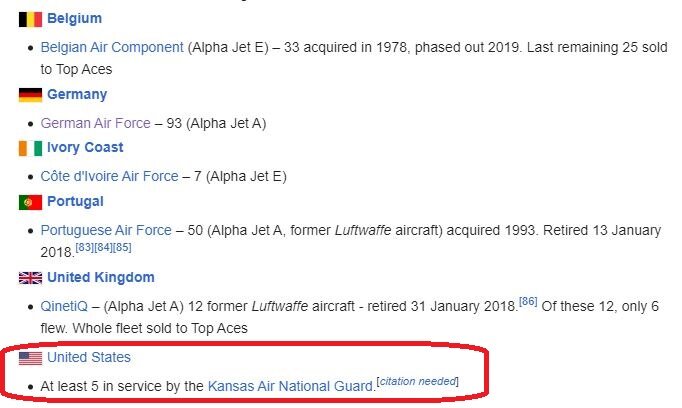
I guess whoever wrote this must have seen some private Alphajets somewhere in Kansas and thought they belonged to the local ANG.
Anyone unfamiliar with the subject can be fooled by pseudo US Navy or USAF markings.

76725_1257907671.jpg
 
I put a lot of thrust into their SpaceX articles (runs for cover !)
 
I guess whoever wrote this must have seen some private Alphajets somewhere in Kansas and thought they belonged to the local ANG.
Anyone unfamiliar with the subject can be fooled by pseudo US Navy or USAF markings.

View attachment 724934

And fooled by Photoshop...

Isn't the internet wonderful? Too many people think posting an image or two adds to the 'legitimacy' of what they post. Grrrr !
 
Hi Ed,

The problem with the People's EncyKlopedia is that this information is not vetted by experts.

It's interesting to see that in this example, a concerned Wikipedia contributor tagged the statement about the Kansas ANG Alphajets with "citation needed", but left it at that.

The cultural default in the Wikipedia pretty much seems to be "if in doubt, leave a claim in the article", rather than only allowing information supported by evidence into the article.

Obviously, that's not without consequences for reliability.

Regards,

Henning (HoHun)
 
Hi Ed,


It's interesting to see that in this example, a concerned Wikipedia contributor tagged the statement about the Kansas ANG Alphajets with "citation needed", but left it at that.

The cultural default in the Wikipedia pretty much seems to be "if in doubt, leave a claim in the article", rather than only allowing information supported by evidence into the article.

Obviously, that's not without consequences for reliability.

Regards,

Henning (HoHun)

Hi Henning,

It is wrong to live in a world governed by Joe Nobody. I wonder how many people understand the term "citation needed." Perhaps it should be changed to "Hey! We will delete your unsupported entry in 24 hours if you do not find a credible source."

Imagine opening a real encyclopedia and finding an article with even one "citation needed."

But people are programming themselves to run to Wikipedia because it's quick and easy. Doing actual research is not quick or easy.

Regards,
Ed
 
Hi,

On the Ka-50 page, I've tried several times to modify the operators section, because Macedonia is indicated as having received two Ka-50s, and I'd tried to place this in a "potential operator" section. But each time another user changed it from behind.
https://en.m.wikipedia.org/wiki/Kamov_Ka-50

My impression is that discussion is what Wikipedians try after everything else has failed. The "revert" really is the everyday tool to avoid discussions, and discussions are routinely avoided because there are so many articles and so many edits.

Often one or several guys basically do watchdog duty on an article and figuratively bark at everyone who changes the article in a way they don't like (while reverting the change).

In my opinion, that's more territorial behaviour than editorial process, though of course it's not entirely without merit considering the great number of not-so-great edits ...

Regards,

Henning (HoHun)
 
Wikipedia is peer-reviewed after publication (and with peers defined as anyone who wanders in).

This works quite well.

Somehow the editorial process leads to fairly reliable and balanced articles in many cases (i.e. edit wars are often stopped in reasonably reasonable places).

There are issues with niche knowledge where many published sources are wrong (i.e. books being cited have myths) and areas where there is so little interest that no one bothers to update/improve the articles.

As a general rule I now have the perspective that one needs to always check the original sources (including data) before reaching a decision... and this applies to official documents, published books, and peer-reviewed scientific literature (show me the methods section! show me the results! does the theory fit or does it contain prejudicial assumptions?)

So, on the whole, I'm impressed by the wikipedia... but I'm now at a point where I don't trust any authorities if I can't independently access data to assess their methods (wikipedia or otherwise).

...so my answer doesn't really fit your scale.

That said - I know of some hilarious aerospace stuff over the years... like a couple of edits I made to an article on the Mi-24 that were based on the data available in decent English language sources circa 2005... but which was incorrect... and how every attempt to fix it led to it being reverted to my original mistake (and then finding that mistake incorporated into other publications!)
 
Having chatted with a Wikipedia person, Wikipedia will not allow self-attributions even if you are the expert (no writing or even correcting articles about yourself), but will allow multiple outside sources even if the sources are blatantly wrong.

Ie if my birthday is 1/1/2000, but two articles claim it was 2/3/2001 Wikipedia will use the wrong date and you have to get some two other outside sources to quote the correct date for them to even consider fixing it.
 
Having chatted with a Wikipedia person, Wikipedia will not allow self-attributions even if you are the expert (no writing or even correcting articles about yourself), but will allow multiple outside sources even if the sources are blatantly wrong.

Ie if my birthday is 1/1/2000, but two articles claim it was 2/3/2001 Wikipedia will use the wrong date and you have to get some two other outside sources to quote the correct date for them to even consider fixing it.
This is exactly correct. Wikipedia is not supposed to contain any original research, it is supposed to be a compilation of existing published information.

So if I am the chief designer of the B-2, say, and I want to correct the Wikipedia entry on the B-2, I would need to write a book first, and then cite the book.
 
What a mess. Just get the book - about anything. Do your own research. Fer cryin' out loud, this is not progress.

As far as Wikipedia being a compilation of existing published information, it does not explain the blatant errors and biased statements in the Wikipedia article for my company. Another Wikipedia entry for a publication I produced and published has one vague comment that is negative. Hardly the factual and unbiased approach I would expect from a professionally written, fact checked and properly edited print magazine article.
 
Hi,

Wikipedia is peer-reviewed after publication (and with peers defined as anyone who wanders in).

This works quite well.

Not by my definition of "well", absolutely not. And I've wasted an awful lot of time on "peer reviewing" Wikipedia articles. It's more like, "When the cat's away, the mice will play".

That said - I know of some hilarious aerospace stuff over the years... like a couple of edits I made to an article on the Mi-24 that were based on the data available in decent English language sources circa 2005... but which was incorrect... and how every attempt to fix it led to it being reverted to my original mistake (and then finding that mistake incorporated into other publications!)

I'm totally with you here ... I've composed some paragraphs for a Wikipedia article that subsequently got copied into another Wikipedia article, then lifted (without attribution) by a popular aviation website - which then got referenced as a source for the Wikipedia text! The perfect crime, for practical purposes it's virtually impossible to anyone to track this by the paper trail.

Regards,

Henning (HoHun)
 
Hi Ed,

As far as Wikipedia being a compilation of existing published information, it does not explain the blatant errors and biased statements in the Wikipedia article for my company.

Normally, company articles are more likely to read like they were written by the respective company's marketing department (and I suspect they often are, though sometimes it might just be "well intentioned" Wikipedians lifting text from company material), but the "beauty" of Wikipedia really is the disconnect between content and author ... maybe just a disgruntled ex-employee trying to get even?

Company rating sites like Kununu are the more obvious platform for that, but at the same time, it's more obvious that on such a platform, you might get an unfair rating, while Wikipedia content often gets taken at face value ...

Regards,

Henning (HoHun)
 
This is exactly correct. Wikipedia is not supposed to contain any original research, it is supposed to be a compilation of existing published information.

So if I am the chief designer of the B-2, say, and I want to correct the Wikipedia entry on the B-2, I would need to write a book first, and then cite the book.
Nope, can't cite your own book. You have to get someone else to cite the book...
 
Wikipedia has sources (or should) included in its articles. Those are where the information came from, and should be checked, as such. The Wikipedia articles, themselves, are more of a condensed package of all referred-to sources.
 
Hi,

Wikipedia has sources (or should) included in its articles. Those are where the information came from, and should be checked, as such. The Wikipedia articles, themselves, are more of a condensed package of all referred-to sources.

Not to say the Wikipedia doesn't have good ideals, but I've checked sources repeatedly, and found - among other problems - examples of both very inadequate source types, and the use of sources to support claims not actually supported by these sources.

It should be remember that Wikipedia, despite mostly avoiding to advertise itself as such, is really a social media platform, where the users are not any less human than on other social media platforms.

If they'd advertise the Wikipedia as a "large collection of articles largely written by a handful of amateurs each, who mostly don't even talk to each other", that wouldn't be very confidence-instilling. Unfortunately, that description is so not far from the practical reality.

Regards,

Henning (HoHun)
 
large collection of articles largely written by a handful of amateurs each, who mostly don't even talk to each other
A handful of amateurs? Wikipedia in not so innocent. There are groups of writers organised by politicians/lobbies/fanatics that use it as a social engineering tool, promoting their particular interests.
 
Short answer: Yes, for everyday quick lookup.

Long answer: Depends. All my opinions ofc.
Wikipedia articles can be sorted into 3 groups of almost equal proportion:
- literature: books, universes, characters etc.
- media: movies, TV, universes, characters etc.
- technical, scientific, professional (engineering, architecture etc.), educational, hypothesis, general overviews of fields etc.; this group is shrinking compared to the other two.

So I'm referring to the 3rd group only where it matters.
AFAIK, if you do need details and exact numbers wikipedia only provides at best 10% of what you need to know.
It's a good tool to get you started on research as well as look up for standard information like physical constants and the like. The rest you have to research yourself.

As for accuracies, it has three problems:
- uninformed editors often interfer with basics & data; leading to loss thereoff or instead of citing exact numbers often round them up.
- It relies on sources that irl are also often copies themselve, so there are stuff that carry over and over and may not be accurate. An easy example are atomic states. A molecule's "weight" is a combination of the atoms and their binding energy. Now if you look up on wikipedia and professioanl/government databases almost all of them do not match up with expectated results. In this case accuracy is as good as any.
- Apparently, there are entities inerferring with information. They tend to split up undesired information (into more opscure articles) to remove them or make them hard to find. Or they promote their own agenda.

In recent times, wikipedia has hired professionals to rewrite mosly technical and educational articles. They have become more elitistic and theoretical which comes with shortcuts in equations or typical dismisal of zeroed-portions; as well as removing final solutions. In this case rather than about accuracy it prevents proliferation.

Wikipedia is also riddle with advertising schemes like the redifinition of x-Bytes data amount into classic x-Bytes and x-iBytes: for example 1kB=1024 B vs 1KiB=1000 B. The inclusion of unprofessional standards muddles and degrades knowledge let alone causes unnecessary confusion. This clearly makes people stupidier.

The degree of accuracy changes depending on what you are looking up.
 
Back
Top Bottom