Status
Not open for further replies.
I think a lot of Type 26 decisions (the gun, the Mk 41 VLS) have to be taken as export promotion, showing prospective Commonwealth buyers like the RCN and RAN that the T26 could accommodate their preferred US weapons. But then the export customers ended up customizing the ships almost beyond recognition.

Edit: and of course, in hindsight, it would have made sense to swap around the guns, putting 57mm on the T26 and the 5-inch gun on the T31 (if anywhere at all), using them the way the T21s were used in the Falklands, as relatively expendable gunline ships for shore bombardment. Of course, the proliferation of proper coast defenses makes any use of NGFS Falklands-style extremely questionable. And requiring a 5-inch gun would have blown the cost estimates for the T31 right out of the water-- as it is, they had to accept a lot more GFE than originally planned to hit the artificial limits for CFE.
 
Last edited:
I think a lot of Type 26 decisions (the gun, the Mk 41 VLS) have to be taken as export promotion, showing prospective Commonwealth buyers like the RCN and RAN that the T26 could accommodate their preferred US weapons. But then the export customers ended up customizing the ships almost beyond recognition.

That might make some sense. The current position of 4.5" and 57mm/40mm makes zero.

If only we'd got the TMF...

Unless the BAE Systems Kingfisher System in brought in giving it 5" ASW capability amongst other things.
As one might remember talk of using the Hypersonic Round fired out of the 5".

That would require someone to fund it...I think it will stay on the drawing board personally.
 
Unless the BAE Systems Kingfisher System in brought in giving it 5" ASW capability amongst other things.
As one might remember talk of using the Hypersonic Round fired out of the 5".

That would require someone to fund it...I think it will stay on the drawing board personally.
As usual, the greatest threat to HM military is HM Treasury.
 
I share the perplexity with the Mk 41 obsession, as I've said numerous times we've nothing really to put in it. Having a couple of Mk 41 packs just for cruise missiles (Tomahawk or FCASW) seems wasteful. Certainly if the RN gets serious about hypersonics, Mk 41 won't be big enough - cue the submariners Vs surface sailors battle on who gets those - SSN(R) or T83.

I can see the logic of designing our ships for Mk 41 for the export market - but as Tinymagic says, being outside the US missile ecosystem since the 1960s has pushed the RN on an ever divergent path and there is no easy or cheap way back. Given how CAMM has evolved into a separate family and we're still doing Anglo-French missiles that divergence doesn't seem near at hand.

Saying that, we don't know for sure that T83 won't have Sylver - it's not likely but is still a possibility. Of course they might go for a CAMM 'mushroom'/Sylver/Mk 41 mix just to be 'edgy'!
 
I can see the logic of designing our ships for Mk 41 for the export market - but as Tinymagic says, being outside the US missile ecosystem since the 1960s has pushed the RN on an ever divergent path and there is no easy or cheap way back. Given how CAMM has evolved into a separate family and we're still doing Anglo-French missiles that divergence doesn't seem near at hand.

Only 1 country has made Mk.41 compatible munitions that have gone operational (Japan) and never sold them anywhere else (principally as a result of their domestic restrictions). The Koreans went and developed their own VLS for their missiles..

I think I'm right in saying that the CAMM that is going on the Saudi MMC vessels in Mk.41 (presumably with an ExLS liner) is the first sale ever of a 'foreign' missile to a Mk.41 customer....thats not a spectacular record in 40 years of Mk.41....

So whenever someone touts the 'Mk.41 compatability' line I'm very dubious to say the least....I know the FCASW is going to be Mk.41 compatible, but I just can't see any of the users out there with Strike Length Mk.41 actually buying it.
 
Of course one might ask why we didn't try to pack CAMMs into Sylver?

Mainly because there has been no need. Sylver customers have purchased an expensive hot launch VLS specifically for expensive hot launch missiles (Aster, and I believe MICA-VL in due course). As those customers have their VL and compatible missiles there isn't a real possibility of sales, so why spend money on a trials campaign for no benefit? Instead CAMM customers seem to be happy with standalone launchers that get benefit from the cold launch method from the canister to keep costs down. It would be tempting to put Sylver VLS on Type 26 for the CAMM missiles, but it wouldn't give any benefit, just add cost.
 
Instead CAMM customers seem to be happy with standalone launchers that get benefit from the cold launch method from the canister to keep costs down.

And of course the Canadians opted for CAMM but with ExLS instead of the dedicated mushroom launchers. As well as Mk 41 with SM-2 and ESSM. And no, I don't understand that choice either, except that they already own ESSM (and ESSM production workshare) so feel the need to use it. And Lockheed really needed a launch customer for ExLS.
 
Last edited:
Mainly because there has been no need.
It was just my musing, after all the RN does have Sylver and doesn't (yet) have Mk 41 so it crossed my mind why wouldn't you make it compatible with Sylver since we're wedded to Aster anyway - hell we could have even brought MdCN instead of trying to get Tomahawks off the subs and into the ships and instead of having to buy RGMs to complement the UGMs, that money could have been used to support MBDA.

But I guess having missiles with three different sets of VLS is fine - I mean who says the MOD has to work with any logic?
 
  • Haha
Reactions: zen
Mainly because there has been no need.
It was just my musing, after all the RN does have Sylver and doesn't (yet) have Mk 41 so it crossed my mind why wouldn't you make it compatible with Sylver since we're wedded to Aster anyway - hell we could have even brought MdCN instead of trying to get Tomahawks off the subs and into the ships and instead of having to buy RGMs to complement the UGMs, that money could have been used to support MBDA.

But I guess having missiles with three different sets of VLS is fine - I mean who says the MOD has to work with any logic?
To be honest I think we're all as mystified as you are. It makes no sense at all, and I really don't think the RN could really articulate it either. Which given the amount of public money they're proposing to spend is incredible really.

Tomahawk was definitely the right choice at the time, and MdCN is more expensive, but I wonder how much of that is due to the limited production run, that may have been bolstered by a UK order. I'm not sure how much (if any) UK content is in it though.
 
I remember, back during the FSC debates over on warships1 that my conclusion of the need to cut costs was.
Diesels.
Sylver silo.
Aster or MICA-VL or 'some development of ASRAAM' and a PAAMS system but skimping on the radar as cheaply as possible.
At the time I argued ASRAAM's use of datalink and a beefed up helicopter rotating AESA would do at a pinch.

And during this I remember pointing out we've already committed to Sylver so following the French and opting for MdCN seemed a logical choice and ought to integrate it to the SSN fleet as well.
As equally a development based on Storm Shadow for Anti-ship Missile.

So in part I'm fairly chuffed to have called some things right but perplexed by what diverges so far from that.

It seems the obsession with USN 5" and the wider user base at sea trumped domestic integration with the Army's use of 155mm. Even though BAE Systems built a prototype.....
 
It seems the obsession with USN 5" and the wider user base at sea trumped domestic integration with the Army's use of 155mm. Even though BAE Systems built a prototype.....
Admittedly, the 5" gun has a huge production run and therefore an equally huge supply of spare parts and ammunition, which tends to mean lower costs. And being able to take ammo from USN stockpiles in a conflict.

The 155mm would have required the development of a brass case to hold the powder. Or at least a hybrid case like a shotgun shell. And the modification of the autoloader to handle the case.
 
Well i think we now know why MK.41 for some ships. CAMM-MR which is dual Packed into the cells. Probaly WE will see also Sylver cells in the Type 45 replacement. Maybe something like 16-48 Sylver cells, 16-32 mk.41 and camm mushrooms. Then a it could with 16-48 Aster 30, 32-64 CAMM-MR or 16-32 FC-ASW or a mix, and other camm missiles. I would guess 32-48 Aster, 32 CAMM-MR and 16 cells for both FC/ASW and then camm in the range of 24-48 missiles. With that it has 3 layers for Air defense and 16 Strike weapons.
 
Mk41 has a generic connotation coming from politicians. The average politician couldn't tell you what a Mk41 is otherthan its a VLS container. There is no grasp that VLS has been progressing such as with Mk57 on the Zumwalt, or G-VLS built around MRC from the army. European politicians are probably unaware Sylver is not another Mk41. Perhaps they can figure out an SCL on a slight slope to pop the missile out where it would never dud drop back on its own footprint.
 
Mk41 has a generic connotation coming from politicians. The average politician couldn't tell you what a Mk41 is otherthan its a VLS container. There is no grasp that VLS has been progressing such as with Mk57 on the Zumwalt, or G-VLS built around MRC from the army. European politicians are probably unaware Sylver is not another Mk41. Perhaps they can figure out an SCL on a slight slope to pop the missile out where it would never dud drop back on its own footprint.
Politicians aren't the ones making technical design decisions like selecting the type of VLS.
 
Well i think we now know why MK.41 for some ships. CAMM-MR which is dual Packed into the cells. Probaly WE will see also Sylver cells in the Type 45 replacement. Maybe something like 16-48 Sylver cells, 16-32 mk.41 and camm mushrooms. Then a it could with 16-48 Aster 30, 32-64 CAMM-MR or 16-32 FC-ASW or a mix, and other camm missiles. I would guess 32-48 Aster, 32 CAMM-MR and 16 cells for both FC/ASW and then camm in the range of 24-48 missiles. With that it has 3 layers for Air defense and 16 Strike weapons.

We don't even know that any British forces will adopt CAMM-MR -- it's a Polish initiative, after all. And it comes a solid decade after the decision to fit Mk 41 in the T26. And of course T31 has nothing like the appropriate sensors to exploit CAMM-MR.
 
On what do you base this assertion?

I was thinking that the T31 had a less capable radar, but I think I crossed that with the T26, which has Artisan.

Still, it seems unlikely that the T31 will be fitted for area air defense, which is CAMM-MR's role.
 
My understanding is CAMM is sensor agnostic and thus as long as you can give the system the right data, it has a reasonable chance of success.
Obviously the more data, and the more accurate, the better the chances of success.
 
I was thinking that the T31 had a less capable radar, but I think I crossed that with the T26, which has Artisan.

Still, it seems unlikely that the T31 will be fitted for area air defense, which is CAMM-MR's role.
Maybe not in every Mission but its possible. It can be on of the reasons they toke MK.41. We dont know how old the Talk with poland is that the new camm (CAMM-MR) is for MK.41. That with FC/ASW can be some good reason on why to use it even if its larger and heavier then Sylver.
 
Also If i remember right Camm has a CEC capability as all use the same Data-Link?. So they could work as "Arsenal Ships" as example for bigger ships with mutch better Radar.

I think you're confusing CEC for the datalink system used by CAMM.

CAMM doesn't communicate directly with any shipborne radars for its midcourse updates, but rather datalinks with Platform Data Link Terminal, which is a two-way datalink that communicates with the ship's CMS. This stands in contrast with systems like Aster or the Standard Missile Family, where these uplink/downlinks are transmitted via the multi-function radar (EMPAR, SAMPSON, MFRA, SPY-1, SPY-6, etc).

This makes CAMM somewhat simpler to integrate on to different platforms, because you no longer have to concern yourself with the integration of the missile with any specific radar. The same applies to CAMM-ER and presumably will also for CAMM-MR.

This is not the same thing as CEC, however. A ship equipped with any missiles from the CAMM family certainly could engage with the benefit of sensor fusion with another ship with more capable radars, but that would depend on the ships actually being equipped with the appropriate datalinks for CEC in the first place (as would be the case with any SAM family).
 
They are the ones holding the purse strings, however.

"Why are you buying (other VLS) instead of Mk41? Mk41 is a lot cheaper!"
Mk 41 is a lot heavier (for equivelant size launcher), it's also an awful lot slower. when the priority is to get Aster into the sky as quickly as possible, a slow hatch and gas exhaust system isn't ideal.
 

If manpower is a pressing issue I expect that the Type 83 is going to be a much larger ship, to allow for greater automation and access for maintainence, and greatly improved crew quarters to improve retention.

The desire to put large radars as high as possible is also going to drive up ship size, and since it looks like every other European country is looking at splitting phased array radars between fore and aft superstructure blocks for survivability (as seen in the German F126 and F127, Italian DDX and Dutch FuAD), I expect the same will be done with Type 83, which will almost certainly drive displacement well beyond 4000 tons and very likely over 10,000 tons.
 
If manpower is a pressing issue I expect that the Type 83 is going to be a much larger ship, to allow for greater automation and access for maintainence, and greatly improved crew quarters to improve retention.

The desire to put large radars as high as possible is also going to drive up ship size, and since it looks like every other European country is looking at splitting phased array radars between fore and aft superstructure blocks for survivability (as seen in the German F126 and F127, Italian DDX and Dutch FuAD), I expect the same will be done with Type 83, which will almost certainly drive displacement well beyond 4000 tons and very likely over 10,000 tons.
The genius of the 4,000 ton concept is that it doesn’t need a high mounted radar installation when it’s operating with the carriers. As an escort, most likely in the company of allied ships equipped with SM-3, it also doesn’t need to be a primaryABM platform. That eliminates the need for an excessively wide hull. Moreover, with totally unmanned machinery and non-habitable spaces filled with inert gas, you can minimize hull and crew size. No need for damage control. Get rid of silly missions like anti-drug patrols and SAR and you don’t need a permanently embarked helicopter. The Type 45 was profoundly noisy and a hopeless ASW platform, so limit the minimal 4,000 ton ship to active anti-torpedo defense. No capability lost. It could work.

On the other hand, retiring the Type 45s prematurely in favor of AAW optimized Type 31s could work as well. You might even be able to “recycle” much of the Type 45’s sensor suite, in the same way that the Type 26s do with the Type 23s.
 
The genius of the 4,000 ton concept is that it doesn’t need a high mounted radar installation when it’s operating with the carriers. As an escort, most likely in the company of allied ships equipped with SM-3, it also doesn’t need to be a primary ABM platform. That eliminates the need for an excessively wide hull.

As part of a relatively small navy, it will almost certainly be operating independently at times. ABM capability should be organic, given the proliferation of ballistic missiles, and US politics, Britain may find itself with the need to defend against ballistic threats without Allies who have access to SM-3.

Additional beam is not the problem, if you can afford the AAW combat system, then you can afford a considerably larger hull.

Moreover, with totally unmanned machinery and non-habitable spaces filled with inert gas, you can minimize hull and crew size. No need for damage control. Get rid of silly missions like anti-drug patrols and SAR and you don’t need a permanently embarked helicopter.

Non-habitable spaces filled with inert gas suggests a hull significant volume will be required, hence something much larger than 4000 tons.

Again said combatant is likely to be used in a general-purpose role (why else is it called a Type 83, rather than a Type 46?), and helicopters are too useful to do without.

The Type 45 was profoundly noisy and a hopeless ASW platform, so limit the minimal 4,000 ton ship to active anti-torpedo defense. No capability lost. It could work.

The Type 83 is a new build destroyer design, it hardly has to have the same limitations as the Type 45. Silencing was fitted to previous Royal Navy destroyers, and even when operating in concert with a carrier, you don't want it's escort revealing the location of the carrier group.

On the other hand, retiring the Type 45s prematurely in favor of AAW optimized Type 31s could work as well. You might even be able to “recycle” much of the Type 45’s sensor suite, in the same way that the Type 26s do with the Type 23s.

If I was designing a new destroyer with the expectation that I would operating it potentially well into the 2060s, I would want a ship with significantly more margins (be they topweight, volume, power generation or cooling capacity) than a Danish frigate design from the 1990s.

Better to build a 10-15,000 ton plus hull with IEP and a Type 26-esque mission bay
 
Better to build a 10-15,000 ton plus hull with IEP and a Type 26-esque mission bay
You only have to look at Zumwalt as an example of IEP which did not go well both for its cost and extraordinary number of years in build, and do not want to repeat the experience, if you want a quiet ASW ship nearly all use hybrid propulsion system, otherwise for an AAW ship is there any reason that they have to be as quiet as an ASW ship when they will be escorting a much nosier carrier, if you need additional electrical power use larger DGs which would not be surprised if an order magnitude cheaper and faster to build than any IEP system.
 
You only have to look at Zumwalt as an example of IEP which did not go well both for its cost and extraordinary number of years in build,

Britain has made use of IEP and Electric drive on the Type 23s, Type 45s, Albion and Queen Elizabeth classes, the Royal Navy now has plenty of experience with it.

IEP does not add anything to the build time of a ship.

if you want a quiet ASW ship nearly all use hybrid propulsion system, otherwise for an AAW ship is there any reason that they have to be as quiet as an ASW ship when they will be escorting a much nosier carrier,

I would hope the Carrier, AAW escorts and ASW escort all have similar, and very extensive, levels of silencing. I would like to minimise undersurface threats to warships, especially assets as important as a carrier group.

Even if you're not worried about the noise signatures of your Carrier and it's AAW escorts, the ASW escort's job is made much easier if the radiated noise from its consorts are much lower.

if you need additional electrical power use larger DGs which would not be surprised if an order magnitude cheaper and faster to build than any IEP system.

At the expense of greater cost, size, fuel burn, worse endurance, more personnel for maintenance, and the small but glaring fact that nobody has built such a ship. When faced with the need for much greater power generation, defence bureaucracies around the world keep selecting IEP. I'm not aware of a modern CODAD surface combatant with the 120-140 MW of power generation capacity that DD-21 was intended to have, or for that matter the 78 MW of Zumwalt as built.
 
The concept of a AAW only ship could encompass something down to 4,000tons....maybe even less.
But this would struggle to perform other duties. As such it should either be described as a Type 4X or Type 6X vessel.

It could only become multirole and be described as Type 8X if it was in fact a distributed systems concept and purchased in large numbers.

While a ship over 10,000tons could potentially perform a very wide range of duties as a Singular vessel alone and be built in low numbers.

Arguably in a shooting war as Ukraine, and frankly most other conflicts that endure over more than a few months, favour the large scale production over small scale.

Should we say get into a conventional shooting war with the likes of China and manage to keep it below the nuclear threshold. Then endurance and capacity will count.
This may be prompting the Admiralty to change it's thinking......

But it's hard to envision the solution being a return to something like the Ivar Huitfeldt AAW ships.
 
If manpower is a pressing issue I expect that the Type 83 is going to be a much larger ship, to allow for greater automation and access for maintainence, and greatly improved crew quarters to improve retention.

The desire to put large radars as high as possible is also going to drive up ship size, and since it looks like every other European country is looking at splitting phased array radars between fore and aft superstructure blocks for survivability (as seen in the German F126 and F127, Italian DDX and Dutch FuAD), I expect the same will be done with Type 83, which will almost certainly drive displacement well beyond 4000 tons and very likely over 10,000 tons.
I agree. I've heard the V-class SSBNs have become maintenance nightmares as they've aged because they're very cramped and it's hard to access many parts. On the other hand, it's often said that steel is cheap and air is free - what mainly drives cost is complexity.

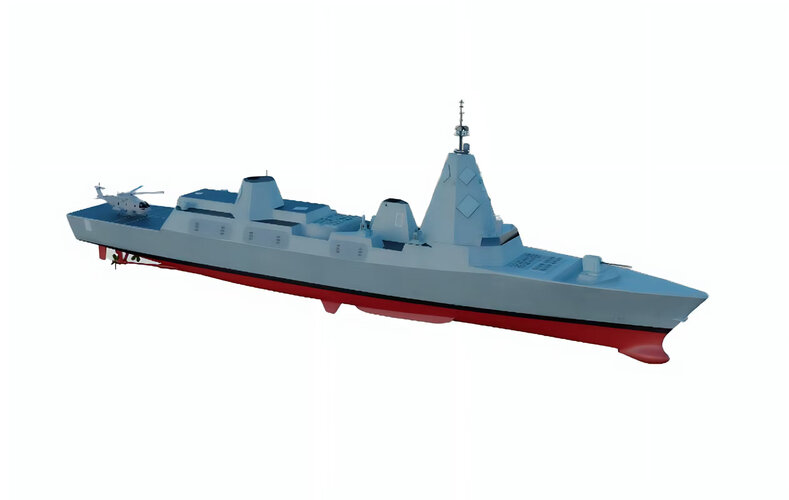
The Zumwalt Mini-Me concept is very unlikely in my opinion. The one (very) early concept we've seen from BAE for the Type 83 is quite sizeable and has radars on the aft funnel.
 

Attachments

  • TYPE83-UKDJ.jpg
    TYPE83-UKDJ.jpg
    159.9 KB · Views: 108
Britain has made use of IEP and Electric drive on the Type 23s, Type 45s, Albion and Queen Elizabeth classes, the Royal Navy now has plenty of experience with it.

IEP does not add anything to the build time of a ship.
Understood Type 23 propulsion is a hybrid CODLAG with the Spey GTs driving through a reduction gearbox so not an IEP, the Type 45 IEP was a disaster as they kept breaking down, now class slowly undergoing expensive propulsion upgrade with more powerful diesels being fitted.

One of the reasons given for Zumwalts very long time in build was the IEP
I would hope the Carrier, AAW escorts and ASW escort all have similar, and very extensive, levels of silencing. I would like to minimise undersurface threats to warships, especially assets as important as a carrier group.

Even if you're not worried about the noise signatures of your Carrier and it's AAW escorts, the ASW escort's job is made much easier if the radiated noise from its consorts are much lower.
Don't disagree but would point to the new German 10,000t F126 class designed by Damen who had originally looked at GTs, but finally chose all diesel, CODLAD with the main MAN propulsion diesels equipped with a high displacement, soft resilient mounting system to comply with the latest regulations regarding shock and noise requirements.
At the expense of greater cost, size, fuel burn, worse endurance, more personnel for maintenance, and the small but glaring fact that nobody has built such a ship. When faced with the need for much greater power generation, defence bureaucracies around the world keep selecting IEP. I'm not aware of a modern CODAD surface combatant with the 120-140 MW of power generation capacity that DD-21 was intended to have, or for that matter the 78 MW of Zumwalt as built.
Not saying if you require very high power GTs are not a good choice as the main propulsion engines for max speed but at anything other than max speed they are gas guzzlers, e.g. the all GT Burkes range limited to approx 3,000nm with the Navy standard min 30% reserve, would note have seen the 16,000t Zumwalt IEP all GT quoted max range 6,000nm, so approx. 4,000 nm actual with 30% reserve whereas the all diesel Iver Huitfeldt class max range 9,000nm plus gives approx. 6,000nm actual. Long range is what's required for USN ships operating in the Pacific unless relying on noisy oilers which will be one of the prime targets for the Chinese subs.
 
  • Like
Reactions: H_K
As far as I remember the situation of Type 45's IEP was due to the operating environment was very different from design (Middle East vs North Sea), as well as software setting issue that will overload the GTs.

As there will only be more electronics on future vessels, having IEP will bring the benefit of providing more power which helps future upgrades also. Lasers will eat up some consumption too.

The last time I heard about limiting a 4000ton-ish vessel design was the Taiwan Navy with their 4250-ton design, and that didn't go well.
 
As far as I remember the situation of Type 45's IEP was due to the operating environment was very different from design (Middle East vs North Sea), as well as software setting issue that will overload the GTs.

Issue originally was the Intercooler from Grumman Marine. It didn't work as advertised and instead of 'degrading gracefully' would fail totally and trip the entire system. The Diesel gensets onboard the T45 as built were designed to take over the load gradually (or provide hotel load etc when the ship was at anchor etc.). Instead when the entire system shut down rapidly the diesel gensets could not respond fast enough or provide enough power for the entire ship without the WR-21 running. There have been workarounds and some improvements made that appear to have mitigated most of the issues in practice (which lets face it is common across most systems). The full belt and braces Propulsion Improvement Project (PIP) underway at present for the T45's replaces the gensets with 3 far more powerful MTU diesels. In effect they take the place of the WR-21 as the main generators with the GT's providing additional power. Type 45 after PIP is still IEP, but with Diesel instead of the GT's primarily providing the bulk of the 'E' bit...
 
Understood Type 23 propulsion is a hybrid CODLAG with the Spey GTs driving through a reduction gearbox so not an IEP, the Type 45 IEP was a disaster as they kept breaking down, now class slowly undergoing expensive propulsion upgrade with more powerful diesels being fitted.

One of the reasons given for Zumwalts very long time in build was the IEP

Don't disagree but would point to the new German 10,000t F126 class designed by Damen who had originally looked at GTs, but finally chose all diesel, CODLAD with the main MAN propulsion diesels equipped with a high displacement, soft resilient mounting system to comply with the latest regulations regarding shock and noise requirements.

Not saying if you require very high power GTs are not a good choice as the main propulsion engines for max speed but at anything other than max speed they are gas guzzlers, e.g. the all GT Burkes range limited to approx 3,000nm with the Navy standard min 30% reserve, would note have seen the 16,000t Zumwalt IEP all GT quoted max range 6,000nm, so approx. 4,000 nm actual with 30% reserve whereas the all diesel Iver Huitfeldt class max range 9,000nm plus gives approx. 6,000nm actual. Long range is what's required for USN ships operating in the Pacific unless relying on noisy oilers which will be one of the prime targets for the Chinese subs.
...Gas Turbines and IEP go together so well BECAUSE they have a narrow efficient drive band. They only have to maintain one set of rpm when driving a gen set. If you need more power, you bring another GT, or some diesel gensets online.

And if you need 78 megawatt or more, the size of diesel generators becomes prohibitive.
 
Gas Turbines and IEP go together so well BECAUSE they have a narrow efficient drive band. They only have to maintain one set of rpm when driving a gen set. If you need more power, you bring another GT, or some diesel gensets online.

Absolutely, when running correctly a Type 45 which was almost twice the size of a Type 42 that it replaced would burn dramatically less fuel as the WR-21 would be happily spinning at its optimum settings. Unfortunately it hasn't worked out that well on T45 (but has on the QE class with the MT-30's). It remains to be seen how the PIP will change things in terms of fuel burn.
 
Understood Type 23 propulsion is a hybrid CODLAG with the Spey GTs driving through a reduction gearbox so not an IEP, the Type 45 IEP was a disaster as they kept breaking down, now class slowly undergoing expensive propulsion upgrade with more powerful diesels being fitted.
The problems are the GT engines not the IEP itself.
One of the reasons given for Zumwalts very long time in build was the IEP
Because the original electric motor was tbe problem. But then again zumwalt is a first case ship.
Don't disagree but would point to the new German 10,000t F126 class designed by Damen who had originally looked at GTs, but finally chose all diesel, CODLAD with the main MAN propulsion diesels equipped with a high displacement, soft resilient mounting system to comply with the latest regulations regarding shock and noise requirements.
F-126 also got an IEP or AEP how MTU likes to call it
 
Status
Not open for further replies.

Similar threads

Back
Top Bottom