Status
Not open for further replies.
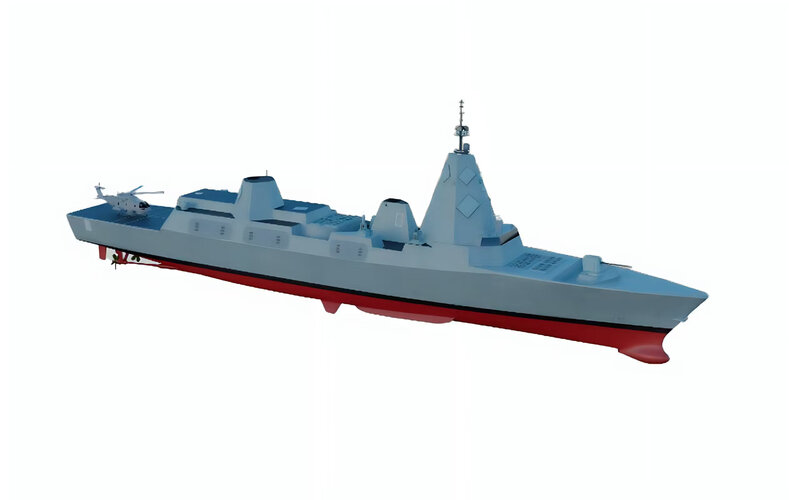
UKDJ on the BAE concept.

https://ukdefencejournal.org.uk/britains-new-warship-a-type-83-destroyer-concept-surfaces/
There's a nice cleaned up image.

The concept reveals a ship comparable in size to the Chinese Type 055 Destroyer (which is around 12,000 tonnes) and armed with a five-inch main gun, Phalanx Close-In Weapon Systems, two 30 or 40mm guns and additional unidentified close-in weapons systems, plus a significant missile payload. The missile payload seems to be divided into two sets of Mk 41 vertical launch system cells, each holding an estimated 64 VLS, resulting in potentially 128 missile cells per ship.

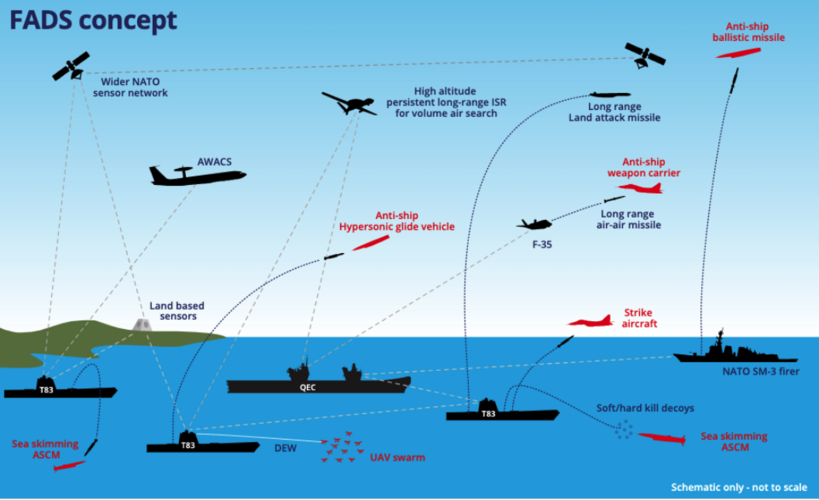
Navy Lookout discusses it in the context of the RN's Future Air Dominance System.

https://www.navylookout.com/options...r-dominance-system-and-the-type-83-destroyer/
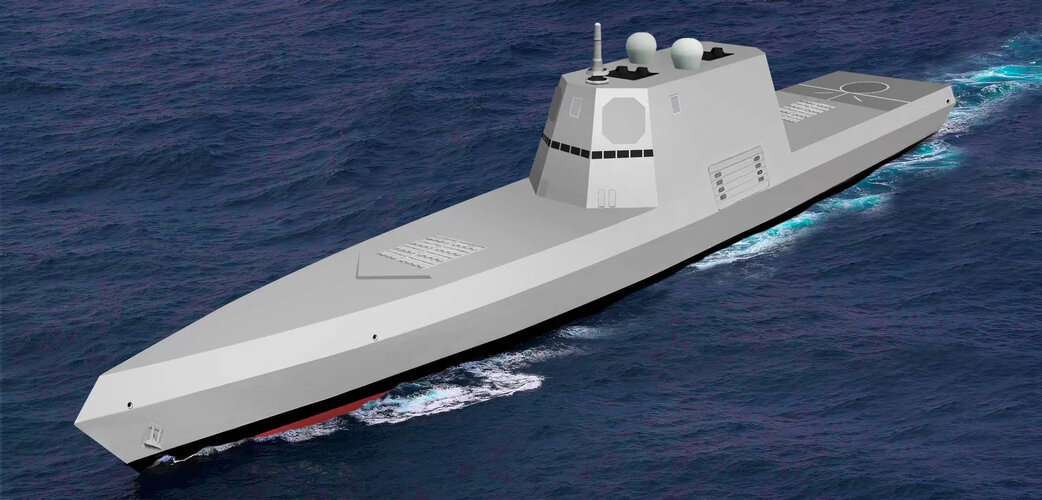
While the concept we've seen is referred to as the 'cruiser solution', individual ships would be very expensive and an alternative is a smaller, extremely specialised design (the third image that looks like a small Zumwalt).

Instead of building a typical surface combatant with a mix of capabilities, the proposal is to build a ship of around 4,000 tonnes that is only equipped with high-end radar and plenty of VLS cells. (Main concept image above) The ship would have no guns (except light weapons for force protection), no ASW capability, no hangar and a crew of less than 50. Manning would be so taught that small teams might need to be embarked by helicopter or boat for specific evolutions such as replenishment at sea, preventative maintenance or additional force protection for high-threat transits.

By simplifying the design to focus on a single role, the build and sustainment costs would be much-reduced and in theory, this could allow 3 or 4 times the number of hulls to be built for the equivalent price of a full-capability spectrum air-defence cruiser. More hulls increase availability and the force could be more widely distributed to provide a larger area of air dominance around the carrier strike group. The vessel would be reliant on ASW defence provided by other platforms in the group.


The author is very sceptical that it could work in political and logistical reality though:

It would require an unusually disciplined procurement process to build a large number of specialist hulls. Historical precedent suggests regular defence economies would likely see numbers trimmed over time and ‘mission creep’ could see additional capabilities added increasing costs. The result could be a ‘worst of all worlds’ scenario producing a low number of hulls only really good at one mission.

Both are just concepts at this point. No decision has been made to pursue either path yet.
 

Attachments

  • TYPE83-UKDJ.jpg
    TYPE83-UKDJ.jpg
    159.9 KB · Views: 116
  • Screenshot 2023-06-10 at 10.05.15 AM.png
    Screenshot 2023-06-10 at 10.05.15 AM.png
    231.8 KB · Views: 116
  • Future-Air-Dominance-System-Type-83-Destroyer-Royal-Navy.jpg
    Future-Air-Dominance-System-Type-83-Destroyer-Royal-Navy.jpg
    457.2 KB · Views: 102
Given the cost of high-end air defense/TBMD radars, I'm pretty skeptical about buying 3-4 times as many ships, even with the deletion of all these other systems. Seriously, the cost of the radar, CMS, and launchers alone is probably a third to half of the price of a high-end DDG.

And then there's the problem that these specialized AAW-only ships can't be solo deployers like the current DDGs (even with a tanker). So you're left with only the T26s for a lot of missions.
 
One thing I noticed about the BAE concept that hasn't been remarked upon is the number of boat bays - three starboard and probably two, maybe three (depending on the forward funnel) port, making five at least. A Type 45 has two quite small ones. A Type 26 has a large full-width bay continuous with the hangar, and a Type 31 has two starboard bays and one port, all small compared to the Type 26's because of the placement of the port funnel and VLS.

Although it's only a concept, it does indicate their thinking and this suggests that while it's nominal role is as part of an air dominance system, maybe it has a secondary littoral strike role or carries surface/submersible drones.
 
Given the cost of high-end air defense/TBMD radars, I'm pretty skeptical about buying 3-4 times as many ships, even with the deletion of all these other systems. Seriously, the cost of the radar, CMS, and launchers alone is probably a third to half of the price of a high-end DDG.

And then there's the problem that these specialized AAW-only ships can't be solo deployers like the current DDGs (even with a tanker). So you're left with only the T26s for a lot of missions.
Worth pointing out that the 4000-ton design is essentially a fan-made design by Navy Lookout.
 
  • Like
Reactions: zen
Instead of building a typical surface combatant with a mix of capabilities, the proposal is to build a ship of around 4,000 tonnes that is only equipped with high-end radar and plenty of VLS cells. (Main concept image above) The ship would have no guns (except light weapons for force protection), no ASW capability, no hangar and a crew of less than 50. Manning would be so taught that small teams might need to be embarked by helicopter or boat for specific evolutions such as replenishment at sea, preventative maintenance or additional force protection for high-threat transits.
It is beyond stupid to cut crewing that tight! The USN had originally run the LCS like that, and quickly discovered it wasn't possible to run a ship for any length of time like that. It's why the LCS have about tripled their embarked crew since the original commissioning.

You need sufficient production to keep any kind of national defence industry going. You can't keep trickling in R&D money to build one-off prototypes and fancy CAD models forever to sustain an industry.
You can't build critical mass from building 150 fighters or 150 tanks every 40 years or 8 frigates every 25 years. Rising unit costs and manpower costs have drastically reduced what can be acquired.

What is "critical mass" in this case? If you mean sustainable returns on investment, the UK is well past that point. Which is why it's sort of floundering, at least in areas of armored vehicles and aircraft, and to a lesser extent surface escorts.

Production isn't important aside from a minimum scale to maintain a pool of talented welders and production specialists, which can be extremely low rates of production per month. Something like 10 tanks a year or one large ship (T45/FREMM/Burke sized) laid down every year and a half or so for each shipyard, and a plane every two months.

Japan and Korea builds tanks and aircraft at similar rates over long periods in small ateliers. The only problem being it's not easily scaled.

For reference, Japan was producing F-2s at a blistering speed of...about five or six a year, at maximum rate. The minimum economic rate was around eight but the LDP sorta just muscled it through anyway with the SDF getting about two squadrons' fewer fighters (~30) than it wanted.. You really don't need many fighters to be built to be economic at the lower end of the production scales, assuming you're just feeding a domestic market anyway. Domestic markets are small and have known quantities. Export markets can potentially be lucrative but are not serious in almost all realms for European production aside from extremely small missile boats or whatnot. No one who is buying major surface escorts, aside from the usual flaky suspects (Australia and Canada, well known renegers), are interested in British large ships. They want Spanish, German, or French. Or they make their own.

So, instead of 8 frigates in 4 years, why not 8 frigates in 16? Or 150 fighters or tanks over 15 years? That would be comparable to Japanese production rates of warship classes and fighters, respectively, and seems to be adequate to sustain industrial base. It's also long enough period that by the time you finish rolling out the last airplane or frigate, you're ready to do work on the next thing. Whether that's a mid-life upgraded version of the old ships, or a "technology insertion", or an entirely new ship; or upgrading old airframes to a new standard, or producing the next airplane's prototype.

FWIW the UK really hasn't lost its shipbuilding prowess though, which aside from airplanes, is the only thing it really needs.

The only thing European countries really need to do is realize that their arms markets aren't sustainable at their current grossly inflated sizes and scale back accordingly. Some international concerns are probably going to be necessary (Ericsson, Thales, etc.) since not every can make super radars like the SMART-L, but nearly every country in Europe has oversized basic AFV, ship, and aviation industries that results in bizarre and silly work sharing agreements that probably do more long term damage than not.

I guess long term (a few decades from now) those concerns are going to be consolidated into two or three major pan-European conglomerates, like how Airbus was formed, or they're going to be bought by Americans or Chinese or German investors at some point. Neither outcomes are particularly good for the individual countries those firms exist in, though.

You might want to doublecheck your Japanese ship production numbers, they're honestly building one ship of each class every year or two.
 
I was discussing the BAE concept drawing the other day on another forum to tease out some details from this admittedly vague concept artwork (and keeping in mind my Rule #1 - never get excited about CGI art!).
- Looks like it has widely spaced MT30s with two funnels or perhaps a CODAG system, plenty of electric generation.
- CEAFAR only has four arrays rather than six usually employed.
- It's really hard to tell given the fuzziness but it looks like most of those 128-cells are actually CAMM silos with only perhaps 32 Mk 41 cells.

How feasible is it that the MoD will stump up cash to integrate Aster-30 with Mk 41 after 30 years of waiting?
Some kind of CAMM, CAMM-ER, Aster 30 mix seems reasonable but if it can't be integrated than what is Plan B? SM-6? Relying on CAMM-ER as a poor man's long-range SAM?

There has been a marked reluctance to fit many Mk 41 packs in recent designs, probably because the RN has very little to actually put inside them which makes them uneconomic to fit. They can't (yet) take CAMM, or Aster and that just leaves Tomahawk and its successor FCASW. So without a Mk 41 compatible SAM there is no rationale to fit more than 32 cells given you're not likely to pack more than 32 cruise missiles/anti-ship missiles at any one time.

My gut feeling is that the 12,000 ton concept is the top-tier BAE offering, to show what could be done. It would never be built in that form due to cost alone.
A smaller mass-distributed AAW ship sounds groovy but as we know, Cooperative Engagement Capability never became a reality for T45, in fact very few of the proposed retrofits ever happened. No reason to see why T83 will be any different given how the funding situation is probably worse now than it was in the mid-90s. Also with only 8 T26 offering ASW screening it seems pointless in buying 8 or more dedicated AAW platforms given how stretched the ASW screen is even with a potential UUV swarm (assuming this concept actually proves workable in reality) and an Astute backing this up. Plus with only three Wedgies any AEW link is more reliant on AEW drones (drones that do not yet exist) - FADS makes a groovy infographic but I'm not sure that the hardware is there to actually back it up in reality.
 
How feasible is it that the MoD will stump up cash to integrate Aster-30 with Mk 41 after 30 years of waiting?
Some kind of CAMM, CAMM-ER, Aster 30 mix seems reasonable but if it can't be integrated than what is Plan B? SM-6? Relying on CAMM-ER as a poor man's long-range SAM?

I'd bet the solution is to drop ASTER and switch to the USN's Standard Missile family for long-range engagements, with CAMM/CAMM-ER for the short- to middle-range role. Not just SM-6 but also SM-3, if the RN is serious about the TBMD role.
 
I was discussing the BAE concept drawing the other day on another forum to tease out some details from this admittedly vague concept artwork (and keeping in mind my Rule #1 - never get excited about CGI art!).
- Looks like it has widely spaced MT30s with two funnels or perhaps a CODAG system, plenty of electric generation.
- CEAFAR only has four arrays rather than six usually employed.
- It's really hard to tell given the fuzziness but it looks like most of those 128-cells are actually CAMM silos with only perhaps 32 Mk 41 cells.

How feasible is it that the MoD will stump up cash to integrate Aster-30 with Mk 41 after 30 years of waiting?
Some kind of CAMM, CAMM-ER, Aster 30 mix seems reasonable but if it can't be integrated than what is Plan B? SM-6? Relying on CAMM-ER as a poor man's long-range SAM?

There has been a marked reluctance to fit many Mk 41 packs in recent designs, probably because the RN has very little to actually put inside them which makes them uneconomic to fit. They can't (yet) take CAMM, or Aster and that just leaves Tomahawk and its successor FCASW. So without a Mk 41 compatible SAM there is no rationale to fit more than 32 cells given you're not likely to pack more than 32 cruise missiles/anti-ship missiles at any one time.

My gut feeling is that the 12,000 ton concept is the top-tier BAE offering, to show what could be done. It would never be built in that form due to cost alone.
A smaller mass-distributed AAW ship sounds groovy but as we know, Cooperative Engagement Capability never became a reality for T45, in fact very few of the proposed retrofits ever happened. No reason to see why T83 will be any different given how the funding situation is probably worse now than it was in the mid-90s. Also with only 8 T26 offering ASW screening it seems pointless in buying 8 or more dedicated AAW platforms given how stretched the ASW screen is even with a potential UUV swarm (assuming this concept actually proves workable in reality) and an Astute backing this up. Plus with only three Wedgies any AEW link is more reliant on AEW drones (drones that do not yet exist) - FADS makes a groovy infographic but I'm not sure that the hardware is there to actually back it up in reality.
VL-ASROC is another option to stuff in the Mk41.

I found a "typical" VLS loadout, but like an idiot forgot to record where I found it.

2018 typical Ticonderoga class VLS load (128 cells):
12x SM6
3x SM2ER
56x SM2MR
12x RIM-162 ESSM (3 cells)
10x SM3
32x Tomahawks
6x VL-ASROCs
(counts to 122 cells...)
(plus 8x Harpoons are in individual launchers on the fantail)

So, guesstimating for a Burke class (96 cells, so ¾ the load of a Tico):
9x SM6
3x SM2ER
42x SM2MR
12x ESSM (3 cells) (same as Tico because that’s a self-protection weapon)
6x SM3
24x Tomahawks
6x VL-ASROCs (same as Tico because that’s a self-protection weapon)
(counts to 93 cells…)
(plus 8x Harpoons in individual launchers amidships)
 
- CEAFAR only has four arrays rather than six usually employed.
And one flat staring straight up I notice.
Two possibilities lurk here.
One is that this reflects a yet to be announced development of CEAFAR.
Though it's also possible that just because it looks vaguely like CEAFAR doesn't mean it's not a set of next generation Samson arrays arranged in the manner of CEAFAR.

Two is that experience with Hunter has rammed home the need to keep topweight under control and if less arrays can do the job...

How feasible is it that the MoD will stump up cash to integrate Aster-30 with Mk 41 after 30 years of waiting?
At this stage any and all crazy schemes are likely. Whether they result in improvement is another question.
Some kind of CAMM, CAMM-ER, Aster 30 mix seems reasonable but if it can't be integrated than what is Plan B? SM-6? Relying on CAMM-ER as a poor man's long-range SAM?
As I've long pointed out, the technologies in CAMM don't exclude a competitor to Aster or Standard being developed.

It is certainly an argument that ascribing a Type 80 series designation suggests these ships would also provide ASW capability.
8 Type 26 and 8 Type 83 would ensure a similar (but not the same) capability to 16 Type 23 of decades ago.
While Type 26 can and has to range away from a fleet in pursuit of hunting submarines. Some ASW capability has to stay close in attendance of the high value assets at the fleet's core.
 
The USN usually had a crane that filled 3 cells of a 64-cell VLS, for at-sea replenishment. I thought those had all been removed and replaced with missile cells though.
Just plated over, the cranes are still inside apparently...no cells there.
 
Just plated over, the cranes are still inside apparently...no cells there.

Correct. Actually putting in missile cells would require pulling out the VLS block with the crane and fitting a new one. That's a major effort plus new construction Mk41s are not exactly the same as older ones (different electronics, mainly) so it would have created logistical headaches. Not worth it for 6 missiles.

I'd be skeptical of any specific missile load out. They vary with deployment area, role, availability, etc.
 
Last edited:
I found a "typical" VLS loadout, but like an idiot forgot to record where I found it.
You quite likely found it here.

http://influenceofhistory.blogspot.com/p/missile-loadouts.html
This blog contains the missile loadouts (amongst other things) of basically all USN surface ships at various times from what I can tell, as well as the loadouts of other NATO vessels and a few PLAN ones.

In 2018 the loadout of the Arleigh Burke-class destroyer John Finn was as follows: 8x SM-3, 16x SM-6, 30x SM-2MR, 16x ESSM, 32x TLAM, 6x VLA
 
I'm not sure who is posting such detailed loads and why, but they should stop.
 
I'm not sure who is posting such detailed loads and why, but they should stop.

OK, so looking at the website, it looks like these are just guesses by the blogger, based on the availability of various missiles over time, the number of ships in the fleet, etc.

All of these loadouts represent theoretical maximum wartime loadouts and do not include the training missiles that were often carried for arm launchers. They also do not account for the fact that ships often go to sea with far less than a full loadout of missiles and will sometimes deploy with specialized loadouts designed for particular missions However, when possible, I have attempted to determine number of missiles that were actually possessed at the time and avoid purely theoretical loadouts.
 
(counts to 122 cells...)
The USN usually had a crane that filled 3 cells of a 64-cell VLS, for at-sea replenishment. I thought those had all been removed and replaced with missile cells though.
And the Burke would also have a pair of those, so I should probably be aiming at 90 cells for that loadout.

I'm not sure who is posting such detailed loads and why, but they should stop.
Probably, assuming that it's someone who would be in a position to know.

I mostly posted this in terms of figuring out what the likely loadout for the RN Mk41s would be. With 32x Mk41 cells, I'd expect 6x VL-ASROC for shipside self protection and the rest Tomahawks. No need for ESSM quad-packs when the Brits have other missiles already in use.
 
Updating.

VL-ASROC is another option to stuff in the Mk41.


I found a "typical" VLS loadout, but like an idiot forgot to record where I found it.

2018 typical Ticonderoga class VLS load (128 cells):
12x SM6
3x SM2ER
56x SM2MR
12x RIM-162 ESSM (3 cells)
10x SM3
32x Tomahawks
6x VL-ASROCs
(counts to 122 cells...)
(plus 8x Harpoons are in individual launchers on the fantail)

So, guesstimating for a Burke class (96 cells, so ¾ the load of a Tico):
9x SM6
3x SM2ER
42x SM2MR
12x ESSM (3 cells) (same as Tico because that’s a self-protection weapon)
6x SM3
Edit: 21x Tomahawks
6x VL-ASROCs (same as Tico because that’s a self-protection weapon)
(counts to (edit) 90 cells…)
(plus 8x Harpoons in individual launchers amidships)
The Guesstimate for the Burke class should only count to 90 cells, due to the crane sections fore and aft. I think I'd make that 21x Tomahawks and keep all the AA side as-is.
 
I'd be skeptical of any specific missile load out. They vary with deployment area, role, availability, etc.
Granted, though I'd expect that some parts will stay pretty constant. VL-ASROCs and ESSM, for example, and as you can tell by my Guesstimate I also expect that the SM2ER load (and any SM3s) would stay pretty close to constant. Though I also expect the SM2ER load to decrease over time as the SM6 stockpile grows.
 
I think USN loadouts are not really appropriate for a thread on the RNs next warship design.

ASROC is unlikely.
I've heard of potential for drone delivery of Torpedos being looked at some years back.
 
I think USN loadouts are not really appropriate for a thread on the RNs next warship design.

ASROC is unlikely.
I've heard of potential for drone delivery of Torpedos being looked at some years back.
Ignoring all the Standards and ESSM, I think it's an idea for just how many cells the RN would want for tomahawks and VL-ASROC. Drones dropping a Stingray or Mk46/50/54 are going to be pretty big, that's a 600lb load. You'd be talking about something the size of an MQ-8B or larger.

But as we all know, HM Treasury is the greatest threat to HM military.
 

But as we all know, HM Treasury is the greatest threat to HM military.
Following the precedent of calling a carrier a 'through-deck cruiser' to get the budget through Whitehall and Westminster, I have the following suggestions:

Locally-commanded Surface Drone (i.e., the crew is 'local' by being on board)

HMS Alexander Boris de Pfeffel Johnson and HMS Jeremy Corbyn (neither major party leader will even want to mention them - it's better than any security)

Bulk Ordnance Transport (well it spends most of its time carrying it and only a little firing it)

Post-diplomatic Persuasion Ship (the Foreign Office will like the sound of that)

Expeditionary Air Traffic Control Facility (it's global humanitarian work, you understand)

Year-Round Guy Fawkes Celebration Ship (surely a lot more spectacular than the 'National Flagship')
 
Last edited:
So is the UK Type 83 meant to operate as a standalone cruiser or as a fleet destroyer?
 
  • Like
Reactions: zen
So is the UK Type 83 meant to operate as a standalone cruiser or as a fleet destroyer?
Not sure there is all that much difference between the two these days.

Of course Radar Signature requirements , the need to put large radars very high up in the ship, improved living conditions etc are all going to drive up the size of the ship, not that it is much of problem most of the costs are going to be from the sensors, those cost will stay the same regardless of whether you use an 8,000-ton or 12,000-ton hull.
 
I'd bet the solution is to drop ASTER and switch to the USN's Standard Missile family for long-range engagements, with CAMM/CAMM-ER for the short- to middle-range role. Not just SM-6 but also SM-3, if the RN is serious about the TBMD role.
I can't see that happening, We could have FCM arriving in the late 2020's, we're upgrading the Aster 30 to 1NT standard over the next few years. After all the work on complex weapons that would be a huge backwards step, with the exception of SM-3 which to be fair would cost a huge amount to develop (mind you I'm not convinced HMT would ever stump up the cash..).
The Guesstimate for the Burke class should only count to 90 cells, due to the crane sections fore and aft. I think I'd make that 21x Tomahawks and keep all the AA side as-is.
The Burkes weren't all fitted with cranes, just the Flight 1's, it was only operational for a very limited period of time.

Ignoring all the Standards and ESSM, I think it's an idea for just how many cells the RN would want for tomahawks and VL-ASROC. Drones dropping a Stingray or Mk46/50/54 are going to be pretty big, that's a 600lb load. You'd be talking about something the size of an MQ-8B or larger.

Here's the concept vehicle they were looking at, RN also have an unmanned helo in the works with Leonardo, plus the BAE Strix might go ahead.

https://www.baesystems.com/en-uk/product/t-650-heavy-lift-electric-uas-concept-vehicle
 
Last edited:
Ignoring all the Standards and ESSM, I think it's an idea for just how many cells the RN would want for tomahawks and VL-ASROC. Drones dropping a Stingray or Mk46/50/54 are going to be pretty big, that's a 600lb load. You'd be talking about something the size of an MQ-8B or larger.

Here's the concept vehicle they were looking at, RN also have an unmanned helo in the works with Leonardo, plus the BAE Strix might go ahead.

https://www.baesystems.com/en-uk/product/t-650-heavy-lift-electric-uas-concept-vehicle
That 80km/30km range means that it's basically got a 20-30km range with the torpedo, since it can go most of the 30km range out and still make it back based on the unloaded range. Assuming that it wasn't already airborne and had burned range already.

The BAE Strix is interesting visually, but too small to carry a torpedo. Only has a 160kg payload, and you need at least 300kg for Stingray or Mk46/50/54.
 
So is the UK Type 83 meant to operate as a standalone cruiser or as a fleet destroyer?
That's the question!
The latter is more flexible if arguably overkill outside of proper war....though that could be said of most warships.

While the former could end up unable to do anything without supporting ships.

I suspect a lot of arguments are being made either way.
 
I can't see that happening, We could have FCM arriving in the late 2020's, we're upgrading the Aster 30 to 1NT standard over the next few years. After all the work on complex weapons that would be a huge backwards step, with the exception of SM-3 which to be fair would cost a huge amiunt to develop (kind you I'm not convinced HMT would ever stump up the cash..).

Sorry, is FCM the FC in FCASW? My impression is that FCASW is going to be Mk41 compatible, else why have Mk41 and no Sylver in the T26 and T31?

Which leaves just Aster in Sylver launchers. Given the timelines for the T83, it still makes sense to update Aster to 1NT because it's going to serve another 20+ years before the last T45 is gone, regardless of [what missiles] the T83 has.

Keeping Aster in T83 probably means having both Mk41 and Sylver in the same ship or buying FCASW in both Mk41 and Sylver canisters. I guess the latter is probably the least impact since FCASW/Sylver will already exist for the French Navy.
 
Last edited:
So is the UK Type 83 meant to operate as a standalone cruiser or as a fleet destroyer?

Looking at the deployment patterns of the T45s, I think at least as much independent ops as dedicated escort. That's basically true across the fleet -- T23s frequently sail independently as well, and the T26s will probably follow the same pattern.
 
The RN like most navies spends most of its time in non-combat roles which end up using high value warships.
It is increasingly rare for these ships to actually be used in anger.
The RN County class destroyers had not fired a Seaslug at anything other than targets until 1982, some two decades after they entered service and when only two out of eight ships were used.
The T42s had a rather more eventful career. But out of those built only a handful fired Seadarts at real threats in 1982 and 1991.
 
The existence of a force, perceived by others, exerts effect upon their minds.
This is the visible stick.

A fool would not take it into account when considering what he might attempt and in doing so, act and find himself confronted with the force he should have taken seriously.

That a certain type of ship armed for control of a domain, has not used it's weapons in anger much. Is a testament to it's Deterrent Effect upon potential enemies.

They did not act, because it was there.
If it had not been there......they may have acted safe in the knowledge of it's absence.

Argentina for example knew of the number of Sea Dart armed ships in the RN and knew what they could do. This is why they flew attacks at low level, safe from this weapon system.
 
Sorry, is FCM the FC in FCASW? My impression is that FCASW is going to be Mk41 compatible, else why have Mk41 and no Sylver in the T26 and T31?
FCM is the Future Common Missile, the UK-Poland development of a long range CAMM variant. It can't possibly fit in the existing CAMM canister as its already maxed out with CAMM-ER.
My impression is that FCASW is going to be Mk41 compatible, else why have Mk41 and no Sylver in the T26 and T31?
FCASW will, allegedly, be Sylver, Mk.41, sub launched and air launched. I've even heard a canister mentioned...all things to all men it appears...

Mk.41 is a similar story for the RN as the 5" gun on the Type 26. Basically they're installing it on the wrong vessel...

Truth be told we should have either gone with Mk.41 right from the off with T45, or just stuck with Sylver...

For the RN I can see no great reason why Mk.41 is a good idea.....
 
.

IF I was to build a new cruiser/high-end destroyer for the Royal Navy I would start from the Invincible class "through deck cruisers" that hanger space will be needed to get sufficient drones to sea.

But the RN can't afford the type of ships it needs.

.
 
Tomahawks? VL-ASROC, if the RN is interested? Any other weirdness the US invents, say, for some BMD work?
Thats the thing.

Tomahawk is getting dated, and the UK/French FCASW is arriving around the time T26 arrives. That will be Sylver capable and have 50% UK industrial involvement (plus...non-stealthy cruise missiles seem to be pretty easy for AD systems to shoot down now, let alone in 10 years time, but stealthy seem to have a chance). HM Treasury has also seen little need to increase the existing UK stockpile...

VL-ASROC? An incredibly dated system, expensive, short ranged with an inferior Torpedo payload. Meanwhile the RN has hundreds of Stingray Mod 1 going spare...and is looking at Quadcopters dropping them at longer ranges than VLA can manage.

BMD, specifically via SM-3, is the only reason for the UK to get Mk.41. But I don't think anyone really believes the Treasury will fund it, in addition to Aster 30 1NT upgrades. And we're currently sticking Mk.41 on the wrong ships for BMD anyway....

If you're not in the US naval SAM missile eco-system there's really little reason to go down the Mk.41 route.
 
Tomahawks? VL-ASROC, if the RN is interested? Any other weirdness the US invents, say, for some BMD work?

I think there's evidence the RN surface ship community have wanted Tomahawk (as much to keep up with the submariners as for any real operational need), but FC/ASW seems to have killed that ambition. And FC/ASW comes in a Sylver version as well as Mk 41 flavor.

VLA has been mentioned off-hand once or twice, but there's no sign of it being a program of interest to the RN leadership (or budget). In the past, I'd have said that they would need to adapt VLA for Stingray, but they did adopt Mk 54 with the P-8 rather than adapting the planes for a new torpedo, so they could buy it off the shelf. But no ship needs 24 VLA.

As for BMD, I suggested they might want SM-3, but surely not on either the T26 (an ASW specialist ship) or T31 (a general-duties patrol ship), The one RN ship class that was designed for Mk 41 and might have actually taken advantage of it for BMD is the T45, which has just had the Mk 41 reserved space taken over the CAMM instead. And they are pressing forward with improved BMD-capable versions of ASTER.

So, I'm with @timmymagic in wondering why the RN seems dead set on adopting Mk 41 when literally none of their current inventory fit it and their future plans seem to work just as well with Sylver.
 
Last edited:
Tomahawks? VL-ASROC, if the RN is interested? Any other weirdness the US invents, say, for some BMD work?

I think there's evidence the RN surface ship community have wanted Tomahawk (as much to keep up with the submariners as for any real operational need), but FC/ASW seems to have killed that ambition. And FC/ASW comes in a Sylver version as well as Mk 41 flavor.

VLA has been mentioned off-hand once or twice, but there's no sign of it being a program of interest to the RN leadership (or budget). In the past, I'd have said that they would need to adapt VLA for Stingray, but they did adopt Mk 54 with the P-8 rather than adapting the planes for a new torpedo, so they could buy it off the shelf. But no ship needs 24 VLA.

As for BMD, I suggested they might want SM-3, but surely not on either the T26 (an ASW specialist ship) or T31 (a general-duties patrol ship), The one RN ship class that was designed for Mk 41 and might have actually taken advantage of it for BMD is the T45, which has just has the Mk 41 reserved space taken over the CAMM instead. And they are pressing forward with improved BMD-capable versions of ASTER.

So, I'm with @timmymagic in wondering why the RN seems dead set on adopting Mk 41 when literally none of their current inventory fit it and their future plans seem to work just as well with Sylver.
I think that's going to be the "any other weirdness the US invents". Or that the Admiralty has been briefed in on but isn't out in public yet, whichever.
 
Outside of the long range Anti-ship Missile the USN is acquiring, the BMD flavours of Missile seem the chief reason for the RN.
Unless they think things like PrSM is getting aboard and USN VLS or the resurrection of Polar.
And for Type 31, it's these land attack options that make most sense.
While it's the Anti-ship option that fits best the Type 26.....unless there's a ASROC development coming down the pipeline we don't know about?
 
So, I'm with @timmymagic in wondering why the RN seems dead set on adopting Mk 41 when literally none of their current inventory fit it and their future plans seem to work just as well with Sylver.
I keep asking this question of people and they never have an answer....

We don't want to purchase ESSM, SM2 or SM6...we've got our own SAM's...

When you tell them there is a rocket launched Torpedo that has twice the range of VLA and is made in Europe, with a manufacturer who would love to stick Stingray on it (MBDA MILAS) and is canistered so doesn't take up precious VL space you can guarantee they've never heard of it...

Everyone seems to be pretending that non-stealthy cruise missiles are still credible, despite the daily shootdowns of Russian ones...some people even think it has credibility as a long range anti-ship missile...have they never heard of CIWS? No way a Tomahawk, that is slow and not even sea skimming with terminal maneuvres actually hits any target worthy of it....

Hypersonics all seem to require larger VL than Mk.41...

And as we know the chances of SM-3 being purchased are slim enough, and the Mk.41 are on the wrong ship anyway....

It's as daft as a hugely expensive, automated magazine, 5" gun for NGFS on the RN's precious principal ASW vessel...

And I'd bet my house on the RN being utterly unable to explain their reasoning either....probably some guff about 'Future Proofing' or 'Commonality'...which ignores the fact that the only way we can make use of Mk.41 is by shooting our own missile industry in the foot...
 
It's as daft as a hugely expensive, automated magazine, 5" gun for NGFS on the RN's precious principal ASW vessel...
Unless the BAE Systems Kingfisher System in brought in giving it 5" ASW capability amongst other things.
As one might remember talk of using the Hypersonic Round fired out of the 5".
 
Status
Not open for further replies.

Similar threads

Back
Top Bottom