martinbayer
ACCESS: Above Top Secret
- Joined
- 6 January 2009
- Messages
- 5,062
- Reaction score
- 6,969
I'm honestly not kidding you, but when I first read this posting, I thought "WTF, the B-21 will IM alerts to enemy systems??? Different times...

I'm honestly not kidding you, but when I first read this posting, I thought "WTF, the B-21 will IM alerts to enemy systems??? Different times...

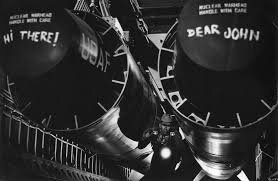
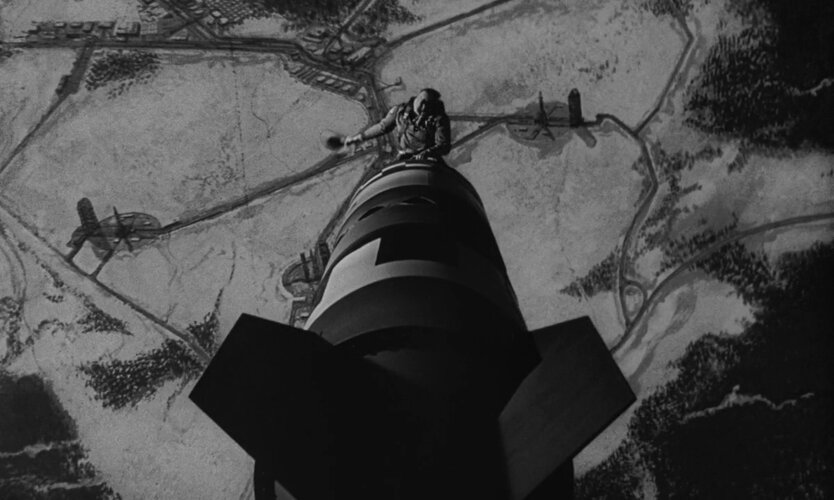
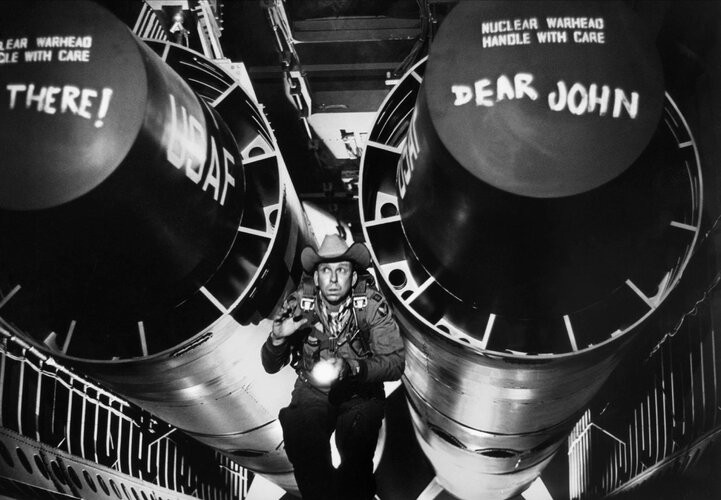
I have to admit that ever since I watched the movie for the first time I wondered about the kludgy aerodynamics of the bombs themselves and even much more so of anybody riding them (as well as any associated asphyxia issues) ... and also, who was that mysterious "Dear John" character supposed to be? An inquiring German mind wants to know.These messages, maybe. (Seriously, tho., their existence is the message.)
View attachment 701481

I have to admit that even when I watched the movie for the first time I wondered about the aerodynamics of the bombs themselves as well as of anybody riding them... and also, who was that John???
Thank you honestly for the cultural background, but I *still* can't make logical sense of the concrete context of the particular situation - why would any male USAF active service member spray an (anticipated or even received?) breakup message from their former female partner on a strategic weapon system? But perhaps I'm being too Sheldon here (and this is an absolutely honest question - imagine Mr. Spock with a quizzical look on his face here...)? In summary, I just don't get it, as is the case with ever more things in our current universe...I have to admit that even when I watched the movie for the first time I wondered about the aerodynamics of the bombs themselves as well as of anybody riding them... and also, who was that John???
It's a reference to the infamous "Dear John"-type letters that a GI would receive during WW2 from a former lover back home, announcing the end of a relationship.
https://time.com/6137746/dear-john-letters-world-war-ii/


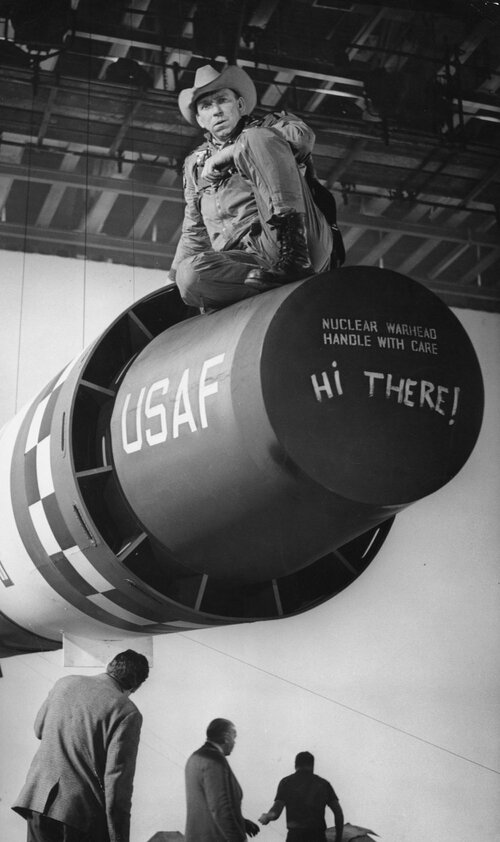
Actually, as a matter of fact, I would indeed also ask exactly who the "Hi there" graffiti is directed to - as a child growing up in Germany in the Sixties, I am utterly lacking any cultural context or reference frame for that message as well - which gender is it aimed at, if any?Stick with it MartinBayer, you'll get it (you could as easily ask who the "Hi there" is directed to).
Meanwhile the prize goes to Slim Pickens:
View: https://youtu.be/nRY5-6Fikz0
Either.Actually, as a matter of fact, I would indeed also ask exactly who the "Hi there" graffiti is directed to - as a child growing up in Germany in the Sixties, I am utterly lacking any cultural context or reference frame for that message as well - which gender is it aimed at, if any?
Actually, as a matter of fact, I would indeed also ask exactly who the "Hi there" graffiti is directed to - as a child growing up in Germany in the Sixties, I am utterly lacking any cultural context or reference frame for that message as well - which gender is it aimed at, if any?Stick with it MartinBayer, you'll get it (you could as easily ask who the "Hi there" is directed to).
Meanwhile the prize goes to Slim Pickens:
View: https://youtu.be/nRY5-6Fikz0
During the Second World War, German bomb handlers would paint messages on some bombs, like 'Happy Easter' or "For Stalin.' Unlike their crass American counterparts who painted 'pin-ups' on the noses on some of their bombers (yes, some; it was not universal), they would paint a bomb going through Chamberlain's umbrella. This was to convey an attitude toward the enemy.
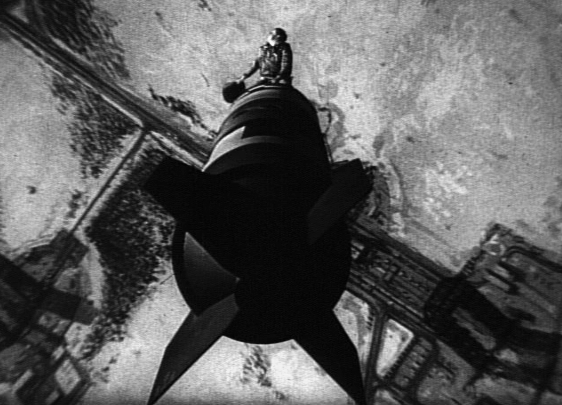
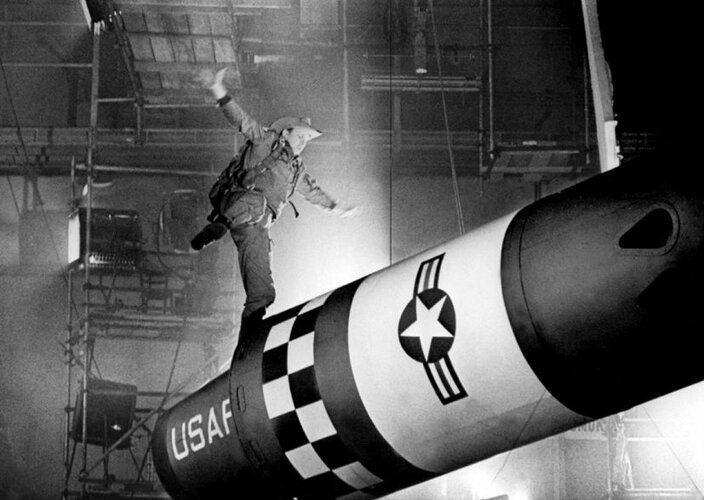
While IRL I doubt Major Kong would have even been able to hold on to the bomb, I think the film-makers did well to play it for humour. As for asphyxia, they were coming in under the radar sufficiently low that breathing wouldn't be a problem for him. World War 1 pilots probably flew and fought without oxygen at higher altitudes than that B-52 was when they dropped.the kludgy aerodynamics of the bombs themselves and even much more so of anybody riding them (as well as any associated asphyxia issues)
During the Second World War, German bomb handlers would paint messages on some bombs, like 'Happy Easter' or "For Stalin.' Unlike their crass American counterparts who painted 'pin-ups' on the noses on some of their bombers (yes, some; it was not universal), they would paint a bomb going through Chamberlain's umbrella. This was to convey an attitude toward the enemy.
"Crass?" Hmmm...
Worldview 1: A bomb dropping on an enemy sez "this is what we're fighting against."
Worldview 2: A hot chick sez "this is what we're fighting *for.*"
Both are valid, but I'd argue the former to be more crass.
While IRL I doubt Major Kong would have even been able to hold on to the bomb, I think the film-makers did well to play it for humour. As for asphyxia, they were coming in under the radar sufficiently low that breathing wouldn't be a problem for him. World War 1 pilots probably flew and fought without oxygen at higher altitudes than that B-52 was when they dropped.the kludgy aerodynamics of the bombs themselves and even much more so of anybody riding them (as well as any associated asphyxia issues)
I also suspect that the bombs' design is not reflective of reality. If they are, a nuclear bomb designed for internal carriage on a strategic bomber like the B-52 can afford to be high-drag; its business is to slow down as soon as it's released and start making for the ground, giving the launch aircraft time to put distance between; not to retain speed and continue keeping pace with the aircraft that dropped it. Nukes designed for external carriage under tactical bombers are usually dropped in parachute-retarded laydowns or lob-toss manouevres designed to throw the bomb toward the target while the aircraft exits in a different direction.
Hmmm, I see. We wuz fighten' so dat da Nazis wouldn't overrun England and Russia, as once said by Popeye the Sailor.
Hmmm, I see. We wuz fighten' so dat da Nazis wouldn't overrun England and Russia, as once said by Popeye the Sailor.
Nah. We were fighting to keep Nazi mitts off American hotness.
The US gave zero damns about Nazis whacking Commies. We gave maybe a third of a damn about the Brits. But Betty Grable? Yeah, lotsa damns given there. Helping the Sovs and the Brits was just a means to an end.
There's reasons given, then there's the real reasons. The think your average GI gave a rats ass about saving Stalin?


Although made about the US Dr Strangelove was a very British comedy film in the spirit of the BBC TV show "That was the week that was.." and the magazine "Private Eye".. Satyr humour in the film is much easier for a British viewer than our friends abroad.
The messages on the bombs are British takes on US slang (Dear John letters led to many Brit women going Stateside and Hi there had come into British use from all our US friends).
Even the design of the bombs is a very Gerry Amderson home made look from an old battery with balsa wood fins!
Perhaps the most British aspect of the film is the dark haired actress playing the Playmate of the Month.. Look at a picture of Christine Keeler who brought down the Macmillan government and you ll see a distinct likeness. A US General's babe would have had peroxide blonde hair!
The joke about fluoride in the water is another clue. This issue was big in Britain in the early 60s.
Maybe Hollywood should get its own back with a film about a deranged British Prime Minister (far fetched! I know) nuking Moscow.
It's a satirical comedy made with no cooperation from the USAF or Boeing or whoever, so we need to cut some slack. Kubrick being a super-nerd managed to get together a B-52 cockpit that actually looked realistic.
Perhaps the saving grace of the film was Peter Seller's falling off the B-52 set and breaking bones and being unable to play the role of Major Kong. I don't think that he could have done it as well as Slim Pickens. Saying that Sterling Hayden did well to keep it together with Seller's ad libbing things like "the string has gone in my leg..."
Now let us also discuss the contemporary, very bleak, and not at all comedic "Fail Safe".
If you can find a copy of the novel, it's somewhat different from the film but no less enlightening and horrifying.
The one thing the two have in common is that unknown to the authors, the basic premise was flawed (Source: Men Who Play God: The Story of the Hydrogen Bomb by Norman Moss). Everything that flows from it, however, was very well handled.
https://en.wikipedia.org/wiki/Stanislav_PetrovNow let us also discuss the contemporary, very bleak, and not at all comedic "Fail Safe".
If you can find a copy of the novel, it's somewhat different from the film but no less enlightening and horrifying.
The one thing the two have in common is that unknown to the authors, the basic premise was flawed (Source: Men Who Play God: The Story of the Hydrogen Bomb by Norman Moss). Everything that flows from it, however, was very well handled.
I saw it and it reflected U.S. planning at the time. Unknown to movie audiences, there were other measures that were undoubtedly in place to prevent such a scenario. Trust me, both I and the people I knew had a great time in the 1960s. We knew this was just a movie, not real life.
Not long ago, I saw an interview with the former head of Russian Space Forces. He related that in the late 1960s, he received an alert of an attack by the United States. As he looked into it, it appeared we had launched all missiles. He had 15 minutes to decide what to do. He dispatched two high-speed aircraft to certain coordinates which would show a launch of this magnitude. The pilots saw nothing. Russian agents in the U.S. also saw nothing. He announced an end to the alert. Later, it was discovered that Russian satellites designed to detect a launch had been triggered by the sun reflecting off the tops of clouds at a certain altitude.

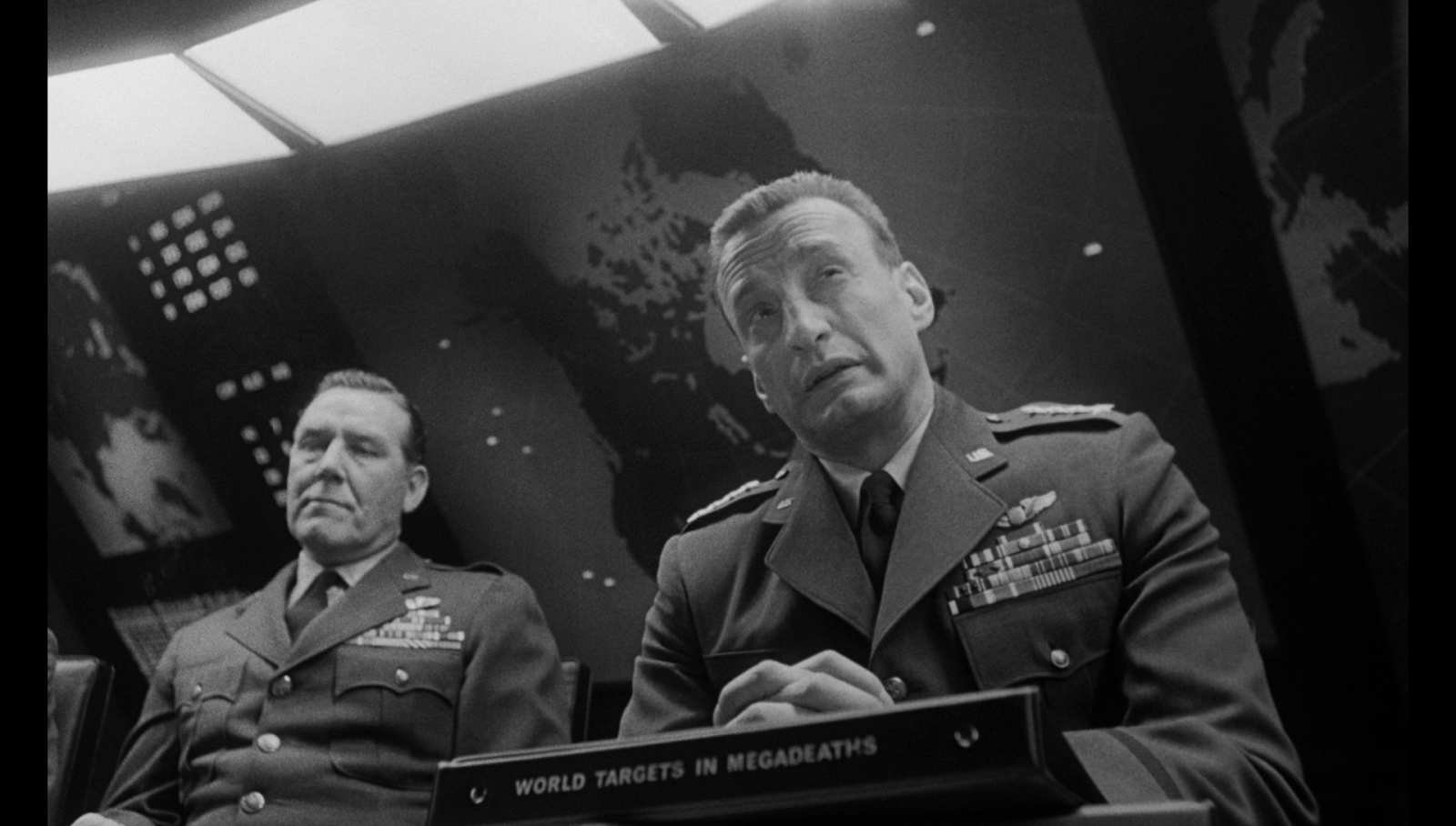

The flaw that Moss wrote of is that the order to attack isn't an electronic signal that could go out by accident (as it does in the film, thanks to a single blown transistor). According to him, SAC training also emphasized that if your aircraft has not specifically received a directed attack order, you turn back at the failsafe line - even (as one pilot tried to argue) if the rest of your flight is going ahead and you see mushroom clouds rising behind you.Unknown to movie audiences, there were other measures that were undoubtedly in place to prevent such a scenario.
Also, national markings on that kind of system seem rather unnecessary.The *size* of the bomb is about right, but the shape is wholly fantastical. That annular inlet is just kinda weird.
Fail Safe (1964) is grimm vision how highly automatic system fails do blown transistor, issue automatic Attack order to Bombers.Now let us also discuss the contemporary, very bleak, and not at all comedic "Fail Safe".