Atlas FCA-1 Carver fighter project

I think we are talking official.
The fibreglass display model of the twin engined model is an official model, but as stated, is really giving an idea of what the twin engined model looked like, as opposed to a developed wind tunnel model.

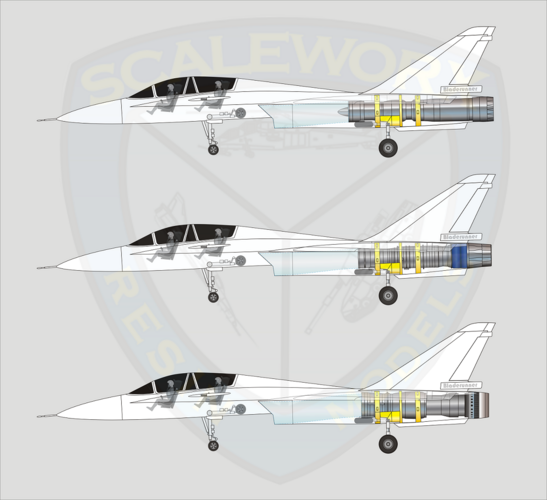
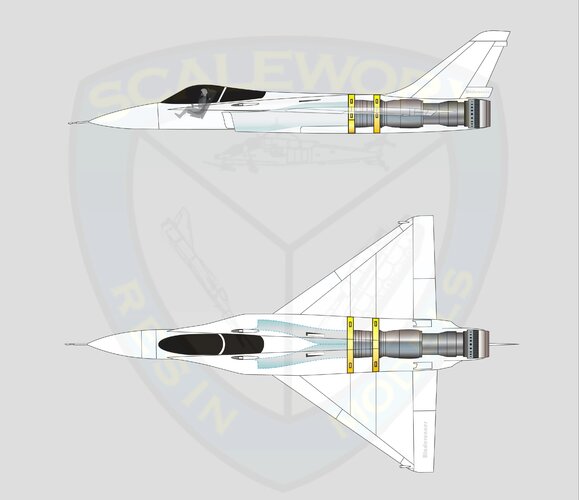
That drawing above is a non-official extrapolation of the fact that when the project moved from a single engined model to a twin, various configurations were looked at.
These looked-at configurations included single and twin vertical stabilisers.

From the shape and overall layout, the twin-engined variant was in the Mirage 4000 size category, whilst the single engine was in the Mirage 2000 size category..but perhaps marginally bigger due to the requirement for greater range needed by South Africa considering the much larger theatre they were operating in.

In any event, the displayed model of the twin engined variant is only one of the models.
It has been stated by some who have seen them, that there were definitely single and twin vertical stabiliser models.

It is a beautiful looking design either way.

Edit: Thorn..could you not perhaps tap into some of your previous contacts from your previous work in another life and find out more? ;)
Hi kaiserbill

Regarding the edit. I think that I have a good idea, but check out my conversation with you just to make sure... .
 
The SMR project kicked off in 1989 but I would guess high level discussions opening up the possibility thereof must have been going from 1988 already. Actual technical work only started in 1990 with the SA team going to Russia. They operated as Aerosud as pseudo independant from Atlas. Carver was cancelled in 1990/91 odd to the best of what I can asertain.

Other than an Atar powered single engine design no other engine/airframe combo to the best available information proceeded very far at all.
Thanks for the timeline. Saved me some online browsing and local database diving.
 
About the size of the twin engine model:

An engineer on the project explained to me that the engine size and weight offers clues as to the eventual size.
This is common sense, and I knew that there was a rough "rule-of-thumb" regarding this before our conversation.

It therefore stands to reason that if the upgraded indigenous ATAR 9k50 was to be used, an aircraft in the same weight and size class as the Mirage 4000 would be the result.
Ditto for a Spey powered example.
If the Aerosud engine was used, some minor gains in making it smaller and lighter could be achieved...probably approximating around a ton in weight.
If the mooted under-the-counter purchase of the M88 had come about, then an aircraft perhaps only marginally heavier and larger than the Rafale.

A completely indigenous engine would only result in complete speculation.

The upgraded ATAR 9k50 had, amongst others, as two of its major goals:
1: A thrust increase.
2: weight reduction.

The thrust increase was apparently achieved (10%).
The weight reduction did not achieve as much as was aimed at before cancellation.
Not much by way of M88 I could find regarding this powerplant & SA, but found this at https://hushkit.net/2019/06/25/10-exotic-cancelled-fighters-from-countries-you-didnt-expect/

"The nation did not have the know-how to build its own jet engines and instead unsuccessfully attempted to acquire French M53s and designs for the M88 by subterfuge, and it was stuck with the elderly Snecma Atar".
 
If you are looking at Spey, then why not RB.199?

I thought the British cut them off from major programs in that timeframe.
 
If you are looking at Spey, then why not RB.199?

I thought the British cut them off from major programs in that timeframe.
This is not just a matter of going to the market and picking the engine you want thanks to the sanctions. SA could not even get their hands on J79's from Israel thanks to the strong US link. Obtaining engines needed a seller willing to look the other way and a middleman to hide behind. That is mostly how extra Atar's were obtained.

The Spey was in use on the Buccaneer so there was local familiarity in servicing it although the 101 and 202/3 still have plenty differences. The Spey 202/3 was only used on UK aircraft so no international partners involved unlike with RB199 and it being an older technology engine by this time period maybe under less scrutiny. It must be noted that everything that emerged thus far still points to the Atar as choice engine - simply because of availability I imagine. RR's support was mainly on spares level from 1985 onwards. As I said previously, obtaining enough engines to fit to a fighter fleet with spares is different than getting one or two as is the case with Spey 202/3.

Edit: Kaiserbill brings up some interesting links to exporting the reheat Spey... I still mark it as an outside chance, but certainly not impossible.
 
Last edited:
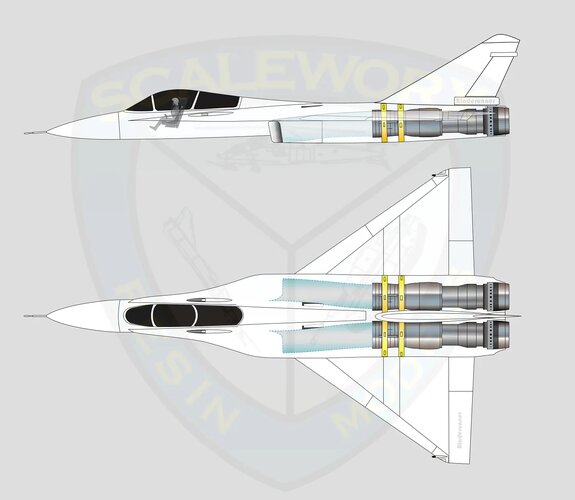
The three most likely candidates for a powerplant would probably be the reheated Spey, SMR-95 and the ATAR 09k50. I drew all three engines to scale for my twin tail fin illustration to compare their size in the fuselage, and the Spey is quite girthy...lol
 

Attachments

  • Carver B-Twin 3 PP -2.png
    Carver B-Twin 3 PP -2.png
    617 KB · Views: 447
The positives on the Spey extend to greater flexibility in a future engine replacement.

One can also see post Apartheid RR trying to flog 205 as an upgrade.

It would also put the twin engined Carver into F4 or F15 scale. No mean achievement if they had done it.
 
Black Mamba, did you manage to find the pics of the Speys at Swartkop?

I find it particularly interesting the point that, as you said, Atlas re-established good relations with Rolls Royce from 1985 onwards, allowing spares for the Buccaneer Spey engines.
This was at the height of sanctions, although I know plenty of under-the- counter dealing went on.
And it's also a crucial time period of the Carver program.

The head of RR at Atlas that mentioned the Spey in relation to the Carver... I assume this was the South African liaison dealing with RR?

It's an intriguing situation.
Not just for perhaps wholly imported engines, but rather for engines built up from imported components with perhaps locally manufactured add-ons.
With a different afterburner section, or exhaust nozzle for example, it could be presented and carried off as a local development of the Spey. There is precedent for this type of subterfuge.
The local turbine industry certainly was moving in the direction of local production and development of turbine blades (including single crystal), hot sections, design, gearboxes etc.

A South African company for example ended up manufacturing gearboxes for RR turbofans in the early/mid 1990's, shortly after sanctions ended.
Clearly, to move with that rapidity, they were utilising work and infrastructure done previously.
 
Last edited:
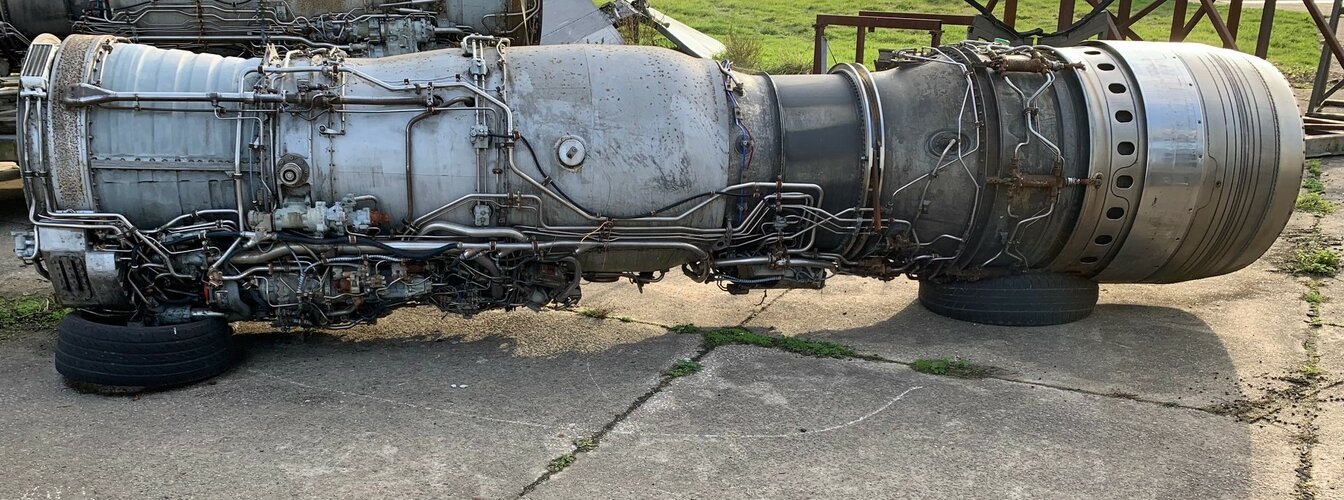
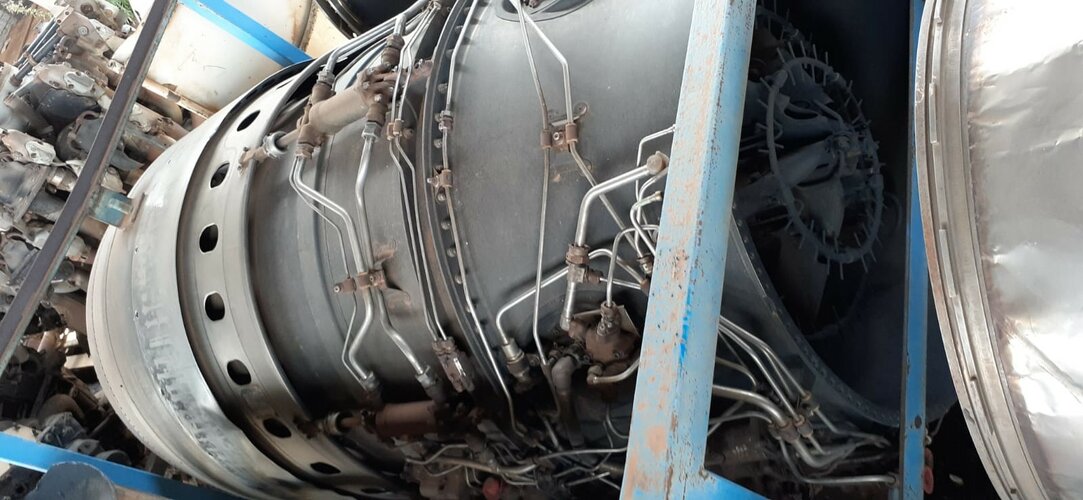
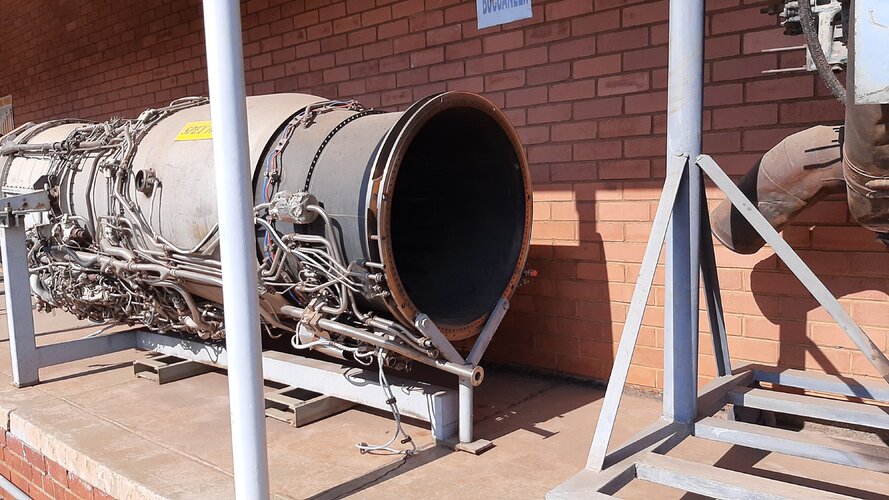
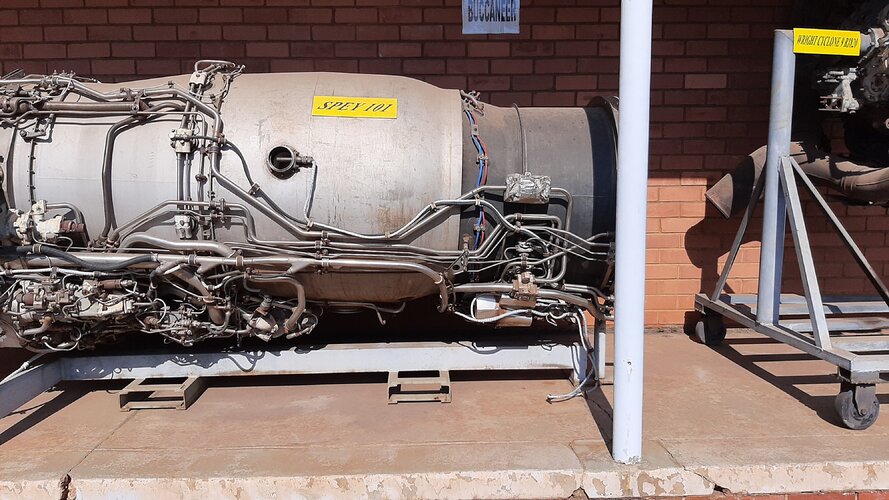
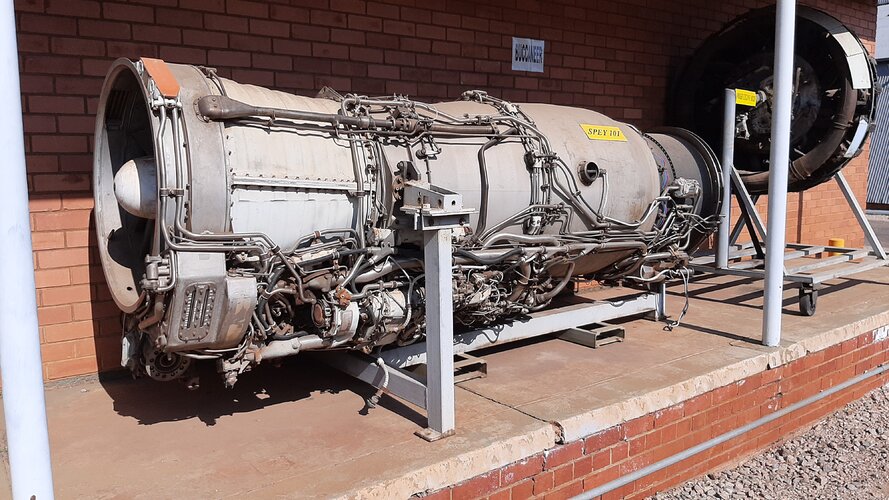
It is somewhat hidden in between other engines, but I attach a admittedly poor pic of the reheat section - I have not been able to get to the scrapyard to get better pictures. I also attach some pics of the Spey forward section (exactly the same as the other forward section in the scrapyard beside the reheat section) on public display incorrectly marked as a Spey 101 (they also have a SMR-95 marked as a RD-33...). Notice how even the external plumbing is a match for the attached Phantom Spey.

The head of RR at Atlas that mentioned the Spey in relation to the Carver... I assume this was the South African liaison dealing with RR?
He was in charge of all RR service work at Atlas. I assume some level of direct comunication with RR was involved?

It's an intriguing situation.
Not just for perhaps wholly imported engines, but rather for engines built up from imported components with perhaps locally manufactured add-ons.
With a different afterburner section, or exhaust nozzle for example, it could be presented and carried off as a local development of the Spey. There is precedent for this type of subterfuge.
The local turbine industry certainly was moving in the direction of local production and development of turbine blades (including single crystal), hot sections, design, gearboxes etc.
Atlas did initially pass off the Turbomeca Makila used in the Oryx and Rooivalk as the Atlas Topaz so even a straight rebrand is not off the table...
 

Attachments

  • Spey.06.jpg
    Spey.06.jpg
    546.7 KB · Views: 317
  • Reheat section.jpg
    Reheat section.jpg
    261.4 KB · Views: 147
  • Spey3.jpg
    Spey3.jpg
    2.3 MB · Views: 138
  • Spey2.jpg
    Spey2.jpg
    2.5 MB · Views: 141
  • Spey1.jpg
    Spey1.jpg
    2.6 MB · Views: 281
Very very interesting. Thanks.
Would be interesting to discover the date these were acquired, and their providence.
 
Last edited:
The Spey was definitely proposed as a powerplant for the single engine Carver, and would have been a sensible option for the twin engined designs. Had some more fun with illustrations of the single seat twin engined version with the single tail fin (the fiberglass model that was at the Rand Show) with Spey engines, and it looks plausible.
 

Attachments

  • 20230531_021236.jpg
    20230531_021236.jpg
    343.9 KB · Views: 364
How does the original Spey Mk202/203 exhaust/afterburner nozzle though compare with more modern fully variable exhaust nozzle that came afterwards?
I suspect there was considerable room for improvement there, considering the 20-25 years of passage between the 1960's Spey and the late 1980's.
Does anyone know what work was done in that area for the developed 25 000lbs Spey Mk205 that was kicking around in the same timeframe as Carver in the mid/late 1980's?
 
Re the Cheetah & F1 - the engine was the same with both airframes from talking to the engineer, but the cold feathers where different (obviously). They however were part of the airframe and not the engine - they connected the the SMR's hot flaps so the engine inside wasn't required to be different, but the tailfeather cone was to match the airframe.

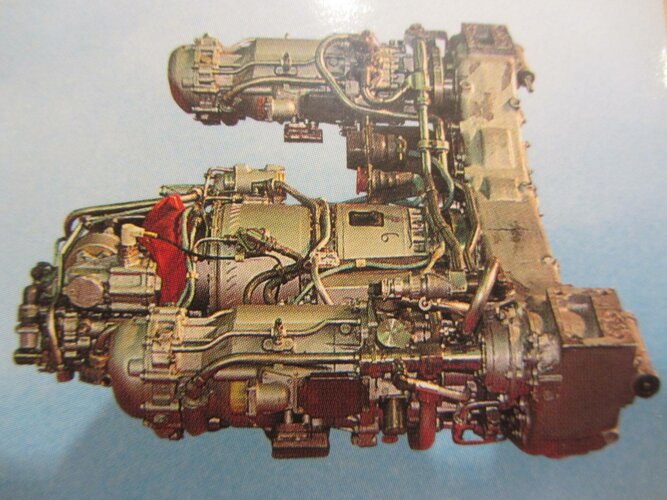
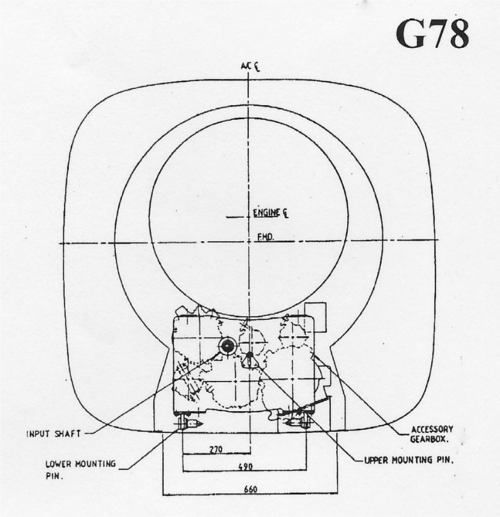
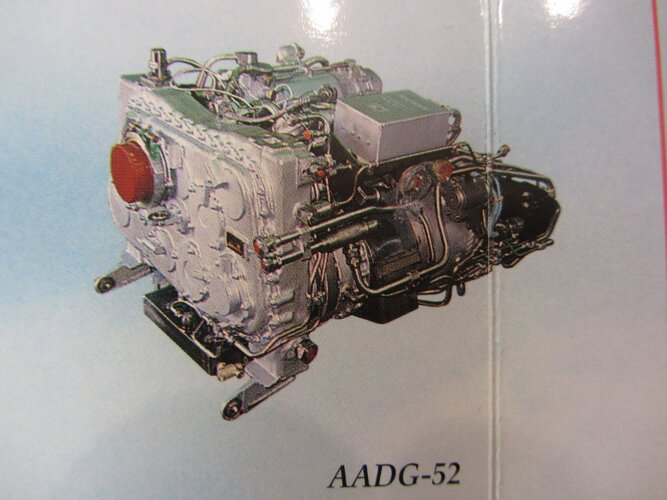
This post of mine from a while ago recently came up again. In the meantime it was confirmed that there was an SMR-95A and B for the Mirage F1 and Cheetah. The difference however was not in the actual engine but in the gearbox accesories. The Cheetah/Mirage III had less airframe space below the engine compared to the F1 so required a different gearbox configuration. Klimov saw and sold the gearbox and engine as a combo, and since the gearboxes differed from there the variants -A and -B.

As to Carver II, I would reason the lower profile Cheetah gearbox would be the prefered choice but that is pure speculation on my part. From that post I still maintain that had the SMR ended up in Carver, it would have been no different from the one used in the other types to retain commonality.
 
This post of mine from a while ago recently came up again. In the meantime it was confirmed that there was an SMR-95A and B for the Mirage F1 and Cheetah. The difference however was not in the actual engine but in the gearbox accesories. The Cheetah/Mirage III had less airframe space below the engine compared to the F1 so required a different gearbox configuration. Klimov saw and sold the gearbox and engine as a combo, and since the gearboxes differed from there the variants -A and -B.

As to Carver II, I would reason the lower profile Cheetah gearbox would be the prefered choice but that is pure speculation on my part. From that post I still maintain that had the SMR ended up in Carver, it would have been no different from the one used in the other types to retain commonality.
Makes sense. The main difference between the various CFM-56 engines early on was where the accessory drives were. The KC-135R and Airbus engines were at the bottom of the engine, IIRC, while the 737 engines were on the sides. KC0135R engines were otherwise the same as on the 737s, same fan diameter etc.
 
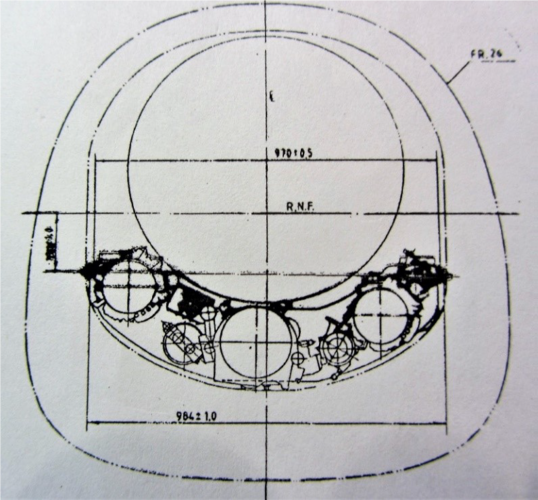
In clarity to my pervious post - I believe it was more to do with the location of the main gear and their retraction wells, than anything else. The Cheetah D (Mirage IIIDZ, D2Z and Nesher T based all with Atar 09C) was relatively easily upgraded to the same engine as the Mirage F1 namely the Atar 09k50. I do not believe the engine change required gearbox changes, but rather engine control connection changes etc. Both shared the same mounting points. From the attached pictures I think it is clear why I think the Cheetah gearbox would have received the nod for Carver II. Development had already switched to a twin when the SMR project became a reality thus my exclusion of it for consideration in the single engine design.

Cheetah gearbox:
Cheetah gearbox installation.png
18768534_10156217924240558_2331564746444342304_o.jpg

Mirage F1 gearbox:
F1 gearbox layout.png
Mirage F1 gearbox.jpg
 
Last edited:
I have not been able to get to the scrapyard to get better pictures.
I have recently finally managed to arrange entry to the scrapyard again to photograph the Spey 202. I find it very interesting that South Africa managed to obtain atleast one and a half Spey 202's which certainly adds fuel to the fire that Carver considered it as a option. I am sure somewhere the additional reheat section should still be around.

Other than these two I don't know and doubt if more were obtained. Perhaps that was all possible, or it was decided something else was a better option? Who knows...
 

Attachments

  • Spey 202 Swartkop.jpg
    Spey 202 Swartkop.jpg
    4.2 MB · Views: 91
  • Spey reheat 1.jpg
    Spey reheat 1.jpg
    1.4 MB · Views: 80
  • Spey reheat 2.jpg
    Spey reheat 2.jpg
    3.7 MB · Views: 71
  • Spey reheat 3.jpg
    Spey reheat 3.jpg
    3.4 MB · Views: 138
The 202s might also have been acquired from China, as the UK had transferred the tech to China for the WS-9 for the JH-7….
While an interesting possibility especially given later work with the Soviets, the timing doesn't work. Besides the RR dataplates on them indicating UK rather than chinese produced engines, Carver only picked up steam towards the mid-1980's.

From what I gather the UK - Chinese Spey technology transfer happened in the mid-1970s so one could not really siphon off a quantity of engines to SA as part of that deal - especially as at the time there would have been no interest in them.
 
The only reason for acquiring a reheated Spey is for a supersonic fighter project.
No aircraft in South Africa's inventory used a reheated Spey.
The only possible projects were the Cheetah C or Carver.
Cheetah C was meant to be an interim project until revised Carver became available later, so pretty self explainable.
Be interesting to know the actual story behind this, and dates.
Thanks Black Mamba...very interesting.

Edit:
Black Mamba, surely somebody at the museum might have an inkling of how these engines wound up there in their engine store?
Somebody (management?) would surely have asked a question or two as to their providence when these were offered to the museum?
 
Last edited:
I couldn't locate an full engine data plate with serial, but some items had Rolls Royce dataplates on them so they are UK produced Speys.
Interesting!

Wouldnt the only source of RR Spey 202s at this point have been the UK MoD?
 
Interesting!

Wouldnt the only source of RR Spey 202s at this point have been the UK MoD?
The Chinese JH7 used the 202, first as British made imported engines, then later licence produced.
This occurred right at the same time the Carver project was in full swing.
The problem with that is that South Africa and China were completely opposed at the time, with strong trade and full diplomatic relations only between Taiwan and South Africa.
Romania had a fighter project (IAR-95) that was to be powered by an afterburning Spey, although this seemed to go nowhere.
They took a licence in 1980 (For the 512-14 DW) and indeed manufactured the Spey, albeit in non afterburning form as part of their BAC 111 programme. This was also at the same time as Carver.
http://bac1-11jet.co.uk/bac1-11jet.co.uk Rombac.htm
Still, as mentioned earlier in this thread Rolls Royce had started resupplying spares to SAAF non afterburning Spey engines as used in the Buccaneer.
Black Mamba says the manufacturing plates were RR, so it must strongly be assumed that these came directly from Britain. The balance of probability always strongly favoured the UK instead of the other two.
Whether from the MOD or from RR is anybodies guess.

It would be really interesting to find out the history/providence of these engines.
Any chance of getting a pic of those plates Black Mamba?
 
Last edited:
Any chance of getting a pic of those plates Black Mamba?
The world, publically, was very opposed to Apartheid South Africa, but in the less public military industry sphere there was less opposition... I also strongly believe these Speys came direct from RR. Possibly diverged from another intended/faked destination hence not a reliable source and hence why Carver didn't full on commit to Spey 202.

I will see if I can arrange some photos of them. I have left the province so it makes things more difficult...
 
Black Mamba says the manufacturing plates were RR, so it must strongly be assumed that these came directly from Britain. The balance of probability always strongly favoured the UK instead of the other two.
Whether from the MOD or from RR is anybodies guess.

The RAF started winding down it's Phantom fleet in 1987, 29 Squadron at Conningsby being the first to go. I don't know exactly how the aircraft were disposed of but the photos of the dumped airframes I have seen show them with engines removed. A hypothesis, Spey 202s started to be sold for scrap by the UK MOD in the late 1980s. At that point it would have been relatively easy for South Africa to acquire them and it could have been done without the knowledge or consent of either Rolls Royce or the MOD.

Presumably the disposal of the Phantom engines would have been similar to the sale of the engines from the Vulcans, Conways, which was an open tender as described in Parliament:

Vulcan bomber engines contain no precious metals. The modules and components which together comprise an Olympus engine contain a variety of special steels and other alloys. The engine heat shield, though strictly not part of the engine, is fabricated from an alloy of titanium.

Surplus engines were disposed of by competitive tender. A number of firms—including the original manufacturers of the engine and firms which specialise in the recovery of spares and scrap materials from aircraft and aircraft engines—were invited to bid. Heat shields, because of the specialist nature of titanium bearing scrap, were sold separately under open tender arrangements directed to appropriate firms.

The Department has made no estimate of the intrinsic value of metals contained in an Olympus engine. Open tender procedures ensure competitive offers for any component, material or element which can be commercially recovered from aero-engine scrap.
 
Last edited:
JFC Fuller, I also think that is probably the likely scenario.
It is well known now that Armscor and the intelligence services operated a vast network of shell companies in Europe, Asia, and the Americas doing sanctions busting and technology acquisition. I recall off the top of my head that shell companies were operating in Guernsey and Jersey for example, amongst many others.
This would have been relatively achievable.

The two likely scenarios for these engines are:

1. Under the counter dealings with MOD/RR and a straight purchase.
Supporting this is the information earlier given in this thread that the RR representative in South Africa stated that RR had started resupplying spares for the Buccaneers Speys in SAAF service, and that Spey was a contender for Carver.
I do agree with the earlier poster that this would entail a purchase of likely a couple of hundred engines, making this extremely unlikely. Even though RR had gone against law with the China Spey deal.

2. This was a limited purchase.
The only reason for this scenario was for studying or technical appraisal or technology acquisition.
And the only reason for that would be injection into a locally designed engine.
South Africa had technical know how and indeed a production licence for the ATAR 9k50, but they wanted an afterburning turbofan for Carver. And this was an afterburning fighter turbofan to study at leisure.
We know that this (an indigenous option) was on the table (as a last, eventual option) due to various technical development projects within SA, even though this was definitely the last insurance policy if an existing engine could not be sourced due to the sheer expense of developing a new engine.

Either way, as mentioned before, the presence of two afterburning mk202 engines in the SAAF museum is fascinating.
Unless it was part of an inter museum exchange which is extremely unlikely as it was never used on any platform in SA, it had to have come from or been gifted by the SAAF or a government agency (Atlas or Armscor etc) to the museum in my opinion.
 
Last edited:
The Spey matter is an interesting one to me. We have someone at Atlas saying Spey would have been the engine used - he likely was asked to do a feasibility study in supporting the engine. That Said, Atlas and the general defense industry at the time was so compartmentalised at the time that very, very few people knew the full picture.

Hence the point of them being aquired as study and reference samples feeding into a local engine also seems very plausible. Certainly easier getting small samples than enough to equip a Squdron or two worth of aircraft.

By the late 1980s Carver was in a bit of a spin with too many options and variants floating around within Atlas to deal with the shift in requirements so who really knows why they acquired Speys...

I am pretty sure they came from Atlas. One engine is dismantled and is dispalyed incorrectly marked as a Spey 101 though that I suspect is the museum itself being told this is a Buccaneer engine. The scrapyard has, I recall, around four 09Bs, and the post afterburner section from an 09C/09K50. Some more Impala Viper engines and a Sabre Orenda is floating around in there too. Looks almost like someone wanted an old engine storage shed at Denel cleared and when queried about what to do with the engines was told "send them to the museum".
They also have another 09B on display in the museum as well as a 09k50 and a SMR-95.
 
When looking at engine choices, and numbers, we simply have to look at what Carver was aimed at.
It was intended to replace not only the fighter fleet (Mirage III, F1, and Cheetah) but also the longer range strike fleet such as Buccaneer and Canberra. This last requirement is what drove the change to a twin engine design change after the de facto completion of the single engine design.

When one looks at fleet and squadron numbers, particularly considering the conflict that was ongoing at the time in Southern Africa, as well as the Soviet support and regional introduction of the MiG-23 (and distinct later possible/probable introduction of the MiG-29 etc), you are looking at an eventual fleet of over 100 aircraft.

The Mirage/Cheetah fleet was always around the 100 aircraft mark. The initial intention was a licence produced fleet of 100 Mirage F1's.
Add the twin engine strike aircraft (Canberra and Buccaneers) squadrons, perhaps an OCU component too in a Conflict situation, and you are looking at a fleet of around 130 aircraft. Very similar to the AIDC F-ck-1 production run in Taiwan.
So that is quite a few engines needed....and doubled up numbers in twin engine configuration.
It's not too far off the total UK Spey engined Phantom production run in numbers actually.

Having said that, I don't actually think that number of Speys, even in the Carver single engine format, would have been a simple matter of importation. So I have doubts..

Still, with the Soviet introduction regionally of more modern fighters, South Africa clearly weren't going to do nothing and sit still about the situation.
The expensive aerospace design infrastructure, and knowledge acquisition, as well as the development of standoff weapons (some large) point to this.
The engine issue would be resolved, one way or another.
 
Last edited:
Do we have some idea on how many carvers south africa was planning to buy when it stated this project?
Nothing official or rumoured has ever emerged. That said, looking at the Impala production run of Mk.1 (151 A/C) and Mk.2 (100 A/C) and considering the force size of Mirages and Cheetahs SA tried to maintain I think Kaiserbill's estimate of around 100 aircraft is a very good guess from a force size and a scale of economy view point.
 
Nothing official or rumoured has ever emerged. That said, looking at the Impala production run of Mk.1 (151 A/C) and Mk.2 (100 A/C) and considering the force size of Mirages and Cheetahs SA tried to maintain I think Kaiserbill's estimate of around 100 aircraft is a very good guess from a force size and a scale of economy view point.
The licence production taken by South Africa on 27th June 1971 for the Mirage F1 and ATAR 9K50 was with the intention of a fleet of 100 Mirage F1's.
The stated intention behind the F1 purchase was to replace the Mirage III fleet acquired before, as well as the Canadair Sabre Mk.6.
The arms embargo in 1977 threw a spanner in the works concerning the second part of that plan, and 48 F1's were bought from France, with local assembly.
A total of 58 Mirage III airframes of all versions were acquired.

South Africa's Mirage III and F1 fleet numbered around 100 airframes.
Before that, the Mirage III and Sabre Mk.6 fleet a little under 100.

But......

This plan (F1 totals) was based on the threat level of 1971.
The situation in the mid to late 80's was dynamically different, with conflict having subsequently broken out, and Soviet, Cuban, and Warsaw Pact support into Southern Africa multiplying, especially in the aerospace realm.
When one looks at this changed situation, plus the dwindling Buccaneer fleet and obsolete Canberra that also needed to he replaced, I think it is safe to conclude a production run for Carver of over 100..probably more along the lines of 130 minimum, perhaps a bit more.
This would include fighter, strike, as well as Operational Conversion Units (OCU) and trainers.
The strike component was just as essential a part in the programme as the fighter part.

An equally vital part was independence from overseas suppliers and the vagaries of politics. A long, tailored production run would be my guess, replacing the various other aircraft in stages as needed.
I suspect the F1 fleet, pre Cheetah C, would be the last to go.
 
Last edited:
Is anybody aware or have more concrete info on what year or date the larger twin engined Carver superseded the first single engine Carver design that was nearing fruition?
 
Is anybody aware or have more concrete info on what year or date the larger twin engined Carver superseded the first single engine Carver design that was nearing fruition?
Best info I have heard over the years is by around 1988 when the new CAF came in and requested a more multirole aircraft. That is a pretty vague timeline though.

Fighter pilots receiced a briefing around single and twin engine concepts while at an Upington ACM camp. From the description it sounded like it happened at the June 1989 camp. The Atar 09k50 was still the engine of choice as decribed at the time which didn't impress the pilots at all! It sounds like the project team who gave the presentation wasn't convinced by the twin design and wanted to revert back to a single while the pilots, knowing the F1 already wasn't cutting it against the latest MiGs, pushed for two in hopes of getting a higher performance aircraft.

The issue of course is double the engines requires double the fuel. More fuel and two engines needs a bigger airframe and additional systems to support it all so your structural mass also goes up and the end result is you end up more or less at parity again thrust to weight wise compared to a single. The conclusion really was the Atar wouldn't and couldn't cut it.

Strangely, 1989 if I recall events correctly, was also the year that the SMR project kicked off in earnest although negotiations seems to have started around 1987 already.
 
There was an aircraft with a pair of 9K50, historically: the Mirage G8. The two Mirage G8, 01 and 02 were blistering fast - Mach 2.35, still accelerating, hitting temperatures limits of the Atar. Of course they were nothing like the Carver : closer in shape from a Tornado. And to get a decent range they had to be pretty heavy - up to 24 tons.
Bottom line: a twin 9K50 airplane, if done right, could give a MiG-23 a run for its money.
 
Last edited:
There was an aircraft with a pair of 9K50, historically: the Mirage G8. The two Mirage G8, 01 and 02 were blistering fast - Mach 2.35, still accelerating, hitting temperatures limits of the Atar. Of course they were nothing like the Carver : closer in shape from a Tornado. And to get a decent range they had to be pretty heavy - up to 24 tons.
Bottom line: a twin 9K50 airplane, if done right, could give a MiG-23 a run for its money.
Indeed.
And once you remove the heavy swing wing mechanism/system and add to that the use of composites and other design elements over the 20 years since the G8 flew, you would see gains, particularly with a developed Atar plus pushing out 10% more power.
The fuel consumption would still be an issue though.
 
Last edited:
Black Mamba, thank you.
The reason I asked was because I was reviewing the change from single to twin engine, but could never find a definitive time for this, beyond what has always been generally intimated online:
That when Lieutenant General Denis Earp (Mirage pilot, but also flew Canberras) was replaced as Chief of the Airforce on 30th June 1988 by Lieutenant General Jan van Loggerenberg ( Sabres, Canberra, Buccaneer) the Carver under Van Loggerenberg was changed to be a larger twin engine design to also cover long range strike.

Flight was the only publication in those days that had reports mentioning the development of an indigenous Combat jet by South Africa.
I know they got many things wrong, such as the name, and detailed design features as examples, but nevertheless they clearly had been told about the project, even if only vocally in vague and general terms.

Yet, in December 1987 (7 months before van Loggerenberg was appointed) Flight already mention that a twin engine was potentially being looked at.
'Besides looking at a Lavi lookalike(which might be twin engined)"
https://web.archive.org/web/2015032...bal.com/pdfarchive/view/1987/1987 - 2650.html

Then in May 1989, 11 months after van Loggerenbergs appointment, it is now mentioned only in the context as a twin engine.
https://web.archive.org/web/2018010...bal.com/pdfarchive/view/1989/1989 - 1248.html
It appears to me that a twin engined aircraft was being strongly looked at before van Loggerenberg was Chief, but that he was probably the one that finally pushed the button.
 
Last edited:
Indeed.
And once you remove the heavy swing wing mechanism/system and add to that the use of composites and other design elements over the 20 years since the G8 flew, you would see gains, particularly with a developed Atar plus pushing out 10% more power.
The fuel consumption would still be an issue though.
Which bring us to the G8A (silly name, it was no longer VG) better known as ACF : Avion de Combat Futur (May 1972 - December 1975, unfinished prototype never flew). The G8-02 flew with its VG wing blocked at 55 degrees, and the ACF got a swept wing with that angle. By this point however the M53 was available for a push to Mach 2.5, which was done by the Mirage 4000, but that's another story.
 
Bottom line: a twin 9K50 airplane, if done right, could give a MiG-23 a run for its money.
Unfortunately combat is more than top trumps. How fast did the aircraft accelerate? How much fuel did it use to attain these speeds? Did it carry any stores? There are plenty accounts of the amazing acceleration of the MiG-23 which counts far more in combat than top speed. Most Mirages had to fly special mission profiles with clean aircraft to reach Mach 2+ and had to return to base after with all their fuel gone.

Yes, I know the Mirage G8's were prototypes, but they in no way give an idea that the Atar 09k50 was the right engine for the job especially when the M53 was their intended engine from the start. Why else would Atlas attempt their level best to obtain pretty much every engine other than an Atar 09k50? Because the end result brought them back to an F1 more or less which simply didn't cut it.
 
Another aircraft with twin Atar 9k variants was the Mirage IV.

The Atar Plus South Africa were working on had 2 main design goals.
1: Thrust increase.
2: Weight reduction.

The thrust increase (10%) was achieved, but apparently the goals set out for weight reduction was not.
I am unsure what that goal was.

The programme also apparently had as a goal better throttle handling and spoolup times.

To these ends, the various improvements such as single crystal blades, new compressor, new turbine, modified combustion chamber, and new electronics.

But of course, a more modern engine was being sought for obvious reasons.
 
Last edited:
It appears to me that a twin engined aircraft was being strongly looked at before van Loggerenberg was Chief, but that he was probably the one that finally pushed the button.
Interesting. It wouldn't surprise me at all that twin studies started earlier. Given the engine limits it wouldn't surprise me that they hoped to use at the time modern manufacturing etc to try and extract extra performance with two Atars.

The change did set the design team back quite a bit so the decision could not have been taken lightly.

I wonder how much of the 10% increase Atar Plus was realistic? The eventual Atar Plus tested in an F1AZ and used in the Cheetah C, had minimal thrust increase. The biggest improvements were in reliability and spool up time. The afterburner, for example, kicked in in 1/10th the time compared to the standard 09k50. But the 09k50 was already at its limits and by this point you were draining water from a rock.
 

Similar threads

Back
Top Bottom