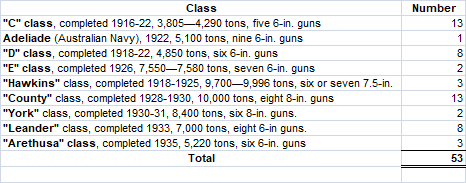
Interwar USN built to or near treaty limits

lancer21

ACCESS: Top Secret
Joined
9 January 2010
Messages
1,640
Reaction score
3,872
This is a spinoff from this topic which brought up some fascinating facts and figures for the major interwar navies
https://www.secretprojects.co.uk/th...ncapacitated-in-1934.40597/page-2#post-593376I wanted to explore a wider period re the USN. One of the common themes is the very anemic post WNT US naval construction in the 1920s and early 1930s. Here is a very interesting article putting more light on the subject:
https://www.usni.org/magazines/proceedings/1938/july/naval-race
So what if they build more interwar? I am thinking of at least more even handed replies to the IN 1923 and 1927 shipbuilding programs. For instance in reply to the 1923 IJN plan the 1924 USN program might add in adition to the CAs and gunboats the 12 DDs and 6 subs left over from the 1916 appropriations, and perhaps a handful of auxiliaries too. I have read in Friedman's that USN wanted some destroyer leaders at this time, so perhaps the DDs could be updated version of the 1919 2100 tons DD leader design. Also shipyards that went under at this time such as Bath and Cramp could be saved from bankrupcy if they receive contracts for a handful of CAs or DDs.

Also the CAs could be laid down earlier say 1925 to 1927, matching well the IJN CA construction.

In reply to the IJN 1927 program, perhaps the OTL cruiser bill of 1929 can be brought forward to 1928, and also include some DDs of new design (such as say a dozen or more of pre-Farraguts or updated leaders), subs, a few auxiliaries etc. The LNT will upset the plans of course, perhaps they won't be able to build the OTL Porter DDs if they have large leaders already built. It possibly may affect the post LNT DD building numbers, not sure, if they build or planned 24-30 or so DDs before the LNT in this scenario.

Next, in reply to the 1931 Maru 1 keikaku IJN program, the so called USN NIRA program can be brought up to 1932. I know it's depression and stuff, it may or may not be feasible to bring it up a year forward. Ideally the Brooklyns should be brought forward too, since more CAs were built earlier.

So my reasoning is if they are significantly closer to treaty limits at it's expiry in 1937 then the shipyards would not be quite so crowded (and perhaps in better shape) to allow earlier building of the BBs, as well as the ships of the Second Vinson act of 1938. As a comparison the british were having no less than 5 BBs laid down in 1937, plus the 4 Illustrious also in 1937, plus they were building loads of cruisers as well. In comparison the US managed a measly 1 BB in 1937, 1 in 1938, 3 BB and one CV in 1939 etc. and not a single CV in 1940, just 3 BBs.

If for instance they laid down 2 BB each in 1937, 1938, and 1939, and the two Vinson carriers in 1939, then their situation in early 1942 would be quite a lot better with 4 modern BBs not 2 and one extra CV. Possibly a few more modern cruisers such as Atlantas or Clevelands and some more modern DDs and subs? Oh and of course more naval planes for the extra CVs, and in general. Plus perhaps a few more CVEs?

This then gets to something i'm very curious about, namely how close was the USN in underage tonnage for cruisers, DDs, subs etc in 1941 compared to what they were supposed to have according to the expanded navy of the 1938 Vinson act (not counting the Two-Ocean Navy provisions or even the month earlier 11% increase, as they wouldn't have made a difference for late 1941 i believe). Presumably all the Clemsons were overage at this time, and most of the Omahas.
 
Last edited:
According to the 1938 second Vinson act, the USN was supposed to reach the following tonnage of underage ships:
660,000 tons of BBs
175,000 tons of CVs
412,524 tons of CA/CLs
228,000 tons of DDs
81,956 tons of subs

In what year was the increase supposed to be achieved? I must have seen the year somewhere, but i can't recall now if was it 1944 or earlier or later?
 
Have you read the actual acts? They can be downloaded from the internet. That's where the text of the First Vinson Act that I put in the other thread came from.
 
I did just found it actually in the wikipedia article, i skimmed through it but haven't seen anything about the timeframe unless i missed it. However Conway's says it was supposed to be spread over 10 years (3 BB, 2 CV, 9 CL, 23 DDs, 9 subs)

For reference:
 

Attachments

  • STATUTE-52-Pg401.pdf
    132.8 KB · Views: 18
Thanks, will have another look through it, must be some interesting info there. Though for this ATL i wasn't contemplating an interwar increase in size over treaty limits, or altering the treaties, or bigger ships etc.

Reading through the other topic i didn't realize until now the differences in overage ships ages for ships build before and after 1919. So as i understand then not all Omahas were underage. Also for BBs the limit was increased to 26 years, when was this at 1st LNT or 2nd LNT? I'll do some more reading.

PS: looks like it was during the second LNT where the battleship age was increased to 26 years,
 
Last edited:
This is a spinoff from this topic which brought up some fascinating facts and figures for the major interwar navies
https://www.secretprojects.co.uk/th...ncapacitated-in-1934.40597/page-2#post-593376I wanted to explore a wider period re the USN. One of the common themes is the very anemic post WNT US naval construction in the 1920s and early 1930s. Here is a very interesting article putting more light on the subject:
https://www.usni.org/magazines/proceedings/1938/july/naval-race
So what if they build more interwar? I am thinking of at least more even handed replies to the IN 1923 and 1927 shipbuilding programs. For instance in reply to the 1923 IJN plan the 1924 USN program might add in adition to the CAs and gunboats the 12 DDs and 6 subs left over from the 1916 appropriations, and perhaps a handful of auxiliaries too. I have read in Friedman's that USN wanted some destroyer leaders at this time, so perhaps the DDs could be updated version of the 1919 2100 tons DD leader design. Also shipyards that went under at this time such as Bath and Cramp could be saved from bankrupcy if they receive contracts for a handful of CAs or DDs.

Also the CAs could be laid down earlier say 1925 to 1927, matching well the IJN CA construction.

In reply to the IJN 1927 program, perhaps the OTL cruiser bill of 1929 can be brought forward to 1928, and also include some DDs of new design (such as say a dozen or more of pre-Farraguts or updated leaders), subs, a few auxiliaries etc. The LNT will upset the plans of course, perhaps they won't be able to build the OTL Porter DDs if they have large leaders already built. It possibly may affect the post LNT DD building numbers, not sure, if they build or planned 24-30 or so DDs before the LNT in this scenario.
The problem with this is that, until the late 1920s, the US had a surplus of new destroyers above & beyond that required for fleet use... meaning it would likely be impossible to get Congress to authorize new builds before the number of DDs considered "obsolete" got to where replacement could be justified to a budget-conscious Congress.

The US had a considerable number of DDs mothballed, and was rotating them in & out of the fleet to keep wear down, but they could not build more until Congress, not the USN, felt they were needed.
 
Here is a breakdown of USN ships in late 1941. Apparently they are wrong about the Atlantas though, they must mean 6 building, 2 nearly ready. So not sure if the DD and subs figures are 100% accurate.
https://www.ww2-weapons.com/us-navy-in-late-1941/
The use of the term “under construction” is a bit misleading. “Authorised” or at best “ordered” is a fairer description.

For example, of the 11 Essex class noted as “under construction”, all had been ordered but only 5 were physically laid down in 1941 and 2 of those were in the week before PH.

15 Battleships “under construction” includes 5 Montanas, that there was no intention to start building until the new dry docks in which they were to be built were completed starting in 1942.

Only 4 of the Baltimores were laid down in 1941. The others had to wait until 1943.

Etc etc
 
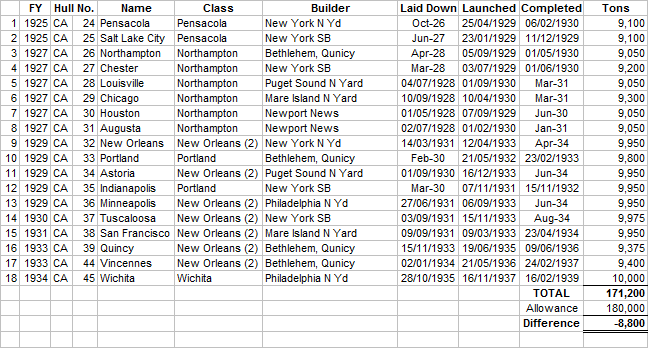
The USA built Heavy Cruisers to the limits allowed by the 1st LNT. See below.

US Treaty Cruisers CA.png
Standard Displacements are according to "US Warships of World War 2" by Paul H. Silverstone.
Building dates are according to Conway's 1922-46.
NOTES
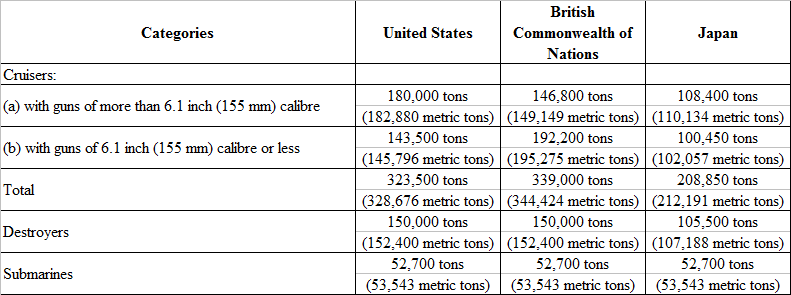
  • The 1st LNT allowed the USA to have 180,000 tons of Heavy Cruisers and the USA was limited to a maximum of 18 ships of this type by Article 16, Pararaph 3 of the Treaty, viz.​
    • "The maximum number of cruisers of sub-category (a) shall be as follows: for the United States, eighteen; for the British Commonwealth of Nations, fifteen; for Japan, twelve."
  • As can be seen 15 of the 18 were completed by 31.12.35, the 16th was completed in 1936, the 17th in 1937 and the 18th in 1939. This was in accordance with Article 16 of the Treaty, viz.​
    • "The United States contemplates the completion by 1935 of fifteen cruisers of sub-category (a) of an aggregate "tonnage of 150,000 tons (152,400 metric tons)."
    • "For each of the three remaining cruisers of sub-category (a) which it is entitled to construct the United States may elect to substitute 15,166 tons (15,409 metric tons) of cruisers of sub-category (b)."
    • "In case the United States shall construct one or more of such three remaining cruisers of sub-category (a),"
      • "the sixteenth unit will not be laid down before 1933 and will not be completed before 1936;"
      • "the seventeenth will not be laid down before 1934 and will not be completed before 1937;"
      • "the eighteenth will not be laid down before 1935 and will not be completed before 1938."
Therefore, the United States did built Heavy Cruisers to Treaty Limits and furthermore it built them within the time period prescribed by said Treaty.
 
Last edited:
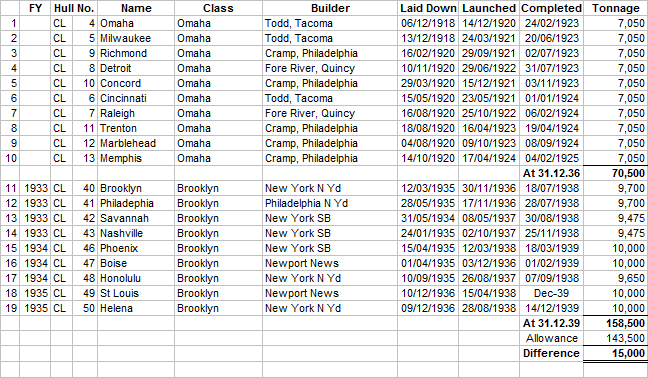
They didn't do as well with Light Cruisers.

US Treaty Cruisers CL.png
Standard Displacements are according to "US Warships of World War 2" by Paul H. Silverstone.
Building dates are according to Conway's 1922-46.​

NOTES
  • According to Conway's 1922-46 all the older Light and Protected Cruisers were scrapped by 1933.
  • Therefore, the USA only ad 70,500 tons of Light Cruisers at 31.12.36 when it could have had 143,500 tons.
  • However, it was a different story 3 years later because the 19 Light Cruisers in existence at that date displaced 15,000 tons more than the 1st LNT allowed.
  • Although, if the Treaty had still been in force.
    • The 18 Heavy Cruisers displaced 8,800 tons less than the Treaty's allowance, that could be transferred to the Light Cruiser category, which reduced the difference to 6,200 tons.
    • Plus Omaha and Milwaukee became over-age in 1939 (they were laid down before 01.01.20 and therefore became overage 16 years after their date of completion) so one of them could have been scrapped, which meant the USA would have been 850 tons within the 1st LNT's tonnage quota for Cruisers.
  • The other Light Cruisers of the Omaha class were laid down after 31.12.19 and therefore became over-age 20 years after their date of completion. Which meant that Richmond didn't become over-age until 1943 in spite of being completed 2 weeks after Milwaukee. If she had been laid down 7 weeks earlier, she would have become over-age in 1939.
 
Last edited:
This is a spinoff from this topic which brought up some fascinating facts and figures for the major interwar navies
https://www.secretprojects.co.uk/th...ncapacitated-in-1934.40597/page-2#post-593376I wanted to explore a wider period re the USN. One of the common themes is the very anemic post WNT US naval construction in the 1920s and early 1930s. Here is a very interesting article putting more light on the subject:
https://www.usni.org/magazines/proceedings/1938/july/naval-race
So what if they build more interwar? I am thinking of at least more even handed replies to the IN 1923 and 1927 shipbuilding programs. For instance in reply to the 1923 IJN plan the 1924 USN program might add in adition to the CAs and gunboats the 12 DDs and 6 subs left over from the 1916 appropriations, and perhaps a handful of auxiliaries too. I have read in Friedman's that USN wanted some destroyer leaders at this time, so perhaps the DDs could be updated version of the 1919 2100 tons DD leader design. Also shipyards that went under at this time such as Bath and Cramp could be saved from bankrupcy if they receive contracts for a handful of CAs or DDs.

Also the CAs could be laid down earlier say 1925 to 1927, matching well the IJN CA construction.

In reply to the IJN 1927 program, perhaps the OTL cruiser bill of 1929 can be brought forward to 1928, and also include some DDs of new design (such as say a dozen or more of pre-Farraguts or updated leaders), subs, a few auxiliaries etc. The LNT will upset the plans of course, perhaps they won't be able to build the OTL Porter DDs if they have large leaders already built. It possibly may affect the post LNT DD building numbers, not sure, if they build or planned 24-30 or so DDs before the LNT in this scenario.
The problem with this is that, until the late 1920s, the US had a surplus of new destroyers above & beyond that required for fleet use... meaning it would likely be impossible to get Congress to authorize new builds before the number of DDs considered "obsolete" got to where replacement could be justified to a budget-conscious Congress.

The US had a considerable number of DDs mothballed, and was rotating them in & out of the fleet to keep wear down, but they could not build more until Congress, not the USN, felt they were needed.
That is of course true about the DDs, however as per Friedman the USN did wanted some destroyer leaders to lead these, hence that 2100 ton leader project of 1919, of which they asked for 5 in FY21 (eventually they will build 13 leaders Porter/Somers type, in the 1930s, number limited by LNT). In my TTL in which more is build in the 1920s those 12 DDs left from the 1919 appropriation could be build as that 2100 ton leader or an improved variant of.

According to the USNI article the four pipers were beggining to become overage as of 1930, so replacements for them can be started in 1928 to be finished in 1930, have i got that right?
 
Here is a breakdown of USN ships in late 1941. Apparently they are wrong about the Atlantas though, they must mean 6 building, 2 nearly ready. So not sure if the DD and subs figures are 100% accurate.
https://www.ww2-weapons.com/us-navy-in-late-1941/
The use of the term “under construction” is a bit misleading. “Authorised” or at best “ordered” is a fairer description.

For example, of the 11 Essex class noted as “under construction”, all had been ordered but only 5 were physically laid down in 1941 and 2 of those were in the week before PH.

15 Battleships “under construction” includes 5 Montanas, that there was no intention to start building until the new dry docks in which they were to be built were completed starting in 1942.

Only 4 of the Baltimores were laid down in 1941. The others had to wait until 1943.

Etc etc
Thanks for the very useful clarification.
 
They didn't do as well with Light Cruisers.

View attachment 698455
Standard Displacements are according to "US Warships of World War 2" by Paul H. Silverstone.
Building dates are according to Conway's 1922-46.​

NOTES
  • According to Conway's 1922-46 all the older Light and Protected Cruisers were scrapped by 1933.
  • Therefore, the USA only ad 70,500 tons of Light Cruisers at 31.12.36 when it could have had 143,500 tons.
  • However, it was a different story 3 years later because the 19 Light Cruisers in existence at that date displaced 15,000 tons more than the 1st LNT allowed.
  • Although, if the Treaty had still been in force.
    • The 18 Heavy Cruisers displaced 8,800 tons less than the Treaty's allowance, that could be transferred to the Light Cruiser category, which reduced the difference to 6,200 tons.
    • Plus Omaha and Milwaukee became over-age in 1939 (they were laid down before 01.01.20 and therefore became overage 16 years after their date of completion) so one of them could have been scrapped, which meant the USA would have been 850 tons within the 1st LNT's tonnage quota for Cruisers.
  • The other Light Cruisers of the Omaha class were laid down after 31.12.19 and therefore became over-age 20 years after their date of completion. Which meant that Richmond didn't become over-age until 1943 in spite of being completed 2 weeks after Milwaukee. If she had been laid down 7 weeks earlier, she would have become over-age in 1939.
According to the USNI article above the 2nd LNT escalator clause allowed the USN quote cruisers 20,270; destroyers 40,550; submarines 15,598.

This presumably because the brirish were over the treaty limits as you shown in the other topic. And the japanese although they built CAs and CLs to allowance they retained the overage CLs that should have been otherwise scrapped or converted to training ships.

So the americans were entitled to 163,770 tons of CLs in total, and they were slightly below that in 1939. If we add the Second Vinson Act increase they were supposed to have 232,254 tons of CLs plus the 8,800 tons left from the CAs, but in fact not one single cruiser was comissioned between late 1939 and early 1942. So in theory they could have brought the Atlantas forward a year or two so they would have say 4 of them already in service by late 1941. And/or perhaps a reduced Brooklyn to stay under the 8000 ton limit (the Clevelands or just repeat Brooklyns are too big to be brough forward before the war started in Sept. 1939)

As to the Brooklyns, indeed the first 7 could have been in commisioned already in 1936, which could have been done if they were started earlier, say 1932-33, which could have been done of the CA program was started earlier say 1924-1925 and telescoped by a few years (say have 12 of them ready by or just after the LNT say 1928 to 1931 and the rest in the early 1930s say 1933-34, without spreading them like OTL for which the LNT needs to be altered a bit)
 
Last edited:
This is a spinoff from this topic which brought up some fascinating facts and figures for the major interwar navies
https://www.secretprojects.co.uk/th...ncapacitated-in-1934.40597/page-2#post-593376I wanted to explore a wider period re the USN. One of the common themes is the very anemic post WNT US naval construction in the 1920s and early 1930s. Here is a very interesting article putting more light on the subject:
https://www.usni.org/magazines/proceedings/1938/july/naval-race
So what if they build more interwar? I am thinking of at least more even handed replies to the IN 1923 and 1927 shipbuilding programs. For instance in reply to the 1923 IJN plan the 1924 USN program might add in adition to the CAs and gunboats the 12 DDs and 6 subs left over from the 1916 appropriations, and perhaps a handful of auxiliaries too. I have read in Friedman's that USN wanted some destroyer leaders at this time, so perhaps the DDs could be updated version of the 1919 2100 tons DD leader design. Also shipyards that went under at this time such as Bath and Cramp could be saved from bankrupcy if they receive contracts for a handful of CAs or DDs.

Also the CAs could be laid down earlier say 1925 to 1927, matching well the IJN CA construction.

In reply to the IJN 1927 program, perhaps the OTL cruiser bill of 1929 can be brought forward to 1928, and also include some DDs of new design (such as say a dozen or more of pre-Farraguts or updated leaders), subs, a few auxiliaries etc. The LNT will upset the plans of course, perhaps they won't be able to build the OTL Porter DDs if they have large leaders already built. It possibly may affect the post LNT DD building numbers, not sure, if they build or planned 24-30 or so DDs before the LNT in this scenario.
The problem with this is that, until the late 1920s, the US had a surplus of new destroyers above & beyond that required for fleet use... meaning it would likely be impossible to get Congress to authorize new builds before the number of DDs considered "obsolete" got to where replacement could be justified to a budget-conscious Congress.

The US had a considerable number of DDs mothballed, and was rotating them in & out of the fleet to keep wear down, but they could not build more until Congress, not the USN, felt they were needed.
That is of course true about the DDs, however as per Friedman the USN did wanted some destroyer leaders to lead these, hence that 2100 ton leader project of 1919, of which they asked for 5 in FY21 (eventually they will build 13 leaders Porter/Somers type, in the 1930s, number limited by LNT). In my TTL in which more is build in the 1920s those 12 DDs left from the 1919 appropriation could be build as that 2100 ton leader or an improved variant of.

According to the USNI article the four pipers were beginning to become overage as of 1930, so replacements for them can be started in 1928 to be finished in 1930, have I got that right?
According to my figures.
  • The USN & USCG had 309 Destroyers of 342,142 tons at the end of 1929.
    • This was considerably more than the 150,000 tons allowed by the 1st LNT.
  • The 309 Destroyers consisted of:
    • 46 of the "Pre-Flush-Deck" types.
      • And.
    • 263 of the "Flush-Deck" type. (10 out of 273 were wrecked or lost in collisions in the 1920s.)
  • All but one of the 46 "Pre-Flush-Deck" Destroyers were scrapped 1934-36.
    • The survivor was DD-66 Allen which served in World War II and was sold for scrapping in 1946.
  • All 273 "Flush-Deck" Destroyers were laid down before 01.01.21.
    • Therefore, under the terms of the 1st LNT they became over-age 12 years after their date of completion.
    • And as they were all completed between October 1917 and August 1922 they became over-age 1929-34.
  • Of the 263 "Flush-Deck" Destroyers left at the end of 1929.
    • 53 were scrapped in the second half of 1930.
    • 5 were scrapped in November 1931.
    • 27 were scrapped 1935-36, which made a total of 86 scrapped before the 1st LNT expired.
    • DD-135 Smith Thompson was lost in a collision on 14.04.36.
    • 7 were scrapped in January 1937.
    • 2 were scrapped in 1938.
    • Which is a Grand Total of 95 scrapped or lost 1930-39.
  • Of the 168 "Flush-Deck" Destroyers left at 03.09.39.
    • 50 were transferred to Britain in 1940.
    • DD-245 Reuben James was sunk on 30.10.41.
    • 46 were serving in Subsidiary Duties on 07.12.41. (Page 100 of "US Warships of World War 2" by Paul H. Silverstone.)
    • 71 remained in service as Destroyers on 07.12.41. (Page 100 of "US Warships of World War 2" by Paul H. Silverstone.)
The first new destroyers were the 8 Farragut class in the FY 1932 Building Programme. They were laid down 1932-34 and completed 1934-35.
 
According to the USNI article above the 2nd LNT escalator clause allowed the USN quote cruisers 20,270; destroyers 40,550; submarines 15,598.
The 2nd LNT didn't have tonnage quotas for those vessels. In fact it didn't have tonnage quotas for any type of naval vessel, Therefore, from 1st January 1937 the USA could have had as many Cruisers, Destroyers and Submarines as it wanted, provided the individual ships met the Treaty's requirements regarding their tonnage and armament.

Are you confusing the Second London Naval Treaty with one of the Vinson Acts?
This presumably because the British were over the treaty limits as you shown in the other topic. And the Japanese although they built CAs and CLs to allowance they retained the overage CLs that should have been otherwise scrapped or converted to training ships.
So the Americans were entitled to 163,770 tons of CLs in total, and they were slightly below that in 1939. If we add the Second Vinson Act increase they were supposed to have 232,254 tons of CLs plus the 8,800 tons left from the CAs, but in fact not one single cruiser was commissioned between late 1939 and early 1942. So in theory they could have brought the Atlantas forward a year or two so they would have say 4 of them already in service by late 1941. And or perhaps a reduced Brooklyn to stay under the 8,000 ton limit (the Clevelands or just repeat Brooklyns are too big to be brought forward before the war started in Sept. 1939).
I repeat, from 1st January 1937 International Law entitled the USA to as many Cruisers as it wanted.
As to the Brooklyns, indeed the first 7 could have been in commissioned already in 1936, which could have been done if they were started earlier, say 1932-33, which could have been done of the CA program was started earlier say 1924-1925 and telescoped by a few years (say have 12 of them ready by or just after the LNT say 1928 to 1931 and the rest in the early 1930s say 1933-34, without spreading them like OTL for which the LNT needs to be altered a bit)
This is the only part that I understand and with which I agree. That is (as pointed out by @BlackBat242 in Post 8) if the budget-conscious Congress can be persuaded to spend the money.
 
According to the USNI article above the 2nd LNT escalator clause allowed the USN quote cruisers 20,270; destroyers 40,550; submarines 15,598.
The 2nd LNT didn't have tonnage quotas for those vessels. In fact it didn't have tonnage quotas for any type of naval vessel, Therefore, from 1st January 1937 the USA could have had as many Cruisers, Destroyers and Submarines as it wanted, provided the individual ships met the Treaty's requirements regarding their tonnage and armament.

Are you confusing the Second London Naval Treaty with one of the Vinson Acts?
Reading the article again I think 2nd LNT is a typo for 1st LNT and you are referring to this section of the article.
The London Treaty contained an “escalator clause” which any signatory could invoke, whereby he could build beyond the treaty limits after notifying the other signatories of his decision to do so. This clause having been invoked by other signatories than the United States, we became entitled to the following additional tonnage: cruisers 20,270; destroyers 40,550; submarines 15,598. This additional tonnage was, by the wording of the Act, authorized by the Vinson-Trammell Act.
And the author of the USNI article was referring to this article of the 1st LNT.
Article 21

If, during the term of the present Treaty, the requirements of the national security of any High Contracting Party in respect of vessels of war limited by Part III of the present Treaty are in the opinion of that Party materially affected by new construction of any Power other than those who have joined in Part III of this Treaty, that High Contracting Party will notify the other Parties to Part III as to the increase required to be made in its own tonnages within one or more of the categories of such vessels of war, specifying particularly the proposed increases and the reasons therefor, and shall be entitled to make such increase. Thereupon the other Parties to Part III of this Treaty shall be entitled to make a proportionate increase in the category or categories specified; and the said other Parties shall promptly advise with each other through diplomatic channels as to the situation thus presented.
Does anyone know when and how the increases were announced?

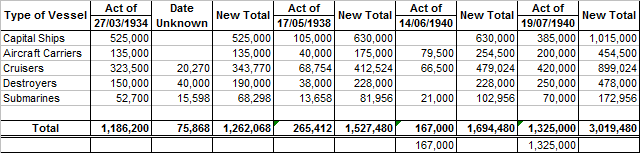
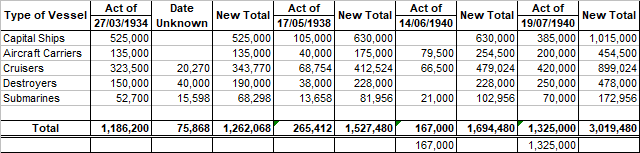
Naval Act Tonnages.png

The above was compiled by me from the copies of the Naval Acts that I downloaded from the Library of Congress website, but I was unable to find the Act that authorised the increase in the "Date Unknown" column.

I noticed the discrepancy when I put the increases in the Act of 17.05.38 into the spreadsheet and the "New Total" was less than the new totals in the text of the Act. This is the relevant section of the Act.
Be it enacted by the Senate and House of Representatives of the United States of America in Congress assembled, That in addition to the tonnages of the United States Navy as agreed upon and established by the treaties signed at Washington, February 6, 1922, and at London, April 22, 1930, and as authorized by the Act of March 27, 1934 (48 Stat, 503), as amended by the Act of June 25, 1936 (49 Stat. 1926), the authorized composition of the United States Navy in underage vessels is hereby increased by the following tonnages :

(a) Capital ships, one hundred and five thousand tons, making a total authorized underage tonnage of six hundred and thirty thousand tons : Provided, That vessels of tonnages in excess of thirty-five thousand tons each may be laid down if the President determines with respect to the tonnage of capital ships being built by other nations that the interests of national defense so require, in which event the authorized composition of the United States Navy of capital ships is hereby increased by one hundred and thirty-five thousand tons, making a total authorized underage tonnage of six hundred and sixty thousand tons;​
(b) Aircraft carriers, forty thousand tons, making a total authorized underage tonnage of one hundred and seventy-five thousand tons;​
(c) Cruisers, sixty-eight thousand seven hundred and fifty-four tons, making a total authorized underage tonnage of four hundred and twelve thousand, five hundred and twenty-four tons;​
(d) Destroyers, thirty-eight thousand tons, making a total authorized underage tonnage of two hundred and twenty-eight thousand tons;​
(e) Submarines, thirteen thousand six hundred and fifty-eight tons making a total authorized underage tonnage of eighty-one thousand nine hundred and fifty-six tons.​
I have a copy of the Act of June 25, 1936 (49 Stat. 1926) referred to above and I can see nothing in it about increasing the tonnages of Cruisers, Destroyers and Submarines beyond those set by the by the 1st London Naval Treaty.
 
Last edited:
I guess that extra tonnage became automatically authorized, the USNI article says quote This additional tonnage was, by the wording of the Act, authorized by the Vinson-Trammell Act. (of 1934)

I wonder who exactly are the other powers who invoked the escalator clause thus triggering the US (automatic) response. Must have happened between 1936 and 1938.

PS: Btw i too never realized the discrepancy between the "treaty navy" and the "1938 Vinson navy" tonnages until i read that USNI article few days back and found out about those 75,868 "automatic" tons.
 
Last edited:
I guess that extra tonnage became automatically authorized, the USNI article says quote This additional tonnage was, by the wording of the Act, authorized by the Vinson-Trammell Act. (of 1934).
That does not answer the questions that I asked, which were, "Does anyone know when and how the increases were announced?"

The Treaty required the Party making the change to ...
... notify the other Parties to Part III as to the increase required to be made in its own tonnages within one or more of the categories of such vessels of war, specifying particularly the proposed increases and the reasons therefor, and shall be entitled to make such increase. Thereupon the other Parties to Part III of this Treaty shall be entitled to make a proportionate increase in the category or categories specified; and the said other Parties shall promptly advise with each other through diplomatic channels as to the situation thus presented.
Therefore, there must be a "paper trail" diplomatic correspondence.

For example, the "paper trail" of diplomatic correspondence that led to the escalator clause in the 2nd LNT allowing Capital Ships to be armed with 16in guns being invoked and to the amendment that increased the maximum tonnage of Capital Ships from 35,000 tons to 45,000 tons on 30.06.38 was 27 pages long. I know because I downloaded it from the Library of Congress website.
 
Last edited:
I guess that extra tonnage became automatically authorized, the USNI article says quote This additional tonnage was, by the wording of the Act, authorized by the Vinson-Trammell Act. (of 1934).
Another thing to consider is that the Vinson-Trammell Act of 1934 and the later acts that increased the authorised size of the USN specifically refer to the tonnage of under-age vessels. E.g. the word "underage" appears no fewer than seven times in the section of the 1938 Act that I quoted in Post 17. Therefore (subject to sufficient funding) the USN could have had as many over-age vessels as it wanted (if they still had some military value) over and above the permitted tonnage of under-age ships.
I wonder who exactly are the other powers who invoked the escalator clause thus triggering the US (automatic) response. Must have happened between 1936 and 1938.
It has to be the British Commonwealth and Japan. The "escalator clause" in the 1st LNT (i.e. Article 21) only applies to vessels in Part III of the Treaty and that part of the Treaty is about Cruisers, Destroyers & Submarines. The British Commonwealth (i.e. the UK, Dominions & India) and Japan were the only other countries that were party to that section of the Treaty. Therefore, it has to be one or both of them.

We do know that the British Commonwealth kept more Cruisers and Destroyers than were allowed by the 1st LNT. I thought it was because the 1st LNT's tonnage quotas became a "dead letter" on 25th March 1936 when the 2nd LNT (which abolished said quotas) was signed.

However, I think Friedman said in one of his books that the British kept them by invoking Article 21 of the 1st LNT. However, I don't remember if he said when Article 21 was invoked and I don't remember which book he said it in other it would have been in his book about British Cruisers (Volume 2), British Destroyers & Frigates or his book about British Submarines.

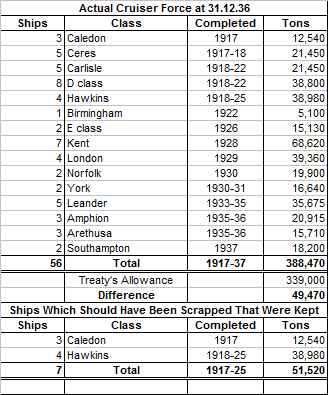
The British Commonwealth had 388,470 tons of Cruisers at the end of 1936 instead of the 339,000 tons allowed by the 1st LNT, an increase of nearly 50,000 tons. If the USA wanted to increase its Cruiser tonnage to match the British it would have increased its total by 50,000 tons too, instead of by 20,270 tons.

Similarly, the British Commonwealth had 204,064 tons of Destroyers at the end of 1936 instead of the 150,000 tons allowed by the 1st LNT. Therefore, the Americans would have increased their total by at least 50,000 tons, not 40,000 tons, if they wanted to retain parity in Destroyer tonnage with the British Commonwealth.

I've not "done the arithmetic" on the difference between the British Commonwealth's Submarine tonnage at 31.12.36 and the 52,700 tons allowed by the 1st LNT, but an increase of 15,598 tons looks too high to me in this case.

Therefore, you may be right when you wrote that the increases were a reaction to Japan giving notice that it would be leaving the Treaty System and the increases were to cover Japan keeping vessels that it no longer had to scrap to keep within the 1st LNT's limits. However, I haven't "done the arithmetic" to see if there is a correlation between the increases and the displacements of the ships kept by Japan.
PS: BTW I too never realized the discrepancy between the "treaty navy" and the "1938 Vinson navy" tonnages until I read that USNI article few days back and found out about those 75,868 "automatic" tons.
For what it's worth it's nice to know that it wasn't just me.
 
Last edited:
I guess that extra tonnage became automatically authorized, the USNI article says quote This additional tonnage was, by the wording of the Act, authorized by the Vinson-Trammell Act. (of 1934).
Another thing to consider is that the Vinson-Trammell Act of 1934 and the later acts that increased the authorised size of the USN specifically refer to the tonnage of under-age vessels. E.g. the word "underage" appears no fewer than seven times in the section of the 1938 Act that I quoted in Post 17. Therefore (subject to sufficient funding) the USN could have had as many over-age vessels as it wanted (if they still had some military value) over and above the permitted tonnage of under-age ships.
I wonder who exactly are the other powers who invoked the escalator clause thus triggering the US (automatic) response. Must have happened between 1936 and 1938.
It has to be the British Commonwealth and Japan. The "escalator clause" in the 1st LNT (i.e. Article 21) only applies to vessels in Part III of the Treaty and that part of the Treaty is about Cruisers, Destroyers & Submarines. The British Commonwealth (i.e. the UK, Dominions & India) and Japan were the only other countries that were party to that section of the Treaty. Therefore, it has to be one or both of them.

We do know that the British Commonwealth kept more Cruisers and Destroyers than were allowed by the 1st LNT. I thought it was because the 1st LNT's tonnage quotas became a "dead letter" on 25th March 1936 when the 2nd LNT (which abolished said quotas) was signed.

However, I think Friedman said in one of his books that the British kept them by invoking Article 21 of the 1st LNT. However, I don't remember if he said when Article 21 was invoked and I don't remember which book he said it in other it would have been in his book about British Cruisers (Volume 2), British Destroyers & Frigates or his book about British Submarines.

The British Commonwealth had 388,470 tons of Cruisers at the end of 1936 instead of the 339,000 tons allowed by the 1st LNT, an increase of nearly 50,000 tons. If the USA wanted to increase its Cruiser tonnage to match the British it would have increased its total by 50,000 tons too, instead of by 20,270 tons.

Similarly, the British Commonwealth had 204,064 tons of Destroyers at the end of 1936 instead of the 150,000 tons allowed by the 1st LNT. Therefore, the Americans would have increased their total by at least 50,000 tons, not 40,000 tons, if they wanted to retain parity in Destroyer tonnage with the British Commonwealth.

I've not "done the arithmetic" on the difference between the British Commonwealth's Submarine tonnage at 31.12.36 and the 52,700 tons allowed by the 1st LNT, but an increase of 15,598 tons looks too high to me in this case.

Therefore, you may be right when you wrote that the increases were a reaction to Japan giving notice that it would be leaving the Treaty System and the increases were to cover Japan keeping vessels that it no longer had to scrap to keep within the 1st LNT's limits. However, I haven't "done the arithmetic" to see if there is a correlation between the increases and the displacements of the ships kept by Japan.
PS: BTW I too never realized the discrepancy between the "treaty navy" and the "1938 Vinson navy" tonnages until I read that USNI article few days back and found out about those 75,868 "automatic" tons.
For what it's worth it's nice to know that it wasn't just me.
Well that's one for us to keep scratching our heads about for a while. The americans must have used some kind of benchmark calculation to arrive at those quite specific figures. Skimming through Friedman's US cruisers book last night i did found reference in the pages refering to the 2nd LNT to the british wanting to keep more cruisers (CLs, the only type allowed by LNT) than the treaty allowed and wanting to have the americans agree to that, but need to read it again to see the exact wording and timing.

Perhaps those american tonnage figures were taking into account only those british ships kept over the treaty that were underage? Also there is the ratio between british and US CLs of about 1,35 so those 20,000 tons of US CL could be a reply to about 27,000 tons of (underage?) british CLs over the LNT limits? No idea if that's the case, just an exploratory musing.
 
Well that's one for us to keep scratching our heads about for a while. The americans must have used some kind of benchmark calculation to arrive at those quite specific figures. Skimming through Friedman's US cruisers book last night i did found reference in the pages referring to the 2nd LNT to the British wanting to keep more cruisers (CLs, the only type allowed by LNT) than the treaty allowed and wanting to have the Americans agree to that, but need to read it again to see the exact wording and timing.
That's likely to be during the abortive Geneva Disarmament Conference of 1927 or the First London Conference that produced the 1st LNT.

The British had wanted 70 Cruisers since the early 1920s. This was a problem for the Americans because they wanted parity with Britain in all types of warship. They needed the same number of Fleet Cruisers as the British because the WNT allowed them to have the same number of 35,000 ton Capital Ships (i.e. 15 each). However, they needed fewer Trade Protection Cruisers on account of having a smaller Merchant Navy and shorter trade routes.

The 1st LNT tonnage quota for the British Commonwealth was only large enough for 50 Cruisers (15 CA & 35 CL). That's because the British Government made the British Admiralty accept a smaller quota. If the Admiralty had got its way the Cruiser Quota would have been around 500,000 tons (instead of 339,000 tons) to allow a force of 70 Cruisers consisting of 15 CA & 55 CL. That's also why the Treaty only allowed the British Commonwealth to build 91,000 tons of new Cruisers between 1930 & 1936. The politicians felt that building more would not be within the spirit of the Treaty.

A paragraph from the 1st LNT that I quoted here or on the other thread also allowed the USA another 45,500 tons of Light Cruisers if they only built 150,000 tons of Heavy Cruisers out of the 180,000 tons that they were allowed under the Treaty. The net increase of 15,500 tons would have increased the total Cruiser tonnage from 323,500 to 339,000 tons, i.e. the same as the British Commonwealth's total Cruiser quota.
Perhaps those American tonnage figures were taking into account only those British ships kept over the treaty that were underage? Also there is the ratio between British and US CLs of about 1,35 so those 20,000 tons of US CL could be a reply to about 27,000 tons of (underage?) british CLs over the LNT limits? No idea if that's the case, just an exploratory musing.
Fair enough. However, I think not and I've already explained why I think not.
 
Friedman's "British Cruisers Two World Wars and After"
In the wake of the Abyssininian Crisis 1935/36 the RN began to plan to upgrade the fleet's AA armament. Part of that was to rearm the old C class cruisers and a number of V&W class destroyers and older sloops as convoy AA escorts. Friedman notes that:-

"In December 1936 the British government assured the Japanese and US governments, the other signitories of the 1930 London Treaty, that five of the 'C' class cruisers it was retaining would be converted into anti-aircraft ships, and that they would be scrapped by 1941. As of March 1937 plans called for taking four cruisers in hand during 1938 for completion by that December. The programme applied to six 'C' class cruisers and eight 'D' class cruisers, in addition to the two earlier conversions. Selected merchant ships would receive the set of weapons and fire controls as the converted 'C' class cruiser."

The retention of 5 C class cruisers, clearly with the agreement of the other parties, accounts for about 21,000 standard tons depending on what 5 ships were intended to be included. Maybe their rearming as AA ships with 4xtwin 4" was enough to remove them from being considered a threat by other parties.

There is also the question of the status of the Hawkins class as of Dec 1936 given that Britain could only retain 15 cruisers with guns larger than 6.1".

Raven & Roberts "British Cruisers of World War Two"

"Under the terms of the 1930 London naval Treaty, the Hawkins Class were due to be demilitarized by December 1936, as being additional to the number of cruisers armed with guns above 6.1in calibre allowed to the British Empire."


Article XVI (2) of the 1930 Treaty stated that they should be "disposed of gradually during the period eding on 31 December 1936", and Article XX (a) allowed Frobisher & Effingham, which were not then overage, to be disposed of by 31 December 1936.

So in 1932 Frobisher had become a cadet training ship with only 5x7.5" and 2x4". Then in 1936 Frobisher had her armament reduced to 1x4.7" and the 2xsubmerged TT "in compliance with the 1930 London Treaty" and continued her training ship role. Plans to refit her as in Effingham came to nothing and she was taken in hand to be rearmed in Sept 1939 after the outbreak of WW2. That process lasted until Dec 1941.

1937/38 saw Hawkins, Vindictive and Effingham demilitarized having all their 7.5" guns and above water TT removed.

Vindictive was converted to a cadet training ship after losing her inboard shafts and turbines and half her boilers which limited her speed to 24 knots. Her armament was then 2x4.7". She recommissioned in her new role in Sept 1937. Plans in 1939 to refit her along the lines of Effingham came to nothing and instead she became a repair ship in 1940.

Effingham, in reserve from 1935, was refitted 1937/39 as a light cruiser with 9x6" guns, 4x twin 4" and 3xquad 0.5". She also lost 2 of her boilers and had the funnels retrunked.

Finally Hawkins was also in reserve from 1935 and was due to be refitted as Effingham. But with the arrival of WW2 she was simply refitted and rearmed and put back into service in December 1940.

It is not clear to me by what means Britain was allowed to keep the Hawkins class in "demilitarised" form after 1936 but it happened. The removal of their main armament suggests at least an attempt to comply with the 1930 Treaty. They account for 39,440 standard tons of total cruiser tonnage.
 
Friedman's "British Cruisers Two World Wars and After"

In the wake of the Abyssinian Crisis 1935/36 the RN began to plan to upgrade the fleet's AA armament. Part of that was to rearm the old C class cruisers and a number of V&W class destroyers and older sloops as convoy AA escorts. Friedman notes that:-

"In December 1936 the British government assured the Japanese and US governments, the other signatories of the 1930 London Treaty, that five of the 'C' class cruisers it was retaining would be converted into anti-aircraft ships, and that they would be scrapped by 1941. As of March 1937 plans called for taking four cruisers in hand during 1938 for completion by that December. The programme applied to six 'C' class cruisers and eight 'D' class cruisers, in addition to the two earlier conversions. Selected merchant ships would receive the set of weapons and fire controls as the converted 'C' class cruiser."

The retention of 5 C class cruisers, clearly with the agreement of the other parties, accounts for about 21,000 standard tons depending on what 5 ships were intended to be included. Maybe their rearming as AA ships with 4xtwin 4" was enough to remove them from being considered a threat by other parties.

There is also the question of the status of the Hawkins class as of Dec 1936 given that Britain could only retain 15 cruisers with guns larger than 6.1".
Are you sure that's December 1936? I think it should be December 1935.

It if was the former I don't see the point of making such an announcement as the tonnage quotas of the 1st LNT were about to be abolished (i.e. on 01.01.37) when the 2nd LNT replaced the 1st LNT and the tonnage quotas had been a "dead letter" since March 1936 when the 2nd LNT was signed.
Raven & Roberts "British Cruisers of World War Two"

"Under the terms of the 1930 London naval Treaty, the Hawkins Class were due to be demilitarized by December 1936, as being additional to the number of cruisers armed with guns above 6.1in calibre allowed to the British Empire."

Article XVI (2) of the 1930 Treaty stated that they should be "disposed of gradually during the period ending on 31 December 1936", and Article XX (a) allowed Frobisher & Effingham, which were not then overage, to be disposed of by 31 December 1936.

So in 1932 Frobisher had become a cadet training ship with only 5x7.5" and 2x4". Then in 1936 Frobisher had her armament reduced to 1x4.7" and the 2xsubmerged TT "in compliance with the 1930 London Treaty" and continued her training ship role. Plans to refit her as in Effingham came to nothing and she was taken in hand to be rearmed in Sept 1939 after the outbreak of WW2. That process lasted until Dec 1941.

1937/38 saw Hawkins, Vindictive and Effingham demilitarized having all their 7.5" guns and above water TT removed.

Vindictive was converted to a cadet training ship after losing her inboard shafts and turbines and half her boilers which limited her speed to 24 knots. Her armament was then 2x4.7". She re-commissioned in her new role in Sept 1937. Plans in 1939 to refit her along the lines of Effingham came to nothing and instead she became a repair ship in 1940.

Effingham, in reserve from 1935, was refitted 1937/39 as a light cruiser with 9x6" guns, 4x twin 4" and 3xquad 0.5". She also lost 2 of her boilers and had the funnels re-trunked.

Finally Hawkins was also in reserve from 1935 and was due to be refitted as Effingham. But with the arrival of WW2 she was simply refitted and rearmed and put back into service in December 1940.
I also think Raven & Roberts were wrong and the word scrapped should be substituted for demilitarized.

For what its worth.

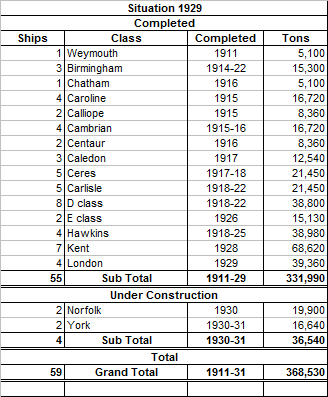
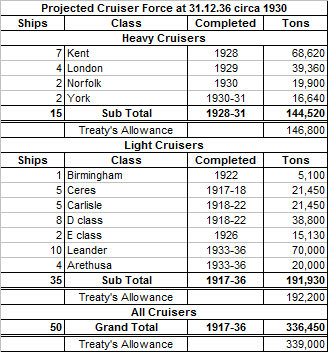
31.12.29 Cruisers.png

31.12.36 Cruisers at 1930.png

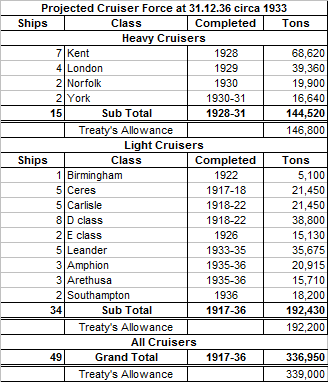
31.12.36 Cruisers at 1933.png

31.12.36 Cruisers at 1936.png

Both projected Cruiser Forces at 31/12/36 included 14 Ships of 62,860 tons that were overage on 31/12/36 but couldn't be replaced by that date due to the 91,000 tons rule. The 7 extra ships at 31/12/36 were also ships that were overage at that date or in the case of Effingham & Frobisher underage ships that the 1st LNT said could be scrapped by 31/12/36.

The exact wording of the relevant parts of the First London Naval Treaty were.
Article 16

1. The completed tonnage in the cruiser, destroyer and submarine categories which is not to be exceeded on 31 December 1936 is given in the following table:

1st LNT Quotas.png

2. Vessels which cause the total tonnage in any category to exceed the figures given in the foregoing table shall be disposed of gradually during the period ending on 31 December 1936.
Article 20

Notwithstanding the rules for replacement contained in Annex I to Part II:

(a) The "Frobisher" and "Effingham" (United Kingdom) may be disposed of during the year 1936. Apart from the cruisers under construction on 1 April 1930, the total replacement tonnage of cruisers to be completed, in the case of the British Commonwealth of Nations, prior to 31 December 1936, shall not exceed 91,000 tons (92,456 metric tons).
The four surviving Hawkins class cruisers were all laid down before 01.01.20 and therefore under the terms of the 1st LNT became overage 16 years after their date of completion, which meant they became overage on:
31/12/34 Vindictive​
19/07/35 Hawkins​
31/10/40 Frobisher​
09/07/41 Effingham​

It is not clear to me by what means Britain was allowed to keep the Hawkins class in "demilitarised" form after 1936 but it happened. The removal of their main armament suggests at least an attempt to comply with the 1930 Treaty. They account for 39,440 standard tons of total cruiser tonnage.
The tonnage quotas ceased to be at midnight on 31.12.36 so the British Commonwealth of Nations could have as many tons of Cruisers as their Governments were prepared to pay for (demilitarised or militarised) from 01.01.37 onwards.
 
Last edited:
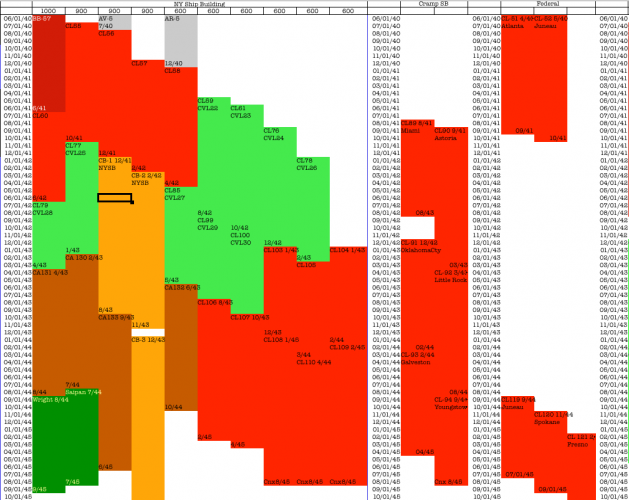
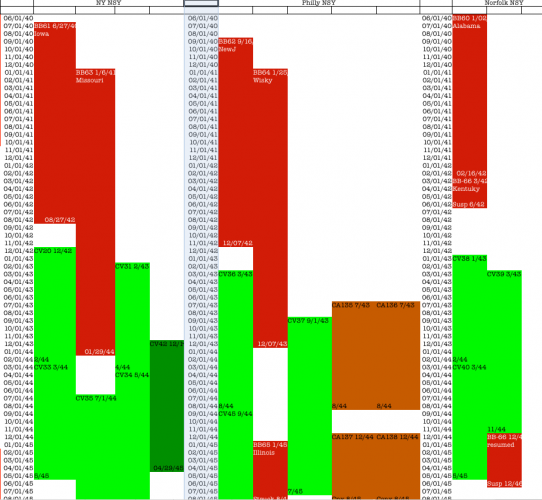
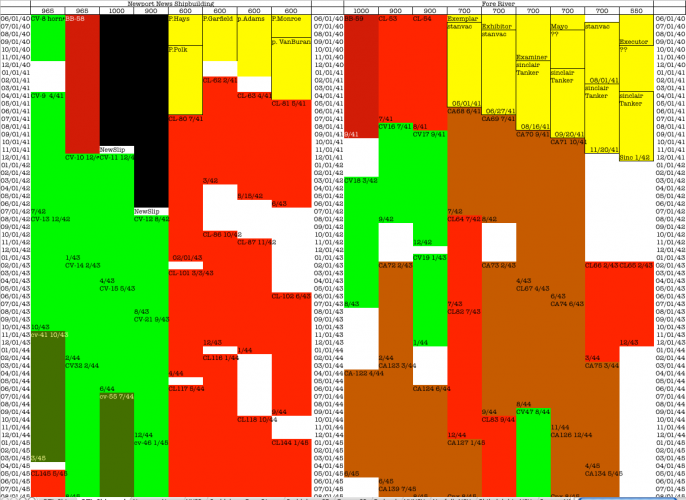
Something that might be relevant to the discussion, someone at AH.com reposted these very interesting shipbuilding diagrams. They may possibly not be 100% accurate, but they give a good idea.
https://www.alternatehistory.com/fo...ese-carrier-development.541172/#post-24137904US diagrams show the deleterious effects of being so late with finishing their CA and CL allowance, even if LNT is still the same they should have had on the slips only 1 CA and 2 CLs after 1936. So in this TTL it seems to be possible to bring forward to 1937-38 at least 2 of the BBs as i was exploring the other day. Also with some jiggling around, wonder if space for CV-9 can be found too roughly alongside CV-8.
Btw thanks again NOMISYRRUC and EwenS for the info and the fantastic tables you bring forward, there is so much info digesting to do!
 
Just found (or found again) this outstanding source re US shipards/shipbuilding, there's a mountain of data to go through. From the few lists i checked so far the almost complete lack of shipbuilding in the 1920s is evident.
https://shipbuildinghistory.com/
 
Bumping this because after many years wondering about it found on my computer some diagrams (made by someone else, but i have no idea who or where) of US WW2 shipbuilding of everything from CLs upwards, including slipway lengths. So this will help us understanding better what can be built where. Unfortunately the diagrams only start from 1940 but still very useful for ATL scenarios.
 

Attachments

  • M8jsb3i.png
    M8jsb3i.png
    139.3 KB · Views: 21
  • O91szlm.png
    O91szlm.png
    176.2 KB · Views: 21
  • sS3meRm.png
    sS3meRm.png
    173.7 KB · Views: 18
A nuance to consider is that a large interwar fleet could have reduced the apparent need for a major building program in the 37-39 timeframe and the commiserate investment in industrial infrastructure. This in turn may have made the US less effective throughout the war.
 
A nuance to consider is that a large interwar fleet could have reduced the apparent need for a major building program in the 37-39 timeframe and the commiserate investment in industrial infrastructure. This in turn may have made the US less effective throughout the war.
Commensurate is the word you were looking for: "suitable in amount or quality compared to something else; matching in degree".

Commiserate means "to empathize with, to express sympathy for".
 
Does anyone know when and how the increases were announced?

Navy Acts 1934-40.png
The above was compiled by me from the copies of the Naval Acts that I downloaded from the Library of Congress website, but I was unable to find the Act that authorised the increase in the "Date Unknown" column.
I recently read this in Brassey's 1937 which is on Pages 58 and 59 (Pages 113 and 114 of PDF on Internet Archive).
RETENTION OF OVER-AGE TONNAGE.
The British Government in the spring of 1936 took action for the retention of 40,000 tons of over-age destroyers which would otherwise have been due for scrapping by December 31, 1936, under the London Naval Treaty of 1930. As was explained in the House of Commons by Lord Stanley, Parliamentary Secretary to the Admiralty, Great Britain made a definite reservation in the White Paper accompanying that Treaty that she would have to increase her destroyer tonnage if existing submarine programmes were not reduced. The Government approached their co-signatories of Part III of the Treaty in May, 1936, with an informal proposal to retain the tonnage in question. The United States replied that, since the Treaty provided means for dealing with such a contingency, such means should be followed. The Japanese gave a verbal reply to the effect that if Great Britain proposed informal departures from the Treaty terms, Japan would probably do likewise.
Accordingly, a note was handed to the U.S. and Japanese Ambassadors in London on July 15, 1936, formally invoking Article 21 of the Treaty (the "escalator" clause) to permit the retention of 40,000 tons of destroyers, increasing the British tonnage in this class from 150,000 to 190,000 tons. Next day, Admiral W. H. Standley, acting Secretary of the U.S. Navy, announced that the United States would similarly retain 40,000 tons of her destroyers due for scrapping, and an official notification to this effect was sent to the British Government on August 15. On September 2, the Japanese Government delivered in London a note in reply to that of July 15, stating that they proposed to retain over-age destroyers to a total of 11,059 tons, and over-age submarines to a total of 15,598 tons, a combined total of 26,657. It was understood that Japan represented that she had not sufficient over-age tonnage in destroyers alone to make up the figure of 28,133 tons to which, in accordance with the 5-5-3 ratio, she automatically became entitled by the retention of 40,000 tons each by the United States and Great Britain.
The effect of this decision was to make Japan the superior Power of the three in submarines. She already possessed equality under the London Treaty, each of the three Powers being allowed 52,700 tons of submarines. She was, moreover, already over treaty strength in this type. The official Return of Fleets as on January 1, 1936 (Cmd. 5038), showed her to possess fifty-seven submarines with an aggregate tonnage of 70,234, or 17,534 tons more than the total allowed by treaty; and she had also ten more building, amounting to 13,700 tons, a combined total of sixty-seven vessels of 83,934 tons. Great Britain and the United States did not have so great a surplus over treaty strength, and included in their totals were larger proportions of obsolete vessels of War design. The figures were:-
Brassey's Naval 1937 notes about Escalator Clauses.png


That answers the question for destroyer tonnage. Although I don't understand why the British Government felt the need to announce that it was keeping 40,000 tons of overage destroyers as the tonnage quotas were a dead letter due to them being abolished by the recently signed Second London Naval Treaty that would come into effect on 1st January 1937.

It also explains where the 15,598 tons of submarines came from, but not when the USA formally said it was following suit with Japan. Although I don't understand why the Japanese Government felt the need to do that (or announce the increase in destroyer tonnage) as it had already announced that it was leaving the treaty system at the end of 1936.
 
Last edited:
Nice find, @NOMISYRRUC, another little mystery elucidated. As to the why, perhaps the british just wanted to do their on the surface stereotypical "gentleman" thing, and/or more likely they were still hoping to get Japan (and others) back in the treaty system and didn't wanted to be seen as cheating.
 
I recently read this in Brassey's 1937 which is on Pages 55 and 56 (Pages 110 and 111 of the PDF on Internet Archive)
BRITISH CRUISER STRENGTH.
But for the decision of the Government, announced by Sir Samuel Hoare to the House of Commons on December 17, 1936, to invoke Article 21 (the "escalator clause") of the London Naval Treaty to retain five over-age vessels of the "C" class which were scheduled to be scrapped, the British Navy would not have possessed after December 31, 1936, even the minimum of fifty effective cruisers agreed upon in 1930. The present total is fifty-three ships (excluding the Vindictive, in process of conversion into a demilitarised cadet training ship). Four of the fifty-three cruisers belong to the Royal Australian Navy. The total is made up as follows:-
Brassey's Naval 1937 British cruisers.png

According to the displacements in the list of British Commonwealth cruisers on Pages 205 to 211 that comes to a total of 359,280 tons, which is 20,280 tons more than the British Commonwealth's cruiser quota of 339,000 tons.

And here's is what Sir Samuel Hoare said according to Hansard.
https://hansard.parliament.uk/commo...5a-31ff-4029-ad0a-c745bfe5a48d/CommonsChamber
In common with the announcement to keep 40,000 tons of destroyers, I don't know why they bothered as the Second London Naval Treaty made the tonnage quotas in its predecessor a dead letter. Furthermore, they left it quite late as the First London Naval Treaty only had another 14 days to run.
 
This is the table of British Commonwealth Cruisers from Brassey's 1937

1764769274813.png

As the accompanying text said Vindictive isn't in the list because she was being converted to a demilitarised cadet training ship, but there are still 3 other Hawkins class cruisers with 7.5in guns which means the British Commonwealth still more cruisers armed with guns of more than 6.1inches in calibre. However, it also says in Brassey's (Page 357 Book & 442 of the PDF) that.
The Effingham, the Vindictive, the Hawkins and the Frobisher have had their 7.5-inch armament removed in accordance with the terms of the London Naval Treaty, 1930.
The Effingham was taken in hand for large repairs and re-arming at Devonport in September, 1936, and is expected to complete about October, 1937.
The Vindictive was taken in hand at Portsmouth in June, 1936, for large repairs and fitting out as a cadets' training ship to relieve the Frobisher and is due for completion about July, 1937. The Frobisher and Hawkins will be taken in hand for similar work to the Effingham during the latter part of the financial year 1937.
Sheffield and Newcastle were built with 18,200 tons of the 91,000 tons that the British Commonwealth was allowed to lay down after 1st April 1930 and complete before 31st December 1936. They're not in the list because they weren't completed until March 1937. That makes me think that the Government asked the builders to complete the ships late so they would have more cruisers when the tonnage quotas expired.
 
Last edited:
NOMISYRRUC
Sorry I didn't reply to your PM but I was trying to find some information I recalled provided on other sites by David Chessum who is a bit of an authority on the Treaties. Now found the time for another look and a new search has now revealed it.

About the C class he wrote:

"Under LNT30, Britain was required to dispose of five over-age ‘C’ class cruisers (Cardiff, Ceres, Caledon, Calypso and Caradoc) before the end of 1936, which would have reduced British cruiser strength to just 48 vessels, at a time when it was the policy of the British Government to increase cruiser strength up to 70 vessels. As early as 1935 the RN had decided in principle to convert these vessels (along with eight other ‘C’ class cruisers) into anti-aircraft cruisers,[1] however early consideration of this issue had concluded that the argument for invoking Article 21 of LNT30 in respect of cruisers was weak, as there had only been limited construction of such vessels by nations not party to Part III of LNT30. An additional consideration was that Japan was expected to have seven over-age Kuma class cruisers due for disposal before the end of 1936, and that the Japanese retention of some of these ships as a quid-pro-quo would more than offset any benefit of the RN retaining the ‘C’ class cruisers.[2]
On 25 September 1936 the Foreign Office approached the American Ambassador to the United Kingdom to privately and unofficially sound out the American Government on the possibility of retaining the five ships. The British proposal to retain these cruisers was caveated with the restrictions that the ships would only be retained for a maximum of five years, and that they would be rearmed as anti-aircraft ships so that they would not be used as cruisers. The change of heart was motivated not only by the pressing needs of rearmament, but also by the fact that delays in the completion of the Japanese cruisers Suzuya and Kumano meant that Japan was no longer required to scrap the over-age Kuma class cruisers, and Japan could only retain the very old cruisers Tsushima, Hirado and Yahagi in response to any British escalation in cruisers.[3]
The Americans replied at the end of October that they had no objection to the British retention of these cruisers, provided that it was effected by Britain invoking Article 21 of LNT30, and Japan provided a favourable response in December.[4] Britain proceeded to do so on 22 December 1936, citing the recent deterioration of the general political situation, rather than warship construction by non-signatories to Part 3 of LNT30 as the justification.[5] In response, Japan decided to retain the cruiser Tsushima which would otherwise have been disposed of,[6] while the US asserted its right to increase its tonnage in the cruiser category by the same amount. Although it was clearly not possible for America to do anything in the three days available, it was seen to be important that their rights be recorded in order that the terms of the Vinson-Trammell Act (which established the composition of the USN at the limits prescribed by the WNT and LNT30) would be operative.[7]
Although the notification of this escalation specified that the five ships retained would be rearmed as anti-aircraft ships, only one of the ships identified was ever actually converted – Caledon, which was eventually converted between September 1942 and December 1943. [8]

[1] A Raven & J Roberts, 1980, British Cruisers of World War Two, Arms and Armour, London, p212.
[2] The Retention of Over-Age Cruiser Tonnage Due to be Scrapped under the London Naval Treaty, 1930, 22 Dec 1936, NAA: A5954/69, 1720/37.
[3] Ambassador in UK to Secretary of State, 25 Sep 1936, FRUS, 1936, Vol. 1, pp138-140.
[4] Secretary of State to Ambassador in UK, 28 Oct 1936, ibid, pp149-151. The Retention of Over-Age Cruiser Tonnage Due to be Scrapped under the London Naval Treaty, 1930, 22 Dec 1936, NAA: A5954/69, 1720/37.
[5] Eden to Yoshida, 22 Dec 1936, NAA: A981/4, DIS 27 PART 3.
[6] Yoshida to Eden, 29 Dec 1936, TNA: DO/35/545/11.
[7] Secretary of State to Ambassador in UK, 29 Dec 1936, FRUS, 1936, Vol. 1, p157.
[8] Ironically all of the other ‘C’ class cruisers that were not listed in the escalation were converted (with the exception of Capetown whose conversion was cancelled on the outbreak of World War Two). Coventry and Curlew had already been rearmed at the time of the escalation, Cairo and Calcutta were converted in 1938-39, Curacoa and Carlisle were converted in 1939-40 and Colombo was converted in 1942-43. J English, 1989, Royal Navy Anti-Aircraft Ships: Naval and Mercantile Conversions 1934-1943, Warship, 13, pp97-105."

Ewen
 
At the end of 2024 a book on the Hawkins class by Aidan Dodson was published.

https://www.amazon.co.uk/British-Ha...mzn1.fos.95fd378e-6299-4723-b1f1-3952ffba15af
In answer to queries on another site about their modernisation and his book, he wrote:-

"It includes everything I've been able to find on these issues. We have quite a bit of detail on the 8in conversion-plan, including sketches. However, we have almost nothing on the 5.25in conversion plans, which seem to have been scrapped just before any drawings were produced (although I do include my own sketch of what the ships MIGHT have looked like).

It appears that the Munich Crisis meant that it was not sensible to tie up Hawkins and Frobisher for long refits (cf. the non-modernisation Hood), while the difficulty in producing enough 5.25in mountings for not only them but the Didos and King George Vs mean that something had to give - and Hawkins and Frobisher were what 'gave'. Rather, they were now simply to be given single 6in guns in the locations formerly occupied by the 7.5in guns at the outbreak of war - which was switched to reinstatement of the 7.5ins when the UK decided to abrogate the all naval treaties in September 1939. As it transpired, while Hawkins was indeed back in service before the end of the year with her old guns, Frobisher required much more work, which combined with higher priority work, and the need to do yet more work to reflect emerging requirements, to mean she wasn't back in service until 1942."

The discussion about an 8in refit dated to 1925.

Under LNT30 Britain was limited to 146,800 tons of cruisers carrying guns greater than 6.1in. Anything in excess of that was to be disposed of gradually up to 31 Dec 1936. That meant Effingham, Frobisher, Hawkins & Vindictive.

Vindictive, as noted, became a cadet training ship armed with two 4.7in guns.

Effingham & Hawkins went to Reserve in 1935 and were disarmed to comply with the Treaty. Frobisher stayed in service as a training ship but was disarmed in 1936, and then went to Reserve in 1937. At that point the plan was to give them all a 6in armament to allow their retention. This was carried through on Effingham in 1937/38. By 1938 that was switched to thoughts of reconstructing Hawkins & Frobisher with 5.25in turrets, something that was not followed through for reasons Aidan Dodson noted. So the languished in Reserve until the outbreak of WW2 when it was decided to replace their 7.5in guns as explained above.

David Chessum noted in respect of the refits of Hawkins and Frobisher in response to someone's internet proposal to include 7.5in guns and a heavy AA battery in a mid 1930s rearming:-

"Any refit planned or conducted prior to the outbreak of war had to exclude re-installing any of the 7.5-inch guns, as they had been officially converted to light cruisers under LNT30, and Britain was prevented from acquiring heavy cruisers by LNT36.
Once war broke out, and treaty compliance was no longer a constraint, they were useful enough in their restored configuration for work in distant waters that major modifications probably weren't warranted."


Sheffield and Newcastle were built with 18,200 tons of the 91,000 tons that the British Commonwealth was allowed to lay down after 1st April 1930 and complete before 31st December 1936. They're not in the list because they weren't completed until March 1937. That makes me think that the Government asked the builders to complete the ships late so they would have more cruisers when the tonnage quotas expired.

I'll come back to the subject of the 91,000 tons later when I have some more time. Basically the problem in understanding this seems to be between what was planned around 1930 and how things eventually turned out in subsequent events.

But as for the suggestion that "the Government asked the builders to complete the ships late so they would have more cruisers when the tonnage quotas expired" if anything the complete opposite was true. The following has been extracted from "British Town Class Cruisers" by Conrad Waters.

It had originally been planned to build Minotaur / Newcastle & Polyphemus / Southampton of the 1933 Programme in Royal Dockyards. Instead the Admiralty issued tender invitations to 8 commercial companies on 2 March 1934. While all sent representatives to view the draft plans only VA (Tyne), John Brown & Cammell Laird submitted tenders, all of which complied with the tender requirements. Those requirements included one to deliver the ships within 33 months "of receipt of building drawings". The first two were awarded contracts on 1 June 1934 and the ships were laid down on 4 Oct and 21 Nov 1934. (Unfotunately we don't know when the plans were delivered but it must have been sometime between the order & laying down dates).

Two other factors came into play around the decision as well as money. VA proposed reopening the Tyne High Walker Yard that had been closed since Nov 1931 and was one of the more modern naval yards in the country and it was in an area of high unemployment. This was emphasised in the tender. And Cammell Laird had of course won the contract for Ark Royal. So there seems to have been an element of spresding the available work around the country to start building the industry up again.

The two 1934 Programme ships (Birmingham was built at Devonport Dockyard with only her machinery going out to tender) saw tender invitations go out on 5 Sept 1934 with contracts placed on 17 Dec 1934 again with the 33 month clause. VA (Tyne) and Scotts were the successful bidders. VA had proposed building Sheffield at Barrow but the Admiralty insisted it should be built on the Tyne. These were laid down on 31 Jan & 16 April 1935. The switch of VA yard probably helped gain some time as they were already building Newcastle.

For the two 1935 Programme ships built in commercial yards, the invitations to tender were issued on 23 Aug 1935 with contracts issued on 11 Nov 1935. The change in the tendering arrangements was that completion was now to be 30 months from receipt of plans.

In mid-1935 the Admiralty sought to reduce the build time on the commercially built ships in the 1933 & 1934 Programmes by 3 months, so bringing them into line with the 1935 ships. Later, in July 1936, the Admiralty was seeking every effort to be made to reduce the build times to 27 months for the 1935 & 1936 Programme ships. And these reductions being sought were despite there being design changes to be incorporated along the way.

When the 1936 ships were tendered in July 1936 the build time was further reduced to 27 months. Both successful builders highlighted major problems beginning to appear in the industry regarding labour and material shortages. These also impacted the earlier ships and the Admiralty had to accept that the acceleration was not possible.

So the actual build times were (order to completion / lay down to completion)
1933 Programme
Newcastle - 33m 4d / 29m 1d
Southampton - 33m 5d / 27m 13d

1934 Programme (commercial builds)
Sheffield - 32m 8d / 30m 25d
Glasgow - 32m 23d / 28m 24d

1935 Programme (commercial builds)
Liverpool - 35m 22d / 32m 16d
Manchester - 32m 24d / 28m 7d
 
And there is also Article XIX of LNT 30 to be taken into account:-

Article XIX
Except as provided in Article 20, the tonnage laid down in any category subject to limitation in accordance with Article 16 shall not exceed the amount necessary to reach the maximum allowed tonnage of the category, or to replace vessels that become "over-age" before 31 December 1936. Nevertheless, replacement tonnage may be laid down for cruisers and submarines that become "over-age" in 1937, 1938 and 1939, and for destroyers that become "over-age" in 1937 and 1938.
"over-age" = 16
years from completion for cruisers laid down before 1 Jan 1920 & 20 years for cruisers laid down on or after that date (Article XIII)

So all bar one of the C class (Capetown was laid down in late Feb 1918 and completed in April 1922) were "over-age" by 31 Dec 1936, all having been laid down by the end of Feb 1918. Capetown was over age in 1938.

Of the D class 5 were "over-age" by 31 Dec 1936 with the remaining 3 "over-age" in 1937 & 1938.

And the two E class would be over age in 1942.

After that there was Article XX(a) to consider, limiting the new tonnage available to the RN to 91,000 tons

Article XX
Notwithstanding the rules for replacement contained in Annex I to Part II:

(a) The "Frobisher"and "Effingham" (United Kingdom) may be disposed of during the year 1936. Apart from the cruisers under construction on 1 April 1930, the total replacement tonnage of cruisers to be completed, in the case of the British Commonwealth of Nations, prior to 31 December 1936, shall not exceed 91,000 tons (92,456 metric tons).

So in 1930 the Treaty envisaged that all the Hawkins class could be disposed of before 31 Dec 1936 (Hawkins & Vindictive were already over-age by then and the above clause allowed the disposal dates to be brought forward for Frobisher (from 1940) and Effingham (from 1941)

But looking at the overage tonnage available in 1937 & 1938 there would have been no problem constructing Newcastle & Southampton.

The problem then for the RN was how to modernise the cruiser fleet to achieve the 50 cruiser requirement within the limitation of only having 91,000 tons of new construction available.

Edit:- And I forgot the old HMAS Adelaide. Laid down Nov 1915 and completed July 1922, so "over-age" in 1938.​
 
Last edited:
What impact could this have on shipbuilding in the US and UK, both naval and overall? I've recently read that US shipbuilding has never been competitive globally and the UK relied heavily on skilled labour and low management and infrastructure overheads. In the UK this was so bad that a big, modern shipyard, seemingly the sort of thing suited to WW2 and postwar shipbuilding was closed in 1929 due to the high equipment overhead and everything dismantled and sold.
 
Last edited:
What impact could this have on shipbuilding in the US and UK, both naval and overall? I've recently read that US shipbuilding has never been competitive globally and the UK relied heavily on skilled labour and low management and infrastructure overheads. In the UK this was so bad that a big, modern shipyard, seemingly the sort of thing suited to WW2 and postwar shipbuilding was closed in 1929 due to the high equipment overhead and everything dismantled and sold.
The problem in Britain was that ship orders dried up inn the 1920s. Too many yards chasing too few orders. On the naval side the WNT also caused a reduction in orders.

Result was the Ltdformation of National Shipbuilders' Security Ltd in 1930 to reduce the size of the industry.
https://www.gracesguide.co.uk/National_Shipbuilders_Security
One of the conditions attached to yard deals under these provisions was that the yard sites had to be cleared and no shipbuilding was to be permitted on the sites for 40 years. So alternative uses had to be found or they lay derelict.

Beardmore at Dalmuir on the Clyde was one of the first to go. But all of Beardmore's businesses were in trouble in the 1920s and the bits that survived did so under new ownership.
https://en.wikipedia.org/wiki/William_Beardmore_and_Company
Another big naval shipbuilder lost in this period was Palmers on the Tyne.
https://www.tynebuiltships.co.uk/Palmer-History.html
Even part of the Fairfield yard that had been dedicated to building subs in WW1 was closed in this period. IIRC US Army Engineers built a few landing craft there in 1944 but otherwise it has lain derelict until today.
 
What appears strange to me is that in the face of a lack of orders and economic downturn it wasn't the most 'backward looking' yards that were closed, rather it was big, modern and theoretically efficient yards that were closed. I'm no expert on shipbuilding, but it appears to me that a good trajectory for the industry would be the older, smaller, less efficient yards should close during downturns. I'm getting the vibe that interwar shipbuilding is a bit akin to the postwar aviation industry where rationalisation was pushed by the government.
 
Back
Top Bottom