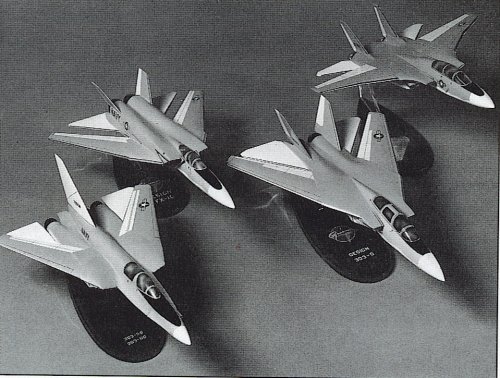
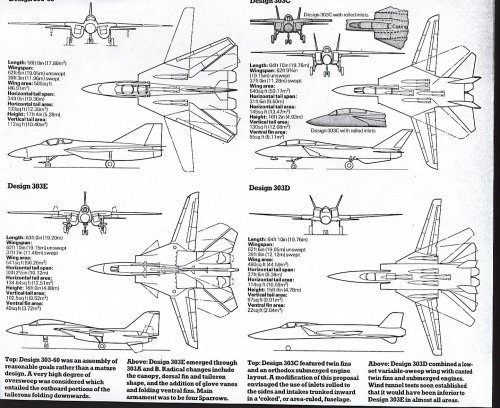
USN VFX Competition (Evolution of and alternatives to the F-14)

I think a lot of members would be happy to see this one: I actually found the RFP for the VFX... I don't know how accurate this is so I could use to know if there were changes

- Two-man crew (tandem-seating)
- Two-engines (Pratt &Whitney TF-30 P-412 to be used as interim)
- Incorporate AWG-9 and AIM-54 Phoenix weapon system
- Carry up to 6 x AIM-54 Phoenix, or 6 x AIM-7 Sparrow, and/or 4 x AIM-9 Sidewinder missiles plus one internal M61-A1 Vulcan-cannon.
- Be designed to endure high fighter loads exceeding those of the F-4J loaded with AIM-7 Sparrow or AIM-54 Phoenix missiles
- Carrier suitability: Landing strengths for 6 x AIM-54 Phoenix missiles and 4,000 lbs of fuel. Landing speeds and weights of VFX are suitable for operations from the Hancock-Class CVA's.

There are probably other requirements too but these I remember finding online. If only I wrote down the URL.
 
Does anyone have more data about the Grumman Fixed-Wing VFX Study?

I've seen a bunch of pictures of it but very little data, particularly pertaining to wing area (and/or any data pertaining to it's performance). I could really use the data if anyone has it.


KJ Lesnick
 
KJ, was that the VFX-A or -B ? There were TWO specifications.
 
Maki said:
I wonder what was the estimated top speed of NAR's concept. Those wings don't look like they are optimized for supersonic performance.

NAVAIR doubted the performance claims of NAR's entry, they didn't think the VFX could be done without VG. The wing was also good deal straighter and less "gothic" than the FX (F-15) entry was. It's also interesting no pictures with an AIM-54 hanging off it have appeared either.

Skybolt said:
KJ, was that the VFX-A or -B ? There were TWO specifications.

Never heard of the terms of VFX-A or -B. I've heard of VFX-1, VFX-2 and VFX-3 though; the original plan the F-14A, B, C production transition plan. (http://www.flightglobal.com/pdfarchive/view/1969/1969 - 0395.html)

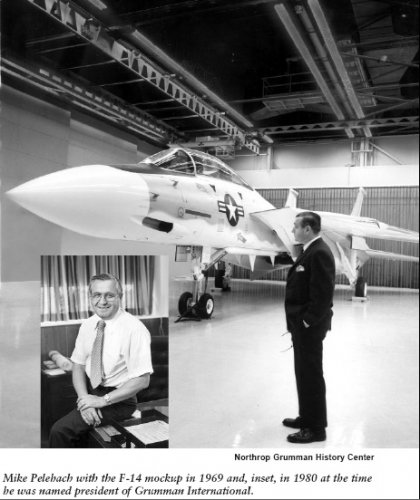
Here's a picture of the F-14 model after it grew a second tail with the lead designer Mike Pelehach.
 

Attachments

  • F14MP.jpg
    F14MP.jpg
    107.7 KB · Views: 1,256
Pyrrhic Victory,

NAVAIR doubted the performance claims of NAR's entry, they didn't think the VFX could be done without VG.

I didn't know NAVAIR was totally opposed to a VG-design.

Never heard of the terms of VFX-A or -B. I've heard of VFX-1, VFX-2 and VFX-3 though; the original plan the F-14A, B, C production transition plan. (http://www.flightglobal.com/pdfarchive/view/1969/1969%20-%200395.html)

How long would it take for them to go from A to C? I was always under the impression they'd go from the original TF-30 directly to the F-401?

Additionally, I was never under the impression that spot-factor relative to the F-4 was considered such a gigantic deal (It was mentioned in the article)


KJ
 
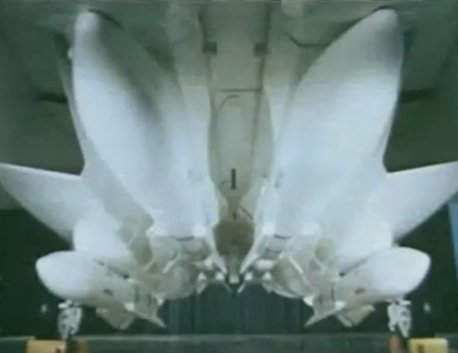
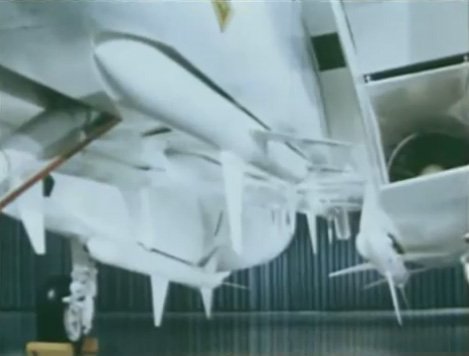
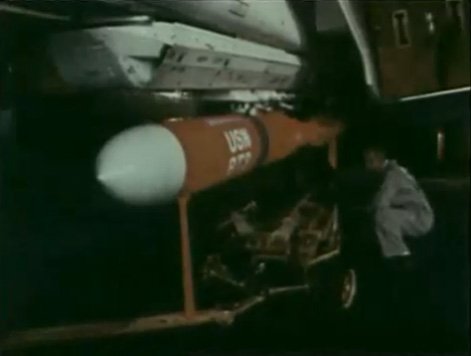
Captures from an Italian doc on the F-14

Underside shots of the mock up with two AIM-54 and AIM-7 place on the engine nacelles. Also some orange thing that I did not recognize.
 

Attachments

  • 6-belly.jpg
    6-belly.jpg
    42.2 KB · Views: 1,112
  • 6-sparrows.jpg
    6-sparrows.jpg
    46.3 KB · Views: 1,038
  • orangething1.jpg
    orangething1.jpg
    38.6 KB · Views: 1,068
The red one could be a Harpoon Mock up?

An Italian Doc? About what?

Why are the under engine nacelles not used like this? Is it because of little space to the deck on hard landings?
 
An Italian documenary on the F-14, made by using US videos. Probably by DELTA. I myself own the B-52 one, that you can find in original version on YouTube.
 
So there was nothing that could have been done that would have persuaded the USN that a fixed-wing would have worked?
 
starviking said:
Racer said:
The red one could be a Harpoon Mock up?

I think it's too small in diameter to be a Harpoon.
I disagree. Compare it to the inlet just to the right, which should be about the same size as the one on the F-14 we know and love. Harpoon's only a hair over a foot in diameter, and a man could crawl down an F-14 inlet if he wished.
 
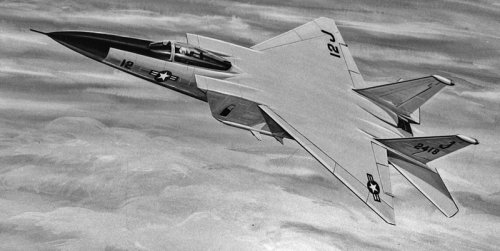
This McDonnell-Douglas fixed wing FX design derivative was considered for the VFX requirement.
 

Attachments

  • xMcDonnell-VFX-fixed-wing-proposal.jpg
    xMcDonnell-VFX-fixed-wing-proposal.jpg
    106.4 KB · Views: 813
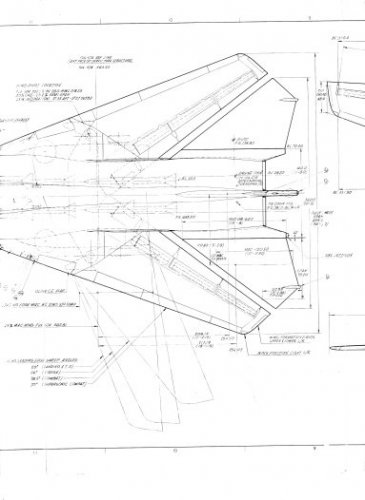
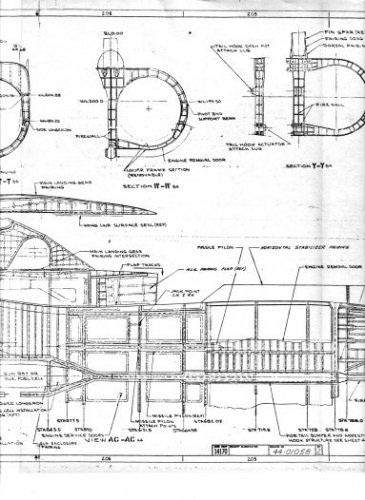
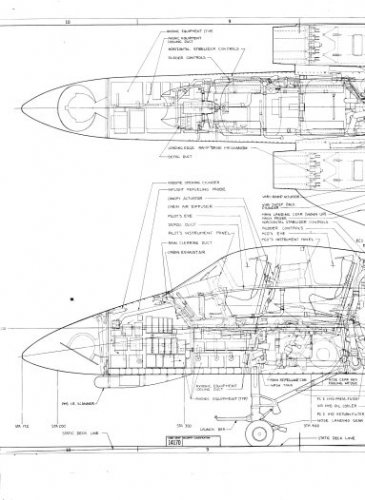
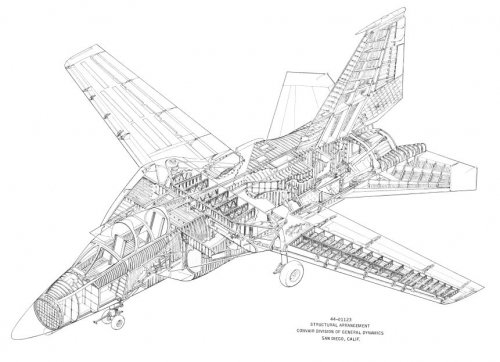
Some greatly reduced (15% of original size) snips of some Convair Model 44 diagrams I came across. The full-rez, complete versions of these may or may not wind up for sale, but for now the full rez versions are "embargoed."
 

Attachments

  • model 44 d.jpg
    model 44 d.jpg
    31.4 KB · Views: 720
  • model 44 c.jpg
    model 44 c.jpg
    55.3 KB · Views: 702
  • model 44 b.jpg
    model 44 b.jpg
    43.7 KB · Views: 886
  • model 44 a.jpg
    model 44 a.jpg
    91.1 KB · Views: 3,257
overscan said:
The cutaway drawing is particularly beautiful.

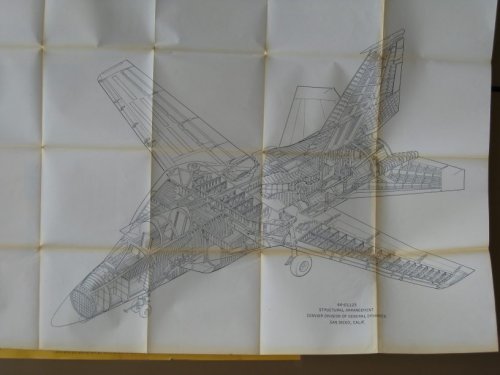
Yeah, it's a hell of a piece of artwork. The first time I saw it, it was in the form of a far-to-big-for-my-flatbed-scanner "blueprint," seen here in photo form. The next day I came across a conveniently sized version that scanned well at 600 dpi.
 

Attachments

  • IMG_9087.jpg
    IMG_9087.jpg
    61.4 KB · Views: 711
That fixed wing design, was that the F-15N or another Naval FX derivative?
 
KJ_Lesnick said:
Abraham Gubler,

If you are going to Sponge KJL at least try and ask less inane questions...

I wasn't trying to sponge, and I didn't think it was an inane question. I know spot factor is important to some extent on all Navy Fighters, I'm just wondering how big a deal it was for this particular program over others for example.

Unless you're the F/A-18, spotting factor is always a major factor. It determines how many you can carry, how many you can maintain, how you can park and store and how you can move around the deck.
 
F-14D said:
Only McDonnell's and Grumman's designs were able to meet the Navy requirements, and McDonnell's only barely. Grumman's design was head and shoulders above everyone else's. But like all the designs, it was based on the Gov't being able to deliver the F401, which didn't happen. The F-14A was never meant to be a production model, it was supposed to be a development version of which only 13-69 would be built to d a lot of the testing since the airframe was running well ahead of the engine development. The [original] F-14B was to be the first production standard model with the definitive engine and other changes for series production (including an APU). In effect what happened would be the equivalent of the vast majority of F-22s being EMD models.

It should be noted that the inability to deliver the F401 was partially due to a crusade against it by a member of the House of Representatives in 1974. His battlecry was "The TF30 is good enough!" and, after two F401 test engines were brought back from the test cells in pieces over the space of a week, he managed to marshall enough support to kill the program. Four years later, with the TF30, which he forced the USN to keep, causing real problems, he charged that "The Navy bought a "Turkey", not a 'Tomcat'!" needless to say, he said nothing about his role in this mess. To some degree, he was emulating his mentor and the sernior senator from his state, WIlliam Proxmire, but with less, IMHO, intelligence. This Representative went on to become president Clinton's first SecDef, Les Aspin.

If you're wondering how/why I remember all this, the F401 cancellation got me laid off from P&W's FLordia R&D Center.
 
elmayerle said:
F-14D said:
Only McDonnell's and Grumman's designs were able to meet the Navy requirements, and McDonnell's only barely. Grumman's design was head and shoulders above everyone else's. But like all the designs, it was based on the Gov't being able to deliver the F401, which didn't happen. The F-14A was never meant to be a production model, it was supposed to be a development version of which only 13-69 would be built to d a lot of the testing since the airframe was running well ahead of the engine development. The [original] F-14B was to be the first production standard model with the definitive engine and other changes for series production (including an APU). In effect what happened would be the equivalent of the vast majority of F-22s being EMD models.

It should be noted that the inability to deliver the F401 was partially due to a crusade against it by a member of the House of Representatives in 1974. His battlecry was "The TF30 is good enough!" and, after two F401 test engines were brought back from the test cells in pieces over the space of a week, he managed to marshall enough support to kill the program. Four years later, with the TF30, which he forced the USN to keep, causing real problems, he charged that "The Navy bought a "Turkey", not a 'Tomcat'!" needless to say, he said nothing about his role in this mess. To some degree, he was emulating his mentor and the sernior senator from his state, WIlliam Proxmire, but with less, IMHO, intelligence. This Representative went on to become president Clinton's first SecDef, Les Aspin.

If you're wondering how/why I remember all this, the F401 cancellation got me laid off from P&W's FLordia R&D Center.


Absolutely true. Another contributing factor was USAF's playing fast and loose with the 150 hr reliability test. By doing that, by the agreement on who paid for what in developing the Advanced Technology Engine (which became the F100/F401), USN would be solely responsible for all costs involved in bringing the ATE up to an acceptable level of reliability. Navy didn't have enough money budgeted to do that. That, plus the factor so accurately described above, was why the F401 died. Ironically, Navy probably ended up paying far more trying to make the TF30 work than they would have spent fixing the far superior F401.
 
hesham said:
Hi,

http://www.flightglobal.com/pdfarchive/view/1969/1969%20-%201308.html?search=VFX

Aha! So it seems Flight made the mistake about this being the Grumman design....
 
overscan said:
hesham said:
Hi,

http://www.flightglobal.com/pdfarchive/view/1969/1969%20-%201308.html?search=VFX

Aha! So it seems Flight made the mistake about this being the Grumman design....

You are right my dear Overscan.
 
Mark Nankivil said:
Hi All -

Some artwork from the Greater St. Louis Air & Space Museum archives showing the design evolution of the McDonnell Douglas F-15.

Based on the photo print numbers, this appears to be a decent timeline at what was transpiring.

I have some more to scan from this set but those pretty much fit into the final design layout though you'll see some of the details disappear or morph into what we all know as the Eagle.

Enjoy the Day! Mark

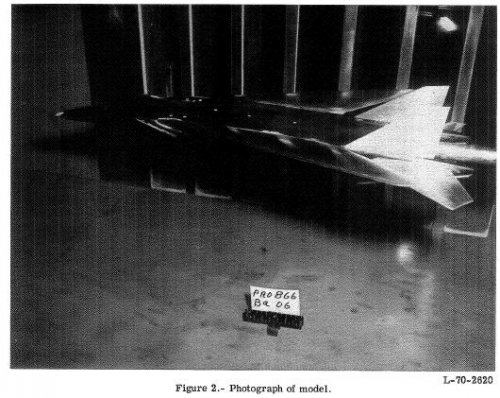
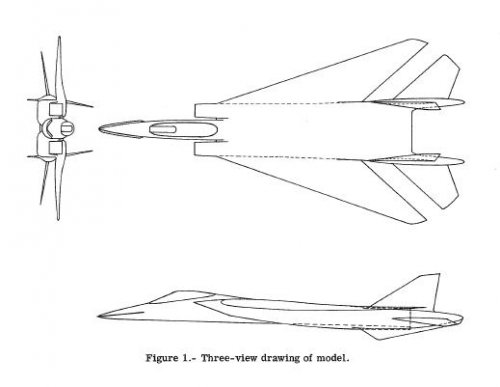
From NASA report,the LFAX-4 with 71 degree swept.


Attachments

  • LFAX 4.JPG
    LFAX 4.JPG
    54.3 KB · Views: 436
  • NASA SWEPT WING FIGHTER 1.JPG
    NASA SWEPT WING FIGHTER 1.JPG
    18.3 KB · Views: 539
Does anyone have a good rundown for G-numbers associated with all versions of the F-14? The only thing I have is 303E for the F-14A.
 
XB-70 Guy, you're too impatient! I've gotten you used to speedy answers, and now you can't wait! Some topics here find their answers months after the initial message was posted, so please give it some more time...
 
You know how to search, don't you? (Y'know, it sounded better when Lauren Bacall said almost the same line... ;) )

Go up to search and enter VFAX. A lot of excellent work has already been done by board members, just waiting for you to research it.
 
With 26 published books and hundreds of articles - yes, I do know how to research. I'm just new to Secret Projects and, frankly, I didn't think of VFAX.
 
aim9xray - not VFAX but VFX.

Here is something, trying to remember the source...
 

Attachments

  • 10-07-2004 02_19_56PM.JPG
    10-07-2004 02_19_56PM.JPG
    234.2 KB · Views: 363
  • 1223B6~1 (2).JPG
    1223B6~1 (2).JPG
    425.3 KB · Views: 396
Matej said:
aim9xray - not VFAX but VFX.
My apologies to all; I did mean to say VFX. Guess I did not take my anti-grumpy pill this morning!

To our esteemed (or steamed) author - yes, I have many of your efforts. The point that I did not make very well was that a lot of the information that you are starting new threads on has already been covered by postings - all you need to do is look! There is a fantastic amount of hitherto unknown information that has come to light *here* in the past few years.

And the VFX thread is at:
http://www.secretprojects.co.uk/forum/index.php/topic,229.0
 
Matej said:
aim9xray - not VFAX but VFX.

Here is something, trying to remember the source...

Great big hugenormous book from the 80's. I forget the title, but it's got big chapters on the F-14, F-15, B-1, Harrier, etc. I seem to recall "Mike Spick" being an author on the B-1 chapter. Similar sort of early B-1 drawings.
 
With these engine problems I am even more baffled why the option on the TF41/Spey wasn't looked at further especially with 17,500/27,000lb available in this timeframe (and an option of 28,000lb reheat on customer requirements - RR option from 71). Considering the reliability record the Spey derivitives had created (not least with the A-7) would have been an interesting fit and even better fuel economy and improved servicing was on the cards from what I have read. The British Phantoms with these engines would have been very interesting indeed.
 
norseman said:
With these engine problems I am even more baffled why the option on the TF41/Spey wasn't looked at further especially with 17,500/27,000lb available in this timeframe (and an option of 28,000lb reheat on customer requirements - RR option from 71). Considering the reliability record the Spey derivitives had created (not least with the A-7) would have been an interesting fit and even better fuel economy and improved servicing was on the cards from what I have read. The British Phantoms with these engines would have been very interesting indeed.

While the thrust levels were improved over the TF-30, the TF-41 had its own issues, both with maintenance and reliability.
 
TinWing said:
norseman said:
With these engine problems I am even more baffled why the option on the TF41/Spey wasn't looked at further especially with 17,500/27,000lb available in this timeframe (and an option of 28,000lb reheat on customer requirements - RR option from 71). Considering the reliability record the Spey derivitives had created (not least with the A-7) would have been an interesting fit and even better fuel economy and improved servicing was on the cards from what I have read. The British Phantoms with these engines would have been very interesting indeed.

While the thrust levels were improved over the TF-30, the TF-41 had its own issues, both with maintenance and reliability.

The notional Advanced Technology Engine that the F-14 designed around had to meet other requirements besides just increased thrust (unrestricted throttle movement, rapid response, function at high angle of attack, improve reliability, etc.). I doubt if the TF41/Spey could have met those, and if it couldn't what would be the point of moving to it? Come to think of it, the F100 didn't meet those requirements until it was faced with competition from the F110. Also, the TF41/Spey was still pretty much a "paper" engine. The TF41 was excellent in the A-7, but that was also a much less demanding role.

The Navy didn't have the money anyway, and if they did, they'd rather have put the money into something that would give them what the gov't originally promised. They finally got it with the arrival of the F110.

Also, the Navy watched what happened in the UK with the Spey on the F-4. The Spey Phantom was a disappointment, and in retrospect many concede that doing it was a mistake, given its performance vs. its cost. The USN probably saw no reason to spend all the money, even if they could have gotten it, on a similar experiment.
 
F-14D said:
TinWing said:
norseman said:
With these engine problems I am even more baffled why the option on the TF41/Spey wasn't looked at further especially with 17,500/27,000lb available in this timeframe (and an option of 28,000lb reheat on customer requirements - RR option from 71). Considering the reliability record the Spey derivitives had created (not least with the A-7) would have been an interesting fit and even better fuel economy and improved servicing was on the cards from what I have read. The British Phantoms with these engines would have been very interesting indeed.

While the thrust levels were improved over the TF-30, the TF-41 had its own issues, both with maintenance and reliability.

The notional Advanced Technology Engine that the F-14 designed around had to meet other requirements besides just increased thrust (unrestricted throttle movement, rapid response, function at high angle of attack, improve reliability, etc.). I doubt if the TF41/Spey could have met those, and if it couldn't what would be the point of moving to it? Come to think of it, the F100 didn't meet those requirements until it was faced with competition from the F110. Also, the TF41/Spey was still pretty much a "paper" engine. The TF41 was excellent in the A-7, but that was also a much less demanding role.

The Navy didn't have the money anyway, and if they did, they'd rather have put the money into something that would give them what the gov't originally promised. They finally got it with the arrival of the F110.

Also, the Navy watched what happened in the UK with the Spey on the F-4. The Spey Phantom was a disappointment, and in retrospect many concede that doing it was a mistake, given its performance vs. its cost. The USN probably saw no reason to spend all the money, even if they could have gotten it, on a similar experiment.
The F401 was cancelled due to a crusade led by Rep. Les Aspin to kill the F401 engine (it didn't help that just after he started this crusade two F401's came back from the test cells in bushel baskets - in one case, there was a manufacturing problem in a second-stage tubrine disk that wasn't caught; the other was a new vibratory mode that was dealt with by re-design for both the F100 and the F401)> I have to assume, given their lack of fight for it, that the USN had lost fiath in the F401. Mind you, Aspin's cry that'The TF30 is good enough!" was manifestly in error as was proved later in the 1970s. Of course, when he later said, "The Navy bought a Turkey, not a Tomcat!", he did not own up to his role in neutering that Tomcat.
 
elmayerle said:
F-14D said:
TinWing said:
norseman said:
With these engine problems I am even more baffled why the option on the TF41/Spey wasn't looked at further especially with 17,500/27,000lb available in this timeframe (and an option of 28,000lb reheat on customer requirements - RR option from 71). Considering the reliability record the Spey derivitives had created (not least with the A-7) would have been an interesting fit and even better fuel economy and improved servicing was on the cards from what I have read. The British Phantoms with these engines would have been very interesting indeed.

While the thrust levels were improved over the TF-30, the TF-41 had its own issues, both with maintenance and reliability.

The notional Advanced Technology Engine that the F-14 designed around had to meet other requirements besides just increased thrust (unrestricted throttle movement, rapid response, function at high angle of attack, improve reliability, etc.). I doubt if the TF41/Spey could have met those, and if it couldn't what would be the point of moving to it? Come to think of it, the F100 didn't meet those requirements until it was faced with competition from the F110. Also, the TF41/Spey was still pretty much a "paper" engine. The TF41 was excellent in the A-7, but that was also a much less demanding role.

The Navy didn't have the money anyway, and if they did, they'd rather have put the money into something that would give them what the gov't originally promised. They finally got it with the arrival of the F110.

Also, the Navy watched what happened in the UK with the Spey on the F-4. The Spey Phantom was a disappointment, and in retrospect many concede that doing it was a mistake, given its performance vs. its cost. The USN probably saw no reason to spend all the money, even if they could have gotten it, on a similar experiment.
The F401 was cancelled due to a crusade led by Rep. Les Aspin to kill the F401 engine (it didn't help that just after he started this crusade two F401's came back from the test cells in bushel baskets - in one case, there was a manufacturing problem in a second-stage tubrine disk that wasn't caught; the other was a new vibratory mode that was dealt with by re-design for both the F100 and the F401)> I have to assume, given their lack of fight for it, that the USN had lost fiath in the F401. Mind you, Aspin's cry that'The TF30 is good enough!" was manifestly in error as was proved later in the 1970s. Of course, when he later said, "The Navy bought a Turkey, not a Tomcat!", he did not own up to his role in neutering that Tomcat.

The reason the Navy lost faith was that people like the senator mentioned above were trying to kill the Tomcat, and Navy didn't want to take on a separate fight over the engine. Since the plane would work with the TF30 (although nowhere nearly as well) they decided to marshal their strength around saving the plane and hope that later they could take care of the engine. At that time, they didn't realize how bad the TF30 was. A major, major additional factor was in my Sept 16, 2009 post replying to your post of earlier that same day. I also went into this issue in greater detail here:
 
elmayerle said:
F-14D said:
TinWing said:
norseman said:
With these engine problems I am even more baffled why the option on the TF41/Spey wasn't looked at further especially with 17,500/27,000lb available in this timeframe (and an option of 28,000lb reheat on customer requirements - RR option from 71). Considering the reliability record the Spey derivitives had created (not least with the A-7) would have been an interesting fit and even better fuel economy and improved servicing was on the cards from what I have read. The British Phantoms with these engines would have been very interesting indeed.

While the thrust levels were improved over the TF-30, the TF-41 had its own issues, both with maintenance and reliability.

The notional Advanced Technology Engine that the F-14 designed around had to meet other requirements besides just increased thrust (unrestricted throttle movement, rapid response, function at high angle of attack, improve reliability, etc.). I doubt if the TF41/Spey could have met those, and if it couldn't what would be the point of moving to it? Come to think of it, the F100 didn't meet those requirements until it was faced with competition from the F110. Also, the TF41/Spey was still pretty much a "paper" engine. The TF41 was excellent in the A-7, but that was also a much less demanding role.

The Navy didn't have the money anyway, and if they did, they'd rather have put the money into something that would give them what the gov't originally promised. They finally got it with the arrival of the F110.

Also, the Navy watched what happened in the UK with the Spey on the F-4. The Spey Phantom was a disappointment, and in retrospect many concede that doing it was a mistake, given its performance vs. its cost. The USN probably saw no reason to spend all the money, even if they could have gotten it, on a similar experiment.
The F401 was cancelled due to a crusade led by Rep. Les Aspin to kill the F401 engine (it didn't help that just after he started this crusade two F401's came back from the test cells in bushel baskets - in one case, there was a manufacturing problem in a second-stage tubrine disk that wasn't caught; the other was a new vibratory mode that was dealt with by re-design for both the F100 and the F401)> I have to assume, given their lack of fight for it, that the USN had lost fiath in the F401. Mind you, Aspin's cry that'The TF30 is good enough!" was manifestly in error as was proved later in the 1970s. Of course, when he later said, "The Navy bought a Turkey, not a Tomcat!", he did not own up to his role in neutering that Tomcat.

My own personal take on the F401 is that it came too late to survive the budget ax. Despite all of its early woes, the F100 was too far along to kill, but the derivative F401 was an easy target. Personally, I'm inclined to say that USN made a mistake by insisting on a slightly higher bypass ratio derivative of the USAF F100, despite the obvious advantages in range and loitering performance. The F401 was just different enough from the vanilla F100 to create additional development costs, risk and delays on top of the early issues associated with the F100. Perhaps a marinized, minimum change F100 would have survived the scrutiny Rep. Aspin? Of course, the decreased endurance of a F100 powered F-14 might have tipped the scales against the entire program?

Of course, the real issue was the high unit cost of the F401 in comparison to the TF30. Even the F100 was substantially more expensive than the TF30.
 
Back
Top Bottom