Canada Future fighter capability project (ex-Next Generation Fighter Capability)

P.S. Regarding the 'long-legs' - I never said that the CF-18/CF-188 was particularly well suited - although the carrier landing equipment was very useful up North. If Canada was large enough in population to develop our own interceptor it'd fall more in the Su-27/Mig-31 category - our requirements are more like those of the Russians due to geography. Maybe our traditional favouring of twin-engined designs and the PVO's favouring of twin engines isn't unrelated either? Have you tried walking home across the Canadian Shield let alone Muskeg?
Too bad Su-57 is off the table. That would be just about ideal for Canada's situation. Range, two engines, arctic conditions, and it sure would annoy the southern neighbors if you think that's a priority. :)
 
F35 makes sense in more ways than one vis a vis gripen..... One thing to note is the multiple countries from where Gripen is actually sourced from. Must be a headache for maintenance and logistics.
F-35 parts production is spread over several countries.
https://www.lockheedmartin.com/en-us/products/f-35/f-35-global-partnership.htmlWiki cites eight level 1/2/3 global partners, Lockheed Martin's global partners map additionally shows Japan, South Korea and Israel as supplier countries. That map also shows Turkey, which is set to produce some parts until 2022.
 
Last edited:
Ottawa is not in the habit of making quick decisions when it come sot weapons. They just spent a few billion dollars to update the CF-18A fleet for the next decade.

As for why Ottawa is finally talking about fighters with enough range to defend our high arctic ... with global warming and arctic ice melting, the Northwest Passage will soon be navigable for ships from dozens of countries.
Heck! Even Communist China claims "observer" status to Artic conferences.
The difficult part of defending Canada's high arctic is stationing white men (European ancestry) in the high arctic. Few white men enjoy those long winter nights. Also supplying them with be prohibitively expensive.
Hint: I spent a summer at CFS Alert ... doing construction work.
would it be easier to station local people there who are used to those long winters.. say locals of Nunavut?
I dont know how Canada works, but in the US the national guard tends to be comprised mostly of locals of the state they represent.
Northern Canada is very sparsely populated more than a few hundred kilometers north of the US border (49th parallel). The main military presence is a few hundred Canadian Arctic Rangers. They are Inuit and Cree who's ancestors have lived on the land for thousands of years. They are traditional hunter-gatherers who depend upon fishing, sealing, hunting cariboo, etc. Their "sovereignty patrols" are along their traditional trap lines and seasonal hunting migrations. They were armed with WW2 surplus, .303 Lee-Enfield rifles until recently. Now they carry 7.62 x 51 mm Sako bolt-action rifles. They also train with both regular and reserves army soldiers from the south. When I went on a Canadian Army Reserve hiking trip - during 1975 - we were assisted by a pair of Canadian Arctic Rangers who showed us edible plants and killed a handful of Arctic Hare for us to cook and eat. Only natives are allowed to hunt in the Canadian high arctic due to sparse wildlife. I learned tremendous respect fro those guys who could scrape out a living in a land that would freeze and starve white-men in a few days.
Inuit also have a reputation for being talented mechanics who can keep their snow-mobiles running despite shortages of spare parts.
Only small numbers of natives (Iroquois, Migmaw, Cree, Algonquin, Dene, Inuit, etc.) join the Canadian Armed Forces, partly because they only represent a tiny percentage of the Canadian population.
 
Ottawa is not in the habit of making quick decisions when it come sot weapons. They just spent a few billion dollars to update the CF-18A fleet for the next decade.

As for why Ottawa is finally talking about fighters with enough range to defend our high arctic ... with global warming and arctic ice melting, the Northwest Passage will soon be navigable for ships from dozens of countries.
Heck! Even Communist China claims "observer" status to Artic conferences.
The difficult part of defending Canada's high arctic is stationing white men (European ancestry) in the high arctic. Few white men enjoy those long winter nights. Also supplying them with be prohibitively expensive.
Hint: I spent a summer at CFS Alert ... doing construction work.
would it be easier to station local people there who are used to those long winters.. say locals of Nunavut?
I dont know how Canada works, but in the US the national guard tends to be comprised mostly of locals of the state they represent.
Northern Canada is very sparsely populated more than a few hundred kilometers north of the US border (49th parallel). The main military presence is a few hundred Canadian Arctic Rangers. They are Inuit and Cree who's ancestors have lived on the land for thousands of years. They are traditional hunter-gatherers who depend upon fishing, sealing, hunting cariboo, etc. Their "sovereignty patrols" are along their traditional trap lines and seasonal hunting migrations. They were armed with WW2 surplus, .303 Lee-Enfield rifles until recently. Now they carry 7.62 x 51 mm Sako bolt-action rifles. ...
Tikka bolt action rifles, actually. Manufactured by Colt Canada under license.
https://www.tactical-life.com/firearms/gun-review-canadian-rangers-tikka-t3x-arctic-rifle/
 
thrax said:
going off topic by why US ( Lockheed) doesnt introduce a 'wattered down' version of the F-22 for export (with F100-110 engines px) like the old F-16/79 project? Most off the closest allies really need a twin engined air-superiority aircraft.

Because it would have cost $1-2 billion just to develop an F-22 without the sensitive technology onboard that the USA didn’t want exported. The issue wasn’t the engines but structures and systems onboard that would reveal how to make certain technologies that the USA did not want revealed. Further the ‘closest allies don’t really need twin engine air-superiority aircraft they need a high survivability, high lethality networked strike fighter. The F-35 will provide this capability which is why everyone is buying it.
Well our allies (looking at you isreal) didn't exactly make it esey to argue that they wouldn't gust hand over the tech to the Russians/Chinese. Before (and after the f-35 has better tech then the f-22) the US had no issue selling full up f-4, f-14,f-15,f-16 all of wich were barely in the us wheel house when they were sold over seas.
 
Flightglobal: Saab boss awaits Canadian decision: says 'politics' tipped HX fighter contest.
https://www.flightglobal.com/defenc...tics-tipped-hx-fighter-contest/147532.article
Sounds like someone is living in denial...
I recall similar comments about 'politics' from France, after the Finnish HX decision.

Some people are never happy. Just because the Rafale lost out to the F-35 does not mean that it is all down to politics.
 
Last edited by a moderator:
Ottawa is not in the habit of making quick decisions when it come sot weapons. They just spent a few billion dollars to update the CF-18A fleet for the next decade.

As for why Ottawa is finally talking about fighters with enough range to defend our high arctic ... with global warming and arctic ice melting, the Northwest Passage will soon be navigable for ships from dozens of countries.
Heck! Even Communist China claims "observer" status to Artic conferences.
The difficult part of defending Canada's high arctic is stationing white men (European ancestry) in the high arctic. Few white men enjoy those long winter nights. Also supplying them with be prohibitively expensive.
Hint: I spent a summer at CFS Alert ... doing construction work.
would it be easier to station local people there who are used to those long winters.. say locals of Nunavut?
I dont know how Canada works, but in the US the national guard tends to be comprised mostly of locals of the state they represent.
Canada does not have a National Guard.
However, our Army Reserve and Naval Reserve serve similar roles as American Reservists.
We used to have RCAF Reserve squadrons, but they were too expensive to equip unless serving alongside a Regular Air Force Squadron flying the same type of aircraft. Regular technicians did all the major maintenance and reserve pilots just "borrowed" aircraft to fly during weekends.
Most major cities in Canada have an old brick armory used by a reserve regiment or three. Traditionally Canadian Reservists are high school or college students who need a part-time job to finance their studies. Reserve ranks are often bolstered by former Regular soldiers and sailors who now only want to sail part time. Most Canadian Reservists only parade only 1 or 2 evenings per week and 1 weekend per month. The more ambitious reservists try to attend summer courses that last a month or two. Reservists are usually equipped with last-week's-fashion of weapons and vehicles. This mean zero conversion training for former Regular soldiers and a reservist can carry a single model of rifle for his/her entire service.
Since the Cold War, more and more Canadian reservists attend Regular Army courses which allow them to be quickly contracted to fill the ranks of regular regiments assigned to NATO or UN missions. Few Canadian Army regiments are kept up to full strength during peace time, so they scramble to integrate reservists whenever assigned a mission overseas.
OTOH reservists are often called-out to deal with local disasters (Aid to Civilian Powers) like fires, riots and mud-slides.
 
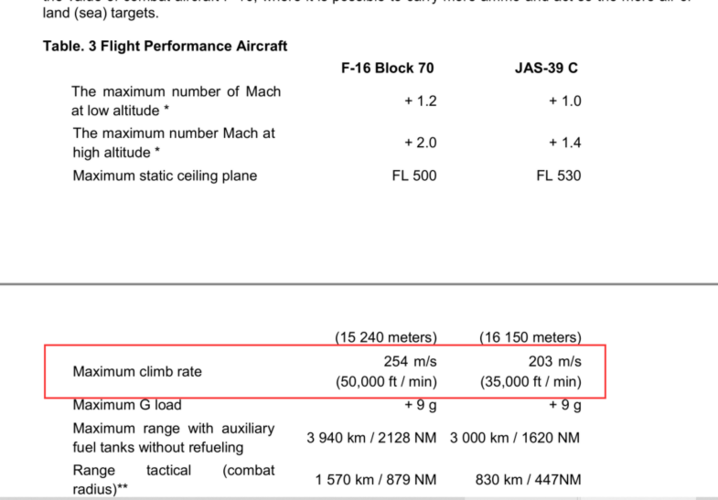
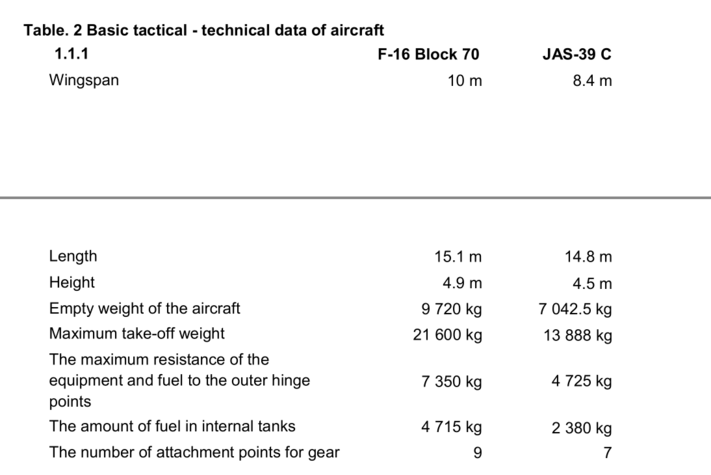
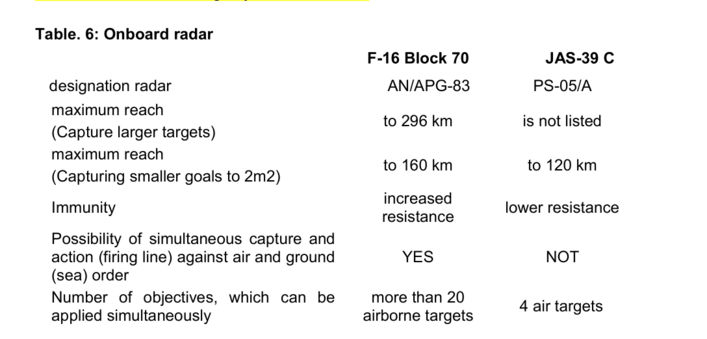
A bit of a tangent but Slovakia recently leaked the specs of the Gripen C in comparison with F-16 block 70. I don’t think it is competitive with the F-35.

1689342405424.png
1689342430455.png
1689342454828.png
 
The block 70 has 1500kg more internal fuel than block 50? How?

Well I suppose if you count CFTs as internal, but wouldn't that affect the performance figures as well?

And the combat range for the F-16 is straight off wikipedia, which is for 2 Sidewinders, 2 amraams, and 3 fuel tanks, but no CFTs. If internal counts CFTs, why doesn't the range include them?
 
The block 70 has 1500kg more internal fuel than block 50? How?

Well I suppose if you count CFTs as internal, but wouldn't that affect the performance figures as well?

And the combat range for the F-16 is straight off wikipedia, which is for 2 Sidewinders, 2 amraams, and 3 fuel tanks, but no CFTs. If internal counts CFTs, why doesn't the range include them?

It includes CFT. This is why the climb rate is only 235 m/s.
 
A bit of a tangent but Slovakia recently leaked the specs of the Gripen C in comparison with F-16 block 70. I don’t think it is competitive with the F-35.

Those are not "leaked specs". Unless by leaked specs you mean a heavily biased compendium based on wikipedia numbers. It looks like a brief for clueless politicians or media.

It includes CFT. This is why the climb rate is only 235 m/s.
The climb rate stated is 50k feet/minute. That's the number given for initial climb rate at sea level for an F-16 without CFTs.

Btw. internal fuel with CFTs should be 10172 lbs or 4618 kg.
 
Those are not "leaked specs". Unless by leaked specs you mean a heavily biased compendium based on wikipedia numbers. It looks like a brief for clueless politicians or media.


The climb rate stated is 50k feet/minute. That's the number given for initial climb rate at sea level for an F-16 without CFTs.

Btw. internal fuel with CFTs should be 10172 lbs or 4618 kg.

Indeed. I concede that Slovakian military probably wanted to paint their selection of F-16 in a good light.
 
https://fortune.com/2025/03/15/f35-...nada-portugal-trump-trade-war-europe-defense/
"On Friday, Canadian Defense Minister Bill Blair said the country is actively looking at other fighter jets amid growing political momentum to scrap a $13 billion deal for 88 F-35s that was signed in 2023.

Canada has committed money for its first 16 planes, which are scheduled for delivery early next year. Blair indicated that after accepting that batch of F-35s, Canada could turn to European aircraft to replace its aging fleet of fighters.

“The prime minister has asked me to go and examine those things and have discussions with other sources, particularly where there may be opportunities to assemble those fighter jets in Canada,” he told the Canadian Broadcasting Corp., alluding to a Swedish proposal for Saab’s Gripen fighter."
 
https://fortune.com/2025/03/15/f35-...nada-portugal-trump-trade-war-europe-defense/
"On Friday, Canadian Defense Minister Bill Blair said the country is actively looking at other fighter jets amid growing political momentum to scrap a $13 billion deal for 88 F-35s that was signed in 2023.

Canada has committed money for its first 16 planes, which are scheduled for delivery early next year. Blair indicated that after accepting that batch of F-35s, Canada could turn to European aircraft to replace its aging fleet of fighters.

“The prime minister has asked me to go and examine those things and have discussions with other sources, particularly where there may be opportunities to assemble those fighter jets in Canada,” he told the Canadian Broadcasting Corp., alluding to a Swedish proposal for Saab’s Gripen fighter."

Subsequently, the new Prime Minister ordered a review of the F-35 buy on Sunday:
https://www.secretprojects.co.uk/th...ii-joint-strike-fighter-jsf.17732/post-766856
 
Last edited:
Canada is now also looking at the Gripen, and likely Portugal too.

Canada's new banker PM is looking at looming budget issues. Limiting F-35 procurement to a single squadron of 16 instead of a full buy of 88 saves a huge amount of money. In other words, the likelihood of the Gripen E being blocked in the event of a partial F-35 cancellation is financially appealing to a beancounter and makes costcutting look like an exercise in Candian patriotism. Expect cuts in the number of Type 26 derived frigates as well after the first batch of 3 have reached a $22 billion price tag. The goal of 15 hulls was implausible to begin with.
 
Canada's new banker PM is looking at looming budget issues. Limiting F-35 procurement to a single squadron of 16 instead of a full buy of 88 saves a huge amount of money. In other words, the likelihood of the Gripen E being blocked in the event of a partial F-35 cancellation is financially appealing to a beancounter and makes costcutting look like an exercise in Candian patriotism. Expect cuts in the number of Type 26 derived frigates as well after the first batch of 3 have reached a $22 billion price tag. The goal of 15 hulls was implausible to begin with.

Cost-cutting is now "an exercise in Canadian patriotism". Particularly when those cost-cuts result in less money being transferred to Canada's only self-declared adversary. So, perhaps that "banker PM" has turned out to be right the man for the job.

(And, yes, the planned River class destroyers will also be cut - or cut back - for the same reasons. Firstly, to get LM's open palm out of the equation. Secondly, because there is no longer any strategic requirement for the RCN to tag along behind the USN fulfilling American foreign policy aims. Thirdly, Canada's half-century policy of paying for 'defence-from-help' has clearly failed.)

As for F-35s, NORAD is over (even if DC eventually drops its current conviction that lovely Mr. Putin can do no wrong). With NORAD fading away, Canada no longer needs to spend on interceptors. And your "banker PM" just committed CAD 4B to buy JORN ... which, hopefully, is his government's first move in detangling Canada from NORAD.

If Canada is outside of NORAD (and the US out or partly out of NATO), FMS approval isn't the issue any more. Overall trust is. So, suddenly, Gripen makes far more sense than F-35s within the new strategic situation. Canada no longer need the range for Arctic interception. We need fighters on our land borders while severing ourselves from as many US systems as is economically practical.
 
All countries that have contracts for the F-35 will buy the F-35.
The idea of replacing a 70s platform with an 80s platform (besides with an American engine) is infantile.

As for smaller countries like Canada - one has to look at use cases... in how many situations is a country like Canada going to need the extra capability when deployed?

The main benefits of the JSF are integration was allies and greater survivability against relatively modern SAMs. So long as we aren't attacking a country fielding S-300/S-400/NASAMs/Patriot we're unlikely to need that capability.

I could see a lot of other countries thinking along similar lines (and using the Gripen to act as am affordable way to maintain a capacity/training while waiting for the GCAP/FCAS to be developed and/or drones to mature).
 
From what I am hearing:

  • Canada is talking Gripen (it came 2nd in the competition)
  • Portugal seems to be thinking Rafale
  • Germany is an interesting one. A lot will depend here on the conversation about France's nuclear brolly.
  • Finland would appear to be having an internal conversation as well and may jump to Gripen as well.
As regards engine, how much hassle would the single engine conversion of the EJ200 be? Especially in the light of the US apparently vetoing the sale to Colombia this might be of interest again.
A high ranking member of the RCAF is proposing that Canada buys 36 F-35A and up to 150 Gripen or Rafale.

https://ottawacitizen.com/public-service/defence-watch/canadian-general-f-35-fighter-jet-deal
What is little known is that there is a defense treaty between Canada and the United States. As part of that, there is a list
of things that can be delivered to Canada without having to seek a special license. One of the parts on this list is the GE F-414.
A ratified treaty is US law. Trump cannot override US law with an executive order. It might be that Trump needs to have this treaty repealed if he wants to block the F-414. For that, he needs a 2/3 majority vote in the Senate. I.E: a number of Democrat senators needs to be convinced that Canada should be mistreated. I do not see that coming.
 
Canadian Exemption https://www.ecfr.gov/current/title-22/chapter-I/subchapter-M/part-126/section-126.5

Permanent and temporary export of defense articles. Except as provided in Supplement No. 1 to part 126 of this subchapter and for exports that transit third countries, Port Directors of U.S. Customs and Border Protection and postmasters shall permit, when for end-use in Canada by Canadian Federal or Provincial governmental authorities acting in an official capacity or by a Canadian-registered person, or for return to the United States, the permanent and temporary export to Canada without a license of unclassified defense articles and defense services identified on the U.S. Munitions List (22 CFR 121.1).

https://www.ecfr.gov/current/title-...bject-group-ECFRf7e5fe639be4566/section-121.1

Category XIX—Gas Turbine Engines and Associated Equipment​


* (a) Turbofan and Turbojet engines (including those that are technology demonstrators, developmental engines, or variable cycle engines) capable of 15,000 lbf (66.7 kN) of thrust or greater that have any of the following:

(1) With or specially designed for thrust augmentation (afterburner);
...

(f) Parts, components, accessories, attachments, associated equipment, and systems as follows:

(1) Parts, components, accessories, and attachments specially designed for the following U.S.-origin engines (and military variants thereof): F101, F107, F112, F118, F119, F120, F135, F136, F414, F415, and J402;
 
Why when Canada couldn't afford more than 88 F-35s would they go out and order 150 Gripen/Rafale, both of which were found to be more expensive in multiple competitions held by multiple countries...?
Because while the price of the F-35 appears to be similar to that of the Gripen E, the cost of maintaining the F-35 is so steep that you can have 3 Gripen for the same price.

The first tender lost was Norway. According to the Norwegian calculations, the Gripen E would have been more expensive even if SAAB had given away the Gripens free of charge. the maintenance cost of Gripen was considered much much higher than the cost Sweden experience for running the Gripen.

Guess what? Now with the real cost known, the Norwegians believe that their 56 F-35As will cost them a lot more. A LOT MORE. NOK326B ($31,24B) during the next 30 years. That is $558M per aircraft or $18,6M per year.
If it flies 200 hours per year, that is $95k per flight hour.
They do include the cost of running the base in that number.

The Gripen is believed to cost $85M on the open market, but Sweden is paying a fixed price of around $3,5B for the development of Gripen E and 60 aircrafts. This is a little low for two reasons. It is not inflation adjusted and there are likely clauses that compensate for currency fluctuations.
The development cost is estimated to be $2B. My best guess is the real cost to Sweden is around $65M per aircraft with $20M as payment for the development. Buying 150 aircraft gives room for a discount on the development part of the price. SAAB of course sells at market value and the cost of production matters less. It is likely that Canada would produce a large part in Canada but would have to pay for Transfer of Technology.

The major item is of course the maintenance cost. In the Danish tender, IIRC the Danes calculated the CPFH by assuming a large part of the ”flights” for the F-35 would be in simulators. The others would mostly be flying IRL. Boeing was so pissed that they considered suing.

The F-35 was seen as the next NATO fighter so there were lots of pressure, internal and external to select it.

Special things blocking a Gripen sale.

* Norway: Wants to sell the Joint Strike Missile to the US. That would not happen without F-35 buy.
* Denmark: ?
* Canada: Required NORAD support without providing documentation on protocol.
* Swiss: Did not allow Gripen to participate in the second tender after it won the first tender.
* Belgium: Required support by Air tankers from the country selling the fighter. No non-US fighter needs to apply.
* Netherlands: ?
* UK, Italy: Need V/STOL
* Finland: ?
* Poland: ?
* Germany: Only aircraft that is capable of dropping US nuclear bombs.

When fair calculations are applied, then the F-35 is 3 x expensive than Gripen and therefore you can replace 52 F-35 with 150 Gripen. I think that if they want to go with Rafale, the number will be smaller,

 
Last edited:
Why when Canada couldn't afford more than 88 F-35s would they go out and order 150 Gripen/Rafale, both of which were found to be more expensive in multiple competitions held by multiple countries...?
Beyond the maintenance costs, the threat of RCAF being involved in future hostilities just surged massively.
 
Why when Canada couldn't afford more than 88 F-35s would they go out and order 150 Gripen/Rafale, both of which were found to be more expensive in multiple competitions held by multiple countries...?
Rafale was. Gripen, even rather packed E/F, never.
 
Some people have been pointing out the use of a U.S. engine in the Gripen. So, to be old-school Canadian for a moment - what about redesigning the airframe to use a pair of Adour Mk 951? Silly idea?
 
Some people have been pointing out the use of a U.S. engine in the Gripen. So, to be old-school Canadian for a moment - what about redesigning the airframe to use a pair of Adour Mk 951? Silly idea?

A cool idea, but impracticable.

It would require changes to the internal airflow ducting, the rear fuselage, and the development of an updated Adour to match the afterburning thrust of the F414.

Lots of work - at least 5 years, if not more.
 
The Norwegians concluded that the F-35 was more than twice as expensive as they expected.
Their figures for the cost of Gripen was far off the cost what was seen by the Swedish Air Force.
Unless you know how the Finns calculated, it is impossible to judge whether they were as ”creative”.
Until we know there specific methods of calculation not the norwegian nor finnish one can be used as the ultimate truth. A lot of factors go into sutch a thing and even the time alone with our economical standing can impact that price.
What is different with Canada is that they do not want the 88 F-35. They, like other air forces adapt their calculations based on what they want.
As far as i can tell from what the said they want F-35 mostly does it. Yes you don't have your twin engine which the oldies love nor 100% free control of the jet but then again considering canadas way of underinvesting i doubt this even matters...
 
The Norwegians concluded that the F-35 was more than twice as expensive as they expected.
Their figures for the cost of Gripen was far off the cost what was seen by the Swedish Air Force.
Unless you know how the Finns calculated, it is impossible to judge whether they were as ”creative”.
Norway remains a terrible example. You're comparing two aircraft, one of which doesn't exist today as the Gripen proposed for Norway is not the Gripen flying today, it was significantly less capable even than the below spec Gripen being delivered now.

Saab even admitted that the Gripen proposed to Norway wasn't good enough. In several trade journals they have spoken about systems as part of the proposal having to be significantly improved given the feedback Norway provided and Saab acknowledging.

As for Finland I don't think anyone can argue they didn't run an above board competition.
What is different with Canada is that they do not want the 88 F-35. They, like other air forces adapt their calculations based on what they want.
You really have little idea of what Canada wants or needs. The Canadian defence budget already has multiple significant acquisitions over the next two decades including ships, submarines as well as the air force acquisitions. Add to that there is a massive manpower issue with the RCAF, they cannot retain enough pilots to fly even their current diminishing fleet of fighters and yet you think they can somehow solve that and employ literally hundreds more aircrew to staff new aircraft, let alone the ground crew to support.
 
You really have little idea of what Canada wants or needs. The Canadian defence budget already has multiple significant acquisitions over the next two decades including ships, submarines as well as the air force acquisitions. Add to that there is a massive manpower issue with the RCAF, they cannot retain enough pilots to fly even their current diminishing fleet of fighters and yet you think they can somehow solve that and employ literally hundreds more aircrew to staff new aircraft, let alone the ground crew to support.
I guess the whole point of the new situation is that they need more, and their wishes and needs may have gone through a revision.
In the end, it's canadians themselves who're talking Gripen now.
 
Last edited:
Norway remains a terrible example. You're comparing two aircraft, one of which doesn't exist today as the Gripen proposed for Norway is not the Gripen flying today, it was significantly less capable even than the below spec Gripen being delivered now.

Saab even admitted that the Gripen proposed to Norway wasn't good enough. In several trade journals they have spoken about systems as part of the proposal having to be significantly improved given the feedback Norway provided and Saab acknowledging.

As for Finland I don't think anyone can argue they didn't run an above board competition.

You really have little idea of what Canada wants or needs. The Canadian defence budget already has multiple significant acquisitions over the next two decades including ships, submarines as well as the air force acquisitions. Add to that there is a massive manpower issue with the RCAF, they cannot retain enough pilots to fly even their current diminishing fleet of fighters and yet you think they can somehow solve that and employ literally hundreds more aircrew to staff new aircraft, let alone the ground crew to support.
For Norway, I am comparing mainly the expected cost, and what it turned out to be.

For Canada, the RCAF general concluded that they want to reduce the F-35 orders and get something else. For the pilots, low pay and few flight hours may contribute. They are limited by their low defense budget so they simply needs to spend more.
 
I guess the whole point of the new situation is that they need more, and their wishes and needs may have gone through a revision.
In the end, it's canadians themselves who're talking Gripen now.
Just take a step back and think about what you are saying. If not taking a US airframe is really the issue why would they then chose an airframe that has a US engine? How does that really reduce their reliance on the US?

Canadians can say all they want but the vast majority don't know the difference between one aircraft or another nor do they understand what they get or don't with various airframes.
 
Just take a step back and think about what you are saying. If not taking a US airframe is really the issue why would they then chose an airframe that has a US engine? How does that really reduce their reliance on the US?
Well, mig-29s fly against Russia, as do Tomcats "against" the US. 1990s engine by itself isn't that magical, and US are Canadian enemy yet.

The goal seems to be buying a much larger force, cheaper, and relying on US for some engine supplies is different from US being in control of your entire air force.
They aren't cutting ties with US, but it's certainly a reduction.
Canadians can say all they want but the vast majority don't know the difference between one aircraft or another nor do they understand what they get or don't with various airframes.
But it's politicians. As much as they don't know (they don't indeed), they call shots.
Which is irony of our world.
 
Back
Top Bottom