XB-70 Valkyrie what-ifs

Scott Kenny

ACCESS: USAP
Joined
15 May 2023
Messages
19,532
Reaction score
27,985
Pretty difficult to assess when none were built. And they probably wouldn't have built very many, so I don't think SAC would have been too keen to equip them with conventional stores and avionics, let alone risk them bombing some trees in Vietnam.
I think B-70s would have helped push for guided bombs that could be carried internally, both nuclear and conventional.
Look at the increase in downrange and cross-range you get dropping AGM-69 SRAMs from Mach 3 and 85,000ft in the Blackbird Bomber charts. ~250nmi cross range and ~550nmi down range!

The bombs would do some weird stuff when they went through the B-70 mach cone, and then some more weird stuff when they slowed down subsonic before impact (assuming that Mk80series would slow to subsonic speeds after a Mach 3 drop).

But I don't think we'd see B-52D Big Belly carpet bombing modifications to a B-70. B-70s would likely be dropping 16x1000lb or 16x2000lb weapons, not carpet bombing 84x500lb or 42x750lbs.
 
I think B-70s would have helped push for guided bombs that could be carried internally, both nuclear and conventional.
Look at the increase in downrange and cross-range you get dropping AGM-69 SRAMs from Mach 3 and 85,000ft in the Blackbird Bomber charts. ~250nmi cross range and ~550nmi down range!

The bombs would do some weird stuff when they went through the B-70 mach cone, and then some more weird stuff when they slowed down subsonic before impact (assuming that Mk80series would slow to subsonic speeds after a Mach 3 drop).

But I don't think we'd see B-52D Big Belly carpet bombing modifications to a B-70. B-70s would likely be dropping 16x1000lb or 16x2000lb weapons, not carpet bombing 84x500lb or 42x750lbs.
Imagine what a B-70 could do with a belly full of SDBs. Or a GBU-57 with a pointy nose.
 
Thrust wise it would be feasible to replace the 6 × J93, afterburning; with 4 × GE4, no afterburner. Or perhaps keep a pair of afterburners then supercruise
 
A bit of cold harsh reality: pushing B-70 into service would means death of B-52. They would be all gone by the end of Vietnam War, since USAF could not allow to demonstrate any doubts about their "ultimate" supersonic bomber (and B-52 was viewed as intermediate plane anyway).
 
A bit of cold harsh reality: pushing B-70 into service would means death of B-52. They would be all gone by the end of Vietnam War, since USAF could not allow to demonstrate any doubts about their "ultimate" supersonic bomber (and B-52 was viewed as intermediate plane anyway).
Maybe.

As mentioned, the B-70 isn't very good for carpet bombing etc. I think the B-52s would have stuck around for other conventional-bombing work, and likely would have stuck around in the ALCM truck role. Both of those are things that the Valkyrie doesn't do well.
 
Maybe.

As mentioned, the B-70 isn't very good for carpet bombing etc. I think the B-52s would have stuck around for other conventional-bombing work, and likely would have stuck around in the ALCM truck role. Both of those are things that the Valkyrie doesn't do well.
I think it would have been nice to have a quick reaction supersonic strategic airborne force at the ready, but thankfully we'll never know.
 
I think B-70s would have helped push for guided bombs that could be carried internally, both nuclear and conventional.
Look at the increase in downrange and cross-range you get dropping AGM-69 SRAMs from Mach 3 and 85,000ft in the Blackbird Bomber charts. ~250nmi cross range and ~550nmi down range!

The bombs would do some weird stuff when they went through the B-70 mach cone, and then some more weird stuff when they slowed down subsonic before impact (assuming that Mk80series would slow to subsonic speeds after a Mach 3 drop).

But I don't think we'd see B-52D Big Belly carpet bombing modifications to a B-70. B-70s would likely be dropping 16x1000lb or 16x2000lb weapons, not carpet bombing 84x500lb or 42x750lbs.
The bombs would need heavy modifications to take into accounts loads caused by a Mach > 2 flight, and supersonic effects. Also they would be probably heavily decelerated by the mach cone, and various shock-waves caused by the aircraft and of course the gigantic drag of any object at that speed (probably not compensated by the lower air density at that altitude).
 
Might B70 have been a useful way of ringing the USSR with Skybolt carrying bombers which could both be on patrol all the time and recalled unlike Minuteman and Polaris.
At the same time the RAF would join in with Vulcans and VC10 Pofflers.
Skybolt B70s would require some heavy expenditure on Soviet air defences.
 
Let Face it You need the B-52 if you want bomb someone into Stone age (conventional)
Operational B-70 would expensive in fuel and maintenance
it's High altitude Mach 3 bomber at 70000ft or 20000 meter
with 1960s technology make guided bombs hit target a challenge

However it could be manageable with Small fleet of B-70
that replace B-58, B-52A to F
the remaining the B-52G/H use for carpet bombing.
 
With enough time and effort Skybolt could have been an effective weapon. Mated to a small B70 and Vulcan/Poffler force it could have forced some heavy expenditure by the Soviet Air Defence.
 
As mentioned, the B-70 isn't very good for carpet bombing etc. I think the B-52s would have stuck around for other conventional-bombing work, and likely would have stuck around in the ALCM truck role. Both of those are things that the Valkyrie doesn't do well.
In that case, why do you need Valkyrie? Its main problem was, that to persuade Congress to actually buy it, USAF need to demonstrate absolute confidence. So no B-52 "just in case" and no B-52 as missile trucks (because it would be used by B-70 opponents to immediately start asking "why can't we have just B-52 with supersonic missiles and scrap the B-70?")

So no, B-70 in service means quick death of B-52. USAF high ranks would be doing all they could to get rid of Stratofortress, so they could buy more B-70.

B-52 would likely be still used in Vietnam, but it would be the last machines in service (likely no B-52H, B-52G being last production model). And they would be retired soon after.
 
However it could be manageable with Small fleet of B-70
that replace B-58, B-52A to F
the remaining the B-52G/H use for carpet bombing.
There likely would be no B-52H in this timeline. B-52G would be last production model. By Vietnam, the early A-F models would be all gone, with only G remaining, partially as Hound Dog carriers.
 
The bombs would need heavy modifications to take into accounts loads caused by a Mach > 2 flight, and supersonic effects. Also they would be probably heavily decelerated by the mach cone, and various shock-waves caused by the aircraft and of course the gigantic drag of any object at that speed (probably not compensated by the lower air density at that altitude).
B-70s would be carrying the bombs internally. So some sustained thermal load but no shockwaves or extra drag.

And yes, the bombs are dropping through a mach cone, so I expect them to get bumped around and maybe even have fins damaged because of that.


There likely would be no B-52H in this timeline. B-52G would be last production model. By Vietnam, the early A-F models would be all gone, with only G remaining, partially as Hound Dog carriers.
When were the -Hs ordered? 1959?

Also, IIRC the "Big Belly" -D models outlasted all other early models. The Big Bellies lasted until the early 1980s, even though all earlier types were retired by 1973. And the Big Bellies can do something that the B-70 can't: carpet bomb.
 
B-70s would be carrying the bombs internally. So some sustained thermal load but no shockwaves or extra drag.

And yes, the bombs are dropping through a mach cone, so I expect them to get bumped around and maybe even have fins damaged because of that.
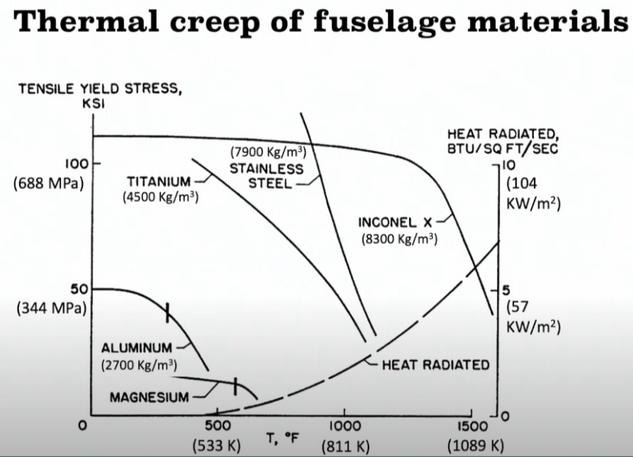
My answer was not clear regarding the thermal loads, I meant once the bombs are dropped. Stagnation temperature at ~30k ft is roughly 624K at Mach 3 (accounting for a free-stream temp of 223K), I did not do the math for the post shock-wave temp as it is geometry dependent. Aluminum is out of the spectrum, titanium might be sufficient. I'm not familiar with materials used on top of laser seekers but my guess would be that they cannot be used in that case. (Source for the image: Javier Urzay) 1787216586981.png
 
My answer was not clear regarding the thermal loads, I meant once the bombs are dropped. Stagnation temperature at ~30k ft is roughly 624K at Mach 3 (accounting for a free-stream temp of 223K), I did not do the math for the post shock-wave temp as it is geometry dependent. Aluminum is out of the spectrum, titanium might be sufficient. I'm not familiar with materials used on top of laser seekers but my guess would be that they cannot be used in that case. (Source for the image: Javier Urzay)View attachment 821562
Their casings are thick iron and it takes a minute to heat up. For a one-way trip down they'd likely be fine. Worst case you spray a little insulation on them. ESSM doesn't burn up and it travels further, faster.
 
Last edited:
Thrust wise it would be feasible to replace the 6 × J93, afterburning; with 4 × GE4, no afterburner. Or perhaps keep a pair of afterburners then supercruise
What about 4xGE4 and 2x Ramjets that support the Mach 3 flight ?

with Skybolt carrying bombers
in fact Skybolt is contra productive here
with range of 1850 km raise the question: do we need a Mach 3 bomber or sub sonic carrier plane with a dozens Skybold?
Since Skybolt was designed to launch from B-52 and Avro Vulcans
and aircraft that could carry allot Skybolds sub sonic, would far cheaper as the B-58 or B-70...
 
Might B70 have been a useful way of ringing the USSR with Skybolt carrying bombers which could both be on patrol all the time and recalled unlike Minuteman and Polaris.
No. The B-70 was not suitable for airborne alert type operations; they were explicitly rejected for the CONOPS. If the USAF wanted to go down that route a supersonic penetrating bomber was not the platform to use.

If the USAF buys the B-70, it is committing to penetrating bombers - and very probably cancelling Skybolt earlier than in OTL. I don't know that the B-52H wouldn't be built. The B-70 would be unlikely to enter service much before 1967, and at planned production rates of 5 aircraft/month it would take at least four or five years to fully replace the B-52. Possibly longer depending on the target fleet size, but that's going to be the direction of travel. Which means the B-52 needs to keep flying... but not with Skybolt or ALCM, and probably not with SRAM, either.

Along the way: no B-70 means there's no need for the FB-111. USAF mirror-imaging probably means more investment in US air defences. It's unlikely that the USSR mirror-images a high performance intercontinental bomber - that wasn't really their thing - but it will probably put more resources into air defence. More on the systems side than the weapons side, to address the shorter warning time that the B-70 will offer.

The big one there is probably more Tu-126 to push their detection horizons outwards. That, or more effort into depressed-trajectory SLBMs to kill the bombers in a pre-emptive first strike, but that's not really the Soviet style.
 
My answer was not clear regarding the thermal loads, I meant once the bombs are dropped. Stagnation temperature at ~30k ft is roughly 624K at Mach 3 (accounting for a free-stream temp of 223K), I did not do the math for the post shock-wave temp as it is geometry dependent. Aluminum is out of the spectrum, titanium might be sufficient. I'm not familiar with materials used on top of laser seekers but my guess would be that they cannot be used in that case. (Source for the image: Javier Urzay)View attachment 821562
Conventional bombs are made with a pretty thick iron or steel casing. What's the free-fall time from 70kft for a Mk80 series? If absolutely required you could add the same insulation sprayed onto bombs for the USN to buy you a couple extra minutes

As to the guidance package, IIRC the housing is also steel. Steel control surfaces, not aluminum. And IIRC the window at the nose of a Paveway is either borosilicate glass, sapphire crystal, or an IR-transparent ceramic. All of which are going to survive 350degC.
 
Back
Top Bottom