
The Mitchell Institute finally published their paper on USAF readiness, capacity, and capability.
https://www.mitchellaerospacepower....ces-capacity-capability-and-readiness-crisis/
They have released a number of articles and podcasts in recent weeks and months in relation to this paper:
https://www.mitchellaerospacepower....ces-capacity-capability-and-readiness-crisis/https://aerospacenation.podbean.com...e-s-capacity-capability-and-readiness-crisis/https://www.mitchellaerospacepower....ir-force-capacity-capabilities-and-readiness/https://www.airandspaceforces.com/article/usafs-capacity-capability-and-readiness-crisis/
View: https://www.youtube.com/watch?v=KfYwxOo-pmY
https://www.mitchellaerospacepower.org/podcast/episode-218-air-force-readiness-crisis/
I'd recommend reading the paper as it provides a good overview of the issues (that's an understatement) the USAF faces in comparison to the PLAAF for a Pacific war, and compares that with the USAF's capabilities versus the Soviets in the latter part of the Cold War.
Here are my notes from the paper:
https://www.mitchellaerospacepower....ces-capacity-capability-and-readiness-crisis/
They have released a number of articles and podcasts in recent weeks and months in relation to this paper:
https://www.mitchellaerospacepower....ces-capacity-capability-and-readiness-crisis/https://aerospacenation.podbean.com...e-s-capacity-capability-and-readiness-crisis/https://www.mitchellaerospacepower....ir-force-capacity-capabilities-and-readiness/https://www.airandspaceforces.com/article/usafs-capacity-capability-and-readiness-crisis/
https://www.mitchellaerospacepower.org/podcast/episode-218-air-force-readiness-crisis/
I'd recommend reading the paper as it provides a good overview of the issues (that's an understatement) the USAF faces in comparison to the PLAAF for a Pacific war, and compares that with the USAF's capabilities versus the Soviets in the latter part of the Cold War.
Here are my notes from the paper:
Findings
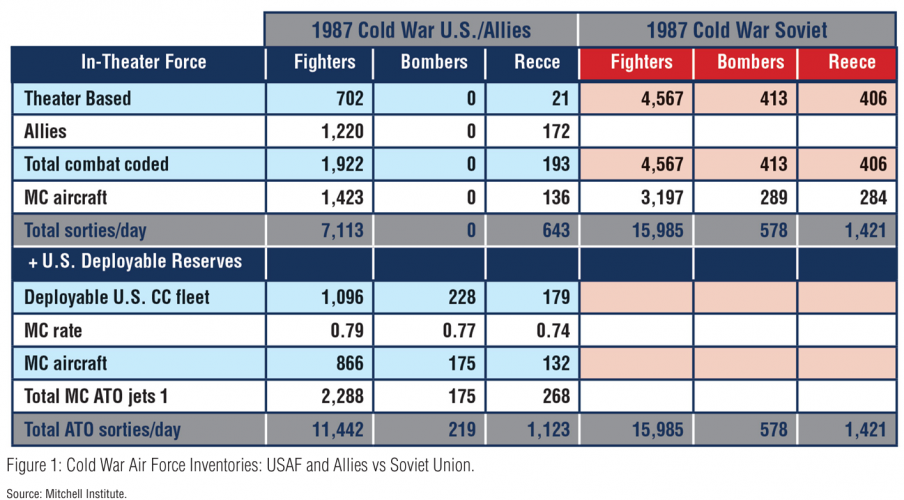
Cold War (1980s)
Fighters
- Inventory (active):
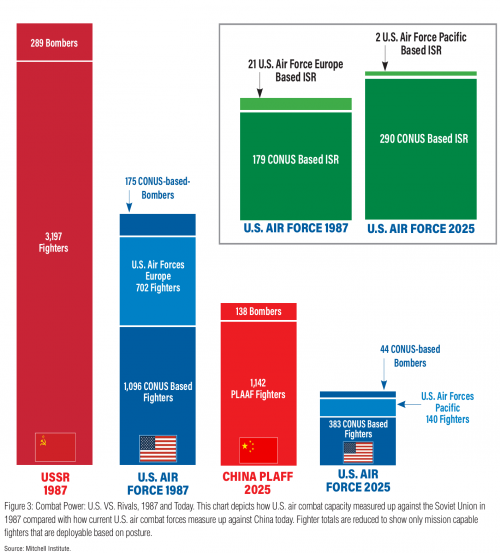
- 732 × F-15 (air superiority)
- 2,135 × multirole (F-16, A-10, F-4, F-111)
- Combat-coded: ~588 F-15, ~1,847 multirole
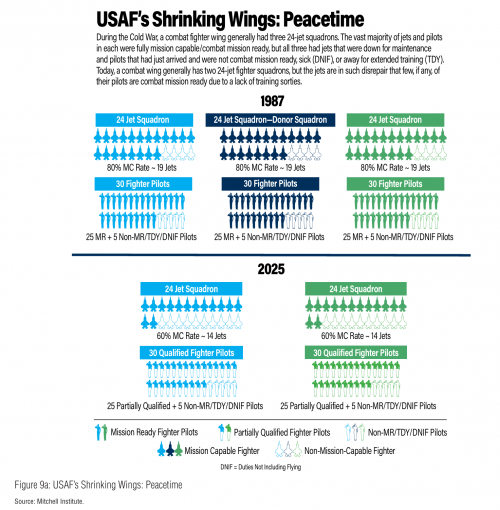
- Mission capable rate: ~81%
- Effective CC aircraft: ~482 air superiority + ~1,459 multi-role = ~1,941
- Training/readiness: ~3-4 sorties per week; ~200 hrs/yr per pilot
Bombers
- Inventory: 263 × B-52; 62 × FB-111
- Average age: 21 years
- Aggregate MC rate: 77%
- Available for long-range strike (after nuclear alert sequestration + MC rates):
- 145 × B-52
- 30 × FB-111
= 175 bombers available
ISR (air-breathing)
- Inventory: 54 × RF-4; 22 × U-2; 21 × SR-71; 34 × E-3; ~25 × RC-135 (+153 RF-4 in ANG)
- Average MC rates:
- RF-4: 74%
- U-2: ~>62% (est.)
- SR-71: (unknown, low ops tempo)
- E-3: 87%
- RC-135: ~>79% (est.)
- Effective MC aircraft (approx.): 154 RF-4; 16 U-2; 3 SR-71; 30 E-3; 18 RC-135
Allies (NATO, 1987)
- Inventory: 1,220 × fighters; 154 × recce; 18 × E-3
- Assumed MC rate: 70% → ~854 fighters, 120 recce jets available
- Training standard: ~200 hrs/yr; frequent live-force package exercises
Sortie Generation (Cold War vs Soviets)
- US & NATO day-one potential:
- Fighters: up to ~11,442 sorties/day (after reinforcements)
- Bombers: up to ~219/day (from UK staging, rising with B-1/B-2)
- ISR (RF-4 in Europe): ~78/day (before reinforcements)
- Soviet sortie potential:
- Fighters: ~16,000/day
- Bombers: ~578/day
- Comparison: USAF/NATO relied on high readiness + quality + forward posture to offset Soviet mass
Present Day
US Fighters
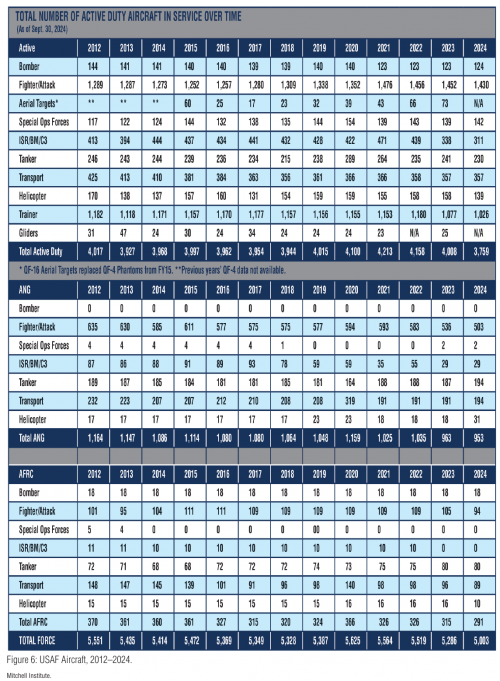
- Inventory (total): 2,026 fighters (↓ from 4,253 in 1987) (not all would be available for the Pacific)
- Combat-coded (CC): ~750
- Stealth share: ~28%
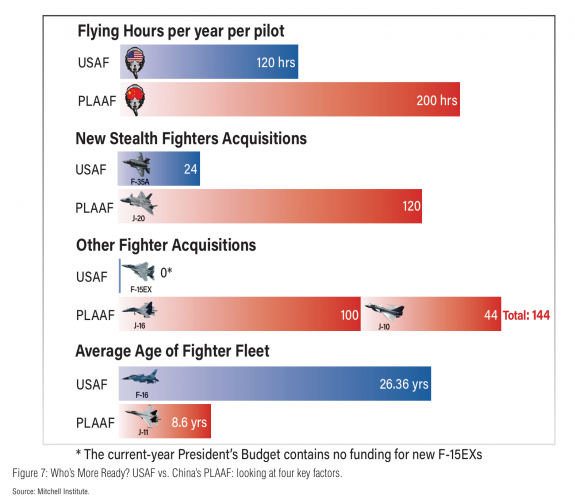
- Average age: 26 years
- Average MC rate: 59%
- Effective CC fighters (MC-adjusted): ~410
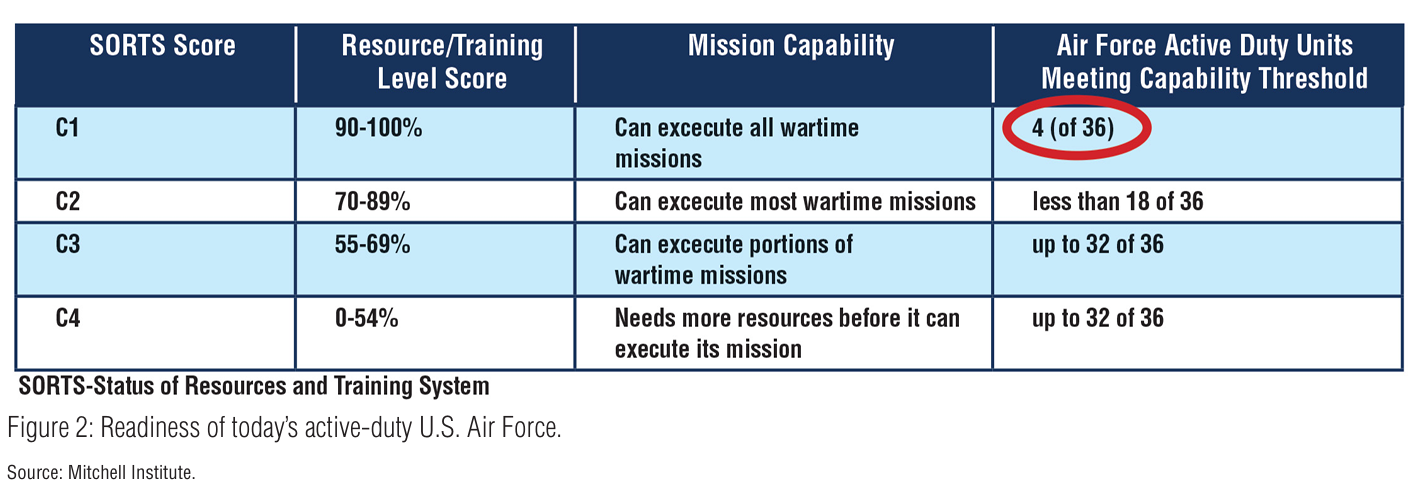
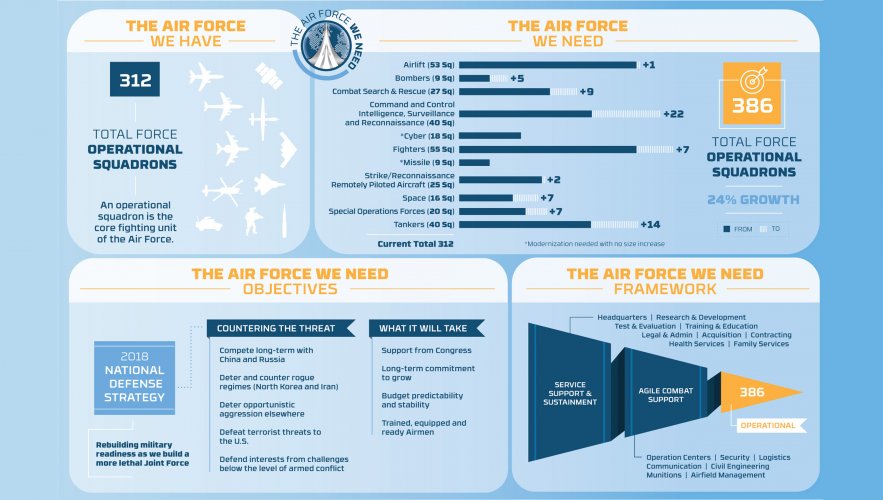
- Force structure: 31 active CC squadrons; 55 total including ARC
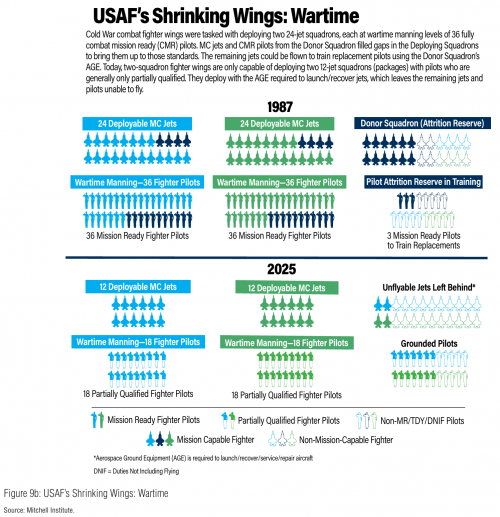
- Training: ~1.2 sorties/week; ~9 hrs/month (Q1 2023)
Bombers
- Inventory (total): 140 (↓ from 393 in 1987)
- Average age: 46 years
- Stealth share: 14%
- MC rates: B-1: 47%; B-52: 54%; B-2: 56%
- Effective bombers (MC-adjusted, conventional tasking): ~51 total
ISR
- Inventory (long-range ISR): 22 × RC-135; 16 × E-3G; 9 × RQ-4; 27 × U-2; ~10 × RQ-170
- MQ-9: 292 combat-coded
- MC rates: RC-135: 79%; E-3G: 56%; RQ-4: 65%; U-2: 62%; MQ-9: 86%; RQ-170: est. 50%
- My note: RQ-180 (stealth ISR) not mentioned in paper
- My note: MQ-9 is highly vulnerable; recent Houthi ops suggest it would be quickly attritted in PLA conflict.
Allies (Indo-Pacific, today)
- Inventory: 1,221 combat-coded fighters (Australia, Japan, ROK, Taiwan, India)
- Hold-back for homeland defense: ~50%
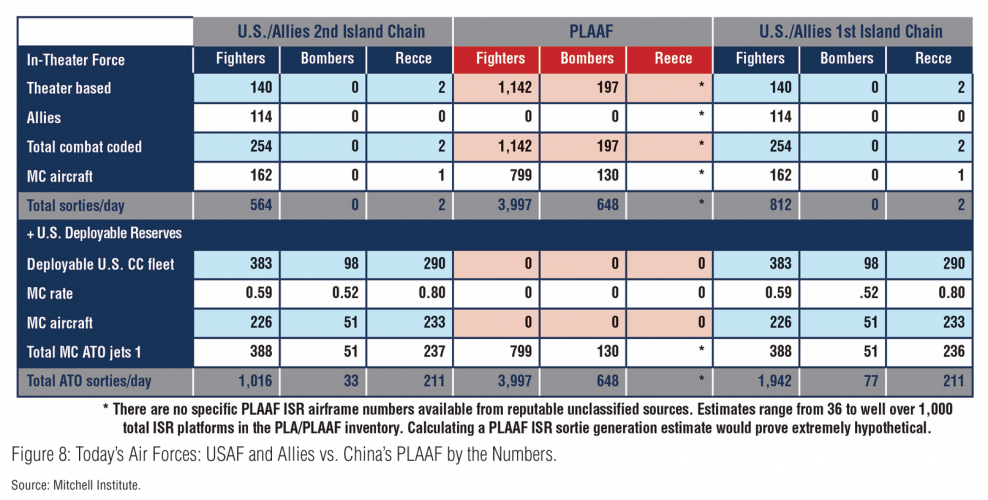
- Usable for ATO (after range/weapons filters): ~114 jets
- MC rate (assumed): ~70% → ~80 available
- Sortie potential (day one): ~399 sorties
- Critical limit: munition ("long range missiles" referring to AMRAAM, cruise missiles, etc.") stocks would be expended day one
Sortie Generation (US + Allies vs PLA, today)
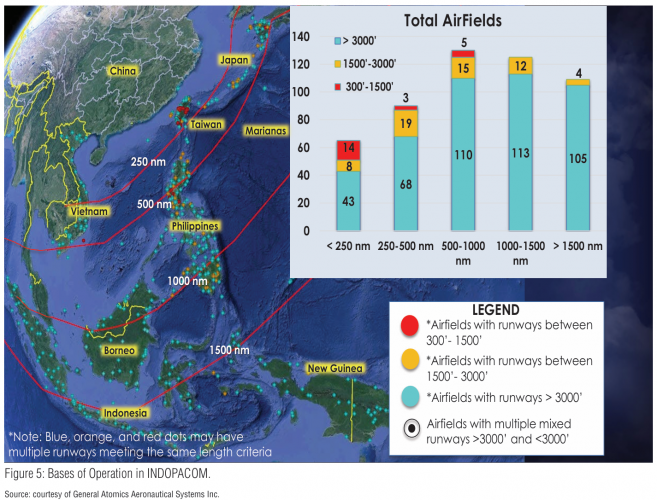
- From second island chain:
- Fighters: ~617/day (with reinforcements)
- Bombers: ~77-102/day
- ISR: ~27 long-range + ~181 MQ-9/day
= ~825 total sorties/day (best case)
- From first island chain:
- Fighters: ~1,543/day
- Bombers: same limit as above (~77-102/day)
- ISR: same as above
= ~1,750+ sorties/day (higher, but under PLA missile threat)
PLA Today
Fighters
- Inventory: ~2,225 (1,311 × 4th-gen; 320 × 5th-gen)
- Production rate: ~120 J-20s/yr (≈3× USAF’s 5th-gen buys) ~144 4th-gen (note: I'm not sure how accurate this is)
- MC-adjusted availability: ~799/day
Bombers
- Inventory: ~197 H-6 (12 nuclear-capable sequestered)
- MC-adjusted availability: ~130/day
- Capability: land-attack and anti-ship cruise missiles
Readiness
- Pilot training: ~200 hrs/yr; 3–4 sorties/week (now exceeds USAF rates)
- Sortie generation advantage: short distances (150 NM to Taiwan); internal LOCs; ~5 sorties/day feasible
Sortie Generation (PLA vs US/allies, today)
- PLA daily potential:
- Fighters: ~3,997/day
- Bombers: ~648/day
= ~4,645/day
- US + Allies daily potential (first island chain): ~1,750/day
- US + Allies daily potential (second island chain): ~825/day
- Ratio: PLA can generate ~3–5× more sorties than combined US/allies.
Recommendations
- Face the reality.
- Admit the USAF lacks the fighters, bombers, and readiness needed for peer war
- Tie force sizing to national defense strategy, not budgets
- Grow the force.
- Stop “divest to invest.” Keep serviceable aircraft until replacements arrive.
- Increase buys:
- F-35: ramp to 72/year (target ~1,250 total).
- B-21: ramp to 21/year (target ~300 total). (note: no justification is provided for this procurement target of 300)
- F-15EX: 24/year.
- Protect critical programs: E-7, CCA, EA-37B, MQ-9 (with attrition backfill).
- Fix readiness.
- Fund spares + flying hours fully.
- Raise pilot training to 3 sorties/week, 200 hrs/year (vs ~1 sortie/week now).
- Restore independent inspections (ORIs) to test deploy-and-fight capability.
- Balance the budget.
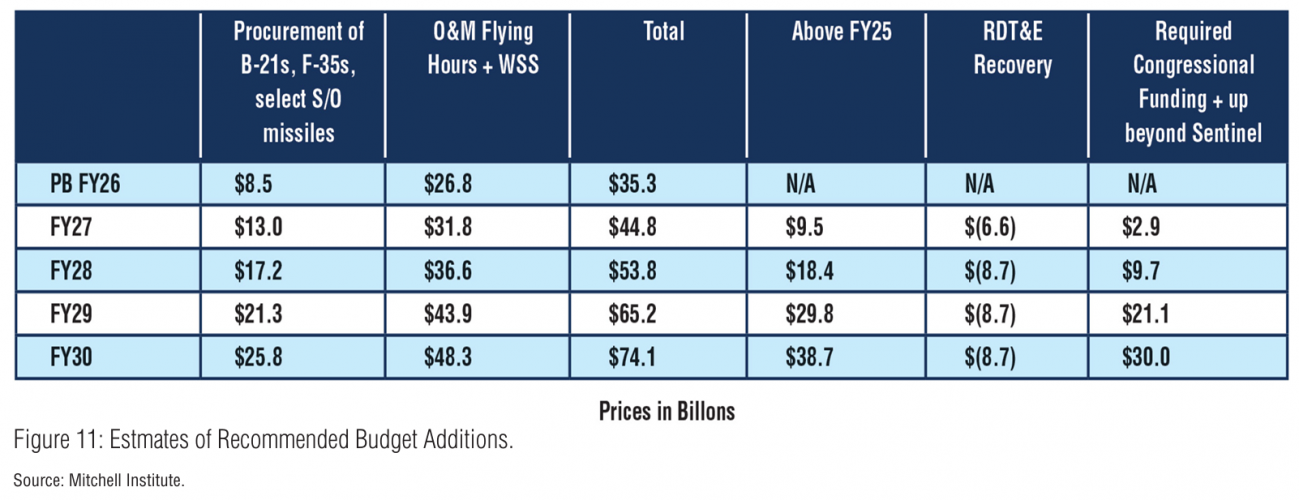
- Shift $6-9B/yr from long-horizon R&D into procurement and sustainment.
- Keep funding for near-to-mid term systems (F-35 Block 4, B-21, Sentinel, etc.) until operational.
- $30B in additional funding needed in total, starting in FY30 (ramp up gradually towards that). This is after moving some funds from RDT&E to procurement and O&M. This $30B might have to be taken from the Army. Excludes Sentinel efforts.
Attachments
-
 Screenshot 2025-09-05 130724.png454.8 KB · Views: 7
 -
 Screenshot 2025-09-05 134337.png275.8 KB · Views: 6
 -
 Screenshot 2025-09-05 134744.png217.2 KB · Views: 7
 -
 Screenshot 2025-09-05 140803.png1.6 MB · Views: 11
 -
 Screenshot 2025-09-05 152902.png659.7 KB · Views: 8
 -
 Screenshot 2025-09-05 155310.png242.3 KB · Views: 11
 -
 Screenshot 2025-09-05 155537.png526.1 KB · Views: 9
 -
 Screenshot 2025-09-05 160411.png391.1 KB · Views: 8
 -
 Screenshot 2025-09-05 160619.png430.1 KB · Views: 9
 -
 Screenshot 2025-09-05 160946.png203.7 KB · Views: 8
 -
 Screenshot 2025-09-05 162606.png337.9 KB · Views: 4
 -
 the air force we need 2018.JPG1.7 MB · Views: 9
 -
Winning-the-Next-War-Capability-Capacity-Readiness-mitchell institute.pdf9.3 MB · Views: 4

