For the 1930 competition,yes it was involved;
Transport seaplane ; Gourdou-Leseurre GL-710,Farman F.310,
CAMS-58,Latecoere Late.501,SPCA-60,Liore et Olivier LeO H-24,
Wibault Wib.240 and maybe Bleriot-250
There were a few mistakes and inconsistencies in this thread, which I have attempted to remedy in the following Excel chart.
I am of course open to comments, corrections and additions.
Nice work,but I can't see any differences between it and my list,and you must know
that,Breguet absorbed Wibault in 1933,so the Model 660 and 670 with 680 were
under Breguet series,and in 1918,Wibault-Bocaccio was built,but he formed his
company in 1919.
Nice work,but I can't see any differences between it and my list,and you must know
that,Breguet absorbed Wibault in 1933,so the Model 660 and 670 with 680 were
under Breguet series,and in 1918,Wibault-Bocaccio was built,but he formed his
company in 1919.
I've added all the missing information (dates, quantities, engine types) and modified erroneous dates and info.
You are right about the Breguet designations, of course.
As for your take on the 1918-1919 chronology, I prefer to rely on an article than on your notes! (Avions N° 35)
I will try to talk about that difficult aircraft designation;
Wib.1 single seat biplane fighter built in 1919 Wib.2 BN.2 two seat heavy bomber biplane,built in 1921 Wib.2T was a 12-passenger transport biplane Project,based on Wib.2,powered by one 700 hp Fiat A 14 engine Wib.3 single seat high-wing monoplane fighter to C.1 1921 competition Wib.4T was a four engined 12-passenger transport monoplane Project of 1922,powered by four Hispano-Suiza engine Wib.5 single seat parasol wing monoplane fighter Project,submitted to C.1 1923 Wib.6 two-seat parasol wing monoplane fighter derivative of Wib.5,Project Wib.7 Rafale single seat parasol wing monoplane fighter,intended for C.1 1923 competition,the winner Wib.71 was a derivative of Wib.7,re-engined with 400 hp Hispani-Suiza 12 Jb engine Wib.72 was strengthened production aircraft for French Air Force and Poland Wib.73 was a production aircraft for Poland and Paraguay powered by 451 hp Lorraine-Dietrich
12 Eb engine Wib.74 was a production navalised aircraft for the French Navy Wib.75 was a camera-equipped version of Wib.74,also naval version Wib.7H was a floatplane version for navy,maybe remained a Project ? Wib.8 two-seat parasol wing monoplane fighter to C.2 1925 competition Wib.8 HE2 was a two-seat trainer seaplane Version,with floats,powered by one 140 hp
Hispano-Suiza 8A engine,remained a Project Wib.9 single seat high-wing fighter,built for C.1 1923 competition Wib.10 a twin-boom single seat fighter Project,may be for C.1 1923 Wib.10GR Tramontane re-allocated for two-seat parasol wing recce monoplane,built for A.2 1923 competition Wib.11 single seat fighter Project powered by one 500 hp Hispano-Suiza 12 Hb engine,for C.1 1923 Wib.12 two-seat parasol wing monoplane fighter,built for C.2 1925 competition Wib.12T was a high-wing monoplane light transport version of Wib.12,Project only Wib.121 fighter-recce derivative aircraft,became Vickers V.121 Wib.122 single seat fighter for British Air Ministry Wib.123 two-seat recce aircraft for R.2 1925 competition Wib.124 two-seat observation aircraft for A.2 1928 competition Wib.125 two-seat observation aircraft for A.2 1928 competition Wib.13 Trombe I single seat lightweight fighter to C.1 1926 Jockey fighter contest Wib.13S was a single seat high-altitude interceptor Project,powered by one 350 hp HS 12 J engine Wib.13bis was a single seat trainer version of Wib.13,Project only Wib.130 Trombe I redesigned of the Wib.13 by 1928 Wib.14 two-seat parasol wing tourist monoplane aircraft Project Wib.14H a floatplane version of Wib.14,Project Wib.15 single seat fighter Project,derivative of Wib.7,powered by one 420 hp Gnome-Rhone 9 Ac engine,to C.1 1926 contest Wib.160 Trombe II a more powerful version of Wib.130 Trombe I,also for C.1 1926 Wib.170 Tornade a single seat lightweight parasol-wing monoplane fighter for C.1 1926 Wib.180 unknown,(but maybe it was a three engined transport Project for Britain),need confirm Wib.190 ------? Wib.200 ------? Wib.210 single seat low-wing lightweight fighter for C.1 1928 Wib.220 three seat high-wing recce aircraft,built for RN.3 1928 Wib.230 three engined transport aircraft Project (not sure) Wib.240 three engined floatplane transport seaplane,built in 1933 Wib.250 ------? Wib.260 two seat recce aircraft,built for A.2 1928 Wib.270 single seat cantilever low-wing lightweight fighter Project for C.1 1928 contest,powered by one 500 hp HS engine Wib.280T (Early) was a high-wing light transport Project,
powered by three engined,one of them was mounted above the wing,consider early concept,later developed into Wib.280 Wib.280 three engined low-wing 12-passenger light transport aircraft Wib.281,282 & 283 developed from Wib.280 Wib.290 was a low-wing light transport Project,developed from Wib.280,powered by three 575 hp HS 9 Va engines Wib.300 ------? Wib.310 was a single seat fighter with Lorraine Petrel engine Wib.311 was a single seat fighter with Farman engine Wib.312 was a single seat fighter with Hispano-Suiza 12X engine Wib.313 single seat low-wing lightweight fighter,built for C.1 1930 Wib.320 was a four-seat night bomber Project (BN.4),tested at Onera in 1931 Wib.330 transport aircraft (no more details) Wib.340 two seat low-wing tourist aircraft Project Wib.350 ------? Wib.360 single engined low-wing light transport aircraft Wib.361,362,363,364,365,366 & 367 were a variants developed from Wib.360 Wib.368 two seat record breaker aircraft,based on Wib.360 Wib.370 ------? Wib.380 unknown,but maybe it was a three engined transport Project,developed from Wib.280 Wib.381,wib.383,Wib.384 & Wib.385 ------? Wib.382 was a three engined light transport Project,powered by three 575 hp HS 9 Va engines Wib.386 was a three engined light transport Project,powered by three 900 hp Gnome-Rhone 14 Kf engines Wib.390 ------? Wib.400T25 was a 25-passenger transport Airplane Project,tested at Onera in 1930 Wib.410 was a high-wing heavy flying boat Project of 1931 Wib.420 ------? Wib.430 ------? Wib.440 was a four engined high-wing heavy flying boat Project of 1932 Wib.450 ------?
Also;
W.100 double deck four engined heavy transport aircraft W.200 was unknown ?,but may it was a 1938 twin engined fighter for C.1 1938 competition W.300 ------? W.400 ------? W.500 ------? W.600 ------? W.700 may be tandem two seat light aircraft
From five months,I discovered that,this company involved in a two competitions,but I was in difficult circumstances,
so when I will back home,I will search and send the source for them.
From five months,I discovered that,this company involved in a two competitions,but I was in difficult circumstances,
so when I will back home,I will search and send the source for them.
Why do you quote your entire lists each time? It's completely useless! Just keep one or two relevant lines, and get rid of the rest. It will make reading the topics a LOT easier.
W.100 double deck four engined heavy transport aircraft W.200 was unknown ?,but may it was a 1938 twin engined fighter for C.1 1938 competition W.300 ------? W.400 ------? W.500 ------? W.600 ------? W.700 may be tandem two seat light aircraft
The double-deck four engine heavy transport was the "Air-Wibault 100", to be abreviated as AW.100, not W.100. The other ones in this list are pure imagination!
The W.100 project has existed: it was a B5 proposed by Michel Wibault to Air Ministry en April 1938 (see attached). He wanted to obtain authorization to work on military projects, but the Ministry rejected his request. So he then only worked on civil projects and his first one was the AW.100.
Attachments
Wibault 100 - Comité du Matériel 8 avril 1938 (PhR).JPG
The W.100 project has existed: it was a B5 proposed by Michel Wibault to Air Ministry en April 1938 (see attached). He wanted to obtain authorization to work on military projects, but the Ministry rejected his request. So he then only worked on civil projects and his first one was the AW.100.
The double-deck four engine heavy transport was the "Air-Wibault 100", to be abreviated as AW.100, not W.100. The other ones in this list are pure imagination!
Agreed. However, I never came across the "AW.100" abbreviation anywhere before. Do you have any examples of that? There seems to be a lot of confusion over that designation. And while modern publications casually refer to it as the "Air Wibault 100", I have found that, in older articles, the aircraft was ALWAYS refered to as the Air-Wibault "1-00" and not "100" (so that is how I wrote it in my Excel file).
It's always best to go to the source, and in a very long and detailed article on the subject written by Michel Wibault himself (L'Aéronautique, January 1940), the aircraft clearly appears as the Air-Wibault 1-00...
()
... a transcription which was correctly retranscribed by international publications, as can be seen here:
(from Journal of the Aeronautical Sciences, Jul. 1940)
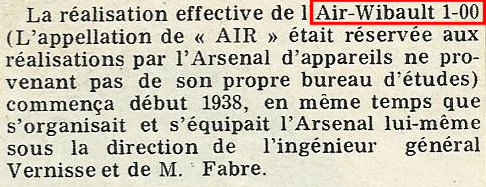
That original designation, therefore, seemed pretty established at the time. Even later articles, such as the excellent 1966 series on Wibault byJean Liron in Aviation Magazine, used the correct spelling:
However, when the aircraft was "rediscovered" in Avions N° 99, through the plan of a wind-tunnel model shared with you by Pierre Cortet, you refered to it as the Air-Wibault "1.00" in the caption, and as plain "100" in the rest of the article. You also did away with the hyphen. Why this simplification?
Since you are usually annoyed by invented or distorted designations, I hope I have convinced you that "1-00" is and always should be the correct spelling. An airplane should always be designated the way it was meant to be by its builders!
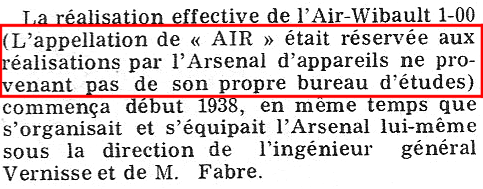
To conclude, Aviation Magazine provided a very interesting explanation for the "Air-" prefix on the designation:
(The « AIR » designation was reserved for machines built by Arsenal but not emanating from their own design bureau)
This, of course, places the "1-00" pretty much in the same category of designations as the Abrial AIR-60 and Arsenal AIR-100/102 sailplanes. And despite the fact that the hyphen was always used in the designations back then, a lot of period articles often failed to transcribe it...
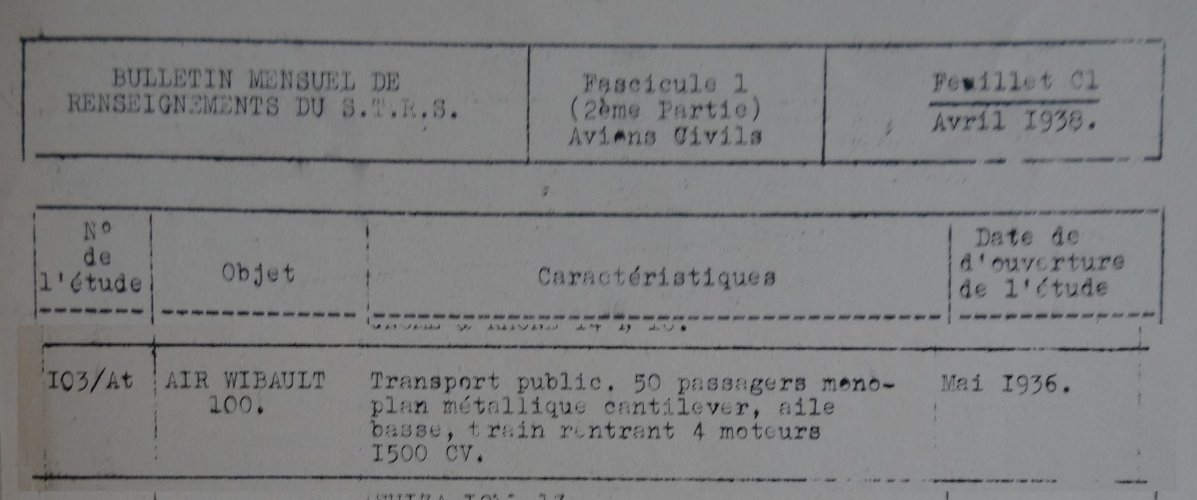
Hi Stargazer. I agree with you, most of the publications used "1-00" instead of "100". Nevertheless, officially, in the Air Ministry archives, it appears as "Air Wibault 100". I attach an example from an STRS bulletin.
"AW" is probably not official. It's more of a habit among the people at the Arsenal that I met.
Here is my Wibault designations Excel file (see attachment) fully updated, also with an additional thumbnail for ONERA and Messier references.
The list runs from Type 1 to Type 44, with a few missing slots of course.
I have done my best to improve upon the previous version and to add as many precisions as I could.
Pre-war undesignated projects are inserted chronologically within the list.
The list does not include the work done under Republic Aviation in the US during the 1940s.
Post-war projects (all undesignated) are in a separate section.
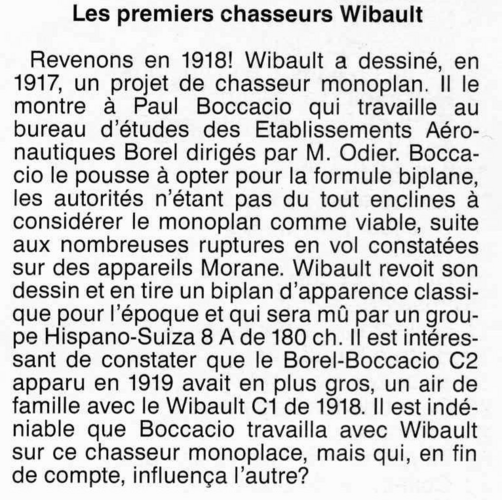
I've corrected a few mistakes, for instance the Wibault-Boccaccio C1 (Wibault Type 1) was previously ill-identified as related to the Borel-Boccaccio C2, which was not the case.
The "Wib." abbreviation has been removed as it was only used to designate military aircraft and never appears in relation to other aircraft.
I've also provided reference tables for both the official French type letters used and the English ones I used in the "role" column.
As always, if you think I've made a mistake or forgotten something, please let me know.
If anyone can add to it or correct anything, please let me know and I'll update it.
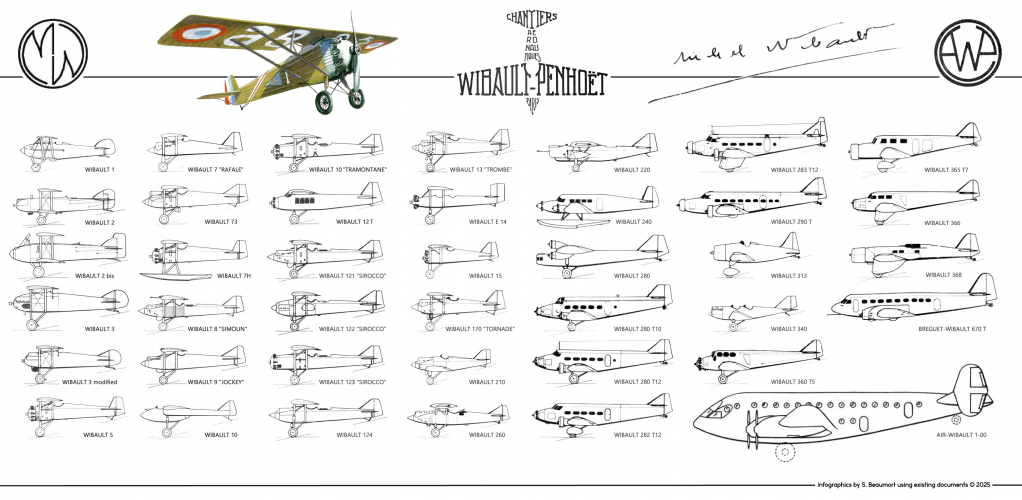
As a bonus, here a little infographic I made to present the bulk of Wibault's aircraft types, built and unbuilt, in profile form. Enjoy!
(Please note that relative sizes are very approximate)
This, of course, places the "1-00" pretty much in the same category of designations as the Abrial AIR-60 and Arsenal AIR-100/102 sailplanes. And despite the fact that the hyphen was always used in the designations back then, a lot of period articles often failed to transcribe it...
For me, it's more related to other engineers that were contracted by French State for manufacturing their prototypes under contract with Arsenal:
- Air Couzinet AC 10 and AC 20 (not the following ones: Couzinet left France in 1940 to Brasil and stopped working with Arsenal, even if he continued using AC designations)
- Air Delanne 10
- Air Guyot (supposed to be VGU 40? not confirmed)
- Air Wibault 1-00
For me, it's more related to other engineers that were contracted by French State for manufacturing their prototypes under contract with Arsenal:
- Air Couzinet AC 10 and AC 20 (not the following ones: Couzinet left France in 1940 to Brasil and stopped working with Arsenal, even if he continued using AC designations)
- Air Delanne 10
- Air Guyot (supposed to be VGU 40? not confirmed)
- Air Wibault 1-00
This site uses cookies to help personalise content, tailor your experience and to keep you logged in if you register.
By continuing to use this site, you are consenting to our use of cookies.