WI China buys Tu-22M3?

Rule of cool

ACCESS: Top Secret
Joined
16 January 2024
Messages
3,566
Reaction score
4,520
I was surprised to read the other day that from about 2013 to 2021 China was looking at buying some 36 Tu22M3s from Russia for $1.5 billion. They finally gave up on the idea in 2022. The reasons being the numbers had dropped from 162 in 2010 to about 60 in 2022 and that their availability and therefore combat performance in Syria and Ukraine was appalling.

WI China had actually bought 36 Tu22M3, presumably earlier in this phase when there were more aircraft available? What weapons would they carry in Chinese service? How do the US and India react to China getting this massive jump in capability.

From the Russian perspective, China buying a fleet of Tu22M3s would presumably provide a huge injection of money and great demand into the bomber program. How does the Chinese demand stimulate the Russian bomber support industry? Does it make the Russian Tu22 fleet perform better? Does this have any impact on Russian plans to restart Tu160 manufacture and does China get in on that?
 
I was surprised to read the other day that from about 2013 to 2021 China was looking at buying some 36 Tu22M3s from Russia for $1.5 billion. They finally gave up on the idea in 2022. The reasons being the numbers had dropped from 162 in 2010 to about 60 in 2022 and that their availability and therefore combat performance in Syria and Ukraine was appalling.

WI China had actually bought 36 Tu22M3, presumably earlier in this phase when there were more aircraft available? What weapons would they carry in Chinese service? How do the US and India react to China getting this massive jump in capability.

From the Russian perspective, China buying a fleet of Tu22M3s would presumably provide a huge injection of money and great demand into the bomber program. How does the Chinese demand stimulate the Russian bomber support industry? Does it make the Russian Tu22 fleet perform better? Does this have any impact on Russian plans to restart Tu160 manufacture and does China get in on that?
A TL i've thought about a lot lately. My understanding is that China was interested in the Tu-22M from the 1990s. So my preferred TL is they somehow find the money to buy say a dozen in the 1990s (iirc i've read somewhere that there were 10 unfinished airframes left at Tupolev from 1993), and then they buy another 24 from Ukraine or Russia or both in the 2000s (this supposes a different Ukraine-Russia relationship in the 1990s-2000s including among others returning all the bombers to Russia rather than have them scrapped by the US friendly ukrainian regime back then).

In chinese service they will probably equip two regiments of 18 each, not sure if for PLAAF or PLANAF. Soon enough they will be modified to carry various chinese missiles such as YJ-12 and other supersonic or even hypersonic ASM/AShMs. Especially if fitted with IFR they will be a significant addition and capability leap to the chinese bomber force.

As to reactions, well if before 2006 this might have the americans retain the F-14/AIM-54 combo in service for longer, at least in the Pacific. Not sure what they will do once the F-14 will be retired eventually, probably in the 2010s, either modify the SH to carry modernized AIM-54s rather than the bulky and unsuitable AIM-174 (much too heavy for SH), or they might do the AIM-174 anyway because there would be no other alternative.

Another very interesting possibility is for China to licence produce the Tu-22M in an updated version, not sure if this might or might not replace the H6K program. One can imagine a Tu-22M with chinese electronics and NK-32 engines. That would certainly give headaches to the americans.

And now that i see it mentioned, iirc i've read recently a hint that China might have been interested in Tu-160 at some point (or maybe just a fanboy dream, not sure). Anyway this will be even more dramatic as the Tu-160 is a fully fledged strategic bomber able to reach US mainland from China. Again, a chinese version with modern electronics and the latest chinese hypersonic and aeroballistic missiles is mouthwatering to contend. But mostly this probably require a lot of things to fall into place, China putting the money forward (they can easily afford it btw, especially from the 2010s onwards), and Russia not kowtowing to US pressure and getting on with the sale and even licence production agreement.
 
Last edited:
Apart from China, Tu-22M3-E version was actually considered for Indian Navy, by late 90's. Specific armament was Kh-22E ASM, Kh-61 ASM and mines. By 2005 India cancelled the negotiations because the parts failed to find an agreement. Also interest from Iran and Libia.
Another weapon intended for this export version was the Kh-59MK ASM.

Tupolev Tu-22. Gordon/Komissarov. Schiffer Publishing. 2022 Pg 93 (Desktop Model images) and Pg 119 to 121 (Description)
 
A purchase in the 2013-2022 range seems sort of superfluous, to me. By the middle of that time, most of us were already starting to dread their A2AD capabilities, and they possess sufficient stand off range in their air launched weapons that, combined with possible combat around Taiwan/South China Sea/out towards but not all the way to Japan, etc, their land based missile should be more than adequately supported by their existing long range, subsonic strike planes, even if they are an antiquated design. I don’t buy them trying to prepare a dance of the vampires-meets-the battle of the Philippine Sea scenario after they commited so many resources to building up such a fearsome missile system, but maybe they’re a belt and suspenders kinda military. An earlier purchase in the 90s makes a lot more sense, I think.
 
Apart from China, Tu-22M3-E version was actually considered for Indian Navy, by late 90's. Specific armament was Kh-22E ASM, Kh-61 ASM and mines. By 2005 India cancelled the negotiations because the parts failed to find an agreement. Also interest from Iran and Libia.
Another weapon intended for this export version was the Kh-59MK ASM.

Tupolev Tu-22. Gordon/Komissarov. Schiffer Publishing. 2022 Pg 93 (Desktop Model images) and Pg 119 to 121 (Description)
The desktop model of the export model seems very interesting, never seen that one and don't have the book, any chance of a picture/screenshot if possible?
 
China is too poor to buy the Tu22 in the 90s. When China took over Hong Kong in 1997 it represented 18% of China's GDP, now it represents about 3%, so as great as the 90s was as a time to get Tu22s China wasn't realistically in the market.

Fast forward to 2013 and China can readily afford to buy Tu22s and maintain them at a high state of availability.
 
China is too poor to buy the Tu22 in the 90s. When China took over Hong Kong in 1997 it represented 18% of China's GDP, now it represents about 3%, so as great as the 90s was as a time to get Tu22s China wasn't realistically in the market.

Fast forward to 2013 and China can readily afford to buy Tu22s and maintain them at a high state of availability.
My understanding that apart from the early 1990s China's defence spending was below 2% of GDP, which i guess it was a political choice, but this could have been easily changed imo if the will/perceived need was there. So they could have afforded the Tu-22M in the late 1990s and quite a lot more stuff on top of that since then if the defence spending was higher, say closer to the US defence spending percentage (fluctuating anywhere between 3 to 5 % since then iirc).
 
IIUC in 1997 China's real GDP was USD $967 billion, by 2013 it was USD $9,782 billion. Sure, it could have afforded some Tu22s in the late 90s, but by 2013 it could afford to buy, upgrade and operate them with a high level of availability rather than have them sit on the tarmac for want of spares.
 
Tu22s in the late 90s, but by 2013 it could afford to buy, upgrade and operate them with a high level of availability rather than have them sit on the tarmac for want of spares.

I think that depends on the nature of such a hypothetical deal/operation.

Because if the PRC just acquired them, then spares could still be an issue. The Tu-22M3s aren't in active production I think (only the Tu-160M2 is IIRC) and while certain parts are probably manufactured to this day, some others may not be. And something like a strategic bomber usually isn't exported, let alone one that isn't in active production anymore. And there is obviously a large demand from the Russians themselves for such spares too.

So either the PRC pays for a continuation run and the associated reactivation of the production line, or they produce it themselves under license or as a knock off based on unfinished airframes. Otherwise it would be close to an IRIAF F-14 scenario I think. With a highly capable, highly complex system that's running dry on spares and thus has diminished realistic use.
 
I think that depends on the nature of such a hypothetical deal/operation.

Because if the PRC just acquired them, then spares could still be an issue. The Tu-22M3s aren't in active production I think (only the Tu-160M2 is IIRC) and while certain parts are probably manufactured to this day, some others may not be. And something like a strategic bomber usually isn't exported, let alone one that isn't in active production anymore. And there is obviously a large demand from the Russians themselves for such spares too.

So either the PRC pays for a continuation run and the associated reactivation of the production line, or they produce it themselves under license or as a knock off based on unfinished airframes. Otherwise it would be close to an IRIAF F-14 scenario I think. With a highly capable, highly complex system that's running dry on spares and thus has diminished realistic use.

This was basically what I was wondering.

As it is Russia has these aircraft (and Tu160s) on the drip feed, so any updating is painfully slow, but if you throw a stack a China money at them what is the impact? I imagine China will want as much tech transfer and do as much of the sustainment as possible, so will likely both energise the Russian company to do more work, hire more staff as well as try to manufacture things themselves, probably under license.

As an aside the Tu160 currently doesn't appear to be 'in production'. The Russians are calling it reproduction, assembling aircraft from stored parts. Apparently, they plan to actually restart production of new Tu160s from scratch, although with everything on the drip feed that sounds unlikely.
 
RW - Just seen a suggestion that Russia may need to buy H6 - badger from china, to replace the Tu95 they may or may not have lost yesterday. All time lines reach the same cusp points.

Wait, whaaaaaat ? do you have a source for that ? the irony would be so strong, just think about it. "Oh, we are running out of Tu-95s and Tu-22Ms, hence we need new bombers: then we heard you still have the Tu-16 blueprints we pased you 65 years ago; and even a production line..."

"Somehow, Tu-16 returned."
 
As an aside the Tu160 currently doesn't appear to be 'in production'. The Russians are calling it reproduction, assembling aircraft from stored parts. Apparently, they plan to actually restart production of new Tu160s from scratch, although with everything on the drip feed that sounds unlikely.
May be more likely now, though.
 
This was basically what I was wondering.

As it is Russia has these aircraft (and Tu160s) on the drip feed, so any updating is painfully slow, but if you throw a stack a China money at them what is the impact? I imagine China will want as much tech transfer and do as much of the sustainment as possible, so will likely both energise the Russian company to do more work, hire more staff as well as try to manufacture things themselves, probably under license.

As an aside the Tu160 currently doesn't appear to be 'in production'. The Russians are calling it reproduction, assembling aircraft from stored parts. Apparently, they plan to actually restart production of new Tu160s from scratch, although with everything on the drip feed that sounds unlikely.

Nah, the Tu-160 is being produced from scratch again, there have been previous units that were assembled from unfinished airframes, but if I recall correctly from 'Valentina Tereshkova' onwards they're new units, when Tupolev showed off 4 shiny Tu-160M/M2s two were modernized, two were new production.

The Russians plan to have their long range aviation being composed of the Tu-160M/M2 and the PAK DA. The Tu-22Ms get retired first, especially given how they're burning through their airframe life, the Tu-95s follow later on. So the restart of production was a vital step and also something that has delayed the PAK DA a bit, as Tu-160s occupy the assembly halls, thus the facility is to be expanded to allow for simultaneous production of the supersonic conventional bomber and the subsonic low observable one.

The Tu-160 is definitely the most well off of the three currently and will remain so when time goes on. Production and ongoing refurbishment contribute to an improvement in part availability and readiness, but the Tu-160s are pretty much relegated to deterrence patrol and training, they're the actual airborne part of the nuclear triad. They take part in conventional strikes from time to time, but generally speaking that task belongs to the Tu-95s and Tu-22M3s. I suppose it's somewhat freeing to use these intensively for conventional strikes when you are aware that their time is limited. It also allows to grow the Tu-160 fleet in the meantime and not burn through flight hours.
 
Nah, the Tu-160 is being produced from scratch again, there have been previous units that were assembled from unfinished airframes, but if I recall correctly from 'Valentina Tereshkova' onwards they're new units, when Tupolev showed off 4 shiny Tu-160M/M2s two were modernized, two were new production.

I'm finding this particular subject confusing. I suspect that's deliberate on the part of the Russians, but surely given the handful of aircraft it shouldn't be impossible to work out.

In early 2025 leaked documents showed Kazan had 7 aircraft in hand, 5 for repair and modernisation which I suspect will come out as Tu160Ms and 2 reproduction using Soviet era stored parts which will delivered as Tu160M2s. Perhaps these are the same aircraft that have been reported as in testing and delivered since 2022, such as the 4 on hand when Putin visited in Feb 2024, or perhaps these are in addition to the 4 or even 6 modernised and 'new build' aircraft announced as delivered in recent years.

To bring this back to the thread, if China had bought ~36 Tu22M3s in about 2015 I'd expect this Russian bomber programme to be more advanced by 2025. For example the engine company insists it needs 20 engine order per year to be viable, but the Russians only order about 4-6. If the Chinese were on board they'd be wanting the engine company to work on their engines as well, giving the company a much firmer financial footing.
 
China is too poor to buy the Tu22 in the 90s. When China took over Hong Kong in 1997 it represented 18% of China's GDP, now it represents about 3%, so as great as the 90s was as a time to get Tu22s China wasn't realistically in the market.

Fast forward to 2013 and China can readily afford to buy Tu22s and maintain them at a high state of availability.
At this time China was buying up ex-soviet tech, the aircraft carrier, Su30 etc. Within this 'plan' they could decide it was a cheap way to get some physically bigger aircraft tech. So they ask for a quote for say 12 aircraft, one Sqn for trials and development. But its an order for 1+11. They never order the 11, take the 1, fly it for a bit, then take it apart. improve, new avionics, and so on.
 
Wait, whaaaaaat ? do you have a source for that ? the irony would be so strong, just think about it. "Oh, we are running out of Tu-95s and Tu-22Ms, hence we need new bombers: then we heard you still have the Tu-16 blueprints we pased you 65 years ago; and even a production line..."

"Somehow, Tu-16 returned."
it was just a suggestion from someone on Twitter, as to how Russia 'recapitalises' its Heavy Bomber fleet. The only thing remotely 'in production' is the H6. Werther Russia can remotely afford such a purchase is another whole conversation. Maybe with China moving to new designs they would sell a Sqn or 2 of in service H6 to Russia? Would they instead push ahead and really get the Tu160 into real new production? Even assuming the war finishes, they will have so much to buy....
 
In chinese service they will probably equip two regiments of 18 each, not sure if for PLAAF or PLANAF.
I'd expect PLANAF, but PLAAF is where they should be IMO.

36x birds each armed with 3x Kh-22 (equivalents) is only 108 incoming missiles, not really enough to get through a typical carrier's defenses. And that's after the Tomcat is retired. When there's still Tomcats and Phoenix missiles in play, well, that makes it even worse. You'd probably need at least another Regiment of 18, if not two, to get through 4-8x tomcats plus Aegis.

Having them in PLAAF and only sometimes doing AShM work is probably better for China.


As to reactions, well if before 2006 this might have the americans retain the F-14/AIM-54 combo in service for longer, at least in the Pacific. Not sure what they will do once the F-14 will be retired eventually, probably in the 2010s, either modify the SH to carry modernized AIM-54s rather than the bulky and unsuitable AIM-174 (much too heavy for SH), or they might do the AIM-174 anyway because there would be no other alternative.
Phoenix missiles need the AWG-9 radar, it'd take major surgery to fit that into a Super Hornet.


Another very interesting possibility is for China to licence produce the Tu-22M in an updated version, not sure if this might or might not replace the H6K program. One can imagine a Tu-22M with chinese electronics and NK-32 engines. That would certainly give headaches to the americans.
I'm still not sure why China hasn't tried for this yet.
 
The more i look at this TL the more i see those ukrainian bombers as a golden opportunity (at least as far as AH goes). They had no less than 19 Tu-160, 23 Tu-95MS and 42 Tu-22M3 after 1991 (plus older models not of interest likely). So maybe China could pull another Varyag somehow, bribe the hell out of some ukrainian politicians/generals and get their hands at least on the Tu-22M3s and/or the Tu-160s. Even a few hundred million dollars is a small price to pay for those planes.

Kazan could still make good money by refurbishing and/or providing spares and service for those bombers, which of course should help with their manufacturing. If somehow China does the same kind of deal with Tupolev as they did with Sukhoi for licence production, then that's more money for Tupolev and at least initially they will delivers the CKDs, again improving their production flow.
 
I'd expect PLANAF, but PLAAF is where they should be IMO.

36x birds each armed with 3x Kh-22 (equivalents) is only 108 incoming missiles, not really enough to get through a typical carrier's defenses. And that's after the Tomcat is retired. When there's still Tomcats and Phoenix missiles in play, well, that makes it even worse. You'd probably need at least another Regiment of 18, if not two, to get through 4-8x tomcats plus Aegis.

Having them in PLAAF and only sometimes doing AShM work is probably better for China.


Phoenix missiles need the AWG-9 radar, it'd take major surgery to fit that into a Super Hornet.


I'm still not sure why China hasn't tried for this yet.
Isn't the APG-71 closely related to the APG-70, in turn related with APG-73 etc.? So doesn't seem like AIM-54 only works with AWG-9, an upgraded variant should be made compatible with APG-79 like the AIM-174 was imo.

As far as a potential dance of the vampires, you'd think the H6K would be even less suitable, but likely they are earmarked for such a scenario nevertheless, no doubt helped by the new generation weapons and ECM as well as new generation battlespace control/surveillance systems (datalinks, satellites etc). Let's also not forget that especially with the newer chinese super and hypersonic missiles, by virtue of it's supersonic speed the Tu-22M could launch those from further away, and also get out of CAP range quicker (if it ever gets that close).
 
Isn't the APG-71 closely related to the APG-70, in turn related with APG-73 etc.? So doesn't seem like AIM-54 only works with AWG-9, an upgraded variant should be made compatible with APG-79 like the AIM-174 was imo.
A quick check says that the APG-71 is an AWG-9 fitted with modules from the APG-70 and a new antenna.

The major issue is the small radome in the Super Bug compared to the F-14. Small radome means small detection range.


As far as a potential dance of the vampires, you'd think the H6K would be even less suitable, but likely they are earmarked for such a scenario nevertheless, no doubt helped by the new generation weapons and ECM as well as new generation battlespace control/surveillance systems (datalinks, satellites etc). Let's also not forget that especially with the newer chinese super and hypersonic missiles, by virtue of it's supersonic speed the Tu-22M could launch those from further away, and also get out of CAP range quicker (if it ever gets that close).
If the Chinese developed a Kh-15-sized AShM, it'd be scary. Total of 10 missiles, 6 internal plus 4 external. That would put a two-regiment-sized Dance of the Vampires into "serious threat" territory even with Tomcats in play.
 
A quick check says that the APG-71 is an AWG-9 fitted with modules from the APG-70 and a new antenna.

The major issue is the small radome in the Super Bug compared to the F-14. Small radome means small detection range.


If the Chinese developed a Kh-15-sized AShM, it'd be scary. Total of 10 missiles, 6 internal plus 4 external. That would put a two-regiment-sized Dance of the Vampires into "serious threat" territory even with Tomcats in play.
Well, they put the AIM-174 on the SH which aiui has an even greater range than the AIM-54. Possibly using third party targeting/guidance data for maximum range shots. Same would apply for an updated AIM-54 on SH, except the AIM-54 would be much lighter and probably have better all around AAM performance (G limit/turning capability).

For AShM, i had in mind chinese types such as KD-21, probably 3 and possibly more could be carried, which is a kind of sino-Kinzhal. Not quite sure if China developed or tried to develop something like the Kh-15, would be interesting to find out.
 
Last edited:
Well, they put the AIM-174 on the SH which aiui has an even greater range than the AIM-54. Possibly using third party targeting/guidance data for maximum range shots. Same would apply for an updated AIM-54 on SH, except the AIM-54 would be much lighter and probably have better all around AAM performance (G limit/turning capability).
I'm not sure how much 3rd party targeting can be done with Phoenix.

Again, Phoenix needs AWG-9 to talk to it.


For AShM, i had in mind chinese types such as KD-21, probably 3 and possibly more could be carried, which is a kind of sino-Kinzhal. Not quite sure if China developed or tried to develop something like the Kh-15, would be interesting to find out.
Supposedly, the Backfire can carry 4x Kinzhal.

A Sino-Kh-15 would be a great weapon.
 
I'd think a Chinese Tu22M3 force would be used less for AShM against CBGs and more as an intercontinental bomber to target the US mainland as part of China's strategic triad.

The Wiki page on the Tu160 says that India had talks with Russia in 2022 about buying 6 Tu160s. Imagine if the Tu160 became available for export? I can't imagine China wouldn't want some of it's own if India was getting them.
 
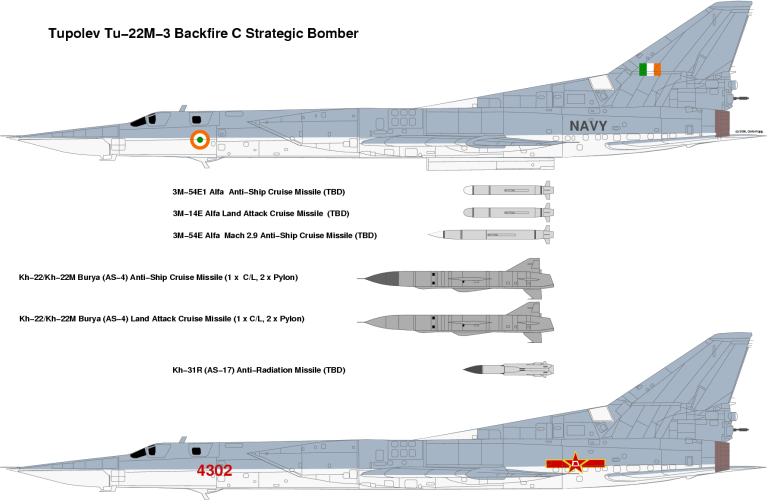
Added only to give some imagery to the thread:

Tu-22M-3-IN-PLAAF.png
 
Added only to give some imagery to the thread:

Tu-22M-3-IN-PLAAF.png
India is upgrading about 100 of its Su30s with aesa and other shit, the upgrade package is called "super sukhoi".

The rest ~170 SU-30s of IAF will not be capable of being used as Frontline fighter in future, or even as support fighters to compliment stealth jets.

Being a long range standoff platform, including anti ship role is the only viable option for ~170 of those jets in future.


I expect PLAAF to do the same with it's older flanker varients.
 

Similar threads

Back
Top Bottom