What actually made "8 gun configuration" of B-25 so deadly to Japanese destroyer?

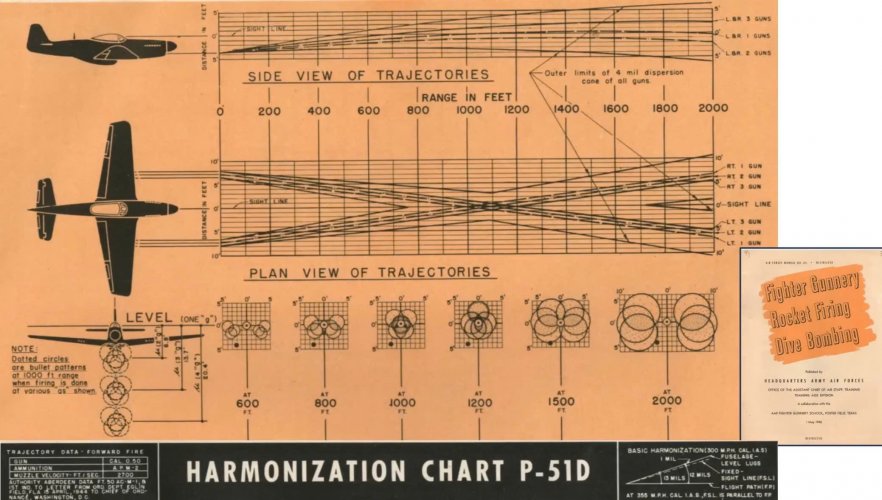
All the guns on the B25 fired directly forward, while the wing guns on the fighters were angled to converge into a single pattern at about 200 yards.
Potentially.
The ground crew gets to calibrate the guns and it's possible to create various patterns. With 8 guns you could very well create a very large beaten zone @ 500 m distance, like 20x20 m with some guns calibrated to aim a bit up, up-left, left, down-left, down, down-right, right, up-right.

The thing about shooting straight forward with central guns and crossing at a certain distance with outer wing guns was all about hitting a fighter in typical air combat shooting scenarios. That's not very relevant for a B-25.

 
I have to imagine a veteran crew with a lot of experience on the type could take some advantage of the 75mm gun's capabilities but for the average crew the strafing configuration with as many .50 caliber MGs as could be fitted was a better choice. I believe later B-25s had the ability to carry 5" HVAR rockets on the wings which helped too.

The XA-38 had a 75mm with automatic loader but I don't think the B-25 ever received that equipment, so it was up to the navigator to load it IIRC. If you took someone like a skilled loader from an M4 Sherman he could probably feed that gun pretty quickly, but your average airman just introduced to the job was only able to give the pilot maybe three well-aimed aimed shots on a pass.

I imagine it would have been possible to fit 20mm or 37mm cannons in the nose but if they tried that I don't think such configurations saw any combat use.
Four shots was reckoned to be about the average for a B-25G/H on each run, during which the aircraft had to be held steady while the pilot aimed the cannon leaving it vulnerable to AA fire.

The A-20G Havoc was intended to have a solid nose carrying 4 x 20mm cannon & 2 x 0.5" MG. However, as the cannon proved to be prone to jamming this was changed to 6 x 0.5" MG after the first Block. Of the 250 cannon armed A-20G-1 built, 237 were supplied to the USSR under Lend Lease and they didn't seem to like the cannon either!

The RAF converted a small number of Mosquitos as the Mk.XVIII "Tse-Tse" with a 6pdr (57mm) anti tank gun in the belly. It was fitted with an automatic loader manufactured by the Molins company, then famous for producing cigarette vending machines. A firing pass would begin at 1,300 yards, firing would begin at 1,000 yards and breakaway at 500 yards allowing for about 4 rounds to be fired. Originally intended as a tank buster, they ended up in service with Coastal Command and had a number of U-boat kills to their credit. Production amounted to 1 prototype and 16 production conversions between June 1943 and Jan 1945, one of which was supplied to the USAAF for trials in 1945. They also had 2 or 4 x0.303 MG in the nose to assist with sighting the big gun.
 
The A-20G Havoc was intended to have a solid nose carrying 4 x 20mm cannon & 2 x 0.5" MG. However, as the cannon proved to be prone to jamming this was changed to 6 x 0.5" MG after the first Block. Of the 250 cannon armed A-20G-1 built, 237 were supplied to the USSR under Lend Lease and they didn't seem to like the cannon either!
The US screwed up the metric-to-Imperial conversion of the 20mm Hispano, the headspace in the chamber was too long, leading to soft strikes from the firing pin. The Ordnance Department were well aware the problem did not affect the British Hispano and that they just needed to adopt the British chamber design, but refused to change. In the meantime the RAF and RAAF were happily using 20mm Hispanos armed Beaufighters and Mosquitos for flak suppression in the North Sea, Med, and SW Pacific.
 
All the guns on the B25 fired directly forward, while the wing guns on the fighters were angled to converge into a single pattern at about 200 yards.
Scott, and all -

Howdy !

According to “ Warfarehistory.com “ , North American Aviation produced 800
B-25Js w/ the 8 gun “ solid nose “. They did not state ( in their “ B-25 Mitchell Medium Bomber played a significant role in WWII “ article ) how many 8 gun solid nose retrofit kits were produced, or installed @ the “ Depot Level “.

A “ Google “ search on the 8 gun solid nose B-25J used in th EAME theatre, produced an “ AI overview “ that stated…

“ Yes, there were B-25J eight gun nose Mitchell’sin the Mediterranean Theatre “.
The overview mentioned “ The 319th Bomb Group, 437th Bomb Squadron, operating from Serraggia airbase in Corsica “, as one USAAC operator in the EAME theatre.

The overview also mentioned a 437th BS aircraft “ Battle number 18 “, and that it flew missions in Nov-Dec 1944.

*** I believe the above quoted “ AI overview also mentioned” generated by my Google search to be in-error. “ Battle number 18 “ is a currently flyin glass-nosed B-25J known widely as “ Made in the Shade “…. and is not a “ solid nose “ -J ***. I read nothing in the planes history to indicate that it was manufactured as a solid nose -J, or that it was retrofitted w/ an 8 gun nose kit in the field. It was a TB-25J when it was retired by the USAF. ***

I have put questions out to B-25historyproject historians, and others; to see if a more -clear answer can be had about whether 8 gun nose B-25Js were flown by the USAAC in the EAME in WWII……

Film @ 11:00 ….


With regards,
357Mag
 
All the guns on the B25 fired directly forward, while the wing guns on the fighters were angled to converge into a single pattern at about 200 yards.
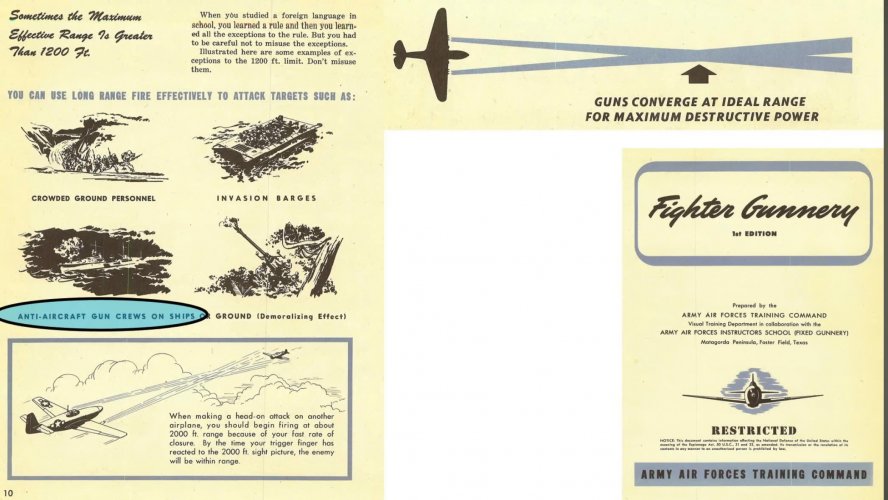
You are correct that guns on the fighters were angled to converge into a single pattern, which make them less effective at longer range against evasive targets such as other fighters. But against soft area targets such as anti aircraft gunner crews, pilots are instructed to open fire at range greater than the converge point. I think mostly because people doesn't need to get hit by more than 1 .50 cal bullet for it to have significant effect on them
P-51 chart.jpg
Gun range.jpg
 
Last edited:
Thank you for still digging this out, @357Mag !!
Scott, and all -

Howdy !

Just read some illuminating information, about the B-25 solid “ 8 gun nose “; at the
B-25history.org website….

A historian there states that B-25J were not manufactured with the “ 8 gun “ solid nose.
He pointed out that the 8 gun nose was “ kitted “ modification, and memtioned that these kits were instead installed at Fairfax; KS on a special “ modifications “ line.
He pointed out that the pic on the b-25history.org website showing a B-25J solid nose aircraft….. was taken on the “ modifications “ line.

As it turns out, at the same website…. If you select “ about “ then select “ restorations “, and then select “ 8 gun “….you will be treated to pics and a delightful story about the restoration of an 8 gun “ straffer “ nose. This nose was formerly installed on
B-25J-25-NC s/n 44-30324.

The website listed 3ea B-25s currently flyable, that have the 8 gun nose.
From what I read, all had their “ solid noses “ added well after the planes had been originally produced. “ Devil Dog “ got the mod, to serve as a civilian freighter
another to become a TB-25J ( albeit w/o the more-familiar point nose cap applied to a glass nose ).
“ Hot Jen “ was given a solid nose to serve as an executive transport.
“ Betty’s Dream “ appears to have had its solid nose installed as a repair after a nose gear failure, before going on to serve as an air tanker.

In the histories and pictures of these aircraft, there are some that had a solid nose that was removed, and as mentioned… those that has one installed… well after the planes had left MIl service. Given the flexibility, past availability, and comparative ease of installation; it is not likely possible to pin-down how many B-25Js left the factory configured w/ the 8 gun nose mod. If some one has better information, it would be something worth reading.

I am still looking into info about the various B-25J models operated in the EAME theatre.
This would include those assigned to squadrons of the: 310th Bomb Group, 319th BG, 321st; and 340th BG.

With regards,
357Mag

 
In my opinion, the destructive capacity of eight machine guns grouped in the nose can have the effect of a chainsaw on the hull, on the bridge or on the torpedo tubes of a destroyer or frigate. During strafing operations on D-Day, many Mustang pilots were amazed at the effectiveness of their weapons against armored vehicles, sometimes destruction being achieved by ricocheting 0.5-in bullets off the ground before penetrating under the poor ventral armor of tanks.
 

Similar threads

Back
Top Bottom