V-1 Of the kaiser

shin_getter

ACCESS: Top Secret
Joined
1 June 2019
Messages
1,323
Reaction score
1,972
What if, somehow someone in Germany figured out pulse jets and fully developed them to V-1 performance level by the 1915~1916 time period.

What happens to the war? What happens when everyone gets a replica? What happens to airpower application and theory ever afterwards?
 
I could safely say that while it's not totally impossible, it would took a lot of time to find a practical applcation. 1910s aircraft aren't exactly designed for velocities at which pulsejet works fine. And pulsejets aren't working good at 1910s aircraft velocities.
 
I could safely say that while it's not totally impossible, it would took a lot of time to find a practical applcation. 1910s aircraft aren't exactly designed for velocities at which pulsejet works fine. And pulsejets aren't working good at 1910s aircraft velocities.
While I don't fundamentally disagree, I am struck by the fact that from an aerodynamic perspective the V-1 fuselage essentially corresponds to a (perhaps somewhat elongated) WWI Zeppelin shape, while the V-1 wings and other aerodynamic surfaces are straight wing constant profile designs, so in my view it would come down to structural materials and concepts (the first all-metal aircraft was the German Junkers J 1, first flown on December 12, 1915), as well as GNC (pioneered by the Kettering Aerial Torpedo (Bug) in 1917). And considering that aerial catapults were pioneered in the early 1900's by Samuel Langley, see https://en.wikipedia.org/wiki/Aircraft_catapult, I'd entertain the notion...
 
Last edited:
While I don't fundamentally disagree, I am struck by the fact that from an aerodynamic perspective the V-1 fuselage essentially corresponds to a (perhaps somewhat elongated) WWI Zeppelin shape, while the V-1 wings and other aerodynamic surfaces are straight wing constant profile designs, so in my view it would come down to structural materials and concepts (the first all-metal aircraft was the German Junkers J 1, first flown on December 12, 1915), as well as GNC (pioneered by the Kettering Aerial Torpedo (Bug) in 1917). And considering that aerial catapults were pioneered in the early 1900's by Samuel Langley, see https://en.wikipedia.org/wiki/Aircraft_catapult, I'd entertain the notion...
I mean, the Zeppelin was a flexible bag filled with gas bladders, not a solid structure. So I am not sure how much that would translate. The J1 would possibly have given useful experience though it was considered too heavy, which might point to issues with a WW1 V1.

However, the V1 being as rough and dirty as it was means that technically all the elements save the pulse jet seem to have been in use somewhere to some extent. Still might be a bit of a stretch, but maybe worth considering.

The use case is still going to be strategic. I can’t see anything smaller than a major city sized target being hit with anything like regularity. So basically it’s an advancement or and adjunct to the zeppelin bombing of London and the Shelling of Paris by super heavy artillery. It could conceivably be better at that than then the methods used RW but seems unlikely it would have an appreciable effect on the war.

I think post war they would be banned for Germany under Versailles and everyone else would be at least experimenting with them to see if they could make them into a more usable weapon system (better guidance, longer range, lighter structures, etc) but in a limited fashion. Similar to the work put in to drone aircraft RW.
 
No, it was a rigid frame, covered with fabric. No more flexible than a DR1 airframe.

Zeppelins are not saggy barrage balloons or Goodyear Blimps!
Yes, you are right. My only defences are that I have spent too much time looking at RNAS dirigibles and that it was very early in morning when I posted. My apologies.

I am still not sure there would be a direct link in design between the two.
 
The Wikipedia article on Robert Goddard contains a wealth of detail concerning when his inventions were developed and patented:


A rocket would probably be more achievable than a pulsejet, since the ballistics of bullet-shaped objects were understood very well and those of high-speed flight of winged aircraft hardly at all. That being said, it would take powerful men to push such ideas through (Goddard was frequently not taken seriously) and secure the massive funding that would be needed to get progress in a hurry. Whether anyone in 1914-1918 had the engineering or metallurgical competence to build anything like that in the time-frame envisaged is the other central question.
 
I wonder if some kind-of coal powder air-breathing rocket would've been possible?

Without the gyroscopes and lifting surfaces you're basically getting a much less accurate version of the Paris gun (albeit in lighter weight form, and with more options for scaling).
 
the V1 was Puls engine powered Cruise Missile
What Wilhelm II needed was this:
Kettering_Bug.jpg


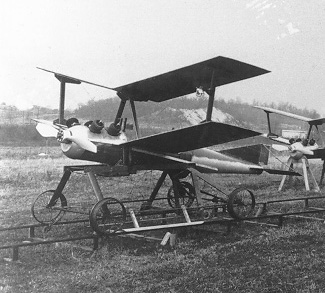
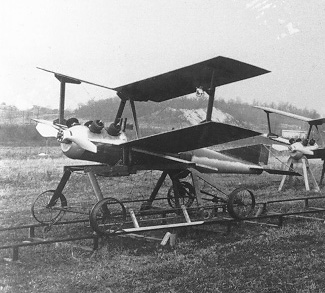
The US worked in WW1 on a "drone" called Kettering Bug
 
Check that
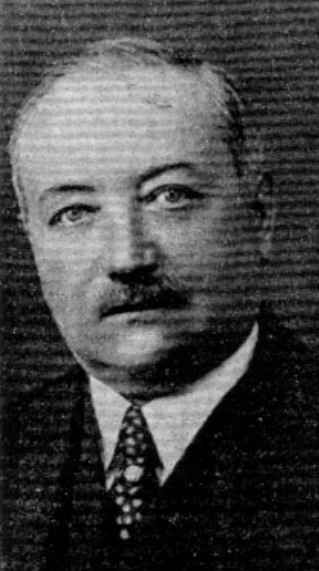
In 1918 , Lorin proposed the construction of a remote-controlled missile capable of bombing Berlin : a projectile carrying 200 kg of explosives, launched from a ramp and able to reach speeds of 500 km/h .

Si le principe de la réaction est vieux comme le monde, on
a toujours tendance à penser que celui de la pulsoréaction ne
serait né qu’avec le XXe siècle. On voit par ailleurs dans les tra-
vaux de René Lorin (1877-1933), la conception, pour ne pas
dire l’invention du projet FZG 76, ce qui est plutôt réducteur,
même s’il a fait preuve dans ce domaine, d’une incroyable
prescience. Il a très vite compris que, tout comme l’électricité
n’a pas été découverte en améliorant la bougie, il était illu-
soire de vouloir développer l’aviation par imitation des oiseaux
mais plutôt en recherchant toujours l’augmentation de la
vitesse. Jurassien d’origine, reçu à la fois à l’école des Mines
et à l’école Centrale, il est sorti brillant ingénieur centralien de
la promotion 1901. Il est vrai que Lorin a travaillé dès 1907
sur un projet de statoréacteur qui est, certes, un proche cou-
sin du pulsoréacteur, mais qui ne correspondait pas à l’usage
que les Allemands voulaient en faire. Le mérite de Lorin est
précisément d’avoir mis en balance la classique propulsion par
piston et celle à flux continu de son projet. Concevant comme
efficace la compression naturelle dynamique, Lorin voyait un
grand avenir en cet engin dont la poussée croît comme le
carré de la vitesse et dont la consommation diminue avec
l’augmentation de celle-ci. Ainsi, entre 1907 et 1913, il publia
dans la revue L’aérophile [42], une série de 13 articles intitulés
“Propulseur par réaction directe” qui ne passa pas inaperçue
outre-Rhin. Il y présente un propulseur pouvant fonctionner
soit à flux continu, soit à flux discontinu, autrement dit un
statoréacteur et un pulsoréacteur. Dans le numéro du 15 mai
1909, il y énonce cette incroyable théorie d’avant-garde :
Nous envisageons la possibilité d’appliquer la propulsion par
réaction directe à des appareils aériens sans pilotes, très
rapides, et par conséquent stables, dirigés par un procédé de
télémécanique, véritables torpilles aériennes, qui, dirigées de
postes de TSF pourraient rendre de grands services, tant au
point de vue militaire qu’au point de vue civil. Faute de moyens
d’essai puisqu’aucun appareil de l’époque ne pouvait lui four-
nir la vitesse minimale requise pour le fonctionnement de son
projet, il ne put donc jamais tester son idée mais en déposa
cependant un brevet le 14 mai 1908 sous le numéro 390.256.
Celui-ci ne fut repris que trente ans plus tard et n’aboutit réel-
lement qu’après la Seconde Guerre mondiale. Employé par la
Compagnie Générale des Omnibus de Paris, Lorin fut tout
naturellement chargé du service automobile d’un corps d’ar-
mée pendant la Première Guerre mondiale et fut décoré de la
croix de guerre avec citation. Toujours obsédé par son projet
auquel il travaille depuis plus de cinq ans, il se fit l’apôtre, en
1915 auprès du gouvernement français, d’un avion sans pilote
capable de bombarder Berlin. Il a pour cela prévu un lance-
ment par rampe pneumatique ou fusées propulsives de poudre
noire. Tenu en vol par un pilote-automatique, cet appareil de
500 kg, transportant une charge de 200 kg, aurait pu se
déplacer à une vitesse estimée de 500 km/h et à une altitude
prédéterminée grâce à une capsule barométrique. Le guidage
jusqu’à sa cible se faisant ensuite à partir d’un ou plusieurs
avions d’accompagnement suivant la trace fumigène laissée
par l’engin. En 1919, il publia l’un des plus beaux livres d’aéro-
nautique, intitulé L’air et la vitesse qui résumait ses
recherches et contenait des vues qui se sont révélées remar-
quablement exactes. Il est vrai qu’il fut le premier à imaginer,
pour la bombe volante, l’utilisation du réacteur à clapets
(comme on le nommait à l’époque), dont un autre illustre
Français avait jeté les bases près d’un demi-siècle auparavant.

 
Last edited:
Yes, you are right. My only defences are that I have spent too much time looking at RNAS dirigibles and that it was very early in morning when I posted. My apologies.

I am still not sure there would be a direct link in design between the two.
There would not - that's where my reference to the Junkers J 1 (aka Blechesel [meaning Tin Donkey or Sheet Metal Donkey]) comes in. It is about a combination/synthesis of *different/disparate* technologies...
 
Last edited:
Yah yah wunderbar ich lieben kartoffels.
Hey Archy, my heartfelt congratulations - you just won a participation trophy in the German Language Mangling category! Now if you're interested, the competition for the Marcel Marceau trapped in an invisible box silent French whiteface mime award is still up for grabs...
 
Last edited:
Mein lieber Archibald, vielleicht sollte Ich Deinem Beispiel folgen und zukuenftig nur noch in Deutsch beitragen?
Hatte Wilhelm II den Krieg gewonnen wurde Europa heute deutsch reden...

Translation
Had Wilhelm II won the War, Europa today talk German

back to Topic
Herman Oberth propose also Rockets that carry poison gas to enemy
but Austria-Hungary Military din't understand him
 
I wonder if some kind-of coal powder air-breathing rocket would've been possible?
Maybe? sufficiently-finely-powdered coal can basically be pumped like a liquid, and the combustion rate of such a fine powder is best described as "dust explosion"

Without the gyroscopes and lifting surfaces you're basically getting a much less accurate version of the Paris gun (albeit in lighter weight form, and with more options for scaling).
Well, didn't torpedoes have gyro "autopilots" in them? as in, "fly this direction at a specified altitude/depth"?
 
Maybe? sufficiently-finely-powdered coal can basically be pumped like a liquid, and the combustion rate of such a fine powder is best described as "dust explosion"
Technically you can do the same with sawdust, grain dust, or even flour. Not sure you would get enough impulse out of them, but it is possible. Nowadays pulse jets are used most extensively as heaters for drying systems, particularly for organics. And it’s not uncommon to use the waste of the material you are drying as a feedstock.
 
I thought about it before and I suspect the metallurgy (and maybe lubricants) might not have been advanced enough for the pulsejet valve.
I do suspect it could have been used for a record aircraft and even the first English Channel crossing, though.
 
I thought about it before and I suspect the metallurgy (and maybe lubricants) might not have been advanced enough for the pulsejet valve.
I do suspect it could have been used for a record aircraft and even the first English Channel crossing, though.
Technically you don’t need a valve. Valveless systems just ensure that the tailpipe is long enough that the vacuum pulls in from the inlet before it does from the tail. They even have the advantage of not dropping off performance at higher speeds that would cause the valve to fail.

I don’t know that anyone knew this at the time, nor if a valveless pulse jet is viable for the period, but it is possible to do it without the valve.
 
Given it took Dornier a lot of time to get a workable metal monocoque fuselage, with the D.1 still dogged with structural failure problems in mid-1918, I doubt that you could build a robust enough structure to withstand the vibrations from the pulsejet. I don't think a wooden monocoque would cope in this era.

How would you 'aim' it? Some kind of clock device? Even if you aimed at London from Belgium most of them would probably fall into the Channel or the Thames Estuary.

And an incensed population would likely lead to the formation of the Independent Force sooner and don't forget, by 1915 Britain and France are building heavy bombers that could target German towns. Small bombs and probably high losses to accidents in night flying, but it could have an effect on Germany's war effort.
Some crazed muppet might even authorise the use of gas bombs against the German population. Who knows what horrors could be unleashed.
 
I thought about it before and I suspect the metallurgy (and maybe lubricants) might not have been advanced enough for the pulsejet valve.
I do suspect it could have been used for a record aircraft and even the first English Channel crossing, though.
I thought the basic shutters like used in the V-1 were pretty basic steel?

Also, if the local technology base can make springs for big guns, they can make springs for the pulsejet valves. Ignoring the valveless types, as I'm not sure they existed back then.


What if, somehow someone in Germany figured out pulse jets and fully developed them to V-1 performance level by the 1915~1916 time period.

What happens to the war? What happens when everyone gets a replica? What happens to airpower application and theory ever afterwards?
What happens? Have Tomahawks ever done anything more than indicate the displeasure of the USGov at the area? (Must admit, Tomahawks are a lot cheaper than a punitive expedition.)

Zeppelin R-types could drop 5 tonnes of ordnance, the P-types only about 4 tonnes.

If you could build 10x V-1s for the cost of a single Zeppelin, you'd have a more effective bomber. You would likely need a number of smaller bombs to be dropped at the end of flight, instead of the one big bomb of the historical V-1.

The major difference would be that nothing in WW1 could catch a Pulse-jet powered aircraft.


How would you 'aim' it? Some kind of clock device? Even if you aimed at London from Belgium most of them would probably fall into the Channel or the Thames Estuary.
Same way you aimed a torpedo: gyro bearing and the torpedo-like depth keeping. Include a timer for how long it's expected to cover the distance and have it pop all the bombs out then tip over and dive itself. Or just go ahead with the big 850kg warhead!
 
How would you 'aim' it? Some kind of clock device? Even if you aimed at London from Belgium most of them would probably fall into the Channel or the Thames Estuary.
AIUI the V1 gyro guidance system worked on the same principles as the torpedo gyro guidance system in use since the 1890’s. So theoretically possible in WW1.

I agree on the extensive miss rate, however. Most combatant nations in WW1 had even worse mapping of their enemies than they did in WW2.
(Partially ninja’d)
 
Well, didn't torpedoes have gyro "autopilots" in them? as in, "fly this direction at a specified altitude/depth"?
AIUI the V1 gyro guidance system worked on the same principles as the torpedo gyro guidance system in use since the 1890’s. So theoretically possible in WW1.

I suspect the gyros used on the V-1 were a lot lighter than those used on torpedoes. There is also the issue of having low enough power (given the low power-to-weight ratios one can't use a very larger air-driven generator).

If I recall correctly as well, a lot of WWI era torpedoes had less capable gyros than those in WWII (e.g. they couldn't turn after launch). The weight issue is the real issue though. Could one build a sufficiently effective gyro that was light enough and required low enough power.
 
I suspect the gyros used on the V-1 were a lot lighter than those used on torpedoes. There is also the issue of having low enough power (given the low power-to-weight ratios one can't use a very larger air-driven generator).
This gyro isn't for stability directly, it provides control inputs to the rudder and elevators (stern planes on the torpedoes). So it doesn't need to be a particularly large gyro.


If I recall correctly as well, a lot of WWI era torpedoes had less capable gyros than those in WWII (e.g. they couldn't turn after launch). The weight issue is the real issue though. Could one build a sufficiently effective gyro that was light enough and required low enough power.
Might not be able to program any maneuvers, but IIRC even WW1 torpedoes could be set to steer a specific course after launch.
 
Back
Top Bottom