jsport
what do you know about surfing Major? you're from-
- Joined
- 27 July 2011
- Messages
- 8,596
- Reaction score
- 6,899

CCA bullshit can't replace a plane like the F-22, it is like fighting a jet with piston engine. Musk is saying bullshit, he want to sell is starlink service for the drone fleet , but soon the conflict will be in space, to shot down the CCA fleet shoot the Starlink satellite detonate a nuclear weapon in orbit an bye bye the marvelous drone fleet. There is nothing better than a human in a real fighter , they must look at the Ukraine war carefully with no dominance in the air no win. Musk is a genious for Space but know nothing about military aviation.
Don't forget that China also has a vote in this as well.What way is there to beat China? Ask the Chinese source who said "To win without fighting is best." Maybe wait until China's demographics make it unable to fight. When is the window of opportunity and when does it close?

Musk is clear out of his depth on this topic, but the goal of CCA is not replacement. If you think of it more as an over sized decoy that can shoot back, perhaps that will sit better.
I would not assume this administration would adopt any specific policy; only about a half dozen policies have been explicitly stated post election and if his previous administration is anything to go by, those are fungible. Best to wait and see.
Mr. ROTH. Propulsion is a key cost driver for attritable aircraft. The Department of the Air Force is working on limited-life engine technologies, prioritizing cost opti- mization over performance. Overall, the Department of the Air Force is pursuing digital designs, low-cost manufacturing techniques, and modular open system archi- tectures to ensure these aircraft are produced at a price point that enables sufficient mass to deter, and if necessary, defeat peer adversaries. The Air Force is pursuing programs such as the manned-unmanned teaming of attritable systems with fighter aircraft to provide an operational benefit to the warfighter at a lower cost. While we do not have specific analysis that compares risk to 5th Gen Fighter Operations operating with or without attritable systems, our wargaming and analysis indicates that attritable aircraft can be a force multiplier in some of the most difficult sce- narios we anticipate the Joint Force may confront in a future operating environment that is highly contested.
Mr. SCOTT. What must be done to ensure that Next Generation Air Dominance (NGAD) will not be a high demand, low density platform?
General BROWN. Because of the high expected unit cost of the NGAD platform, there is a risk that needed numbers may not be affordable. As a result, the Air Force is pursuing uncrewed combat aircraft that would be controlled by an NGAD platform and provide an overall more affordable air dominance capability. The Next Generation Air Dominance (NGAD) Family of Systems (FoS) is foundational to the Air Force’s air superiority capability in the future fighter force structure. Replacing the F–22, NGAD FoS will be the Air Force’s primary air superiority capability in the highly contested environment and will have the ability to engage air and surface based targets and threats."
We also have a very serious challenge on the basis of afford- ability. The aircraft that we currently have in production, both the EX and the F–35, are costing on the order of $85 million to $100 million apiece. The NGAD platform, the Next Generation Air Domi- nance manned platform, is going to cost multiple times those num- bers.
So, we are introducing the CCAs that we were talking about ear- lier, the Collaborative Combat Aircraft, to get a unit-cost item into the fleet that is very cost-effective and improves our ratio of capa- bility on an affordability and a cost-effectiveness basis. So, that is the mix that we are looking at.
Collaborative Combat Aircraft (CCA)
While the NGAD crewed fighter will give us an exquisite edge, it will be unaffordable to purchase these in sufficient quantities to provide the necessary mass on a threat-relevant timeline. CCA provide affordable and capable mass by teaming with the NGAD crewed platform as well as numerous other current and future generation platforms across the joint force. CCA development unites the parallel disciplines of autonomy and low-cost air vehicle construction previously funded under Air Force Research Laboratory’s (AFRL) Skyborg Vanguard program. We have learned a great deal through analysis and experimentation in the Skyborg program, and in our ongoing concept refinement studies. The FY24 PB requests $392 million for competitive concept refinement, design, and development of a first-generation CCA. Additionally, we request $119 million to fund supporting activities that will accelerate platform-agnostic autonomy development, and explore the optimal operations, maintenance, and sustainment concepts for these novel platforms. Our extensive analyses show that CCA are a force multiplier that will allow us to achieve air superiority affordably and at scale. Continued investment in the NGAD Family of Systems will ensure our ability to secure the air against proliferating threats to support future joint operations anytime, anywhere.
Expected, but I still think it's going to try to get the BARCAP/Fleet Air Defense role back as well.
That greatly surprises me.
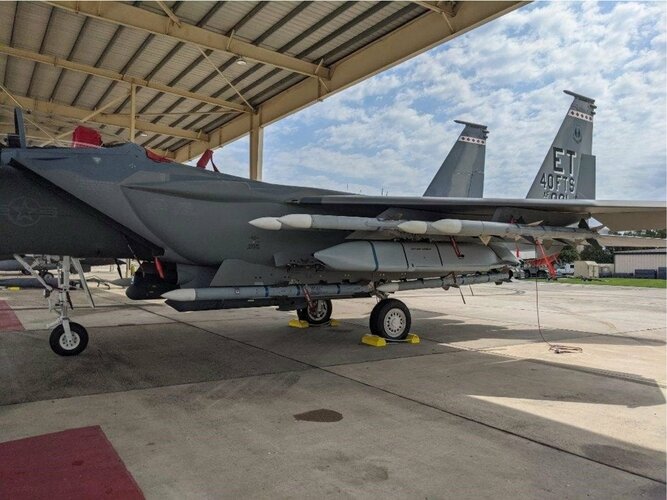
I mean, have you seen the pictures of the Eagle 2s with double rails EVERYWHERE? 8x AMRAAMs on the CFTs, and maybe 8 more on the wings. Plus 4x AIM9s for fun. Or another 4x AMRAAMs, for a total of 20 missiles.

So to me then all those statements simply talk to buying fewer NGADs rather than reducing the requirements of NGAD? i.e. a team of higher/lower capability systems appears more cost-effectiveThe goal of CCA is to reduce costs. With the CCA they can reduce the requirements (and costs) of the manned NGAD.
So to me then all those statements simply talk to buying fewer NGADs rather than reducing the requirements of NGAD? i.e. a team of higher/lower capability systems appears more cost-effective
Even if "drone swarms" were something which could realistically be addressed by treaty, half the American political class thinks "treaty" is a dirty word.
The goal of CCA is to reduce costs. With the CCA they can reduce the requirements (and costs) of the manned NGAD.
Acting SECAF Roth, ( June 2021 )
General Brown (2022):
SECAF Kendall, (April 2023):
Andrew P. Hunter, Assistant Secretary of the Air Force and Lt. Gen. Richard G. Moore Jr., USAF, Deputy Chief of Staff ( March 2023 ) :
(and dozens more)
My post was a polite way of dealing with a broken record.
Exactly.More over it seems exceedingly unlikely the PRC would be bound by treaty, especially in any field it felt it had dominance in. If you you think you are inheriting the world, you do not tie your hands.

And you will fight with what if China realise the hypersonic dream to have mach 4/5 fighter ?USAF will stay in status quo with F-16/F-35? Do you think it is possible to win if the ennemy is running very fast like China ? It is time to go on NGAD , hypersonic etc.... Stop the bla-bla-bla and build a new fleet of Bomber fighter , ISR Hypersonic and new X-37 successor , and there is no years away of China will dominate the space sector too.What way is there to beat China? Ask the Chinese source who said "To win without fighting is best." Maybe wait until China's demographics make it unable to fight. When is the window of opportunity and when does it close? Will NGAD deploy in numbers before the window closes? When was the last time China fought competently in a war? That was the Korean War. They took soldiers and generals who knew how to overthrow a government and they used them as cannon fodder to keep a communist buffer between China and a US client. They fought well compared to most Chinese armies historically. The Chinese know history and take the long view. They were conquered time and again by forces that, on paper, were weaker. They cannot have any belief in the willingness of their troops to fight and fight effectively. The US needs to focus on AA/AD to keep China bottled up. Is an NGAD part of that? I don't see the need for a piloted 60 ton Mach 2 supercruise plane that will cost 300 million each. It would still be cool to have one though.

And smaller, cheaper CCAs (compared to manned aircraft) means it is easier, faster, and cheaper to surge production if the balloon goes up.The CCAs themselves may have reduced life cycle costs. Most often are kept in a box until there is a conflict. They don’t have to be constantly flown like a manned aircraft.
You may or may not have noticed that our debt service now exceeds the defense spending. Perhaps you've noticed the resulting devalued dollar at the store?It is time to go on NGAD , hypersonic etc.

You're too pessimistic on this point, but the first generation of CCA will certainly not be the so equiped.No CCA is going to use adaptive turbines, and USN has already walked away from them for cost reasons. So that's an entire generation of turbines technology in the bin.

The public record is clear and at odds with the narrative espoused by “news” sources such as “Twz’ Sandboxx etc
I remember factual information. The War Zone / The Drive does not. Do you remember facts?

I think some time in the 90s someone looked at the rising costs of fighters and calculated that by 2050 or thereabouts, the entire defence budget could buy one plane. The Air Force could use it on Mondays, Wednesdays and Fridays, the Navy could use it on Tuesdays and Thursdays, and the Marines could have it on weekends.Looks like the Death Spiral is quickly becoming reality, where the next generation costs more thant the last thus fewer fighters get purchased than before. Look at what happened to the F-22 for example, that was what the F-35 was ment to solve.

Digital Century series is dead for manned NGAD, has been for a number of years. It was less the big contractors won and more that PPBE just wasn't flexible enough for that to happen. Portions of it remain with CCA.
Nope, far from dead. As of early summer it was very much alive. USAF wants to produce small numbers at a time and constantly iterate. 3-6 years for each airframe iteration, with 8-16 year service life.
Each iteration could be made by a different contractor. They want to get away from “winner take all” and use CCA to incubate new contractors.

I think some time in the 90s someone looked at the risings costs of fighters and calculated that by 2050 or thereabouts, the entire defence budget could buy one plane. The Air Force could use it on Mondays, Wednesdays and Fridays, the Navy could use it on Tuesdays and Thursdays, and the Marines could have it on weekends.
XVI. In the year 2054, the entire defense budget will purchase just one aircraft. This aircraft will have to be shared by the Air Force and Navy 3-1/2 days each per week except for leap year, when it will be made available to the Marines for the extra day.

I still don't see how this company can do a job in air dominance with their design?https://ir.kratosdefense.com/news-r...-reports-third-quarter-2023-financial-results Why don't chose Kratos who seem to be more serious in term of air dominance concept ?https://www.twz.com/air/former-trum...out-the-future-of-big-ticket-defense-programsIn related news, OpenAI, developers of ChatGPT, has partnered with Anduril for counter-UAS applications, but one has to wonder if the partnership will eventually cross over to their CCA effort.
https://www.anduril.com/article/and...cial-intelligence-leadership-and-protect-u-s/
The advanced carrier based power projection capabilities resident in F/AXX will maintain CVN relevance in advanced threat environments..Navy Aviation Vision 2030-2035
https://media.defense.gov/2021/Oct/27/2002881262/-1/-1/0/NAVY AVIATION VISION 2030-2035_FNL.PDF
I still don't see how this company can do a job in air dominance with their design?https://ir.kratosdefense.com/news-r...-reports-third-quarter-2023-financial-results Why don't chose Kratos who seem to be more serious in term of air dominance concept ?https://www.twz.com/air/former-trum...out-the-future-of-big-ticket-defense-programs
Carriers are built to bring airpower to the fight. Not more, not less. Carriers can(and imho - should) be made cheaper, that's for sure, because last true carrier experience was of them being the single most expendable large asset, not some unsinkable fortress. That's fine.Both the carrier and the fighter are built to beat up on failed states and weak countries like Iraq 1991.
Drones aren't cheap, though. Also, drones are still aircraft, they have to take off and land somewhere.What about NGAD? How far back does a piloted plane stay from air defenses? We are going to see drones, etc. replace piloted planes simply because the piloted plane is not cost effective.
It depends, carriers can move. Fast.How far back do they keep the carriers against China?
All carrier strategic bombers exceeded that by a big margin. A-6 did too.I would argue that a CSG has a strike range of ~1000 miles quite easily against opponent vessels with minimal refueling using stand off weapons. That would put it outside the range of most PRC assets with notable exceptions of DF-26, H-6, and perhaps YJ-21. It also puts it outside unrefueled opponent fighter cover and a week+ cruise for SSKs. The primary ISR threat at this range is probably orbital.
That said, a CVN is a huge number of eggs in one basket.
True, but expendables have nasty side to them: you usually can't stock them.The key Ainen identified is expendable asset. The most capable expendable asset is what is most useful. Cruisers at Guadalcanal were more capable than DDs but still riskable. A CVN is not riskable, neither is a 300 million dollar aircraft.
All carrier strategic bombers exceeded that by a big margin. A-6 did too.
Because range is both security and reach into "World island", and that matters against Asiatic land powers.
That's before taking into account rising importance of desperate bloody khornefest called carrier duels. Where reach and range, is among the most decisive.
Conclusion (surprise), in big power competition, strike range is paramount.
Enemy vulnerability matters too - as 1980s shown, extreme range strike capability, apart from primary purpose, was seen as a fine way to bait response (backfires) beyond escort range, right into hands of several barriers of tomcats, hornets and potentially whatever can take off with amraam.
And, vise versa, flankers with their stupid a2a range were breaking the game. They still are, courtesy of superbug decks.
Plus, during our time, any additional shots against hypersonics(which just won't give surface ships second engagement chances) are of vital importance - as early and as far from csg(or 3rd protected asset!) as possible.
Finally, while b-21 is close expectation, so is H-20. Searching the old way may be necessary.
Tldr: carrier(and naval in general) fighter range is just as decisive. Two main naval fighter aircraft roles(timely intercept and escort, aca local air superiority)hinge on range.
=
I am like 80% sure naval NGAD will go all in to getsomething like ~1500 nmi refueled strike range(and potentially 900-1000 unrefuelled/extended cap). +JASSM-XR and SM-6 on top.
While feasible, it requires significant information and air superiority. Subsonic missiles will take over two hours to get to 1000 miles: they need ota targeting updates, or they can simply miss entirely. They also need escort/air sweep just like any other aircraft.I still think a thousand mile anti shipping strike range is rather relevant, and a CSG can easily achieve a high density strike subsonic strike rather easily with MALD-N, AGM-158C1/2/3, and Tomahawks.

A 165kg warhead only penetrates 70mm of armour?Exocet that could only penetrate 70mm of armor when carriers have more. How far back do they keep the carriers against China?


